7 Best FREE AI Tools for Physics in 2026 — Zero Cost, Maximum Results
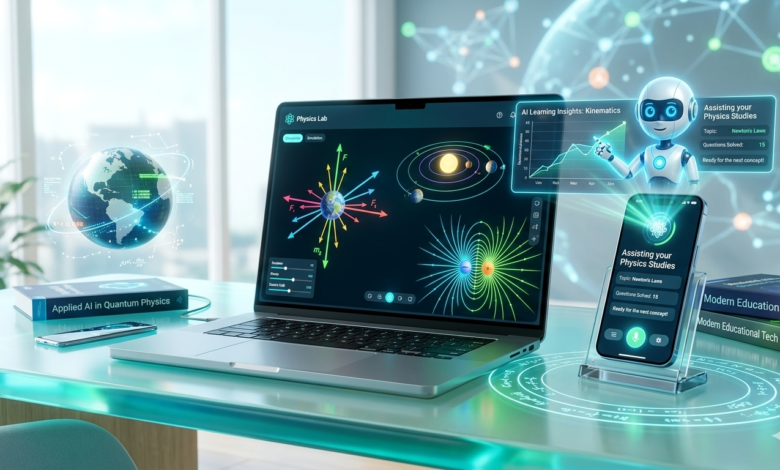
| Tool | Free Limits | Photo Support | Best For | Accuracy |
|---|---|---|---|---|
| ChatGPT | 40 msgs/3hrs (GPT-4o) | ✅ Yes | Concept + numericals | ⭐⭐⭐⭐⭐ |
| Wolfram Alpha | Unlimited basic | ❌ No | Formula + symbolic | ⭐⭐⭐⭐⭐ |
| Microsoft Copilot | Unlimited (web) | ✅ Yes | Quick answers + diagrams | ⭐⭐⭐⭐ |
| Google Gemini | Unlimited (free tier) | ✅ Yes | Explanation + past papers | ⭐⭐⭐⭐ |
| Photomath | Unlimited | ✅ Yes (snap & solve) | Numericals via camera | ⭐⭐⭐⭐ |
| Asksia | 30 questions/day | ✅ Yes | Step-by-step solutions | ⭐⭐⭐⭐ |
| NoteGPT | 20 summaries/day | ❌ No | Notes + revision | ⭐⭐⭐ |
Quick Answer: Best Free AI Tools for Physics (2026)
If you’re short on time, here’s the fast version. The top free AI tools for physics in 2026 are ChatGPT, Wolfram Alpha, Microsoft Copilot, Google Gemini, Photomath, Asksia, and NoteGPT. Each one has a solid free plan, no hidden paywalls for basic use, and they actually work for solving numericals, understanding concepts, and tackling past papers. No calculator? No problem. These tools handle everything from mechanics to thermodynamics — right from your browser or phone.
7 Best FREE AI Tools for Physics Students in 2026
Let’s be honest — physics is hard. Whether it’s Newton’s laws giving you a headache or thermodynamics making zero sense at 11pm before an exam, you’re not alone. The good news? AI has genuinely changed the game for physics students. And you don’t need to spend a single penny.
Here are the seven best free AI tools for physics in 2026, with honest info about free limits, what they’re actually good at, and whether they can solve from a photo.
1. ChatGPT (by OpenAI)
💡 Fun Fact: ChatGPT can solve a university-level mechanics problem in under 10 seconds — something that would take most students 20 minutes with a textbook.
Free Limits: GPT-4o is available free with a limit of roughly 40 messages every three hours. No login required for GPT-3.5, but GPT-4o needs a free account.
Best Physics Topics:
- Mechanics (force, momentum, projectile motion)
- Thermodynamics (heat engines, entropy)
- Numerical problems with full working
- Conceptual explanations in plain English
How to Solve Physics Numericals with ChatGPT: Just type your question with all the given values. For example: “A car of mass 1000 kg accelerates from 0 to 20 m/s in 5 seconds. Find the net force applied.” ChatGPT will show formula → substitution → answer, step by step.
Photo Solving: Yes — with GPT-4o (free), you can upload a photo of your question and it will read and solve it directly. This is one of the most useful features for students who prefer scanning their paper rather than typing.
2. Wolfram Alpha
📌 Side Fact: Wolfram Alpha was launched in 2009 and was designed specifically for computational knowledge — it’s been solving physics problems longer than most AI tools have existed.
Free Limits: Completely free for standard queries. No login required. The Pro version adds step-by-step explanations, but the free version still solves most numerical problems accurately.
Best Physics Topics:
- Formula-based solving (kinematic equations, Coulomb’s law)
- Symbolic mathematics (differentiation, integration for physics)
- Unit conversions and dimensional analysis
- Electrical circuits, wave equations, optics
How to Solve Physics Problems Without a Calculator: Type in the formula and values directly. Example: “F = ma, m = 5 kg, a = 9.8 m/s²”* — Wolfram Alpha computes the result and even shows the units. It handles symbolic solving too, so you can input expressions and get simplified answers.
Photo Solving: Not directly supported for photo uploads on free tier.
3. Microsoft Copilot
💡 Fun Fact: Microsoft Copilot runs on GPT-4 technology for free — the same model that costs users money on other platforms.
Free Limits: Completely unlimited on the web at copilot.microsoft.com. No account required for basic use. Works in Edge browser with extra integration.
Best Physics Topics:
- Quick conceptual answers (What is entropy? How does a transformer work?)
- Diagram descriptions and explanations
- Numerical solving with decent accuracy
- Study summaries and revision notes
How to Use Copilot for Physics: It’s especially handy when you want a quick, clear explanation without going deep into maths. Ask it to “explain Bernoulli’s principle like I’m 16” and it genuinely adjusts its language. For numericals, it follows the same format as ChatGPT formula, working, answer.
Photo Solving: Yes Copilot supports image uploads in the free version.
4. Google Gemini
📌 Side Fact: Google Gemini processes both text and images natively, which means it was built from the ground up to understand visual physics questions not just text.
Free Limits: Fully free on gemini.google.com. Requires a Google account (which most people already have). Gemini 1.5 Flash is the free model fast and capable.
Best Physics Topics:
- Past paper questions (A-Level, GCSE, SAT, O-Level)
- Thermodynamics, electromagnetism, waves
- Revision summaries and concept breakdowns
- Real-world physics examples (great for understanding “why”)
Photo Solving: Yes. Upload a photo of your textbook page or exam question and Gemini reads and answers it.
5. Photomath
💡 Fun Fact: Photomath has been downloaded over 300 million times globally — it’s one of the most used education apps in history.
Free Limits: Unlimited photo solves for free. The Plus version adds extra explanation depth, but the free version is genuinely useful for most high school physics numericals.
Best Physics Topics:
- Kinematics (v = u + at, s = ut + ½at²)
- Force and momentum calculations
- Energy and work problems
- Electrical power (P = IV, V = IR)
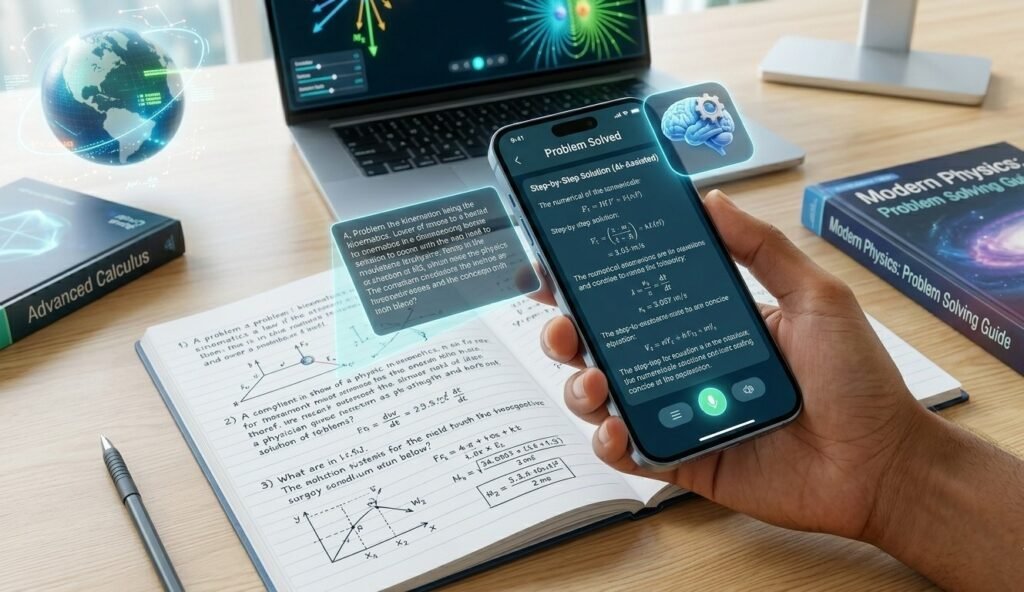
How to Solve Physics Numericals — Step by Step: Open the app → point camera at the question → it reads the numbers → shows the formula used → works through substitution → gives final answer with units. It’s as simple as that. Even if your handwriting isn’t perfect, it usually reads correctly.
Photo Solving: This is literally what Photomath is built for. Snap, solve, done.
6. Asksia
📌 Side Fact: Asksia was specifically trained on science and maths content, which gives it an edge over general-purpose AI when it comes to subject accuracy in physics.
Free Limits: Around 30 free questions per day. Requires a free account. The free tier is generous enough for daily revision sessions.
Best Physics Topics:
- Mechanics, optics, and electromagnetism
- Step-by-step numerical working
- Concept questions with diagrams
- A-Level and GCSE level questions
Photo Solving: Yes one of Asksia’s main selling points is its ability to read physics questions from photos and solve them with explained steps.
7. NoteGPT
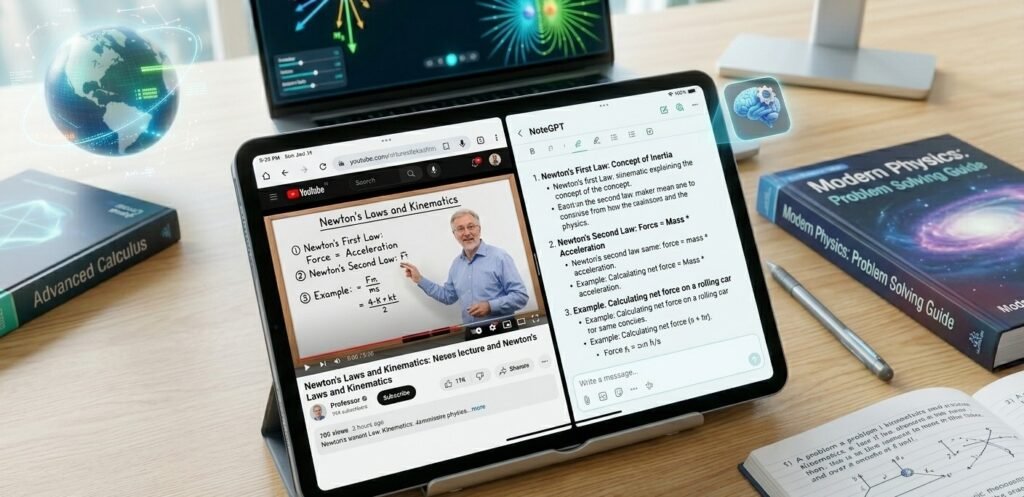
💡 Fun Fact: NoteGPT can turn a 45-minute physics lecture video on YouTube into a structured set of revision notes in under two minutes.
Free Limits: Around 20 AI summaries per day on the free plan. Requires a free account.
Best Physics Topics:
- Turning YouTube physics lectures into notes
- Summarising textbook chapters
- Generating revision flashcards
- Creating study outlines from long content
Photo Solving: Not its primary feature, though it can read uploaded documents.
Comparison Table — All Free AI Physics Tools
| Tool | Free Limits | Photo Support | Best For | Accuracy |
|---|---|---|---|---|
| ChatGPT | 40 msgs/3hrs | ✅ Yes | Numericals + concepts | ⭐⭐⭐⭐⭐ |
| Wolfram Alpha | Unlimited basic | ❌ No | Formula + symbolic maths | ⭐⭐⭐⭐⭐ |
| Microsoft Copilot | Unlimited | ✅ Yes | Quick explanations | ⭐⭐⭐⭐ |
| Google Gemini | Unlimited (Google acc.) | ✅ Yes | Past papers + revision | ⭐⭐⭐⭐ |
| Photomath | Unlimited snaps | ✅ Yes (camera) | Numerical step-by-step | ⭐⭐⭐⭐ |
| Asksia | 30 q/day | ✅ Yes | Science-specific solving | ⭐⭐⭐⭐ |
| NoteGPT | 20 summaries/day | ❌ No | Notes + lecture summaries | ⭐⭐⭐ |
🛑 A Quick Reality Check: Don’t Trust AI Blindly!
Before you go all-in, let’s keep it real. These tools are genius, but they aren’t perfect. To keep your grades safe, keep these two things in mind:
The “Math” Brain vs. the “Language” Brain: Tools like ChatGPT and Gemini are amazing at explaining why things happen, but they can be surprisingly bad at simple math. They might set up a complex Physics logic perfectly but then fail at basic multiplication or division in the final step. The Fix: Use AI for the logic, but use Wolfram Alpha or your actual calculator for the final numbers.
AI “Hallucinations” (Making Stuff Up): Sometimes, if an AI doesn’t know the answer, it tries too hard to be helpful and “invents” a formula that doesn’t exist. It might mix up two different laws of Physics into one messy equation. The Fix: Treat the AI like a study buddy, not a God. If a formula looks weird or new, double-check it with your textbook before you memorize it.
How to Solve Physics Problems Without a Calculator Using AI
A lot of students don’t realise this, but you genuinely don’t need a physical calculator anymore for most physics problems. AI tools like Wolfram Alpha and ChatGPT handle all the arithmetic and more importantly, they handle the reasoning behind the maths.
Here’s how to do it properly:
Using Wolfram Alpha (best for formula-heavy problems): Type in something like “kinetic energy formula, m = 2 kg, v = 10 m/s” and it solves it symbolically, shows the formula, and gives a numerical result. You can also ask it to solve for a specific variable — for example, rearranging v = u + at to find t when u, v, and a are known.
Using ChatGPT (best for conceptual + numerical together): Type the full problem. ChatGPT will explain why a formula applies, substitute the values, and walk you through the working. This is especially useful for multi-step problems where you need to understand the logic, not just the answer.
The combination of these two tools essentially replaces a calculator, a formula sheet, and a tutor all for free.
How to Solve Physics Numericals Step-by-Step Using AI
This is the part most students actually need. Here’s the reliable method that works across all AI tools:
Step 1 — Write out your given values clearly. Before pasting into any AI tool, list what you know: mass, velocity, time, force, etc. Don’t just copy the question word for word.
Step 2 — State what you’re looking for. Ask the AI specifically: “Find the acceleration” or “Calculate the final velocity.” The more specific you are, the better the answer.
Step 3 — Ask for formula first. Say: “What formula do I use for this?” Getting the formula right is half the battle.
Step 4 — Request full substitution and working. Add: “Show full working with units at each step.” This way, you can follow along and actually learn — not just copy the answer.
Step 5 — Check units. Always verify the unit in the final answer. If you’re solving for force, the answer should be in Newtons (N). AI tools are generally good at this, but it’s worth a quick check.
This workflow works on ChatGPT, Gemini, Copilot, and Asksia equally well.
How to Solve Physics Past Papers with AI
Past papers are where exam preparation actually happens. AI tools are surprisingly good at this — here’s a reliable revision workflow:
Step 1 — Upload or type the past paper question. With tools like Gemini or ChatGPT (with photo support), you can upload a scan of the paper. For typed questions, paste them directly.
Step 2 — Ask for a structured answer. Say: “Answer this as if in an exam, with mark scheme format.” This encourages the AI to give concise, structured answers not essays.
Step 3 — Ask follow-up “why” questions. Once you have the answer, dig deeper. Ask: “Why does this formula apply here?” or “What would change if the mass doubled?” This is where AI genuinely beats a textbook.
Step 4 — Create a revision list. Ask the AI: “Based on these questions, what topics should I revise most?” It can analyse patterns in your past paper and suggest a focused revision plan.
For a deeper breakdown of which AI tools work best in a classroom and learning context, check out this guide on the best AI tools for learning physics — it covers tool-by-tool comparisons with student use cases.
AI Physics Simulation Tools — Free Options for Students
Beyond solving numericals, some students need to see physics in action. That’s where simulation tools come in.
PhET Interactive Simulations (University of Colorado Boulder) This is the gold standard for free physics simulations. Topics covered include:
- Wave interference and sound
- Projectile motion
- Electric fields and circuits
- Quantum mechanics basics
PhET is not AI in the traditional sense, but it pairs perfectly with AI tools. Use ChatGPT or Gemini to understand a concept, then run the PhET simulation to see it visually. This combination is genuinely one of the most effective ways to study physics especially for visual learners.
Search for: ai physics simulation tool or virtual physics experiment to find more options. Some AI tools are beginning to integrate live simulations, but PhET remains the most reliable and completely free option for students in 2026.
FAQs — Real Student Questions
What is the best free AI tool for physics?
For most students, ChatGPT (with a free account) is the best all-round option. It handles numerical problems, concept explanations, photo uploads, and past paper questions. If you need pure mathematical precision, Wolfram Alpha is the more accurate choice for formula-heavy work.
Can AI solve physics problems from photos?
Yes several AI tools now support this. Photomath is purpose-built for it. ChatGPT with GPT-4o, Google Gemini, Microsoft Copilot, and Asksia all support image uploads on their free tiers. Simply take a photo of the question and upload it directly.
Is AI accurate for physics homework?
Generally, yes especially for standard A-Level, GCSE, and O-Level problems. Wolfram Alpha is the most mathematically precise. ChatGPT and Gemini are excellent for multi-step reasoning but occasionally make arithmetic errors, so it’s worth double-checking final numbers on complex problems.
Can AI solve physics numericals?
Absolutely. All seven tools in this list handle physics numericals to varying degrees. The best approach is to use Wolfram Alpha for pure calculation and ChatGPT or Gemini when you also need the reasoning explained step by step.
Which AI is best for students?
It depends on what you need. If you are looking for exam revision and past papers, Google Gemini is a great choice. For step-by-step numerical solving, ChatGPT or Asksia work best, while Photomath is ideal for snapping a quick photo of a problem. If your work is formula-heavy, Wolfram Alpha remains the gold standard. Most students end up using two or three of these in combination
Are AI physics tools free?
All seven tools listed here have genuinely usable free plans. Some have daily limits (Asksia limits to 30 questions/day, NoteGPT to 20 summaries), but for typical daily study sessions, the free tiers are more than enough. None of them require a paid subscription to solve basic to intermediate physics problems.
Timeline: How AI Physics Tools Have Evolved
| Year | Milestone |
|---|---|
| 2009 | Wolfram Alpha launched — first major computational knowledge engine |
| 2014 | Photomath released — pioneers camera-based maths solving |
| 2018 | AI tutoring apps begin integrating physics content |
| 2020 | GPT-3 released — general AI starts handling physics questions |
| 2022 | ChatGPT launches — millions of students begin using AI for homework |
| 2023 | GPT-4 with vision — photo-based physics solving becomes mainstream |
| 2024 | Google Gemini, Copilot go multimodal — free photo solving for all |
| 2025 | Asksia and subject-specific AI tools grow rapidly in student market |
| 2026 | All major AI tools offer free physics solving with photo support |
This article was written for students in the UK, USA, and beyond who are looking for reliable, free AI tools to help with physics — from GCSE to university level. All tools mentioned have been verified as free to use as of 2026.
External resource: PhET Interactive Simulations — free physics simulations by the University of Colorado Boulder.