

Quick Answer Best AI Tools for Exams at a Glance
| AI Tool | Best For | Free Plan? | Difficulty Level |
|---|---|---|---|
| ChatGPT (GPT-4o) | Explaining concepts, essay help | ✅ Yes (limited) | Beginner–Advanced |
| Google Gemini | Research, summarising notes | ✅ Yes | Beginner |
| Microsoft Copilot | Writing, revision support | ✅ Yes | Beginner |
| Quizlet AI | Flashcards, practice quizzes | ✅ Yes (basic) | Beginner |
| Khanmigo (Khan Academy) | Maths & science tutoring | ✅ Yes | Beginner–Intermediate |
| Perplexity AI | Fast research with sources | ✅ Yes | Intermediate |
| Wolfram Alpha | Maths & calculations | ✅ Yes (basic) | Intermediate–Advanced |
| Notion AI | Note organisation, summaries | ❌ Paid only | Intermediate |
| Claude (Anthropic) | Long reading, essay feedback | ✅ Yes (limited) | All levels |
Introduction — Why Students in 2026 Can’t Afford to Ignore AI
Let’s be real. Exams are stressful, time is limited, and the gap between students who use the right tools and those who don’t has never been wider. If you’ve been Googling “best AI tools for exams that actually work” you’re already one step ahead.
💡 Fun Fact: A 2024 survey by Pearson found that over 68% of university students now use some form of AI tool during their study sessions. By 2026, that number is expected to cross 80%.
This guide isn’t just another list. It’s a practical, student-tested breakdown of AI tools that genuinely improve exam performance covering free options, subject-specific tools, and how to use each one without crossing the line into academic dishonesty.
Whether you’re prepping for GCSEs, A-Levels, university finals, or professional certifications, there’s something here for you.
What Makes an AI Tool Actually Useful for Exam Prep?
Before diving into the list, it helps to understand what separates a genuinely useful AI study tool from one that wastes your time. Here’s what to look for:
Accuracy matters most. An AI that confidently gives you wrong answers is worse than having no AI at all. The best tools either source their responses or flag uncertainty.
Interactivity beats passive reading. AI tools that quiz you, ask follow-up questions, or make you explain concepts back (active recall) lead to far better retention than ones that just summarise content.
Ease of use keeps you consistent. If a tool has a complicated setup or slow interface, you won’t use it under exam pressure. The best tools open in seconds and get straight to the point.
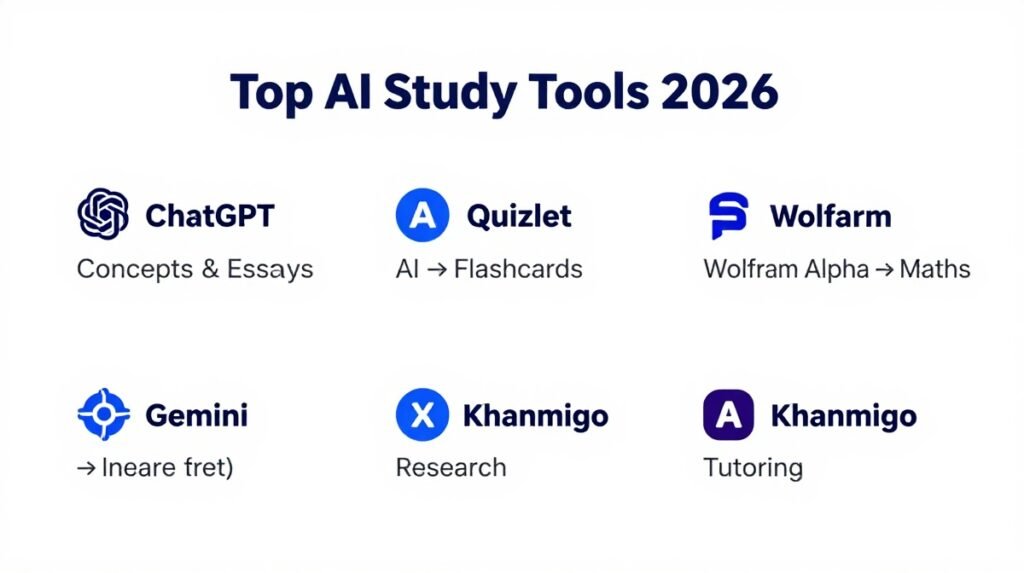
The 9 Best AI Tools for Exam Preparation in 2026
1. ChatGPT — The All-Rounder Every Student Needs
Best for: Understanding difficult concepts, essay planning, mock Q&A
ChatGPT remains the most versatile AI tool available to students in 2026. You can paste in a topic and ask it to explain it like you’re a 16-year-old, or get it to generate practice exam questions in your subject. The free version (GPT-4o) is genuinely powerful — you don’t need to pay unless you’re doing heavy daily use.
How to use it for exams:
- Ask it to create a 10-question practice quiz on your topic
- Paste in your essay draft and ask for feedback on structure and argument
- Say: “Explain photosynthesis as if I have 20 minutes before my biology exam”
What it’s not great at: Live data, maths that requires precise calculations (use Wolfram Alpha for that), and it can occasionally “hallucinate” facts — always double-check anything factual.
🎓 Study Fact: Using AI to self-quiz yourself activates active recall one of the most evidence-backed study techniques in cognitive science. ChatGPT can replace an expensive study group when used this way.
2. Google Gemini — Research Made Fast
Best for: Summarising long texts, note-taking from PDFs, quick research
Gemini has quietly become one of the most student-friendly AI tools available. Its integration with Google Docs and Drive means you can have it summarise your lecture notes or create a revision outline from a textbook chapter in under two minutes.
The free tier is generous, and unlike some tools, Gemini tends to acknowledge when it’s unsure which is exactly what you want before an exam.
How to use it for exams:
- Upload your notes and ask: “Summarise the five key themes in three bullet points each”
- Use it to identify knowledge gaps: “Ask me five questions on this topic and tell me what I got wrong”
3. Microsoft Copilot — Free and Underrated
Best for: Essay writing, revision summaries, students using Microsoft 365
Copilot is completely free and powered by GPT-4, which means it’s essentially a premium AI tool at no cost. It works brilliantly inside Word, so if you’re typing up revision notes or working on an assignment, Copilot is right there in your toolbar.
💡 Fun Fact: Microsoft Copilot is used by over 600 universities worldwide as of early 2026 making it one of the fastest-adopted educational AI tools in history.
For students in the UK especially, Copilot is already bundled with most school and university Microsoft accounts which means there’s genuinely no reason not to use it.
4. Quizlet AI — The Flashcard Game-Changer
Best for: Memorisation, vocabulary, science definitions, dates
Quizlet has been around for years, but its AI features introduced in 2024–2025 have transformed it into something genuinely impressive. The AI can now generate a full flashcard set from your notes in under a minute, adapt to your weak areas, and quiz you using spaced repetition the method proven to help you retain information longer.
How to use it for exams:
- Paste your revision notes and let the AI generate the flashcard set automatically
- Use the “Learn” mode it will prioritise cards you keep getting wrong
- Set a 15-minute daily session for two weeks before your exam
If you’re studying for a content-heavy subject history, biology, law, medicine Quizlet AI is probably the single most efficient tool on this list for raw memorisation.
5. Khanmigo (Khan Academy) — Your Free AI Tutor
Best for: Maths, science, GCSE/A-Level, SAT prep
Khanmigo is what happens when a world-class education platform builds its own AI tutor. It doesn’t just give you answers it asks you questions, guides you through problems, and adapts based on where you’re stuck. That Socratic method approach is genuinely more effective for learning than getting a direct answer.
If you’re struggling with maths or science concepts and don’t want to pay for a private tutor, Khanmigo is the closest free alternative that actually works.
🎓 Fun Fact: Khan Academy has been used by over 150 million learners globally. Khanmigo extends that with personalised AI guidance and it’s free for most users.
6. Perplexity AI — Research With Sources You Can Actually Trust
Best for: Writing essays, fact-checking, understanding complex topics quickly
One of the biggest problems with using AI for studying is not knowing whether the information is accurate. Perplexity AI solves this by citing its sources inline so you can see exactly where each claim comes from and verify it yourself.
This makes it especially useful for essay writing and any subject where citing evidence matters. You can also follow up with questions in the same thread, which helps you build a deeper understanding of a topic rather than just getting surface-level answers.
7. Wolfram Alpha — The Maths and Science Student’s Best Friend
Best for: Calculations, equations, chemistry, physics, statistics
If your exam involves numbers, Wolfram Alpha is non-negotiable. It doesn’t just give you answers it shows you the working in step-by-step detail, which is exactly what you need to understand a process rather than just memorise a result.
It handles everything from basic algebra to university-level calculus, chemistry equations, statistics, and data analysis. The free version covers most student needs, and the paid version adds even more depth.
💡 Fun Fact: Wolfram Alpha was originally built by mathematician Stephen Wolfram to answer any factual question computationally. Today it handles over 100 million queries per year from students alone.
8. Claude (Anthropic) — Best for Long Reading and Essay Feedback
Best for: Reading dense academic texts, essay critique, understanding nuanced arguments
Claude excels at reading long documents and giving thoughtful, nuanced feedback. If you’ve written a 2,000-word essay and want detailed notes on argument structure, clarity, and flow Claude handles this better than most other tools currently available.
It’s also particularly good at explaining complex philosophical, legal, or literary concepts in plain English — something students preparing for humanities exams will find genuinely useful.
9. Notion AI — The Organised Student’s Secret Weapon
Best for: Note organisation, revision planning, summarising research
If your notes are a mess of half-finished documents and random highlights, Notion AI can bring order to the chaos. It works inside your Notion workspace to summarise pages, generate revision plans, and create structured study schedules.
The catch is it’s not free but if you’re already using Notion, the AI add-on is worth considering for the semester before major exams.
How to Use AI for Studying Without Getting Into Trouble
This is the question nobody wants to ask out loud, but everyone needs to know the answer to.
Using AI to understand a topic, generate practice questions, check your own work, or create a revision schedule is completely fine and encouraged by most educational institutions. The problem arises when students use AI to write assignments they then submit as their own.
Here’s a simple rule: if AI is helping you learn, it’s a tool. If AI is doing the work so you don’t have to think, that’s cheating and most universities now have detection systems that will catch it.
Smart ways to use AI for exam prep without crossing the line:
- Use it to quiz yourself, not to write for you
- Ask it to explain a concept, then close the tab and write the explanation in your own words
- Use it for feedback on your drafts, not to generate the drafts themselves
People Also Ask — Quick Answers
Which is the best AI for exam answers?
For understanding and explaining exam content, ChatGPT and Khanmigo are the strongest options. For maths and calculations, Wolfram Alpha wins. None of these should be used to cheat in live exams.
Are there free AI tools for exam prep?
Yes ChatGPT (free tier), Google Gemini, Microsoft Copilot, Khanmigo, and Quizlet AI all have solid free plans that cover most student needs.
What is the best AI for study notes?
Gemini and Notion AI are best for summarising and organising notes. Claude is excellent for digesting long academic texts.
Can I use AI to help with university exams?
You can absolutely use AI for revision, practice, and learning. Check your university’s AI policy for guidance on what’s allowed in assessed work.
Does AI actually improve exam scores?
Research from Stanford and MIT (2024) suggests students who use AI tools as learning aids particularly for self-quizzing and concept clarification score measurably higher than those who don’t. The key word is “learning aids.”
Related Reading from GlobeHustle
If you found this guide useful, these articles on GlobeHustle go deeper on related topics:
- 🔗 Which AI Tool Actually Handles BOTH Math and Physics? (We Tested Them)
- 🔗 7 Best FREE AI Tools for Physics in 2026 — Zero Cost, Maximum Results
- 🔗 How to Make Money with AI in 2026 — Beginner’s Step-by-Step Guide
External Resources Worth Bookmarking
- 🌐 Khan Academy — Free Courses and Khanmigo AI Tutor
- 🌐 Quizlet — AI-Powered Flashcard Platform
- 🌐 Wolfram Alpha — Computational Intelligence for Students
AI Tools for Exams — Timeline of How They’ve Evolved
| Year | Milestone |
|---|---|
| 2020 | GPT-3 released — first AI capable of human-like text at scale |
| 2022 | ChatGPT launches publicly — 1 million users in 5 days |
| 2023 | Google Bard (now Gemini) and Bing AI enter the student market |
| 2024 | Quizlet AI, Khanmigo, and Copilot become mainstream study tools |
| 2025 | Universities begin updating AI policies; spaced repetition AI hits mainstream |
| 2026 | Over 80% of students use AI study tools; AI tutoring platforms multiply |

Final Thoughts — Work Smarter, Not Just Harder
The students doing best in 2026 aren’t necessarily the smartest or the hardest working. They’re the ones using the right tools in the right way. AI won’t pass your exams for you but it can make every hour of revision more effective, help you identify knowledge gaps faster, and give you the kind of instant feedback that used to cost £40 an hour with a private tutor.
Start with one tool. Use it consistently for two weeks. See the difference.
💬 “The secret of getting ahead is getting started.” Mark Twain
If you’re already using AI tools for your studies, drop a comment and let us know which ones are working for you. And if this guide helped, share it with a classmate they’ll thank you after results day.