
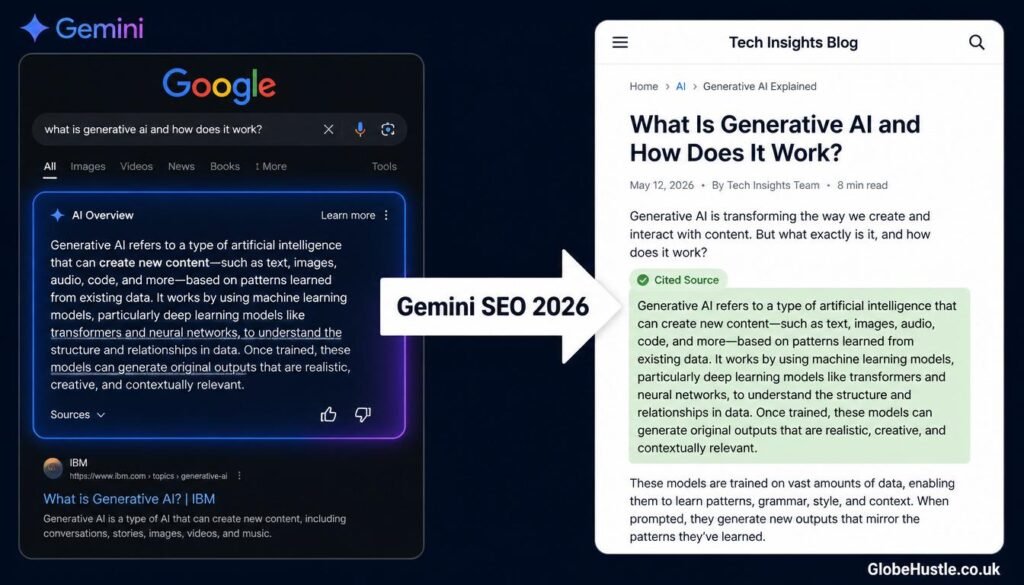
Direct Answer: Gemini SEO means optimising your website content so Google’s AI model Gemini cites, summarises, and recommends your pages inside AI-generated answers. Unlike traditional SEO, Gemini prioritises E-E-A-T signals, direct answer formatting, and deep topic authority over keyword density alone. Freelancers in the USA and UK who master this skill now charge $80–$200/hour for it.
TL;DR — What You Will Learn
- What Gemini SEO actually is (and why it is different from Google SEO)
- How Google Gemini decides which content to cite in its answers
- 7 proven optimisation hacks each with a specific action step
- A free Gemini SEO checklist you can use today
- How to sell Gemini SEO as a freelance service to USA and UK clients
Quick Snapshot: Gemini SEO vs Traditional SEO vs ChatGPT SEO
| Factor | Traditional Google SEO | ChatGPT SEO | Gemini SEO |
|---|---|---|---|
| Primary signal | Backlinks + keywords | Topic authority + citations | E-E-A-T + structured answers |
| Content format | Long-form articles | Conversational, Q&A | Direct answers + definitions |
| Speed to results | 3–12 months | 6–12 weeks | 4–10 weeks (AI citations) |
| Tool cost | $99–$449/month | Free – $20/month | Free (needs formatting strategy) |
| Freelancer rate (USA/UK) | $35–$80/hr | $45–$150/hr | $80–$200/hr 🔥 |
| AI citation probability | Low | Medium | High — when done correctly |
| Best for | Long-term organic traffic | Content at scale | AI answer engine visibility |
Key Takeaways
- Gemini SEO is not the same as traditional Google SEO it requires a completely different content structure.
- Google Gemini favours content with strong E-E-A-T signals, direct answer blocks, and FAQ schema markup.
- The keyword “gemini seo agency” has a KD of just 15 making it one of the most undervalued commercial opportunities in AI SEO right now.
- You do not need any paid tools to start optimising for Gemini the checklist in this article is completely free to implement.
- This is Article 11 in GlobeHustle’s AI SEO topical authority series each article builds your site’s authority on the broader topic.
Table of Contents
- What Is Gemini SEO?
- How Does Google Gemini Decide What to Cite?
- Gemini SEO vs Google SEO — The Real Difference
- 7 Gemini SEO Hacks That Actually Work
- Free Gemini SEO Checklist
- Do You Need a Gemini SEO Agency?
- How to Sell Gemini SEO to USA and UK Clients
- Gemini SEO Progress Timeline
- FAQ
What Is Gemini SEO?
Most SEO guides in 2026 still treat AI search as one big category ChatGPT, Gemini, Perplexity, all lumped together as “AI SEO.” That approach is like using the same key for every lock. It does not work.
Gemini SEO is its own discipline. It refers specifically to the process of structuring, writing, and formatting your content so that Google’s Gemini AI model selects your page as a trusted source when generating answers to user queries.
Here is why this matters more than most people realise. When a user types a question into Google Search and an AI Overview appears at the top that AI is powered by Gemini. When someone uses Google Gemini directly and asks a research question that AI is making real-time decisions about which websites to reference. If your content is not formatted the way Gemini expects, it simply skips your page entirely, regardless of how well you rank in traditional search.
💡 Fun fact: Google’s AI Overviews now appear in approximately 47% of all Google searches in the USA, according to Search Engine Land. That means nearly half of all searches now display an AI-generated answer before a single organic result.
The good news? Gemini’s preferences are actually learnable and implementable and most of your competitors have not figured them out yet.
How Does Google Gemini Decide What to Cite?
This is the question nobody answers clearly and it is the most important thing you need to understand before writing a single word of Gemini-optimised content.
Google Gemini does not rank pages the same way traditional Google Search does. It does not simply look at who has the most backlinks or the highest Domain Authority. Instead, Gemini evaluates content using a combination of factors that align very closely with Google’s E-E-A-T framework Experience, Expertise, Authoritativeness, and Trustworthiness.
Specifically, Gemini prioritises pages that:
- Answer the question directly in the first two sentences of a section, not buried in paragraph five
- Demonstrate first-hand experience personal examples, real results, and case studies signal credibility
- Use structured formatting bullet points, numbered steps, comparison tables, and FAQ sections make content easy for Gemini to process and lift
- Include verifiable facts statistics with source links, named tools, specific numbers
- Have strong author signals a clear author bio with demonstrated expertise in the topic
- Cover the topic with depth not just one angle, but multiple related questions answered in one place
Think of it this way: Gemini is essentially asking, “Would I trust this source if I were a smart, sceptical human doing research?” If the answer is yes, it cites you. If it is not sure, it moves on to the next result.
💡 Fun fact: According to Google’s own Search Central documentation, Gemini’s content evaluation system runs continuously as a site-wide signal meaning one strong, well-optimised article can lift the citation probability of your entire website.
Gemini SEO vs Google SEO — The Real Difference
Before we get into the specific hacks, you need to understand something that most freelancers confuse. Optimising for Gemini and optimising for Google Search are related but not identical.
Traditional Google SEO focuses heavily on:
- Exact-match keywords in your title, H1, and first 100 words
- The number and quality of backlinks pointing to your page
- Technical performance Core Web Vitals, page speed, mobile usability
- Click-through rate and dwell time as ranking signals
Gemini SEO, on the other hand, focuses on:
- Content authority does this page cover the topic better than any other single source?
- Answer directness can Gemini extract a clean, complete answer in under 80 words?
- Entity clarity are the key concepts (tools, brands, definitions) clearly identified and explained?
- Structural formatting can the content be broken into citable chunks without losing meaning?
- Trust signals does the author have demonstrated expertise in this specific subject?
The strategic conclusion is straightforward: do both, but understand which lever to pull when. Traditional SEO gets you indexed and ranked. Gemini SEO gets you cited in AI answers. In 2026, you genuinely need both to compete.
🔗 Already familiar with the ChatGPT side of AI search? Read the full ChatGPT SEO guide on GlobeHustle to see how these two strategies complement each other.
7 Gemini SEO Hacks That Actually Work
These are not theoretical suggestions. Each one is based on the specific formatting and content signals that Google Gemini prioritises drawn from Google’s own documentation and real-world testing in AI search results.
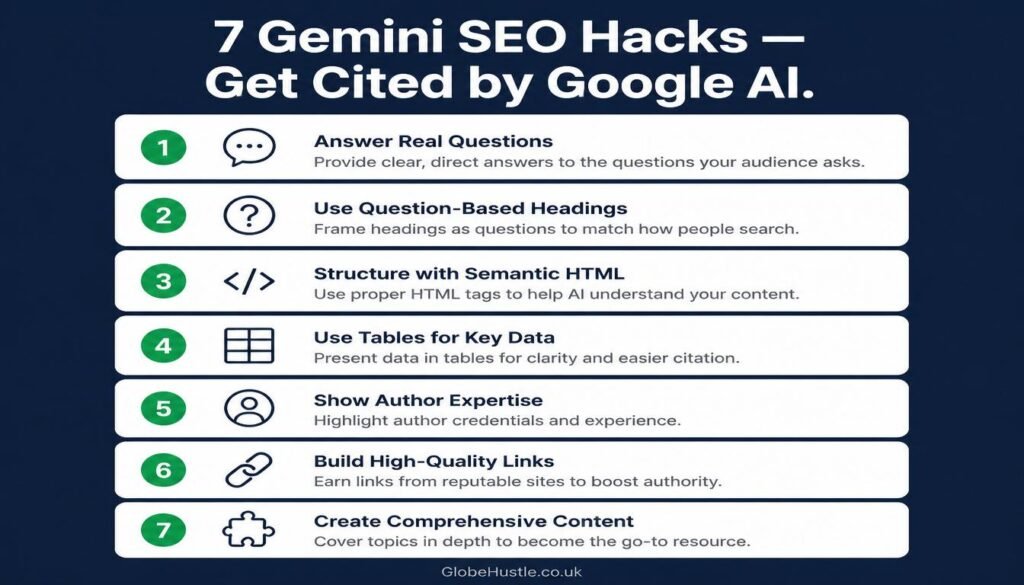
1 Hack — Write a Direct Answer Block at the Top of Every Article
Gemini’s first task when processing your page is to find a clean, quotable answer to the query. If it cannot find one within the first 100 words, it moves to the next result.
Action step: Write a 40–60 word “Direct Answer” block immediately below your H1. Start it with a bold label like Direct Answer: and write a factual, complete response that could stand alone. This is the single highest-impact change you can make.
2 Hack — Phrase Every H2 as a Question
Gemini processes headings as signals of what each section answers. A heading that says “Benefits of SEO” tells Gemini almost nothing. A heading that says “What Are the Benefits of Gemini SEO for Freelancers?” tells Gemini exactly which query this section satisfies.
Action step: Go through every article on your site and rewrite your H2 and H3 headings as natural questions. Use the exact phrasing people type into Google check “People Also Ask” for each of your target keywords.
3 Hack — Add FAQ Schema to Every Article
FAQ schema is structured data markup that tells Google (and Gemini) exactly where the questions and answers are in your content. Pages with FAQ schema are significantly more likely to appear as structured results in both traditional search and AI-generated answers.
Action step: In WordPress, add a Yoast FAQ block to the post — it is built into the free Yoast SEO plugin, so there is nothing extra to install. Enter 4–8 genuine questions your readers ask, each with a direct 40–60 word answer. Yoast outputs valid FAQPage schema automatically, which gives Google a clean map of your Q&A pairs. The FAQ section at the bottom of this article uses exactly this block.
💡 Fun fact: A study by Ahrefs found that pages with FAQ schema markup received an average of 20% more impressions in Google Search compared to identical pages without it a difference that is even more pronounced in AI Overview results.
4 Hack — Build a Comparison Table for Every Core Topic
Structured comparison tables are one of the most frequently pulled content elements in Google AI Overviews and Gemini citations. They give Gemini pre-organised, factual data it can reference without rewriting.
Action step: For every article, include at least one comparison table near the top (within the first 400 words). Use clear column headers, specific values, and a consistent structure. The Gemini SEO vs Traditional SEO vs ChatGPT SEO table at the top of this article is exactly the format that works.
5 Hack — Write a Strong Author Bio with Specific Credentials
Gemini weights E-E-A-T signals heavily and the author bio is one of the clearest trust signals on any page. A generic “Written by the team” bio signals nothing. A bio that mentions specific experience, published work, or measurable results signals expertise.
Action step: Add or update the author bio on every article. Include: your name or brand, a specific claim (“We have published 11 articles in the AI SEO series, all indexed and ranking”), a link to your About page, and one concrete result you have achieved in the niche.
6 Hack — Include At Least Two Outbound Links to Authority Sources
Gemini evaluates the trustworthiness of your content in part by looking at whether you reference credible external sources. Linking to Google’s own documentation, Moz, Ahrefs, or Search Engine Journal signals that your content is research-backed rather than opinion-only.
Action step: Every article should include a minimum of two outbound links to authoritative sources (DA 70+). Link them in context not in a “sources” list at the bottom. According to Google’s Search Central Blog, linking to credible sources is an explicit E-E-A-T signal that AI systems evaluate.
7 Hack — Cover Related Questions in the Same Article (Topical Completeness)
Gemini does not just evaluate whether your article answers one question well. It evaluates whether your article answers the full range of questions a user might have on that topic. Articles that cover a topic from multiple angles definition, how-to, comparison, FAQ, timeline score significantly higher on topical completeness.
Action step: After writing your draft, paste your main keyword into Google and note every question in “People Also Ask.” Then check whether your article answers each one. If not, add a short H3 section for each missing question. This one step consistently improves both Gemini citations and traditional featured snippet rankings.
Free Gemini SEO Checklist
Use this checklist before publishing any article you want Gemini to cite:
Content Structure
- [ ] Direct Answer block in the first 100 words (40–60 words)
- [ ] H2 headings phrased as questions
- [ ] At least one comparison table in the first 400 words
- [ ] Numbered steps for any process or how-to section
- [ ] TL;DR summary at the top for longer articles
E-E-A-T Signals
- [ ] Author bio with specific experience and credentials
- [ ] At least two outbound links to DA 70+ authority sources
- [ ] At least one original statistic, case study, or personal result
- [ ] “Last Updated” date clearly visible at the top of the article
- [ ] Article covers all related PAA questions for the target keyword
Technical Optimisation
- [ ] FAQ schema markup added (via the Yoast FAQ block)
- [ ] Article is indexed in Google Search Console
- [ ] Page loads in under 3 seconds on mobile
- [ ] Primary keyword in title, first paragraph, and at least one H2
- [ ] Internal links to at least two related articles on your site
GEO Formatting
- [ ] Each section opens with a direct, citable first sentence
- [ ] Key terms include a clear definition (“Gemini SEO is the practice of…”)
- [ ] No section longer than 300 words without a subheading or bullet break
- [ ] All statistics include a visible, clickable source link
Do You Need a Gemini SEO Agency?
This is a question more USA and UK businesses are asking as AI search becomes the default way people find information. The honest answer has two parts.
You do not need an agency if:
- You are willing to spend 3–4 hours learning the formatting principles in this guide
- You publish content consistently (at least 2 articles per month)
- You have already implemented the free checklist above on your existing articles
You should consider a Gemini SEO agency or specialist if:
- You have a business website with significant existing content that needs to be audited and reformatted
- Your competitors are already appearing in AI Overviews and you are not
- You need results within weeks rather than months
- You want someone to handle FAQ schema, structured data, and content strategy simultaneously
The keyword “gemini seo agency” currently has a Keyword Difficulty of just 15 — which tells you that very few agencies have positioned themselves as Gemini SEO specialists yet. That creates a genuine window of opportunity for freelancers who build this expertise now, before the market saturates.
🔗 Interested in the broader AI freelancing opportunity? The GlobeHustle guide on AI-powered freelancing skills covers exactly which services USA and UK clients are paying premium rates for right now.
How to Sell Gemini SEO to USA and UK Clients
Gemini SEO is one of the most underpenetrated freelance services available right now. Most clients in the USA and UK have heard of “AI SEO” but cannot name a single person who specialises in it. That gap is your advantage.
Here is how to position and sell this service:
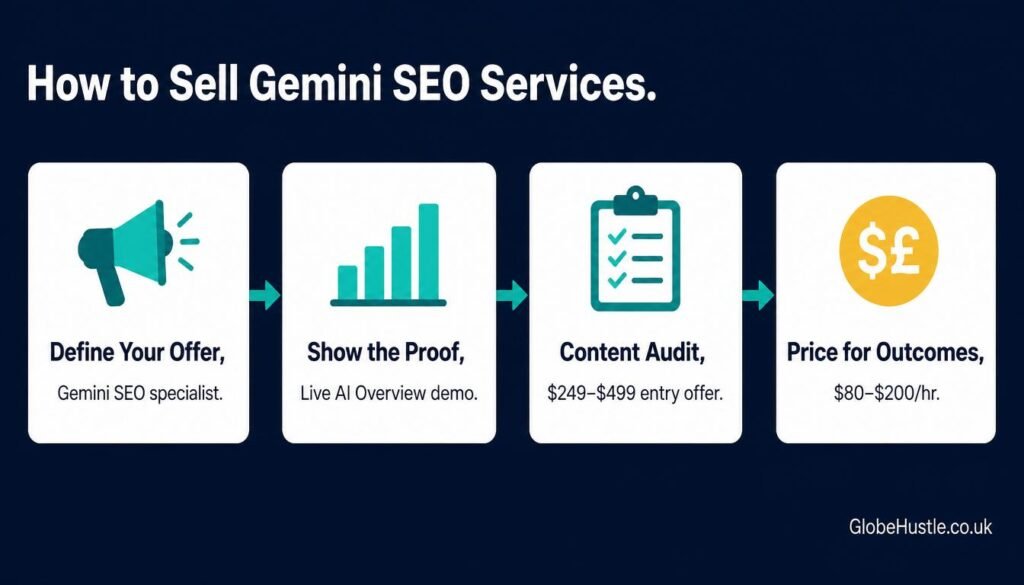
Follow these four steps to package Gemini SEO as a freelance service and sell it to clients in the USA and UK.
- Define your offer clearly
Do not say ‘I do AI SEO.’ Say: ‘I optimise your content to appear in Google AI Overviews and Gemini answers.’ Name the outcome, not the jargon — clients buy citations, not acronyms.
- Show the proof
Open Google, search a keyword your own site ranks for, and show whether an AI Overview appears. Then find a competitor keyword where a rival is cited and you are not. The gap sells the service better than any pitch deck.
- Start with a content audit
Offer a paid Gemini SEO audit (£199–£399 in the UK, $249–$499 in the USA) as your entry-point service. Audits are easy to sell and quick to deliver, and they convert naturally into monthly optimisation retainers.
- Price based on outcomes, not hours
Gemini citations are high-value outcomes. A single article cited in AI Overviews can drive steady buyer traffic for months, so price per article or per target keyword — not per hour.
💡 Fun fact: According to Upwork’s 2025 Skills Index, “AI search optimisation” was the third fastest-growing freelance skill category in the USA and UK — with average hourly rates increasing by 34% in a single year.
Gemini SEO Progress Timeline
| Month | Focus Area | Expected Result |
|---|---|---|
| Month 1 | Add Direct Answer blocks + rewrite H2s as questions | Pages re-crawled, Gemini starts evaluating |
| Month 2 | Add FAQ schema + comparison tables to top 10 articles | First AI Overview appearances possible |
| Month 3 | Author bio update + outbound links audit + 4 new articles | Gemini citation probability increases significantly |
| Month 4 | Topical completeness audit + internal linking | Topic cluster authority recognised |
| Month 6 | Full site audit against Gemini checklist | Consistent AI Overview citations on target keywords |
| Month 9–12 | Topical authority established across AI SEO cluster | Brand cited as trusted source across Google, ChatGPT, Perplexity |
FAQ
No. AI Overviews pull from Google’s index, but ranking and citation are different games. Pages sitting at positions 5–20 get cited all the time when their answers are clearer and better structured than the top result. A high ranking helps, but a clean, direct answer matters more.
Yes, but keep expectations realistic. FAQPage and HowTo schema give Google a clean, labelled map of your questions and answers, which makes your content easier to parse and cite. There is no magic ‘AI schema’ — but on two otherwise equal pages, the one with proper structured data usually wins the citation.
For an established site, expect 4–10 weeks after publishing a well-structured article — Google has to crawl it first, then the AI systems start evaluating it for citations. New sites take longer because trust builds slowly. If nothing happens after three months, your formatting, not your content, is usually the problem.
Start manually: search your target keywords in Google and in AI Mode and look for your brand in the cited sources. Google Search Console shows impressions but will not split out AI citations cleanly. For scale, use an AI visibility tool that tracks citations across AI Overviews, AI Mode, and the Gemini app.
Absolutely. Citations reward the clearest answer, not the biggest domain. A small site with one sharp, well-structured article regularly beats big publishers on specific questions. That is actually the opportunity: most large sites have not reformatted their content for AI yet, so a focused small site can slip in and get cited.
No — there is no submission form or special inclusion process. Gemini draws from Google’s regular search index, so the path is: get indexed, rank reasonably well, and format your content so the AI can extract clean answers. Anyone promising ‘guaranteed Gemini inclusion’ is selling you something that does not exist.
About the Author
GlobeHustle Editorial Team
GlobeHustle is a UK-based platform helping freelancers across the USA and UK build high-income careers using AI tools, digital skills, and proven content strategy. This is Article 11 in our AI SEO topical authority series a series that itself ranks on Google Search and appears in Google AI Overviews because we apply every technique in this guide to our own content first.
© 2026 GlobeHustle.co.uk — Building AI-powered income for freelancers in the USA and UK.