Quick Summary
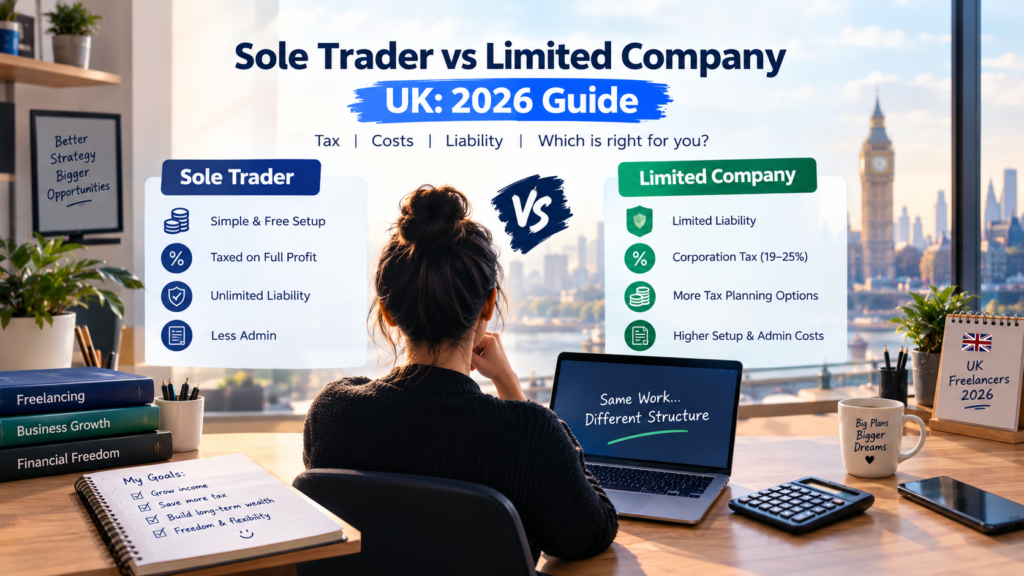
Short version: under ~£30k profit, stay a sole trader Ltd tax savings get eaten by fees and admin. Past £35k, limited usually wins, especially when profits sit in the business. Why? Sole traders are taxed on everything yearly; a company pays Corporation Tax, and personal tax only hits what you take out.
Every UK freelancer hits this fork. You start as a sole trader free, ten minutes, why wouldn’t you? Then one day your accountant mentions it. Or you fall down a forum rabbit hole at 1am. “You’d save THOUSANDS as a limited company.”
Sometimes? Yeah, that’s true. Sometimes the “saving” completely evaporates once you add up the accountancy fees and the hours you’ll spend wrestling with Companies House filings. Fun times.
There’s no universal answer. It depends on your profit, your risk, and how much admin you’ll tolerate. Here’s the full comparison with 2026/27 figures. No fluff.
Key Takeaways
- It’s all about timing. Sole trader? Taxed on the FULL profit every year no exceptions. Company? You decide when to pull money out and get taxed. That control is the real advantage.
- Rough tipping point: under ~£30k, sole trader wins on simplicity the tax gap barely covers extra fees. Above ~£35k, limited tends to win. Rule of thumb, not physics.
- 2026/27 numbers: sole traders pay 20/40/45% Income Tax + Class 4 NIC. Companies pay 19–25% Corporation Tax, then 10.75–39.35% dividend tax on extractions. Key: the company only wins if you don’t withdraw everything.
- Not just tax. Limited liability protects your assets. Many corporate clients won’t hire non-Ltd suppliers. Those can outweigh a few hundred quid either way.
- Unlearn this: “Ltd always saves thousands.” True-er before the 2023 Corporation Tax rise. The advantage is real but narrower than forums claim.
The Core Difference in One Paragraph
Here’s the thing most people don’t get. A sole trader IS the business. There’s no legal separation — you and the business are the same entity. So HMRC taxes your entire profit as personal income. Every year. Whether you spent it, saved it, buried it in the garden. Doesn’t matter.
A limited company? It’s a separate legal person. It pays Corporation Tax on its profits. And YOU only pay personal tax on the salary and dividends you choose to take out WHEN you choose to take them out. Leave money in the company this year, draw it in a lean year. That control over timing? That’s the engine of the whole tax advantage. Everything else — the admin, the liability protection, the credibility all flows from that one separation.
Side-by-Side Comparison
| Sole trader | Limited company | |
|---|---|---|
| Tax on profits | Income Tax at 20%, 40%, 45% on the whole profit — drawn or not | Corporation Tax at 19% (up to £50k) to 25%, then dividend tax of 10.75–39.35% on what you extract |
| National Insurance | Class 4: 6% on profits £12,570–£50,270, then 2%; voluntary Class 2 ~£3.65/week | No NI on dividends; standard employer/employee NI only on salary taken |
| Setup | Free — register with HMRC for Self Assessment, done in minutes | £12–£50 via a formation agent, plus time setting up articles and share structure |
| Yearly admin | One Self Assessment return; that’s genuinely it | Annual accounts and confirmation statement (£34) at Companies House, plus a CT600 corporation tax return |
| Liability | Unlimited — your house and savings are on the line if it goes wrong | Limited to the company’s assets; personal wealth shielded (barring personal guarantees) |
| Privacy | Total — nothing about your finances goes public | Director names and accounts sit on the public Companies House register, permanently |
| Credibility | Fine for small clients; some corporates and contracts require Ltd | Reads as “proper business” — opens doors to bigger contracts, tenders, and funding |
A Worked Example: £60,000 Profit, Two Ways
Enough theory. Let’s talk numbers. Freelance consultant, £60,000 taxable profit, 2026/27, England (Scotland’s bands are slightly different, sorry Scots).
As a sole trader: Income Tax across the bands works out to about £11,400. Plus Class 4 NICs of roughly £2,500. Total damage: around £13,900. You keep about £46,100. (An accountant would fine-tune this — treat it as a map, not a satnav.)
As a limited company (and you draw EVERYTHING): Corporation Tax on £60,000 comes to about £12,150. Note — that’s NOT a flat 19%, because £60k sits in the marginal relief band between £50k and £250k. Then dividend tax on the extraction adds roughly £12,000–£16,000 depending on your salary/dividend split. Total: mid-to-high £20ks. Yeah. WORSE than sole trader if you take it all out immediately.
But here’s what the table doesn’t show you. The company doesn’t HAVE to extract it all. Leave £20,000 sitting in the company for a quiet year, for reinvestment, whatever. That £20k escapes Income Tax and NICs completely until you draw it. It only bears Corporation Tax at around 20% effective. Meanwhile the sole trader? Pays full Income Tax + NICs on the entire £60,000. No choice. No timing. Just pay.
The advantage isn’t the rate. It’s the CONTROL.

When Sole Trader Wins
You’re under ~£30,000 profit. The Ltd tax edge at this level? Small to zero. Meanwhile accountancy fees (£800–£1,500+/year) and your own filing time eat it alive. Simplicity wins. It’s not even close on pure maths.
You’re testing an idea. Side hustle. First clients. Uncertain income. Don’t build a corporate structure around a hypothesis. Start free. Incorporate when numbers justify it.
Privacy matters. Your name, birth month, registered office on Companies House. Forever. Public. Plenty of home-based freelancers don’t want their address googleable. Fair.
Your liability risk is near zero. No employees, no products, no premises, no big contracts. Worst case is an unhappy client. Unlimited liability is theoretical here. (Get professional indemnity insurance anyway.)
You value weekends. One tax return vs accounts, confirmation statements, CT600s, payroll. Some would rather pay more tax than spend Saturdays on compliance.
When Limited Company Wins
Profits reliably clear £35,000+. This is where the tax maths turns. Decisively. Especially if you don’t need every penny for living costs because the more you can retain in the company, the bigger the win. It’s almost linear.
Your work carries real risk. Client premises. Subcontractors. Physical products. Large contracts. Anywhere a dispute could exceed your insurance cover. Limited liability isn’t paranoia it’s literally the reason this structure exists.
You want to hire or raise money. Employees. Angel investment. EIS/SEIS schemes. They ALL assume a limited company. You can’t issue shares as a sole trader. Investors won’t touch an unincorporated business. Full stop.
Big clients demand it. So many corporates, agencies, and public-sector contracts require Ltd suppliers. Partly IR35/off-payroll optics, partly procurement policy. Incorporating removes an entire category of friction. If you keep hearing “are you Ltd?” that’s your answer.
You’re planning around a spouse. Make your partner a shareholder and you split dividends across two personal allowances and two basic-rate bands. One of the biggest legitimate savings available. Completely impossible as a sole trader.
The IR35 Wrinkle (Contractors, Read This)
If you contract for clients — as opposed to freelancing project-to-project IR35 changes everything. The off-payroll rules mean loads of contractors working through limited companies are now deemed “inside IR35.” Translation: taxed like employees, without the tax advantages that made the company worthwhile in the first place.
So before you incorporate for contracting work, get an actual IR35 status determination for your real working arrangements. Not a guess. Not “my mate said.” A proper determination. Because a company that’s inside IR35 on all its contracts? That’s mostly admin cost with very little upside.
Genuine freelancers with multiple concurrent clients are usually outside IR35. But “usually” isn’t a determination. Check properly.
What About Partnerships?
Quick word since it comes up: a partnership is basically two or more sole traders sharing a business. Same tax treatment as sole trading (each partner pays Income Tax on their share), but with SHARED unlimited liability. So you get the worst bit of sole trading (your personal assets on the line) plus relationship risk if things go south with your partner.
It suits genuine co-founders building something together. For most freelancers choosing between the two main structures? You can safely ignore it.
The Switching Moment: How to Incorporate
Most freelancers don’t start as companies. They switch. Here’s how it goes: form the company (£12–£50 online), open a business bank account, move your contracts and clients across, tell HMRC the sole trader business has ceased. Sounds simple. The timing is where people mess up incorporating right before year-end can split profits awkwardly. Most accountants say align it with the tax year if you can.
One thing people don’t realise: you can’t just “convert.” Legally? The sole trader business CEASES. Dies. And a brand new company is born. That has implications for losses, equipment, ongoing contracts. This is where an accountant earns their fee budget £200–£400 for the transition advice alone. Worth every penny.
And from April 2026, sole traders above £50,000 face Making Tax Digital quarterly reporting. Which nudges the admin comparison further toward Ltd for growing businesses. Something to factor in.
Don’t forget the bank account. A limited company NEEDS a business account in the company’s name. You can’t just run it through your personal current account like most sole traders do. Starling, Monzo Business, Tide they open these in days. But factor it into your timeline: clients need the new details before you invoice them, and all your direct debits need moving across. It’s a faff. Plan for it.
The Paperwork Reality Check
People underestimate the admin gap. Sole trader: one Self Assessment return, done in an evening. Director: annual accounts, confirmation statement, CT600, payroll, statutory registers. None hard alone; together it’s days a year plus an accountant. Late filing penalties start at £150 and scale fast.
Frequently Asked Questions
Is it better to be a sole trader or limited company in the UK?
Under ~£30k? Sole trader, no contest simpler, cheaper, tax difference is basically nothing. Over ~£35k? Limited usually wins lower effective tax, you can retain profits, plus liability protection. In between? Depends on your risk appetite and how much admin you can stomach. There’s no universal answer. That’s literally why accountants exist.
How much tax do I pay as a sole trader vs limited company?
Sole trader: 20/40/45% Income Tax on ALL profit, plus Class 4 NIC (6% then 2%). Limited: 19–25% Corporation Tax, then 10.75/35.75/39.35% dividend tax on what you take out. Here’s the thing people miss — if you withdraw everything from the company, it can actually look WORSE. The edge comes from retaining profits and timing your extractions. Not from some magic lower rate.
At what income should I go limited in the UK?
The number everyone quotes: £30,000–£35,000 annual profit. Below that, accountancy and compliance costs eat whatever you’d save. But income isn’t the only trigger. Real liability risk? Planning to hire? Big clients demanding Ltd? Chasing investment? Any of those can justify incorporating earlier, regardless of profit.
Can I switch from sole trader to limited company later?
Yes — and most freelancers do exactly this. You form the company, move your contracts and banking over, tell HMRC the sole trader business has ceased. But it’s not a “conversion.” Legally the old business DIES and a new one is born. That affects losses, equipment, ongoing contracts. Get an accountant for the transition — and watch the timing around tax year-end, it matters more than you’d think.
Do limited companies pay less tax than sole traders?
Often. Not automatically. The advantage got narrower after the 2023 Corporation Tax rise and higher dividend rates — anyone telling you otherwise is working off old numbers. If you extract every penny, the saving can be modest or literally zero. Companies win when profits are high enough AND this is the crucial bit when you can leave money in the business instead of drawing it all immediately.
Is a limited company more credible to clients?
Usually, yeah. Loads of corporate clients, agencies, and public-sector buyers require it or strongly prefer it. Partly procurement policy, partly IR35 optics, partly just… prestige. For small private clients? Rarely matters. But if you’re chasing bigger contracts and keep hitting “are you Ltd?” well, there’s your answer.
Final Thoughts
Look sole trader vs limited company isn’t a personality test. It’s arithmetic plus risk appetite. Run YOUR numbers at YOUR profit level (not some forum stranger’s). Be honest about the admin versus your weekends. And remember: this isn’t permanent. Start simple, incorporate when the maths says so.
Most UK freelancers start as sole traders and switch somewhere past £30k. That’s not just fine — it’s the sensible path. Pair it with strong client-getting fundamentals and the skills clients pay premiums for, and the business side takes care of itself.
About the Author
Asmara Khan is an SEO content writer and GEO specialist who covers freelancing, AI tools, and online business for a UK/USA audience.
General information, not tax advice — structures and rates change, so confirm 2026/27 figures on GOV.UK or with an accountant. For deeper reading, see this freelancer-focused comparison and the 2026/27 rate breakdown.