
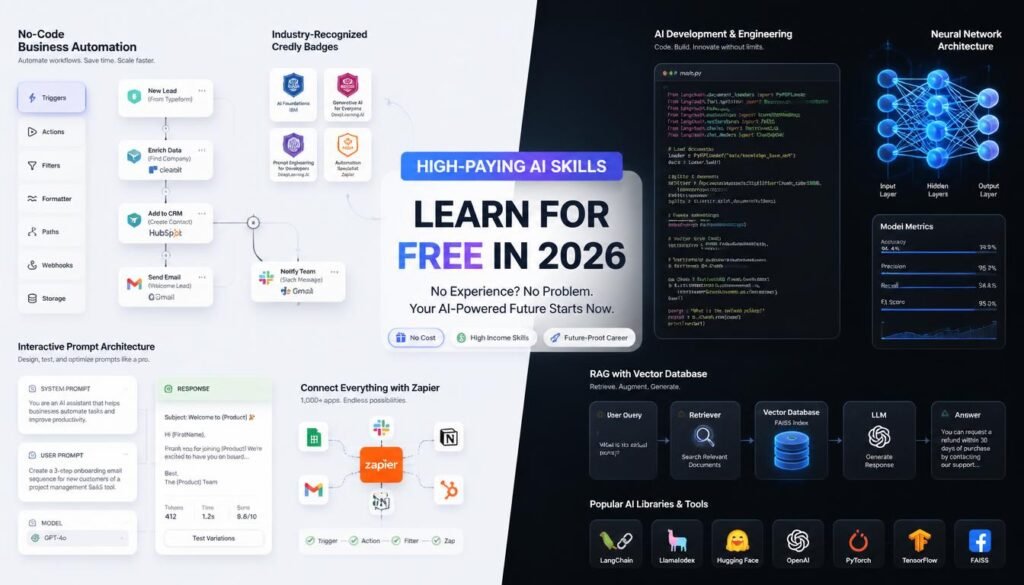
I keep running into the same excuse from people who want to get into AI but never do: “I’d need a degree for that.” No, you wouldn’t. Google, IBM, Microsoft, and Harvard have all put serious AI training online for free, and none of it requires four years and a mountain of debt.
If code isn’t your thing, start with Prompt Engineering, AI automation, or AI governance — none of that requires you to write a single line of Python. If you don’t mind getting your hands dirty technically, the real money right now is in LLM fine-tuning, RAG architecture, and building autonomous agents. Either direction, badges from IBM (through Credly) and Google Cloud actually mean something to hiring managers in the UK and US. Salaries in this space start around $65,000 and go well past $140,000 for the specialists.
Important Highlights
You don’t need a computer science degree, and you definitely don’t need to drop $40,000 on a bootcamp to get hired remotely in this field. There are basically two doors in: the non-technical route (operations, prompting, ethics) or the technical route (RAG, fine-tuning, PyTorch). Both pay reasonably well, so it really comes down to which one sounds less miserable to you.
One thing worth being picky about — make sure whatever course you take actually gives you something verifiable at the end. A random PDF certificate nobody can check is basically worthless. A Credly badge or a Google Cloud badge, on the other hand, employers can click and confirm in five seconds.
And here’s the part most people skip: a portfolio beats a certificate every time. Companies hiring remotely out of London or New York care a lot more about seeing your actual GitHub repo, or a Notion page walking through a real workflow you built, than they care about a “course completed” screenshot.
Fast-Track Overview: Top Free AI Courses at a Glance
| Skill Focus | Course Name | Provider | Skill Level | Verifiable Badge / Cert? | Est. Duration |
|---|---|---|---|---|---|
| Foundational Knowledge | Elements of AI | University of Helsinki | Beginner | Yes (Free Downloadable Cert) | 25 Hours |
| Business AI & Workflows | IBM AI Fundamentals | IBM SkillsBuild | Beginner | Yes (Free Credly Badge) | 10 Hours |
| Generative AI Systems | Intro to Generative AI | Google Cloud | Beginner | Yes (Google Cloud Skill Badge) | 45 Mins |
| Technical AI & Python | CS50’s Intro to AI with Python | Harvard University | Intermediate | Free Audit (Paid Cert Optional) | 7 Weeks |
| Deep Learning & Models | Practical Deep Learning for Coders | fast.ai | Intermediate | No (Open-Source Hands-On) | 9 Lessons |
Why AI Jobs Are Booming Across the UK & US
At this point AI isn’t some experimental side project companies are testing out — it’s just infrastructure. Every office from London to Manchester to New York to the Bay Area, and every remote team scattered in between, is hunting for people who can actually turn AI into something that saves the business time or money.
What’s stopping most people isn’t a lack of ability. It’s the (wrong) assumption that you need advanced math or a CS degree to touch this stuff. You don’t. The big players have opened up their training for free — what actually separates you from the next candidate is whether you picked a lane, built something real, and can prove it with a credential worth something.
Here’s a stat that surprised me the first time I saw it: roughly 78% of remote-first startups in the US and UK say they look at a candidate’s GitHub or Notion portfolio before they even glance at whether that person has a degree.
5 High-Paying AI Skills You Can Learn Online for Free
You’ve basically got two directions to choose from — stay no-code and lean into the business side, or go all-in on engineering. Here’s what’s actually paying right now.
                         ┌──────────────────────────────────────────┐
                         │      Choosing Your AI Skill Pathway      │
                         └────────────────────┬─────────────────────┘
                                              │
                     ┌────────────────────────┴────────────────────────┐
                     ▼                                                 ▼
      ┌─────────────────────────────┐                   ┌─────────────────────────────┐
      │   NON-TECHNICAL PATHWAY     │                   │      TECHNICAL PATHWAY      │
      │   (Business / No-Code)      │                   │    (Engineering / Code)     │
      └──────────────┬──────────────┘                   └──────────────┬──────────────┘
                     │                                                 │
      ├── Prompt Engineering & Workflows                ├── AI Autonomous Agents
      ├── AI Ethics, Compliance & Governance            ├── LLM Fine-Tuning & RAG Arch
      └── AI-Powered Content Strategy (GEO)             └── PyTorch / Python ML Models
1. Prompt Engineering & AI Automation Workflows (No-Code)
Forget the idea that prompt engineering just means “typing better questions into ChatGPT.” That was true two years ago. Now companies want what people are calling Prompt Architects — people who design multi-step reasoning chains, manage huge context windows, and connect AI tools to the rest of a company’s software stack.
It pays well because it saves companies real hours — automating client onboarding, chewing through research, or pulling answers out of internal documentation without a human digging through folders. To actually do this job you’ll want to know system prompt design, how to get clean structured JSON out of a model, Zapier or Make.com, and how to chain multiple tool calls together.
Expect somewhere between $65,000 and $95,000 a year in the US, or £45,000 to £68,000 in the UK. Google AI Essentials and IBM SkillsBuild’s AI Foundation course are both free starting points.
2. Autonomous AI Agent Development (Low-Code / Technical)
A single prompt can only get you so far. What businesses actually want now is agents — systems that run multi-step tasks on their own, check their own output, and fix mistakes without someone hovering over them the whole time.
This is where the bigger paychecks show up, because companies are running whole fleets of agents to handle things like automated code testing, scoring inbound sales leads, or processing financial reports. You’ll need to get comfortable with LangChain, AutoGen, CrewAI, API orchestration, and vector-based memory systems.
Pay tends to land between $95,000 and $145,000 in the US, or £70,000 to £105,000 in the UK. DeepLearning.AI’s short courses and Hugging Face’s open guides are a good place to start without spending anything.
3. LLM Fine-Tuning & RAG Architecture (Technical)
Out-of-the-box, most language models will confidently make things up, and they definitely don’t know anything about your company’s internal documents. Retrieval-Augmented Generation fixes that — it connects a model to your own private database so it’s answering from real information instead of guessing.
Healthcare, legal, and finance companies pay especially well here because getting this wrong isn’t just embarrassing, it’s a compliance risk. You’ll want to learn vector databases like Pinecone, ChromaDB, or Qdrant, embedding models, Python data pipelines, and PyTorch fine-tuning.
This one pays the most on the list — $110,000 to $165,000+ in the US, £80,000 to £120,000+ in the UK. fast.ai’s Practical Deep Learning course and Andrej Karpathy’s “Zero to Hero” series are both excellent, and both free.
Worth mentioning: legal tech firms that adopted RAG setups reportedly cut their hallucination rates by more than 60%, which is exactly why this skill is so in-demand in London and New York right now.
4. AI Ethics, Governance & Compliance (Non-Technical)
As privacy laws keep tightening around the world, companies need someone in the room who understands whether their AI system is actually fair, private, and legal — ideally before a regulator points it out for them.
This pays well for a simple reason: getting GDPR or CCPA compliance wrong is genuinely expensive, and governance specialists are the ones keeping the company out of that mess. The skills that matter here are responsible AI frameworks, bias auditing, data privacy law, and enterprise risk management.
Salaries run $80,000 to $125,000 in the US, £55,000 to £85,000 in the UK. The University of Helsinki’s Ethics of AI course and the Linux Foundation’s open training are both solid free options.
5. Generative Engine Optimization (GEO) & AI Content Strategy (No-Code)
Think of GEO as SEO’s younger sibling. Instead of optimizing so Google ranks your page, you’re optimizing so tools like ChatGPT, Perplexity, Claude, and Google’s AI Overviews actually cite you when someone asks a question.
Brands care about this because more and more people are asking AI chatbots for recommendations instead of scrolling through search results — and if your content isn’t structured in a way machines can parse, you simply won’t get mentioned. This means learning knowledge graph optimization, schema markup, entity extraction, and writing in a way that’s genuinely easy for a model to pull from.
Pay here runs $60,000 to $90,000 in the US, £40,000 to £65,000 in the UK. HubSpot Academy’s AI marketing courses and DataCamp’s free tier are both good starting points.
A Simple Roadmap: How to Learn AI Skills From Scratch
Phase 1: Foundation (Weeks 1-3)     --->  Phase 2: Core Mastery (Weeks 4-8)
- Complete Elements of AI                 - Work through Google / IBM courses
- Learn AI terminology & limitations      - Practice prompting & API calls

Phase 3: Portfolio Build (Weeks 9-12) --->  Phase 4: Career Launch (Month 4+)
- Build 3 live case studies               - Apply for UK/US remote jobs
- Publish repos / workflow demos          - Start freelancing or job hunting
Weeks 1 to 3 are just about understanding the basics — how a model actually predicts the next word, where it tends to fail, and roughly how a neural network processes information. An hour a day working through the University of Helsinki’s Elements of AI is enough to get you there.
Weeks 4 to 8 is where you pick a lane and actually stick to it. Don’t try to do both tracks at once, you’ll just end up half-decent at everything and great at nothing. If you’re going non-technical, focus on prompt design, Zapier or Make automation logic, and connecting tools together. If you’re going technical, get comfortable with basic Python, Pandas and NumPy, and start poking around Hugging Face’s open-source models. By the end of this stretch, try to finish IBM SkillsBuild’s AI Fundamentals path — that’s your first real badge.
Weeks 9 to 12 are about building proof, not collecting more certificates. If you went the no-code route, put together a public Notion page with workflow diagrams and a couple of case studies. If you went technical, get a GitHub repo up with something real in it — a working RAG pipeline, a fine-tuned model, or a custom agent you built yourself.
Month 4 onward is when you actually go looking for work. Freelancers can pitch specific services — “AI Workflow Automation” or “RAG Database Setup” tend to do better than something vague like “AI consulting.” If you’re job hunting, apply for junior-to-mid remote roles and make sure your resume links straight to your badges and your portfolio, not just a list of course names.
Learning Timeline & Milestones
| Timeline Phase | Focus & Milestones | Daily Time | Key Deliverable |
|---|---|---|---|
| Month 1: Fundamentals | Learn how AI models work, plus basic ethics and prompting. | 1–1.5 hrs/day | Finish 1 foundational course + certificate |
| Month 2: Specialize | Go deep on Python/RAG (technical) or Automation/GEO (non-technical). | 2 hrs/day | Build 2 working mini-projects |
| Month 3: Capstone | Build a full solution around a real business problem. | 2 hrs/day | Publish a public repo or case study |
| Month 4+: Job Search | Outreach, applications, and client pitches. | 1–2 hrs/day | Land your first client or interview |
Frequently Asked Questions
Can I really learn high-paying AI skills online for free?
Yes, genuinely. Google, IBM, Microsoft, and universities like Harvard and Helsinki all have full training programs online that don’t cost anything.
Do I need a computer science background to get an AI job?
Not for every role. Prompt Engineer, AI Operations Manager, AI Governance Consultant — none of these need you to write code. They’re built around process, communication, and understanding compliance, not software engineering.
Which free certification actually matters to UK and US employers?
Credly badges (IBM SkillsBuild especially), Google Cloud Skill Badges, and certificates from recognized universities all hold real weight on a resume or a LinkedIn profile. Random no-name course certificates, less so.
How long does this actually take?
Realistically, 1 to 2 hours a day gets you solid foundations and a working portfolio in about 3 to 4 months. If you’re going the technical route with Python and ML frameworks, budget closer to 6 to 9 months there’s just more to learn.
Can I actually freelance with these skills?
Yes. Plenty of small and mid-sized companies in the UK and US hire freelancers specifically to automate support workflows, set up internal knowledge bases, or run AI-driven marketing — you don’t need to land a full-time role to start earning from this.