Quick Summary
Hollywood studios cut production costs with AI mainly behind the scenes in pre-visualisation, storyboarding, virtual sets and visual effects, rather than replacing actors outright. Lionsgate trained a custom model with Runway, and Netflix used generative AI to finish a building-collapse VFX shot in The Eternaut roughly ten times faster than traditional tools would have allowed.
Featured Snippet Table
| AI Use Case | Studio Example | Stage of Production | Cost Impact |
|---|---|---|---|
| Custom-trained video model | Lionsgate + Runway | Pre-production, pitching | Fewer proof-of-concept shoots |
| Generative VFX shots | Netflix (The Eternaut) | Post-production | Shot finished ~10x faster |
| Virtual production backgrounds | Multiple streamers | Principal photography | Less location travel and set-build |
| De-aging and face work | Netflix (Happy Gilmore 2) | Post-production | Reduced prosthetics/reshoot costs |
| Synthetic performers | Studio-by-studio, union-regulated | Casting/VFX | Restricted by SAG-AFTRA contract terms |
Highlights
- Studios publicly call AI a “creative tool.” But the clearest financial win is cost and time savings in pre-production and VFX.
- Lionsgate was the first major studio to strike a formal AI partnership. It trained a Runway model on its own film library back in 2024. By 2026, it had taken an equity stake in the company.
- Netflix has confirmed it used generative AI in finished, aired footage. This started with a VFX sequence in The Eternaut. The studio says the shot would have been unaffordable without AI.
- SAG-AFTRA’s newest contracts don’t ban AI. But studios must notify and bargain with the union first. This applies before using synthetic performers or licensing an actor’s likeness for AI training.
- AI-generated performers have sparked real backlash. The “Tilly Norwood” controversy is the clearest example. It shows why studios stay cautious about how loudly they talk about this.
- None of this is really “secret” in a legal sense. Studios simply downplay it in public. Behind the scenes, they keep ramping it up.
Ask a studio executive on record whether AI is replacing jobs, and you’ll hear that it is just a tool. Ask off the record, however, and the answer changes completely. Over the past two years, generative AI has moved from conference novelties into actual production pipelines. It now shapes how films and shows get made quietly behind the scenes.
This isn’t a story about robots writing scripts or AI actors headlining blockbusters, at least not yet. It’s a story about spreadsheets.
Studios are under enormous pressure to make content cheaper without making it look cheaper, and AI has turned out to be one of the few tools that genuinely helps with that. The trick is doing it without setting off another round of the anger that fuelled the 2023 writers’ and actors’ strikes.
Why Studios Are Being Careful About How They Talk About This
Hollywood learned a hard lesson in 2023. When AI became a headline issue in the WGA and SAG-AFTRA strikes, studios discovered that saying the wrong thing about AI in public could shut down production for months. That memory hasn’t gone away.
So the current approach looks less like a ban and more like a workaround: use AI heavily in the parts of the process the public and unions scrutinise least, and frame every public announcement around “augmenting” human creativity rather than replacing it.
Industry note: Lionsgate’s Vice Chair Michael Burns described AI as a way to develop “capital-efficient” content when the studio’s Runway partnership was first announced — corporate language that, translated, means cheaper.
That doesn’t mean nothing is happening publicly. A handful of studios have actually been fairly open about specific projects. What’s “secret” isn’t the existence of AI in the pipeline — it’s the scale, and the fact that many of these workflows never get announced at all because there’s no strategic upside to talking about them.
1. Pre-Visualisation and Storyboarding
This is where AI adoption is furthest along, and it’s also the least controversial use case, because it replaces work that was already highly disposable — rough sketches and animatics that get thrown away once a scene is locked.
Lionsgate’s partnership with Runway, first announced in September 2024, is the clearest public example. The studio worked with Runway to train a custom AI model on its own film and TV catalogue, giving directors and editors a way to generate rough cinematic sequences for pitching and pre-visualisation before committing money to an actual shoot.
By 2026, that relationship had deepened: Lionsgate took an equity stake in Runway and began developing short-form AI-assisted series drawing on its own franchises, with the studio’s Chief AI Officer Kathleen Grace overseeing the strategy.
The financial logic is straightforward. A studio that can test how an action sequence or an entire trailer concept will look before booking a soundstage avoids paying for reshoots, wasted location scouting and abandoned concepts. That’s real money, even if the finished frame the audience eventually sees never touches AI at all.
2. Virtual Sets and Reduced Location Costs
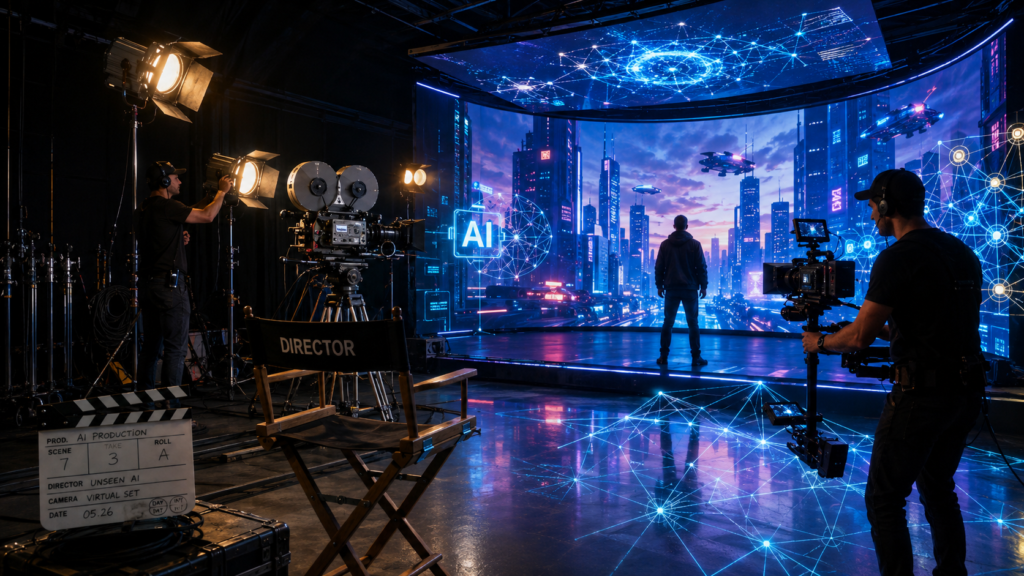
Physical sets and location shoots are among the biggest line items in any production budget. Virtual production — using LED walls and AI-assisted background generation to put actors in front of digitally rendered environments — has been growing since The Mandalorian popularized it, and generative AI is now speeding up how those environments get built.
Instead of sending a crew to Buenos Aires or building a period-accurate street from scratch, studios can generate and iterate on backgrounds far faster than a traditional art department could model and render them. It shortens the timeline from concept to usable environment from weeks to days in some cases.
3. Visual Effects: Where the Real Cost Savings Show Up
This is the part of the industry where AI’s financial impact is now genuinely documented, not just rumoured. Netflix co-CEO Ted Sarandos told investors in July 2025 that the streamer had aired its first generative-AI VFX sequence, in the Argentine series The Eternaut. The scene showed a building collapsing in Buenos Aires, and Netflix’s internal Eyeline production team worked directly with the show’s VFX artists to build it using AI tools.
Sarandos was candid about the numbers: the sequence was finished roughly ten times faster than a traditional VFX pipeline would have allowed, and he said the effect simply wouldn’t have been affordable on that show’s budget without AI. Netflix has since confirmed AI was used for de-aging effects in Happy Gilmore 2 and for pre-production wardrobe and set visualisation on Billionaires’ Bunker.
Fun fact: Netflix says its AI-assisted VFX approach didn’t cut the human VFX team out of the process — it changed how much time they spent on the most repetitive, technically difficult parts of the shot.
That distinction matters, because it’s exactly the argument studios need to make publicly to avoid another union standoff: fewer expensive iterations, not fewer credited artists.
4. Script Development and the “Don’t Ask, Don’t Tell” Workflow
Away from the big press releases, there’s a quieter and more informal layer of AI use happening at the desk level. Development executives, assistants and junior writers on some productions reportedly use AI tools for coverage, outline drafts and dialogue punch-ups, then rework the output enough that it passes as human-written before it goes up the chain. There’s no official studio policy sanctioning this — it exists precisely because there isn’t one, and because openly crediting an AI tool in a WGA-covered production creates contractual headaches nobody wants to deal with.
This is the layer that’s genuinely hardest to quantify, because it doesn’t show up in press releases or earnings calls. It shows up in how fast a script gets a first pass, and nobody outside the room really knows how much of that speed came from a chatbot.
5. Synthetic Performers — the Line Studios Can’t Quietly Cross
Actors are the one area where “secretly” doing this isn’t really an option anymore, because SAG-AFTRA built enforcement mechanisms directly into its contracts after the 2023 strike. Under the union’s newest TV/Theatrical agreement, ratified in 2026,
studios can only use a wholly synthetic performer in place of a union actor if it brings “significant additional value” to a production, and they must notify and bargain with the union first. Digital replicas of real performers require separate consent and compensation for each specific use.
The controversy around the AI-generated performer “Tilly Norwood” in late 2025 is a good illustration of why studios tread so carefully here. Even though the character hadn’t actually been cast in anything, the backlash from actors and agents was immediate and loud, and it pushed the synthetic-performer issue back into headlines right as SAG-AFTRA was finalising its new contract language. No major studio wants to be the one that triggers the next work stoppage over this.
What This Actually Means for the Industry
Put together, the pattern is fairly clear. Studios are comfortable using AI aggressively wherever it touches pre-production, background environments and effects work that audiences never consciously register as AI.
They are far more cautious, publicly at least, about anything touching writers’ credited work or actors’ likenesses, because those are the areas where unions have built real contractual teeth.
For freelancers, VFX houses and mid-level creatives working adjacent to these productions, that means the practical advice is less about whether AI is coming and more about which parts of the pipeline are already using it. Understanding where studios are investing pre-viz, virtual production, VFX cleanup is a far better guide to where the actual job market is shifting than any studio press release.
Timeline: Hollywood’s Quiet AI Adoption
| Date | Event |
|---|---|
| September 2024 | Lionsgate and Runway announce first major studio–AI model partnership |
| 2023–2025 | WGA and SAG-AFTRA negotiate first formal AI contract protections after industry strikes |
| July 2025 | Netflix confirms first aired generative-AI VFX sequence, in The Eternaut |
| October 2025 | “Tilly Norwood” AI performer sparks industry-wide backlash |
| May 2025 | SAG-AFTRA ratifies new Commercials Contract with expanded AI/digital replica terms |
| 2026 | Lionsgate takes equity stake in Runway; launches AI-assisted short-form IP series |
| June 2026 | SAG-AFTRA ratifies new TV/Theatrical Agreement further restricting synthetic performers |
If you’re building content around entertainment shifts, consider how artificial intelligence is also reshaping media coverage. You can explore this further in our guide on how to hire an AI SEO content writer
. AI’s financial impact isn’t just theoretical for major names, either. Stars like Jessica Alba’s net worth
and Selena Gomez’s net worth
show how modern entrepreneurs build businesses far beyond traditional acting. Similar business disruptions echo across the UK entertainment market, too. To see how local founders navigate these shifts, check out this rundown of UK celebrity entrepreneurs featured on Dragons’ Den in 2026.
FAQ Section
Is it illegal for studios to use AI without telling anyone?
No. Using AI in pre-production or VFX isn’t illegal on its own. What’s regulated is specific, contractually defined uses — like creating a synthetic performer or a digital replica of a real actor which now require union notice and bargaining under SAG-AFTRA’s latest agreements.
Which studio was first to officially partner with an AI company?
Lionsgate, which announced its partnership with Runway in September 2024 and later took an equity stake in the company in 2026.
Has AI actually appeared in a finished Netflix show?
Yes. Netflix confirmed generative AI was used for a VFX building-collapse sequence in The Eternaut in 2025, and later for de-aging work in Happy Gilmore 2.
Will AI replace actors?
Not under current union contracts. SAG-AFTRA’s 2026 TV/Theatrical Agreement restricts synthetic performers to cases where they add “significant additional value” and requires bargaining with the union first it stops short of an outright ban but sets a high bar.
Do studios donate any AI cost savings back to workers or funds?
So
Union agreements route AI-related payments into compensation structures rather than direct donations. For instance, digital replica and synthetic performer clauses require payment when a performer’s likeness is used. This functions similarly to a licensing fee rather than a charitable donation.
How can I tell if a movie or show used AI-generated visual effects?
Studios rarely disclose it scene-by-scene. The clearest signals come from studio earnings calls, trade press coverage (Variety, The Hollywood Reporter, Deadline) and, occasionally, direct studio statements like Netflix’s on The Eternaut.