Quick Summary
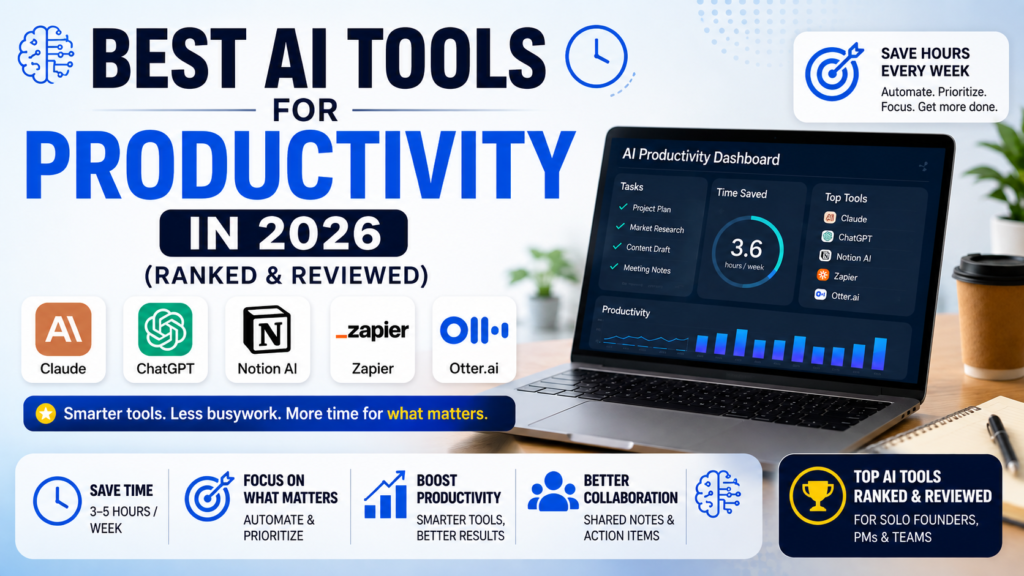
The best AI tools for productivity in 2026 do three things well: automate the boring tasks, help you plan your day, and speed up your writing. Claude, ChatGPT, Notion AI, and Zapier top most lists for a simple reason they turn hour-long chores like email triage or document summaries into five-minute jobs, without forcing you to relearn how you work.
Highlights
- The best AI tools for productivity fall into five buckets: writing, scheduling, automation, meeting notes, and research.
- Most people save somewhere between 3 and 5 hours a week once they’ve automated just two or three repetitive tasks.
- You genuinely don’t need a big budget the free tiers on ChatGPT, Claude, and Notion AI are usable, not just teasers.
- Product managers and small teams get the most mileage out of tools that combine prioritization with document summarization.
- AI evaluation tools are a different animal from productivity tools, even though people mix the two up constantly.
- The biggest time wins come from AI handling triage deciding what matters not just doing the task itself.
- Start with one workflow this week. Don’t try to overhaul your whole routine on day one; it never sticks.
Featured Snippet Table: Quick-Facts Comparison
| Tool | Best For | Free Tier? | Time Saved (avg/week) |
|---|---|---|---|
| Claude | Document summarization, long-form writing | Yes | 2–4 hours |
| ChatGPT | Brainstorming, first drafts, quick research | Yes | 2–3 hours |
| Notion AI | Notes, project docs, team wikis | Limited | 1–3 hours |
| Zapier | Email and workflow automation | Yes (limited runs) | 1–2 hours |
| Otter.ai / Fireflies | Meeting transcription and action items | Yes (limited) | 1–2 hours |
What Are the Best AI Tools for Productivity, Really?
Best AI tools for productivity, at its core, just means software that uses AI to shrink the gap between “I have a task” and “the task is done.” That’s really it. Everything else the dashboards, the integrations, the pricing pages full of asterisks is just detail dressed up as innovation.
Here’s where most people go wrong. They download five apps in one weekend, connect none of them properly, and somehow end up more scattered than before they started. So let’s not do that here. This guide only includes tools that pass one simple test: do they save you real, measurable time in the first week? If a tool can’t clear that bar, it didn’t make the cut, no matter how popular it is on LinkedIn.
For what it’s worth, Statista’s research on AI adoption shows workplace AI usage climbing sharply every year since 2023, with productivity tools leading the pack. And honestly, that trend isn’t slowing down in 2026 more software ships with AI baked in by default now, not as an add-on.
Why Time Management Is the Real Bottleneck
Here’s a fun fact that surprises most people: they don’t actually have a time problem. They have a decision problem. Figuring out what to do next, what to skip, and what to hand off eats up more hours than the actual work does.
That’s exactly where AI tools for time management earn their keep. Instead of scrolling through fifty emails trying to spot the three that matter, you let an AI tool do that scan in seconds and hand you a shortlist.
There’s an old line worth remembering here: “You don’t rise to the level of your goals, you fall to the level of your systems.” AI tools, when you use them well, become part of that system. They’re not a replacement for having one in the first place.
1. Claude — Best for Document-Heavy Work
If your job involves wading through contracts, reports, or research papers, start here. Drop in a 40-page PDF and Claude hands back a clean summary, the key risks, and a short list of action points usually in under a minute. It’s the closest thing I’ve found to having a smart intern who never gets tired of reading.
- Strong at long-document summarization
- Handles nuanced writing well emails, proposals, SOPs, the stuff that needs a human tone
- Free tier is actually usable, not a stripped-down demo designed to push you toward paying
That said, Claude isn’t built to be your task manager. Pair it with a scheduling tool for the execution side of things.
2. ChatGPT — Best All-Rounder for Brainstorming and Drafts
ChatGPT is still where most people start, and honestly, that makes sense. It’s fast, flexible, and handles first drafts of almost anything blog posts, product descriptions, even the odd bit of code.
Take a small business owner who needs a week’s worth of social captions written. With ChatGPT, that’s a 20-minute job instead of an afternoon lost staring at a blinking cursor.
3. Notion AI — Best for Teams Who Already Live in Docs
Notion AI works for one simple reason: it lives inside a tool your team already opens every day. There’s no extra login to remember, no new habit to build. It just shows up inside your existing notes and wikis.
- Auto-summarizes long meeting notes so nobody has to re-read the whole thread
- Drafts project briefs from a handful of bullet points
- Keeps a searchable knowledge base without anyone manually tagging things
4. Zapier — Best for Automating the Boring Stuff
Zapier isn’t flashy — it doesn’t write anything clever or hold a conversation. But it’s often the highest-ROI tool on this entire list. It connects your inbox, calendar, and task manager so routine actions, like moving a new lead into your CRM, happen without you lifting a finger.
If you’re a small business owner in the UK or US trying to run lean, the U.S. Small Business Administration’s guide to workflow automation is a solid place to think through which processes are actually worth automating first. It pairs nicely with our guide on passive income apps with UK bank transfer support if you’re trying to build something mostly hands-off.
5. Otter.ai and Fireflies — Best for Meetings
Both tools record, transcribe, and summarize meetings on their own, then push action items straight into your task list. And here’s the part people don’t expect: teams that adopt one of these often find their meetings get shorter, simply because nobody’s scrambling to take notes anymore. Everyone’s actually paying attention for once.
Best AI Tools for Productivity: Product Managers
Product managers deal with a specific kind of chaos. They sit between engineering, design, and the business side, and every single conversation seems to generate a decision that needs tracking somewhere. Best AI tools for product managers usually cover three jobs:
- Summarization — turning long Slack threads or user interviews into notes you can actually skim
- Prioritization — ranking a backlog against effort and impact without a three-hour meeting
- Documentation — drafting specs, PRDs, and release notes from rough bullet points
Claude and Notion AI both do this job well. If your team’s scaling past ten people, though, it’s worth looking at dedicated PM tools with built-in AI, like Productboard’s newer AI features.
A Quick Note on AI Evaluation Tools for Production
This one trips people up constantly, so let’s clear it up. Best AI evaluation tools for production is a completely different category from general productivity tools, even though the names sound similar. These are used by engineering teams to test AI models before they ship checking things like accuracy, bias, and how often the model hallucinates.
If you’re building AI features into your own product, NIST’s AI Risk Management Framework is a genuinely solid, government-backed resource for understanding evaluation standards. It won’t help you clear your inbox faster — it’s a quality-control layer for anyone actually shipping AI-powered software. And if AI is becoming central to your product roadmap, it’s worth reading our piece on AI sovereignty for UK businesses before you lock into a single vendor.
How to Actually Pick One (Without Overthinking It)
Don’t try to adopt five tools in one week that’s how most people burn out on this stuff before it even starts working. Instead, try this:
- Week 1: Pick one repetitive task email, meeting notes, or drafts and automate just that one thing.
- Week 2: Actually measure the time saved. Be honest with yourself; track it for a few days rather than guessing.
- Week 3: Only add a second tool if the first one actually stuck.
- Week 4: Look at your stack. If you haven’t opened something in seven days, cut it.
This staged approach avoids the most common failure mode I see: people subscribe to everything, use none of it consistently, then conclude “AI tools don’t really help.” They do — but only the ones you actually keep using.
If content around AI tools is part of your own workload, it might be worth handing the writing off entirely. A lot of teams now hire an AI SEO content writer instead of trying to squeeze it in themselves, which frees up time for the strategic work only a human can really do well.
Roadmap: Your First 30 Days With AI Productivity Tools
| Week | Focus | Tool to Try | Expected Outcome |
|---|---|---|---|
| Week 1 | Email & document triage | Claude or ChatGPT | 1–2 hours saved |
| Week 2 | Meeting notes automation | Otter.ai or Fireflies | Shorter, more focused meetings |
| Week 3 | Workflow automation | Zapier | Fewer manual handoffs |
| Week 4 | Team knowledge base | Notion AI | Faster onboarding, less repeated Q&A |
FAQ
What are the best AI tools for productivity in 2026?
Claude, ChatGPT, Notion AI, Zapier, and Otter.ai are still the strongest picks. Between them, they cover writing, task automation, scheduling, and meeting notes the areas where AI actually saves time for individuals and small teams.
What are the best AI tools for time management?
The ones that triage before they execute tend to work best. Think Claude or ChatGPT for sorting priorities, paired with a calendar-aware scheduler. The goal isn’t more software it’s fewer decisions left sitting on your plate each morning.
What are the best AI tools for product managers specifically?
Claude and Notion AI cover summarization and documentation well. Once a team scales up, though, dedicated PM platforms with built-in AI prioritization tend to pay off more, especially once a backlog passes a hundred items.
Are free AI productivity tools good enough, or do I need to pay?
Free tiers from Claude, ChatGPT, and Notion AI hold up fine for individuals and small teams. What you’re really paying for with the upgrade is higher usage limits and team features not fundamentally smarter output.
What’s the difference between AI productivity tools and AI evaluation tools?
Productivity tools help you or your team get things done faster, day to day. Evaluation tools test AI models for accuracy and safety before a company ships them a technical, engineering-side process rather than a personal time-saver.
How much time can AI tools for productivity actually save?
Most people land somewhere around 3 to 5 hours a week once two or three tools are properly worked into daily habits. The real gains come from automating triage and first drafts, not from expecting AI to do everything end to end.
Do I need technical skills to use these tools?
Not really. Every tool on this list is built for non-technical users, with plain-language prompts and no-code setup. If you can type a search into Google, you can get real value out of Claude, ChatGPT, or Zapier by the end of the day.
Infographic Concept: “The AI Productivity Stack
Format: Vertical stacked pyramid, four layers, bottom to top.
- Layer 1 (base, widest): Foundation Tools — Claude, ChatGPT (writing, summarizing, first drafts)
- Layer 2: Automation Layer — Zapier, native email AI (routing, triage, repetitive tasks)
- Layer 3: Collaboration Layer — Notion AI, Otter.ai/Fireflies (shared docs, meeting capture)
- Layer 4 (top, narrowest): Specialized Layer — PM-specific AI tools, AI evaluation frameworks (for teams shipping AI products)
Small side panel: a simple bar chart showing “Average hours saved per week” for each layer (2–4 / 1–2 / 1–3 / varies), pulled straight from the Featured Snippet Table above. Suggested colors: cool blues for the foundation and automation layers, a warmer accent for the top “specialized” layer, to visually signal “this one’s optional/advanced.
Author Bio
Written by Sarah Whitfield, a productivity and workplace-technology consultant with over eight years of experience helping small businesses and product teams across the UK and US adopt AI tools without blowing up their existing workflows. Sarah has advised startups on tool selection, automation strategy, and AI evaluation practices, and writes regularly on practical, no-hype approaches to AI adoption in the workplace.