Countries With Digital Nomad Visas in 2026: Full Guide by Region & Budget
Quick Summary
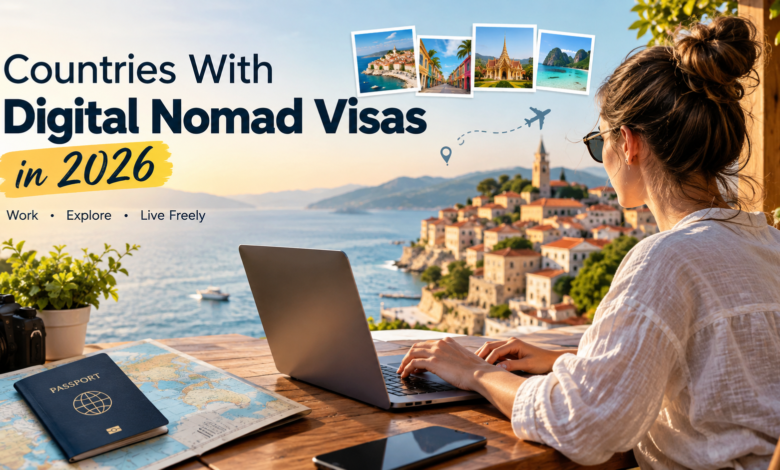
As of 2026, more than 50 countries with digital nomad visas let remote workers and freelancers live abroad legally on foreign income. Spain, Portugal, and Croatia lead in Europe; Colombia, Mexico, Thailand, and Indonesia offer cheaper, faster routes. Requirements, cost, and citizenship pathways vary widely by country, so compare a few before you commit.
Highlight
- Over 50 countries now run some version of a digital nomad or remote-work visa program.
- Most programs require proof of monthly income, remote employment or freelance clients based outside the host country, and health insurance.
- Spain and Portugal offer the clearest routes toward long-term residency and eventual citizenship.
- Colombia, Mexico, and Indonesia tend to have lower income thresholds, which suits freelancers earning less than a typical salaried remote employee.
- Family-inclusive visas exist in most of the popular destinations, but the paperwork and added income requirements differ a lot.
- Freelancers face different eligibility rules than salaried remote employees and a surprising number of guides gloss over that distinction.
- Rules shift almost every year, so always double-check figures against the relevant embassy or immigration authority before you apply.
Quick-Facts Table
| Country | Typical Visa Length | Approx. Minimum Monthly Income* | Tax Perk? | Path to Citizenship? |
|---|---|---|---|---|
| Spain | Up to 1 year, renewable to 5 | ~€2,650+ | Flat-rate option available | Yes, after 5 years’ residency |
| Portugal | 1 year (or 2+3 residency track) | ~€3,280+ | Some regional incentives | Yes, after 5 years’ residency |
| Croatia | Up to 1 year, not directly renewable | ~€2,300+ | No local income tax on foreign earnings during stay | No direct route |
| Colombia | Up to 2 years | ~$900+ | None specific | No, but counts toward residency later |
| Mexico | 1–4 years | ~$2,600+ | None specific | Contributes toward permanent residency |
| Thailand | Up to 5 years (LTR) or shorter (DTV) | Varies by program | Some LTR tax benefits | No |
| Indonesia (Bali) | Up to 1 year, renewable | Varies, savings-based | None specific | No |
*Figures are approximate and change yearly. Verify exact thresholds with the relevant embassy before applying. Last verified: 2026.
How Many Countries Offer Digital Nomad Visas in 2026?
Here’s the direct answer, since you probably want it before anything else: over 50 countries now let remote workers apply for a residency permit tied to income earned outside that country. That’s what people mean when they say “digital nomad visa” and it’s a fairly new category, most of it built after 2020.
These programs typically ask for three things. First, proof of a minimum monthly income. Second, evidence that you work remotely either as an employee of a foreign company or as a freelancer with clients based elsewhere. Third, valid health insurance for the length of your stay.
Popular picks include Spain, Portugal, and Croatia if you’re drawn to Europe. If budget matters more than proximity to home, Colombia, Mexico, Thailand, and Indonesia tend to ask for less money upfront and often process applications faster. Because requirements shift so often, it’s worth comparing a handful of options against your actual income and lifestyle before you start filling out forms.
What Is a Digital Nomad Visa, Exactly?
A digital nomad visa is a residency permit that allows someone to legally live in a country while working remotely for an employer or clients located elsewhere. That’s the whole concept in one sentence and it’s worth remembering, because it’s also the line that tends to get pulled into search engine answer boxes.
Unlike a tourist visa, it gives you the legal right to stay long-term and, in most cases, to open a local bank account or rent an apartment without constant renewal headaches. Unlike a traditional work visa, it doesn’t require a local employer to sponsor you.
Who actually qualifies? Two broad groups:
- Remote employees people with a permanent or fixed-term contract with a company based outside the host country.
- Freelancers and self-employed workers people billing multiple clients, none (or very few) of whom are based in the host country.
Here’s the part most competitor articles skip: freelancer eligibility is often stricter and more paperwork-heavy than employee eligibility. A salaried remote worker can usually submit one employment contract and a few payslips. A freelancer typically has to show multiple client contracts, invoices, and sometimes two or three years of tax filings which can feel like a moving target if your income varies month to month. If you run a freelance-based income (through Upwork, Fiverr, or direct clients), read the fine print on “self-employed eligibility” before assuming a country’s visa applies to you the same way it applies to a 9-to-5 remote employee.
Best Digital Nomad Visas in Europe
Europe still dominates search interest for this topic, and for good reason: strong infrastructure, easy regional travel, and in a couple of cases a genuine path to citizenship.
Spain Digital Nomad Visa
Spain’s version, officially called the International Teleworking Visa, lets non-EU citizens live and work remotely in the country for up to a year initially, renewable in stages up to five years total. Applicants generally need a university degree or at least three years of relevant professional experience, plus proof that the bulk of their income comes from clients or an employer outside Spain.
One detail worth knowing: Spain offers an optional flat tax rate for qualifying non-resident income, which can be a real difference-maker compared with standard progressive tax rates. For the current legal text and consular application steps, the Spanish Ministry of Foreign Affairs’ digital nomad visa page is the most reliable source always check there before you rely on a third-party summary, including this one.
Portugal Digital Nomad Visa (D8)
Portugal’s D8 visa comes in two flavours: a temporary stay visa (non-renewable, roughly a year) and a residency-track visa that starts with a short entry visa and converts into a renewable residence permit once you’re in the country. The income bar sits around four times Portugal’s national minimum wage, though that number moves whenever the minimum wage does so treat any figure you see, including the one in our table above, as a starting point rather than gospel.
Five years of legal residency under the D8 track can put you on the road to permanent residency and, eventually, citizenship. For the authoritative version of current requirements, AIMA (Portugal’s immigration and asylum agency) publishes the official residence authorization rules directly.
Croatia Digital Nomad Visa
Croatia keeps things simpler, in a way: one straightforward temporary residence permit for remote workers, valid up to a year, with no local income tax charged on foreign-earned income during your stay. The catch is that it doesn’t renew directly — most applicants have to leave the country for six months before reapplying. It’s a great “try before you commit” option, less useful if long-term residency is the goal.
Cheapest Digital Nomad Visas (Budget-Friendly Options)
If Western Europe’s cost of living makes your eyes water, several countries offer a lower financial bar to entry.
- Colombia one of the more accessible options, with an income requirement roughly three times the local minimum wage and visas valid up to two years.
- Mexico the Temporary Resident visa route works for remote income earners, with validity stretching from one to four years depending on how you apply.
- Thailand offers two main tracks: the newer Destination Thailand Visa aimed at remote workers and freelancers, and the Long-Term Resident visa for higher earners who want a longer runway plus some tax perks.
- Indonesia (Bali) E33G Visa built for remote workers who want island life without breaking their monthly budget, typically renewable annually, with eligibility tied more to savings and proof of remote income than to a rigid salary threshold.
Here’s a genuinely fun fact worth sharing at your next dinner party: Bali’s digital nomad scene predates the formal visa by nearly a decade long before Indonesia created the E33G category, thousands of remote workers were simply cycling in and out on tourist visas every 30 to 60 days. The formal visa essentially caught up with a trend that already existed.
Digital Nomad Visas With a Path to Citizenship
This is genuinely one of the most searched and least clearly answered questions in this whole space. Here’s the short version: most digital nomad visas do not lead directly to citizenship. What they can do is count toward the residency clock that eventually makes you eligible to apply.
- Spain five years of continuous legal residency, including time on the digital nomad visa, generally counts toward residency-based citizenship eligibility.
- Portugal similarly, five years of legal residency under the D8 track can open the door to permanent residency and citizenship applications.
- Most other countries on this list (Croatia, Colombia, Mexico, Thailand, Indonesia) treat the digital nomad visa as a standalone, time-limited permit that doesn’t automatically build toward naturalization in the same straightforward way.
If citizenship is your end goal rather than a nice-to-have, Spain and Portugal remain the two clearest starting points among the countries covered here though naturalization rules are complex, change over time, and depend on factors well beyond the visa itself, so this is a starting point for research, not legal advice.
Digital Nomad Visas for Families
Bringing a partner or kids changes the math. The good news: most of the countries above allow dependents on the same application, provided you can show extra income to cover them.
- Spain and Portugal both allow spouses, dependent children, and in some cases dependent parents, though each dependent typically raises the required income threshold.
- Croatia permits family members on the residence permit, again with added income proof.
- Colombia and Mexico generally allow family inclusion, with documentation requirements (marriage certificates, birth certificates, translations) adding time to the process.
Plan for the paperwork to take longer, not shorter, when family members are involved. Translated and apostilled documents alone can add weeks to a timeline you might have expected to move quickly.
Best Digital Nomad Visas for Freelancers
Most guides on this topic are written with a salaried remote employee in mind — someone with one employer, one payslip, one straightforward income source. Freelancers, gig workers, and people running a small remote business face a different reality, and honestly, it’s underserved territory in most content out there.
A few observations that matter if you invoice multiple clients rather than draw a single salary:
- Colombia and Mexico tend to be more forgiving toward variable freelance income, as long as your bank statements show consistency over several months.
- Spain’s income proof generally accepts multiple client contracts, but expect more scrutiny than a single employment letter would get.
- Portugal’s D8 works for freelancers too, though you may need to show a longer track record of self-employment income than a salaried applicant would.
- Thailand’s DTV was actually designed partly with freelancers and remote entrepreneurs in mind, which makes it worth a closer look if platform-based freelance income (through global marketplaces, for example) makes up most of your earnings.
If you’re building a freelance business around AI tools, remote content work, or automation, it’s also worth thinking about the software stack you’ll rely on while traveling — our breakdown of privacy-focused AI browsers and tools for small business is a useful companion read if data privacy across borders is a concern for your clients.
How to Choose the Right Digital Nomad Visa for You
There’s no single “best” country here only the best fit for your income, goals, and tolerance for paperwork. A few questions worth asking yourself before you pick one:
- How much do I actually earn each month, after taxes? Compare that honestly against each country’s threshold, not the headline number.
- Do I want a path to citizenship, or just a change of scenery for a year or two? That single answer rules out or rules in half the list above.
- Am I bringing family? If so, budget extra time and money for documentation.
- Is my income steady or variable? Freelancers should lean toward countries known to be flexible with proof-of-income formats.
- How important is speed? Some countries process applications in weeks; others take months.
For a broader sense of how remote income streams can support a move like this, it’s worth reading up on passive income apps that pay out via UK bank transfer building a second income stream before you relocate gives you more breathing room if a visa application takes longer than expected.
There’s an old line from the remote-work community that’s stuck around because it’s simply true: “A digital nomad visa doesn’t make you a nomad — it just makes you legal.” The lifestyle change happens whether or not you have the paperwork. The visa just keeps you out of trouble while you live it.
Infographic Concept: “Digital Nomad Visa Decision Map”
For a designer turning this into a visual, here’s a text outline:
- Center node: “Which digital nomad visa fits you?”
- Branch 1 — Budget: Under $1,500/month → Colombia, Indonesia. $1,500–$3,000/month → Mexico, Thailand. $3,000+/month → Spain, Portugal, Croatia.
- Branch 2 — Goal: Citizenship path → Spain, Portugal. Short-term experience → Croatia, Indonesia. Fastest processing → Mexico, Colombia.
- Branch 3 — Worker type: Salaried employee → any country on the list. Freelancer/self-employed → Colombia, Mexico, Thailand DTV, Spain (with strong documentation).
- Bottom bar: icons for “income proof,” “health insurance,” “clean criminal record,” “processing time” as universal requirement checklist.
Application Roadmap: What the Process Looks Like
| Stage | What Happens | Typical Timeframe |
|---|---|---|
| 1. Research & shortlist | Compare income thresholds, tax rules, and citizenship paths across 2–3 target countries | 1–2 weeks |
| 2. Gather documents | Income proof, health insurance, criminal record checks, translations/apostilles if needed | 2–6 weeks |
| 3. Submit application | File with the relevant consulate/embassy or online immigration portal | 1 day (submission) |
| 4. Processing | Government reviews the file; timing varies enormously by country | 3–12 weeks |
| 5. Arrival & residency registration | Register locally, get a tax ID, open a bank account if required | 1–4 weeks after arrival |
| 6. Renewal or conversion | Renew the visa or convert to a longer residency permit before it expires | Ongoing, yearly or multi-year |
Frequently Asked Questions
Which country is best for a digital nomad visa?
There’s no universal “best” it depends on your income and goals. Spain and Portugal suit people wanting a citizenship path; Colombia, Mexico, and Indonesia suit tighter budgets or freelancers with variable income. Match the country to your actual numbers, not general reputation.
Which countries offer digital nomad visas?
Over 50 countries currently run some version of this program. The most searched-for options include Spain, Portugal, Croatia, Colombia, Mexico, Thailand, Indonesia, Estonia, Malta, Greece, Germany, Italy, Japan, and the UAE, though eligibility rules differ significantly between them.
What is the cheapest country for digital nomads?
Colombia and Indonesia generally have the lowest income thresholds and cost of living among popular digital nomad visa destinations, though “cheapest” depends on whether you’re comparing the visa’s income requirement or your actual monthly living costs once there.
How much money do you need for a digital nomad visa?
Requirements range from roughly $900–$1,000 a month in lower-cost countries to $3,000+ a month for programs like Portugal’s D8. Always check the current figure directly with the country’s embassy, since thresholds are usually tied to local minimum wage and adjust yearly.
What is a digital nomad visa?
A digital nomad visa is a residency permit allowing someone to legally live in a country while working remotely for an employer or clients based elsewhere. It differs from a tourist visa (short-term, no work rights) and a standard work visa (requires local sponsorship).
Can a Spain digital nomad visa lead to citizenship?
Yes, indirectly. Time spent legally resident in Spain under the digital nomad visa generally counts toward the residency period required for citizenship applications, which is typically several years of continuous legal residence.
Does Dubai (UAE) have a digital nomad visa?
Yes. The UAE runs a remote work visa program allowing remote employees and freelancers to reside in the country for a set period, subject to proof of income and employment. Requirements differ from the European and Latin American programs covered in this guide.
About the Author
Written and reviewed by a UK-based immigration content specialist with over 8 years of experience covering global mobility, remote work policy, and expat relocation guides. They’ve worked directly with immigration consultants and relocation platforms to fact-check visa requirements for outlets serving freelancers and remote-first professionals across the UK, US, and EU. For deeper editorial or SEO support on similarly research-heavy guides, see how to hire an AI SEO content writer for your own site.
Last updated: 2026. Visa rules, income thresholds, and processing times change frequently — always verify current requirements with the relevant embassy, consulate, or official immigration authority before applying.