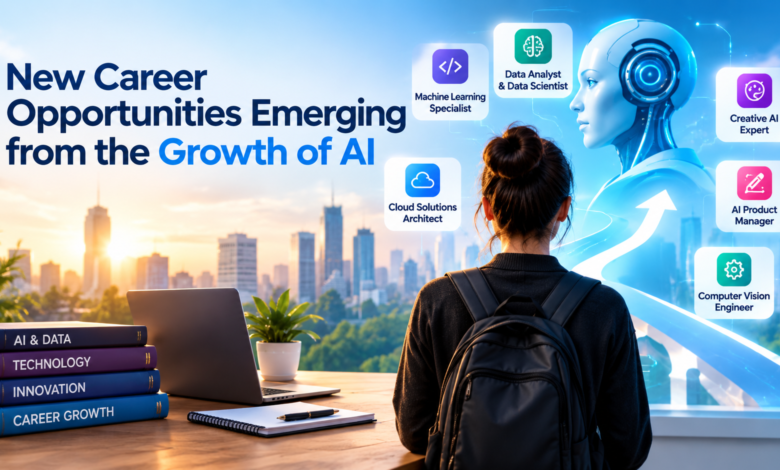
New Career Opportunities Emerging from the Growth of AI
How AI Is Reshaping the Modern Job Market
AI has been altering the contemporary job market through the impact on the way firms’ function, make decisions, as well as offer their products or services to their consumers. Although it has been mainly related to automation of the processes, the expansion of AI creates new prospects for careers in technology, business, medicine, financial sector, marketing, manufacturing, and many other industries.
More and more firms require employees who know how to build AI systems, control the tools that use this technology, analyze the data obtained, and make sure it is implemented responsibly.
Furthermore, there are changes in the conventional professions as people start working side by side with AI. The skills of data analysis, critical thinking, problem solving, communication, and digital literacy become increasingly significant. An individual who learns how to utilize AI may increase the productivity and take up the tasks that are more strategic.
Thus, it can be said that with the growing adoption of this technology, the future employment environment will be characterized by cooperation between human beings and artificial intelligence. According to Consegic Business Intelligence, the Augmented Analytics Market is projected to reach USD 103.12 billion by 2032, growing at a CAGR of 25.5% from 2025 to 2032, highlighting the growing demand for AI-powered analytics and the emerging career opportunities surrounding data-driven decision-making.
Growing Demand for AI Specialists
The fast adoption of artificial intelligence technology results in high demands for AI system designers, developers, trainers, and maintainers. Today machine learning engineers, AI developers, data scientists, computer vision specialists, and natural language processors have become crucial for companies implementing intelligent solutions.
These professionals use big data sets, algorithms, neural networks, and programming frameworks to create the systems which can detect the pattern, predict something, process natural language, or automate complex operations.
For instance, machine learning engineers are capable of building models that can detect frauds, recommend goods, predict the future demand or increase the business efficiency.
The AI professionals can be also responsible for the integration of these models in software and ensure their efficient performance in reality. Since many businesses proceed with their transition from the experimental use of AI to its wide application, the demand for qualified specialists should increase.
The skills required by these professionals include the knowledge of programming languages, statistics, mathematics, data structures, and machine learning. Nevertheless, the experience of working with AI tools and cloud computing is also valuable now. This means that students and specialists can benefit by developing technical skills as well as professional knowledge.
| Career Category | Example Roles | Key Skills Needed |
|---|---|---|
| AI & Machine Learning | ML Engineer, Data Scientist, AI Developer | Programming, Statistics, Neural Networks |
| AI Ethics & Governance | Compliance Officer, AI Risk Analyst | Policy, Law, Critical Thinking |
| AI-Powered Creative | Prompt Specialist, AI Copywriter, Creative Technologist | Writing, Design, Storytelling |
| Human-AI Collaboration | AI Trainer, Workflow Specialist | Communication, Leadership, Adaptability |
Rise of AI Ethics & Governance Careers
Since AI technologies become more popular within businesses and public sector, organizations will need professionals who can deal with various ethical, legal and social issues related to artificial intelligence. In this way, there emerge many new job positions in the sphere of AI ethics, governance, risk management, compliance, and responsibility. Such professionals analyze if companies develop and apply AI technologies in a transparent, unbiased, secure, and accountable manner.
Specialists working in the area of AI governance can create policies of data usage, models creation and analysis, decision-making, etc. Furthermore, these professionals can identify possible risks like algorithmic biases, data protection violations, security threats and misuse of automation.
Specialists working in the sphere of compliance make sure that the application of AI technologies meets all the necessary legislation, industry and organizational standards.
The above-mentioned careers are attractive due to the fact that they combine knowledge in the sphere of IT and other disciplines, such as law, philosophy, business management, cybersecurity, public policy, etc. There is no need for a person beginning to work in this sphere to be an advanced programmer. What really matters is the ability to understand how artificial intelligence operates and how its decisions can affect people.
New AI-Powered Creative Roles
AI is also revolutionizing career paths in creative industries by offering creative professionals innovative tools for writing, design, video production, advertising, marketing, and digital media. Instead of displacing creative professionals, AI platforms can help them in brainstorming, researching, editing, creating images, personalizing the content, and producing repetitive items. This is fostering the emergence of positions dedicated to management and direction of AI-assisted creative work.
Content strategist, AI-assisted copywriter, prompt specialist, creative technologist, AI video editor, and digital campaign specialist will be able to create content with the help of intelligent tools. Marketers will be able to analyze preferences of their target audience and develop personalized campaigns, while designers will be able to quickly test several ideas and choose the best of them. The human touch will be still required as creative work requires context, innovation, emotion and brand consistency.
Those professionals who enter the field will be able to get an advantage from combining creativity with the knowledge of artificial intelligence. Writing, visual communication, storytelling, research, and editing skills will become extremely helpful when working with AI-powered tools.
Human-AI Collaboration & Future Skills
The evolution of AI will lead to human-AI cooperation being one of the key elements of the future workplace. In addition to considering AI as a replacement for the human workforce, many companies use this technology to complement their employees’ work by automating routine actions and helping with analysis, research, communication, and decision-making. The change will impact the desired qualities that employers will look for in candidates.
Workers who will be able to cooperate with the AI while making judgments of their own might benefit from the technologically advanced environment at the workplace. Critical thinking, creativity, emotional intelligence, communication, leadership, and problem-solving will continue to be hard to replace because of their complex nature which relies on interaction with other humans. At the same time, basic knowledge of AI technologies will become valuable even outside of technology-related job positions.
The changes will create new job positions that will allow people to educate employees about the use of AI technologies, implement AI workflow, and assess the output of the AI. Rather than forcing all workers to become engineers who design AI technologies, the future workplaces might require professionals who will be able to use technological advances in their professional work.
Conclusion
The development of artificial intelligence technology is bringing about a lot of transformation in the field of employment while at the same time offering new employment avenues in different fields. These range from those specializing in artificial intelligence and machine learning to those involved in the areas of artificial intelligence management, creative technology, and human and artificial intelligence interactions, among others. The current jobs are being transformed by the integration of artificial intelligence in daily activities.
Those whose professions incorporate technical knowledge alongside creativity, critical thinking, effective communication, and industry knowledge will be able to cope well with the transformations. This implies that artificial intelligence not only transforms current careers but also creates totally new ones.