Quick Summary
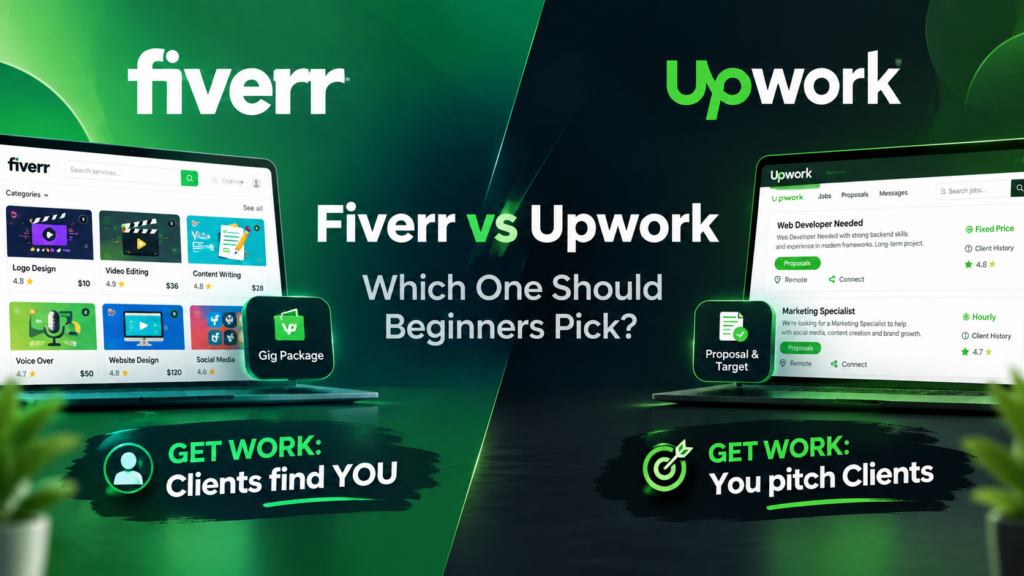
Fiverr vs Upwork for beginners comes down to one thing: how you’d rather find work. Fiverr is better if you want clients to come to you through a ready-made “gig.” Upwork suits people willing to pitch for jobs and build longer client relationships. Neither is universally “better” they solve different problems.
Highlight
- Fiverr uses a passive, gig-based model; Upwork uses an active, proposal-based one.
- Fiverr charges a flat 20% fee on every sale, no matter how long you’ve worked with a client.
- Upwork’s fee shrinks the longer you work with the same client, which rewards repeat business.
- Fiverr tends to produce a first sale faster often within weeks rather than months.
- Upwork generally suits technical, consultative, or higher-budget work better than Fiverr does.
- You don’t have to choose forever. Most experienced freelancers end up using both.
- Your personality matters as much as your skill: comfortable pitching yourself? Try Upwork first. Prefer people finding you? Start with Fiverr.
Featured Snippet Table: Fiverr vs Upwork at a Glance
| Factor | Fiverr | Upwork |
|---|---|---|
| How you get work | Buyers browse and purchase your “gig” | You submit proposals to posted jobs |
| Beginner friction | Low — no pitching required | Higher — needs proposals and Connects |
| Fee structure | Flat 20% on every order | Tiered, drops as you earn more from one client |
| Time to first sale | Often 2–6 weeks | Often 4–12 weeks |
| Best for | Packaged, clearly defined services | Complex, ongoing, or higher-budget work |
| Payment protection | Order-based, gig description as reference | Escrow-based, tied to agreed scope |
Fiverr vs Upwork for Beginners: Why This Question Matters So Much
If you’re weighing Fiverr vs Upwork for beginners, you’re not alone it’s one of the most searched questions in freelancing, and honestly, most answers oversimplify it. The truth is neither platform is “the right one.” They’re built on opposite logic, and the one that fits you depends on how you naturally like to work, not just which has fewer hoops to jump through.
Fiverr and Upwork are, in plain terms, freelance marketplaces where independent workers connect with paying clients online. That’s the whole category. But the way each one gets you to that paycheck couldn’t be more different, and that difference shapes almost everything else: your fees, your timeline, your stress levels, and even the type of client you’ll end up working with.
Let’s dig into what actually separates them, because once you understand the mechanics, the decision gets a lot easier.
The Core Difference: Passive Listings vs Active Pitching
On Fiverr, you build a “gig” a packaged service with a title, description, and set pricing. You publish it, and then you wait. Buyers search, compare, and click “order.” You never write a single pitch.
Upwork flips that entirely. Clients post jobs. You browse them, then write a custom proposal explaining why you’re the right fit, often spending “Connects” (Upwork’s paid bidding credits) just to apply.
For example, imagine two beginner graphic designers. One sets up a Fiverr gig for logo design at a competitive starting price and waits for orders to trickle in. The other spends an evening scrolling Upwork job posts, tailoring five proposals to specific briefs. Both can land work. However, the first path needs almost no writing skill, while the second rewards people who are comfortable selling themselves in text.
Fees: Where the Real Money Difference Shows Up
Fiverr keeps things simple, if a little unforgiving. It takes a flat 20% cut from every transaction, whether it’s your first $5 order or your fiftieth $500 one. There’s no loyalty discount.
Upwork, in contrast, uses a sliding scale. You typically pay more on the first chunk of earnings with a new client, and less as that relationship grows meaning long-term clients become cheaper to serve over time in percentage terms. So if you land one great client and keep working with them for months, Upwork’s fee structure starts working in your favor in a way Fiverr’s never will.
That’s a genuinely important distinction if you’re thinking long-term rather than just chasing quick cash.
How Fast Can You Actually Get Paid?
This is where Fiverr usually wins for absolute beginners. A well-optimized gig can start pulling in orders within a few weeks, sometimes faster, because you’re not competing for attention the way you are in a crowded proposal inbox.
Upwork tends to take longer to click into gear. New profiles often need identity verification, and clients lean toward freelancers who already have reviews a classic chicken-and-egg problem. Most beginners land their first Upwork contract somewhere between four and twelve weeks in, depending heavily on niche and proposal quality.
If you’re impatient (and let’s be honest, most people starting out are), that timeline difference matters a lot.
Which Platform Fits Which Type of Work?
Fiverr shines with clearly packaged, transactional services: logo design, short-form video editing, voiceovers, simple copywriting, quick translations. A buyer can read your gig description and instantly know what they’re getting no back-and-forth required.
Upwork tends to perform better for anything that needs scoping, negotiation, or an ongoing relationship: software development, marketing retainers, consulting, admin support. These are jobs where a fixed $25 gig description just doesn’t capture the complexity involved.
If you want a deeper breakdown of how the two stack up feature-by-feature, this comparison of Upwork or Fiverr, which one is better walks through it in more detail.
A Quick Word From Someone Who’s Been There
“I spent my first three months on Fiverr just tweaking my gig title and thumbnail,” one freelance video editor told me. “It felt silly at the time, but that’s literally what moved me from page four to page one of search results.” Small, unglamorous adjustments not big talent leaps often decide who gets found first.
Fun fact: Upwork actually began life as two separate platforms, Elance and oDesk, which merged in 2015. That merger is part of why Upwork’s system still feels a bit more “enterprise” and process-heavy compared to Fiverr’s shopping-cart simplicity — it inherited habits from two older corporate platforms rather than being built from scratch as a consumer marketplace.
What Determines Success on Each Platform
On Fiverr, early wins usually come down to:
- A specific, keyword-rich gig title (not vague, not clever specific)
- Competitive but not rock-bottom pricing
- Fast response times to buyer messages
- Consistent, on-time delivery in your first few orders
On Upwork, success tends to hinge on:
- Proposals that address the client’s actual problem, not a copy-paste template
- A portfolio with real, relevant samples
- Taking a few lower-paying jobs early just to build review history
- Patience the algorithm rewards accounts with track records, and that takes time to build
Notice something? Neither platform rewards passivity. Fiverr just hides the hustle behind a “set it and forget it” feeling, while Upwork makes the hustle visible from day one.
Payment Protection and Disputes
Fiverr’s dispute process centers on whether the delivered work matches what the gig description promised. It’s fairly black-and-white because the original listing acts as the reference point.
Upwork’s escrow system holds client funds before work begins, which offers a stronger safety net, especially on hourly contracts tracked through its work diary feature. Scope disagreements can get messier here simply because projects are more open-ended, so writing a clear agreement upfront matters more on Upwork than it does on Fiverr.
Acing the Client Call: A Tool Worth Knowing About
Upwork clients especially for higher-budget or technical jobs often want a live call or video interview before they hire, and that’s a step Fiverr rarely requires. Fumbling through those calls, or blanking on a strong answer under pressure, is a common reason good freelancers lose winnable jobs.
Best for live interviews, presentations, and client calls: JobSeeker AI it transcribes the conversation in real time and helps frame quick, confident answers on the spot. Use the code GH5OFF at checkout for 5% off.
Can You Just Use Both?
Yes, and plenty of experienced freelancers eventually do exactly that. However, most people who try to run both from day one end up spreading themselves too thin, building momentum on neither. The more common — and more effective approach: commit to one platform for roughly 60 to 90 days, build a few reviews, then expand.
If Fiverr slows down seasonally, Upwork income can pick up the slack, and vice versa. That diversification only really pays off once you’ve got some traction somewhere first. If you’re curious about other places to find clients beyond these two giants, this rundown of Upwork alternatives is worth a look once you’ve got your feet under you.
According to the Numbers
Freelance and gig-economy work has grown substantially as part of the broader labor market over the past decade, a trend tracked in ongoing contingent-worker research from the U.S. Bureau of Labor Statistics. If you want official context on how self-employment and independent contracting fit into the wider economy, the U.S. Bureau of Labor Statistics publishes regularly updated data on this. For beginners weighing whether freelancing is a viable path at all, the U.S. Small Business Administration also has plain-language guidance on setting up as a self-employed worker or sole proprietor, which is worth reading before your first invoice goes out.
If You’d Rather Skip the Guesswork
Writing gig descriptions and Upwork proposals that actually convert takes practice and a lot of trial and error most beginners don’t have time for. If you’d rather have someone else handle the wording while you focus on the actual work, it’s worth looking at what a professional AI SEO content writer can do for your listings and proposals alike.
Infographic Concept: “Fiverr vs Upwork Decision Path”
A designer could turn this into a simple flowchart-style infographic:
- Start box: “Do you have a clearly defined, packageable service (design, writing, editing)?”
- Yes → “Do you want clients to come to you rather than pitching?”
- Yes → Fiverr
- No → Upwork
- No, it’s more complex/consultative → Upwork
- Yes → “Do you want clients to come to you rather than pitching?”
- Side panel: Fee comparison bar chart (Fiverr flat 20% vs Upwork’s declining tiered scale)
- Bottom strip: Timeline graphic showing “Fiverr: first order in 2–6 weeks” vs “Upwork: first contract in 4–12 weeks”
Second Table: Beginner Roadmap — First 90 Days
| Timeframe | Fiverr Path | Upwork Path |
|---|---|---|
| Week 1–2 | Build profile, publish 2–3 gigs, optimize titles | Complete profile, add portfolio, pass verification |
| Week 3–4 | Respond fast to messages, refine pricing | Send first batch of tailored proposals |
| Week 5–8 | Deliver early orders on time, collect reviews | Take one or two smaller jobs to build reviews |
| Week 9–12 | Raise prices slightly, add gig extras | Apply strategically to higher-budget jobs |
| Day 90+ | Consider expanding to Upwork | Consider adding Fiverr for passive income |
FAQ:
Which is better for beginners, Fiverr or Upwork?
Fiverr is usually easier for absolute beginners because it doesn’t require proposal writing or bidding credits. Upwork has a steeper learning curve but often leads to higher-paying, longer-term work once you’re established.
What fees does Fiverr charge compared to Upwork?
Fiverr charges a flat 20% fee on every transaction. Upwork uses a tiered structure that starts higher and drops as your earnings with one client grow, rewarding repeat business over time.
How long does it take to get your first job on Upwork vs Fiverr?
Fiverr sellers often see their first order within 2–6 weeks. Upwork freelancers typically wait 4–12 weeks, largely due to profile verification and the trust-building nature of proposals.
Can beginners use Fiverr and Upwork at the same time?
Yes, but it’s usually smarter to focus on one platform for the first 60–90 days. Spreading effort too thin early on tends to slow momentum on both.
Is Fiverr or Upwork safer for getting paid?
Both use payment protection, but Upwork’s escrow system, paired with its work diary for hourly contracts, generally offers a stronger safety net for more complex or ongoing projects.
Which platform suits creative freelancers better?
Fiverr tends to suit clearly packaged creative work like logo design or short video edits. Upwork works better for creatives seeking retainer clients or larger, ongoing branding projects.
Do I need a portfolio to start on either platform?
Not strictly for Fiverr even personal or practice projects can fill out a gig page. Upwork proposals, though, land far better when backed by real, relevant work samples.
Author Bio
Written by Asmara khan a freelance platform researcher and content strategist with several years of handson experience building seller profiles on Fiverr and client-facing proposals on Upwork. Focused on helping new freelancers avoid the common early mistakes that cost time and money, drawing on direct platform experience combined with publicly available labor market data.