
Quick Summary
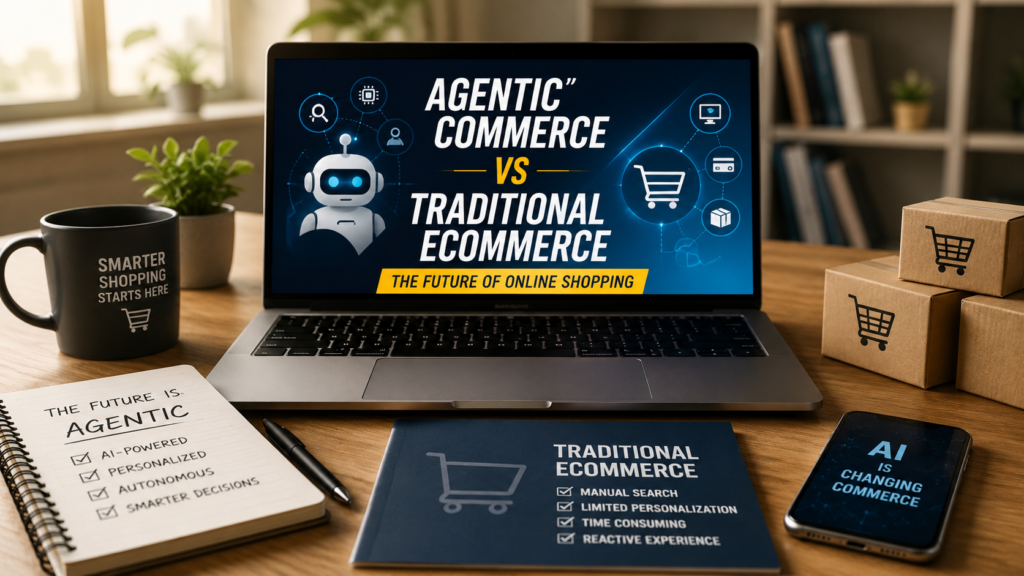
Agentic commerce is when an AI agent searches, compares and buys products on a person’s behalf, often without them opening a browser. Traditional ecommerce still needs a human to browse, decide and check out manually. The core difference is who or what makes the buying decision.
5. Featured Snippet Table
| Factor | Traditional Ecommerce | Agentic Commerce |
|---|---|---|
| Who shops | The customer, manually | An AI agent, on the customer’s behalf |
| Product discovery | Search bars, filters, scrolling | Natural-language requests to an agent |
| Checkout | Manual form-filling, saved cards | Agent completes payment automatically |
| Decision-making | Human compares prices/reviews | Agent compares using set rules or preferences |
| Speed | Minutes to hours | Seconds |
| Best suited for | Considered, emotional purchases | Repeat, rule-based, low-friction purchases |
Highlights
- Agentic commerce lets AI agents browse, compare and buy without a human clicking through every step.
- Traditional ecommerce still depends on a person navigating a website or app.
- Big names Visa, Mastercard, Shopify, OpenAI are already building the payment rails for this shift.
- Small businesses that ignore agentic commerce risk becoming invisible to AI shopping agents.
- Not every purchase suits an agent; considered, high-emotion buys will likely stay human-led for a while yet.
A few months ago, asking an AI assistant to “just buy it for me” sounded like a joke. It isn’t anymore. Visa and Mastercard have both rolled out agent-ready payment tools this year, OpenAI has been testing checkout flows inside ChatGPT, and Shopify merchants are already fielding orders placed entirely by software. That shift has a name agentic commerce and it’s forcing a genuine rethink of how online shopping works.
This piece breaks down agentic commerce vs traditional ecommerce in plain terms: what’s actually different, where the two overlap, and what it means if you run a small business or simply want to understand where your next online purchase might come from.
What Is Agentic Commerce, Exactly?
Agentic commerce is shopping carried out by an AI agent rather than a person clicking through a website. You tell the agent what you want “reorder my usual coffee beans” or “find me a decent pair of running shoes under £80” and it searches, compares, and completes the purchase using stored payment details and preferences you’ve already approved.
It’s not the same as a chatbot that recommends products and then hands you a link. A true agentic commerce transaction closes the loop: the agent finds the item, checks price and stock, and pays for it, often without you seeing a single product page.
Quick fact: IBM’s research team notes that agentic commerce depends heavily on standardised protocols so agents from different companies can talk to different retailers’ systems reliably without that, the whole idea falls apart.
Traditional Ecommerce, for Comparison
Traditional ecommerce hasn’t gone anywhere, and it won’t for a long while. It’s the process most of us know: open a site or app, search or browse, read a few reviews, add to basket, fill in your card details, and hit “pay.” A human makes every decision along the way, even if recommendation algorithms are quietly nudging things behind the scenes.
The key distinction isn’t the technology powering the store plenty of traditional ecommerce sites already use AI for recommendations and fraud checks. It’s who’s actually driving the purchase decision.
Agentic Commerce vs Traditional Ecommerce: The Real Differences
Here’s where the two genuinely diverge, beyond the marketing language.
1. Who does the browsing
In traditional ecommerce, you scroll. In agentic commerce, the agent queries multiple sources at once, often comparing prices across retailers in a way no human realistically has time for.
2. Speed of decision-making
A person weighing up a purchase might spend twenty minutes comparing options. An agent can do it in seconds, provided the rules you’ve set are clear budget, brand preference, delivery window.
3. Trust and payment
This is the sticking point most people raise first, and fairly so. Traditional ecommerce puts you in direct control of every payment. Agentic commerce requires you to trust an intermediary with stored payment credentials and defined spending limits, which is precisely why Visa and Mastercard have spent 2026 building tokenised, agent-specific payment standards rather than letting agents use raw card numbers.
4. Product discovery
Traditional stores rely on SEO, search bars and category pages to get found. Agentic commerce depends on structured product data the agent can actually read and reason over think detailed spec sheets, clear pricing, and machine-readable descriptions rather than flashy banner images.
5. Who the retailer is really selling to
This one matters more than it sounds. In agentic commerce, the retailer’s real “customer” in that moment is the AI agent, not the end user. That changes what good product pages need to look like. If you run a business and want to understand how to prepare your site’s discoverability for this shift, our guide on hiring an AI SEO content writer covers how to structure content so both humans and AI systems can find and understand it.
Where Agentic Commerce Genuinely Helps
Not every purchase benefits from an agent doing the work, but plenty do.
- Repeat purchases household staples, pet food, printer ink where the decision was already made last time.
- Rule-based comparison shopping flights, insurance renewals, energy tariffs where “cheapest that meets these criteria” is genuinely the whole brief.
- Time-poor professionals who’d rather set a budget and let the agent handle admin-style buying.
- Small business restocking ordering the same packaging or supplies each month without a person manually reordering.
If you’re already using AI tools to manage other parts of a small operation, it’s worth reading how AI trading tools handle similar automated decision-making for financial markets the underlying logic of “set rules, let the system act” is remarkably similar.
Where Traditional Ecommerce Still Wins
Agentic commerce isn’t about to replace considered buying. A few categories will likely stay human-led for years:
- High-emotion purchases a wedding dress, a gift for someone specific, a first car.
- Anything requiring physical judgement furniture size, fabric feel, colour accuracy on screen.
- Purchases where trust in the brand itself matters more than price luxury goods, ethically sourced products, local artisans.
People still want to browse sometimes. Scrolling through options isn’t always friction; occasionally it’s the point.
The Privacy Question Nobody’s Skipping
Handing an AI agent access to your payment details and shopping history raises an obvious concern: who else sees that data, and how is it stored? This is a fair worry, and it’s not going away just because the tech is convenient.
If privacy is a priority for you or your business, it’s worth reading our breakdown of privacy-focused AI browsers and tools for small businesses, which covers how to limit data exposure while still using AI-powered tools day to day.
Expert tip: Before connecting any AI agent to a payment method, check whether it uses tokenised transactions (a temporary, limited-use payment code) rather than your actual card number. This single setting makes a real difference to your exposure if the agent’s platform is ever compromised.
How Businesses Should Prepare
If you sell anything online, agentic commerce isn’t a future problem it’s already changing how discoverability works. A few practical steps:
- Structure your product data clearly. Specs, pricing, availability all machine-readable, not buried in images.
- Keep pricing consistent across channels. Agents compare ruthlessly; mismatched pricing looks like an error and gets skipped.
- Don’t ignore schema markup. It’s how agents and search engines alike understand what you’re actually selling.
- Watch your checkout speed. A slow, form-heavy checkout is a dealbreaker for an agent optimising for efficiency.
- Keep a human option visible. Not every customer or agent wants the fully automated path.
A Quick Timeline: How We Got Here
| Period | Development |
|---|---|
| 2023–2024 | AI chatbots start recommending products with outbound links |
| Late 2024 | Early “buy for me” experiments appear in AI assistants |
| 2025 | Visa and Mastercard announce agent-ready payment tokens |
| Early 2026 | Shopify and Adobe Commerce roll out agentic checkout integrations |
| Mid-2026 | First large-scale agent-completed transactions reported across retail |
| Late 2026 | Industry groups push for standardised agentic commerce protocols |
Where This Is Heading
Agentic commerce vs traditional ecommerce isn’t really a fight either side needs to win. They’ll likely sit side by side for a good while agents handling the repetitive, rule-based buying, and people still doing the browsing for anything that genuinely benefits from human judgement. The businesses that adapt early, by making their products easy for both humans and AI agents to find and understand, are the ones likely to benefit most as this shift picks up pace.
8. FAQ Section
What is agentic commerce in simple words?
It’s when an AI agent shops and pays on your behalf, based on preferences and rules you’ve already set, rather than you clicking through a website yourself.
How is agentic commerce different from traditional ecommerce?
Traditional ecommerce needs a human to browse and buy manually. Agentic commerce shifts that decision-making to an AI agent, which can search, compare and complete a purchase automatically.
Is agentic commerce safe to use?
It can be, provided the agent uses tokenised payment methods rather than sharing raw card details, and you’ve set clear spending limits and preferences in advance.
Which companies are already using agentic commerce?
Visa, Mastercard, Shopify, Adobe Commerce and OpenAI have all launched agent-ready payment or checkout tools during 2026, with more retailers integrating support as standards mature.
Will agentic commerce replace online shopping websites?
Unlikely in the near term. Considered purchases and anything requiring physical judgement will likely stay human-led, while repetitive or rule-based buying moves toward agents.
Do small businesses need special tools to support agentic commerce?
Not necessarily special tools, but clear, structured product data and consistent pricing make a real difference to whether AI agents can find and recommend your products at all.