

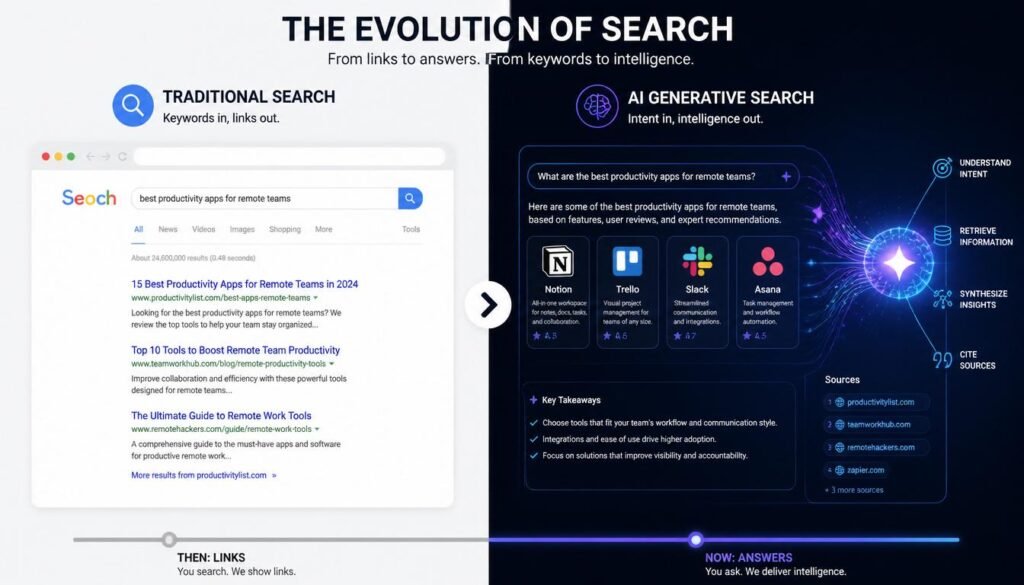
Traditional search engines are no longer the exclusive gateways to online discovery. According to recent data, Gartner predicts traditional search engine volume will drop by 25% due to the rapid rise of AI chatbots. Furthermore, over 35% of consumers have already used an AI tool to locate a local business or service.
For small business owners operating on tight margins, this shift creates a dual challenge: you must maintain high visibility on traditional Google search engine results pages (SERPs) while simultaneously ensuring your brand is recommended, sourced, and cited across Large Language Models (LLMs) like ChatGPT, Perplexity, and Gemini.
This comprehensive guide breaks down the absolute best paid and free AI SEO tools for small businesses available, analyzing their commercial viability, structural benefits, and capability to drive real revenue.
What Is the Best AI SEO Tool for Small Businesses?
The best overall AI SEO solution for small businesses is an autonomous AI SEO Agent like Aira’s SEO Agent, which automates the full technical, keyword, and content cycle for $299/month. For hands-on teams on a budget, SurferSEO ($99/month) delivers unmatched content optimization, while Frase ($49/month) offers the most affordable entry point for AI-assisted workflows.
Featured Snippet Data: 2026 AI SEO Platform Comparison
| Platform Name | Entry Price | Primary Focus | Automation Level | Ideal For |
|---|---|---|---|---|
| Aira SEO Agent | $299 / month | Full-Cycle Autonomous SEO & GEO | Fully Automated | Lean teams with zero execution time |
| SurferSEO | $99 / month | Content Optimization & Scoring | Manual Assistant | In-house writers and content creators |
| Frase | $49 / month | Budget Content Briefs & Writing | Manual Assistant | Solo entrepreneurs and tight budgets |
| Otterly | ~$29 / month | AI Visibility & GEO Auditing | Tracking Only | Monitoring brand citations in LLMs |
| AlsoAsked | $15 / month | PAA & Question Research | Manual Assistant | Answer-driven content planning |
| SEMrush | $199 / month | Enterprise All-in-One SEO Suite | Manual Expert | In-depth keyword & competitor analysis |
| Ahrefs | $129 / month | Backlink & Traditional SERP Data | Manual Expert | Link-building and anchor audits |
| Mangools / Genrank | Free | Baseline Visibility Grading | Free Grader | Discovering your initial AI footprint |
The Strategic Shift: Why Traditional SEO Tactics Fail in 2026
The historical playbook of exact-match keyword stuffing, low-quality backlink volume, and thin content production is completely obsolete. In 2026, building long-term search visibility requires an authoritative strategy optimized for both humans and digital parsers.
Fun Fact: Did you know that only 11% of web domains are cited by both ChatGPT and Perplexity simultaneously? Each AI engine operates on a distinct retrieval model, meaning an optimization strategy tailored exclusively to one platform will leave you completely invisible on the others.
Consequently, forward-thinking operators are transitioning toward GEO (Generative Engine Optimization) and AEO (Answer Engine Optimization). This practice ensures your unstructured data is formatted cleanly so AI models can easily crawl, recognize, and quote your business as a primary source.
If you are expanding your commercial digital strategy, reviewing the localized structural insights found at GlobeHustle can offer exceptional complementary guidance for modern web deployment.
In-Depth Review: The Top 8 AI SEO Tools & Agents
1. Aira SEO Agent — Best for Complete Automation
Aira shifts your operational workflow from manual task execution to high-level strategic review. Operating as a completely autonomous AI SEO agent, it continuously monitors your performance data to execute technical fixes, discover keyword gaps, and publish optimized articles from scratch.
- Key Advantage: It actively tracks your brand’s multi-platform AI visibility across ChatGPT, Perplexity, Gemini, and Copilot.
- Pricing Structure: Growth plan starts at $299/month; Scale plan sits at $599/month.
- Limitation: It is not built for complex corporate multi-domain setups or heavily regulated legal spaces requiring multi-layered human approval steps.
2. SurferSEO — Best for Content Optimization
SurferSEO acts as an advanced data-driven writing editor. By reviewing the currently top-ranking web pages for your targeted search phrase, it outputs an interactive, real-time optimization score out of 100, advising you exactly which semantic entities, headings, and terms to include.
- Key Advantage: Unmatched layout suggestions that perfectly mirror what Google’s modern helpful content system demands.
- Pricing Structure: Essential plan starts at $99/month (billed monthly; $79/month on annual billing); Scale tiers climb to around $219/month.
- Limitation: Focuses purely on on-page text. It does not handle off-page link acquisition, backlink audits, or backend indexing fixes.
3. Frase — Best Low-Cost Entry Point
Frase provides small teams with an affordable method to generate deep SERP analysis, competitive outlines, and basic AI copywriting assistance at a fraction of standard industry pricing.
- Key Advantage: Highly competitive introductory tier for lean budgets.
- Pricing Structure: Starter plan costs $49/month (billed monthly; $39/month on annual billing); Pro and Scale tiers run $129 and $299/month.
- Limitation: The entry tier caps monthly output, so teams publishing at volume will need to move up a plan.
4. Otterly — Best for Generative Engine Auditing
Otterly provides specialized utility designed explicitly for the GEO landscape. Instead of calculating standard keyword rank positions on a traditional index, it audits how frequently generative engines mention or cite your business.
- Key Advantage: Highly affordable window into tracking your true AI market share.
- Pricing Structure: Lite plan starts at $29/month (tracking up to 15 prompts); Standard runs $189/month.
- Limitation: It is strictly an auditing and tracking tool; it will not rewrite your code or produce optimized landing pages for you.
5. AlsoAsked — Best for Answer-Engine Research
AlsoAsked pulls live People Also Ask data straight from Google’s search results, then maps the questions visually so you can see exactly what buyers ask before they buy. For a small business planning content, it’s one of the cheapest ways to build an FAQ and topic cluster strategy that mirrors real search behavior.
- Key Advantage: Visual maps of real buyer questions pulled live from Google, perfect for planning FAQs and topic clusters.
- Pricing Structure: Basic plan starts at $15/month (100 searches/month); higher tiers scale with search volume.
- Limitation: It’s a pure research tool — it finds the questions, but you’ll need an optimizer like Surfer or Frase to act on them.
6. SEMrush — Best Complete Analytical Suite
For teams wanting deep competitive intelligence, historical backlink audits, and rigorous keyword analytics, SEMrush remains the industrial gold standard platform.
- Key Advantage: Massive keyword databases of billions of global queries, plus an AI Visibility add-on (about $99/month) that tracks brand mentions across AI Overviews, ChatGPT, and Perplexity.
- Pricing Structure: Semrush One plans start at $199/month (Starter); Pro+ runs $299/month and Advanced $549/month.
- Limitation: Features a steep learning curve that requires considerable manual time investment to master properly.
7. Ahrefs — Best for Link Profile Architecture
Ahrefs boasts one of the most powerful crawler networks online, making it the preferred solution for studying competitor backlink patterns and isolating high-value digital PR opportunities.
- Key Advantage: Unparalleled accuracy regarding live referring domain metrics and backlink anchor analysis.
- Pricing Structure: Starter plan at $29/month; Lite tier at $129/month; Standard package at $249/month.
- Limitation: Does not offer robust built-in generative AI content creation tools; it functions strictly as an engineering research asset.
8. Mangools & Genrank — Best Cost-Free Graders
These free visibility tools provide small business operators with an instant diagnostic baseline showing exactly where their digital brand footprint stands across modern search layers without requiring any upfront capital.
- Key Advantage: Absolute zero financial cost to run initial checks.
- Pricing Structure: 100% Free introductory grader tiers.
- Limitation: Offers basic snapshots without deep historical tracking data or advanced prompt automation metrics.
Actionable GEO Playbook: How to Get Your Site Cited by AI
To successfully gain citations within AI Overviews, ChatGPT, and Perplexity, you must alter your core structure to match the retrieval mechanisms of LLMs. Use this tactical checklist to optimize your web pages:
Front-Load the Answers: Place a clean, direct definition or answer block consisting of 40–60 words within the first 30% of your page. Research shows that 44.2% of all LLM citations are extracted from the introduction of a post.
Deploy FAQ Schema Explicitly: Pages integrating structured FAQPage markup are up to 4 times more likely to get pulled directly into Google AI Overviews.
Maintain Multi-Platform Entity Consistency: Ensure your business name, address, phone number (NAP), and core service descriptions are identical across your main domain, Google Business Profile, Yelp, and social profiles. Consistent matching metadata across 10+ platforms increases your AI citation rate by 67%.
Incorporate High-Authority Educational References: Back up internal insights by citing reputable public repositories, such as the U.S. Small Business Administration (.gov) or localized academic data sheets. Linking out to recognized databases builds unmatched contextual trust.
Operational Execution Timeline
[Month 1: Audit & Grader Baseline]
               │
               ▼
[Month 2: Structural FAQ & Schema Insertion]
               │
               ▼
[Month 3: Content Expansion via Topic Clusters]
               │
               ▼
[Month 4+ Ongoing: Weekly Brand Optimization & SOV Tracking]| Operational Stage | Primary Technical Focus | Target Frequency | Metric of Success |
|---|---|---|---|
| Stage 1: Diagnostic Audit | Establish foundational visibility benchmarks using free tools and Search Console. | Initial Setup / Month 1 | Clear visibility baseline |
| Stage 2: Schema Insertion | Deploy structured entity schema and precise local category identifiers. | Month 2 Updates | Zero technical index errors |
| Stage 3: Content Building | Generate conversational long-tail articles answering explicit buyer prompts. | Weekly Execution | Rise in organic impressions |
| Stage 4: Visibility Tracking | Track holistic Share of Voice across AI Overviews, ChatGPT, and Perplexity. | Monthly Audits | Increased AI source citations |
Key Takeaways for Small Business Owners
Ultimately, the overall digital paradigm has shifted. In fact, ranking on page one of Google represents only half the equation in 2026. As a result, you must structurally design your web pages so that conversational response engines can naturally extract your data.
Agents vs. Tools: If you have 15 hours a week to spare, buy a manual tool like SurferSEO. If you have zero spare time, leverage an autonomous agent like Aira to run the system for you.
Consistency Breeds Citations: AI models build confidence from repeated signals. Keep your business entities identical across every directory index online.
Frequently Asked Questions
There’s no single winner — it depends on your budget and bandwidth. If you want everything handled for you, an autonomous agent like Aira’s SEO Agent is the closest thing to a hands-off solution. For hands-on teams, SurferSEO remains the strongest content optimizer, while Frase is the most affordable way to get started at $49 a month.
Absolutely — but the playbook has changed. Page-one rankings alone aren’t enough anymore; you also need AI Overviews, ChatGPT, and Perplexity to mention and cite your business. Tools like Otterly let you track that visibility directly. Small businesses that adapt to GEO (generative engine optimization) now are building a real moat over competitors stuck on 2020 tactics.
Plan on $15 to $130 a month for a serious setup. A solo founder can get by with AlsoAsked ($15/month) for question research plus Frase ($49/month) for content optimization. If you need backlink data, Ahrefs starts at $29/month and Semrush One at $199/month. Free graders like Mangools’ tools work for a first audit, but you’ll outgrow them fast.
ChatGPT is a decent assistant, not an SEO platform. It can brainstorm keywords, draft meta descriptions, and outline blog posts, but it can’t track rankings, audit your site’s technical health, or monitor whether AI engines cite your brand. Use it alongside tools like SurferSEO or Otterly — it speeds up writing, but it can’t replace a real SEO workflow.
Traditional SEO tries to rank your pages on Google’s results page; GEO (generative engine optimization) tries to get AI engines like ChatGPT, Perplexity, and Gemini to mention and cite your business in their answers. GEO focuses on clean structure, consistent business details everywhere, and FAQ-style content that language models can easily quote.
For most small businesses, yes — at least for the routine work. Autonomous agents like Aira can handle technical audits, keyword research, and content production for a few hundred dollars a month, far less than a typical agency retainer. Agencies still earn their keep for complex link building, digital PR, and regulated industries where human judgment matters.
About the Author
Alex Vance is a Senior SEO Strategist and GEO Integration Specialist with over 12 years of hands-on experience developing semantic search architecture. Having successfully navigated major algorithm transitions from early semantic updates to modern generative search deployment, Alex helps lean brands maximize their digital real estate using scalable cloud technology and answer-first frameworks.