
Quick Summary
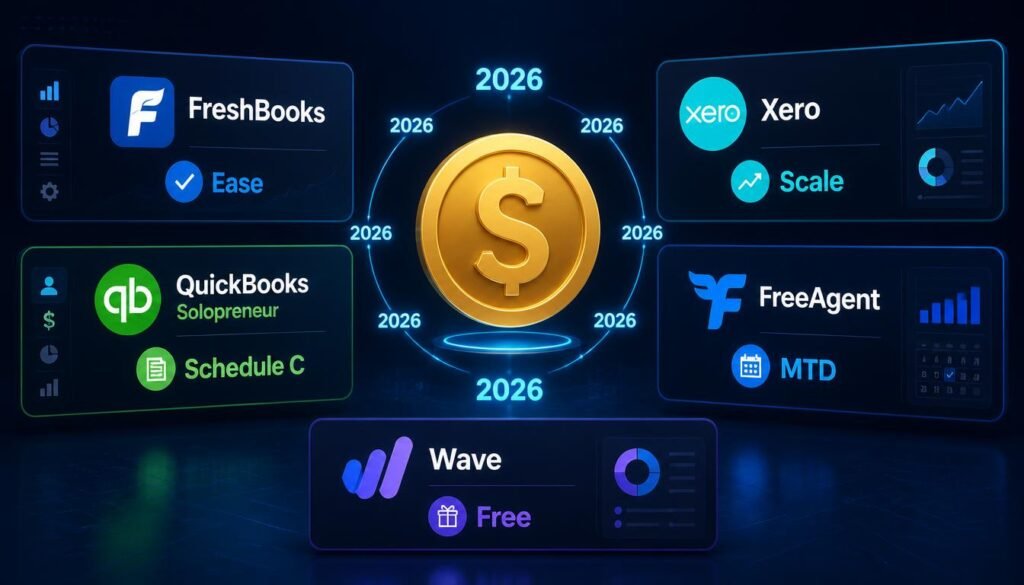
For US and UK freelancers, the best cloud accounting and invoicing software depends on where you’re taxed. FreeAgent and Xero lead for UK Making Tax Digital compliance, while QuickBooks Solopreneur suits US Schedule C filers. FreshBooks works well on both sides of the Atlantic, and Wave remains the strongest free option for simple invoicing.
5. Featured Snippet Table
| Software | Best For | Starting Price | Free Plan | MTD/Tax Support |
|---|---|---|---|---|
| FreshBooks | Overall ease of use | ~$19/month | 30-day trial only | US-friendly, limited UK tax filing |
| Xero | Scaling freelance businesses | £15/$25/month | Trial only | UK MTD + unlimited users |
| QuickBooks Solopreneur | US freelancers & tax prep | ~$20/month | Trial only | Schedule C + IRS-ready |
| FreeAgent | UK freelancers | £14.50/month | No free plan | Native HMRC MTD filing |
| Wave | Free invoicing & accounting | Free (Starter) | Yes | No MTD, limited UK support |
| Zoho Invoice | Free multi-currency invoicing | Free (1 user) | Yes | Basic, no MTD filing |
Highlights
- There’s no single “best” tool for both countries — UK freelancers need Making Tax Digital compliance, US freelancers need Schedule C support, and few platforms do both well.
- FreeAgent and Xero currently offer the strongest native HMRC integration for UK sole traders.
- QuickBooks Solopreneur is purpose-built for US-based freelancers filing quarterly estimated taxes.
- Wave and Zoho Invoice remain the best genuinely free options, though Wave’s UK compliance is thin.
- Pricing across this category shifted more than usual in 2025–2026, so it’s worth checking each provider’s live pricing page before committing.
- Multi-currency support matters more than most freelancers expect, especially once you land your first international client.
If you’ve ever spent a Sunday evening trying to remember which client you actually invoiced last month, you already know why this matters. Freelancing gives you freedom, but it also hands you the accounting workload a company would normally split across a whole finance team. And if you’re working across both the US and UK or just trying to figure out which system fits your specific tax situation the choice gets more complicated than it should be.
Cloud accounting software is a system that lets freelancers track income, manage invoices, and stay compliant with tax authorities like HMRC or the IRS, all from a browser or phone rather than a desktop programme. The “cloud” part matters more than it sounds: your data updates in real time, syncs across devices, and doesn’t disappear if your laptop dies the week before tax season.
This guide compares the tools that actually matter for freelancers working under UK or US tax rules in 2026, based on their compliance features, pricing, and how well they hold up once you’re juggling more than a couple of clients.
Why US and UK Freelancers Need Different Tools
Here’s the thing most general “best invoicing software” roundups miss: tax compliance isn’t universal. A UK freelancer registered for VAT above the £90,000 threshold has to keep digital records under Making Tax Digital and, ideally, file directly to HMRC. A US freelancer, on the other hand, is usually more concerned with tracking Schedule C expenses and staying ahead of quarterly estimated tax payments to the IRS.
Quick fact: Making Tax Digital for VAT became mandatory for all VAT-registered UK businesses regardless of turnover from April 2022, and HMRC has continued expanding MTD requirements to Income Tax Self Assessment on a phased rollout.
That single difference VAT digital record-keeping versus Schedule C tracking explains why so many “best of” lists feel slightly off for one audience or the other. A tool that’s brilliant for UK VAT compliance might offer nothing useful for a US freelancer filing a 1099, and vice versa.
Comparison Table: Top Tools for US and UK Freelancers
| Tool | Best For | Starting Price | MTD/HMRC Support | US Tax Support | Multi-Currency |
|---|---|---|---|---|---|
| FreshBooks | Ease of use, service-based freelancers | ~$19–23/month | Limited | Good | Yes |
| Xero | Growing freelance businesses | £15–£30/month | Full MTD | Good | Yes |
| QuickBooks Solopreneur | US sole proprietors | ~$20/month | None | Excellent (Schedule C) | Limited |
| FreeAgent | UK-only freelancers | £14.50/month | Full MTD + Self Assessment | None | Limited on lower tiers |
| Wave | Free invoicing | Free / ~$16/month | None | Basic | Yes |
| Zoho Invoice | Free multi-currency | Free (1 user) | None | Basic | Yes |
| Invoice Ninja | Open-source, self-hosted | Free (5 clients) / ~$14/month | None | Basic | Yes |
FreshBooks — The Safe Middle Ground for Both Markets
FreshBooks has been around long enough that most freelancers have at least heard of it, and there’s a reason it keeps showing up in comparisons. It’s built around invoicing first, with time tracking, expense capture, and recurring billing layered on top.
What it doesn’t do particularly well is deep tax compliance for either country. You won’t get native MTD filing, and Schedule C support is more basic than QuickBooks. What you do get is a genuinely pleasant interface that doesn’t require an accounting background to use, which counts for a lot when you’re doing your books at 11pm after a client call.
Pricing sits around $19 a month for up to five billable clients, climbing to roughly $38 for fifty. Team members cost extra, so it can get pricey if you ever bring on a bookkeeper or assistant.
Xero — Built to Scale With You
Xero is the tool freelancers tend to graduate into once they’ve outgrown simpler invoicing apps. It handles UK VAT and MTD filing properly, supports multi-currency invoicing out of the box, and unlike several competitors doesn’t charge per seat. That last point matters more than people realise; if you ever want an accountant or a virtual assistant to have access, Xero doesn’t punish you for it.
The trade-off is complexity. Xero was designed for small businesses generally, not freelancers specifically, so you’ll encounter features you’ll never touch. Starter plans also cap you at a limited number of invoices per month, which catches some new users off guard.
Expert tip: If you’re a UK freelancer nearing the VAT threshold, switch to MTD-compliant software before you cross it, not after. HMRC doesn’t offer much grace period once registration becomes mandatory.
QuickBooks Solopreneur — Purpose-Built for US Freelancers
If you’re filing a Schedule C with the IRS, QuickBooks Solopreneur is worth a serious look. Intuit discontinued the older QuickBooks Self-Employed product for new sign-ups back in 2024, and Solopreneur is what replaced it narrower in scope, but sharper for exactly this use case.
It automatically separates business and personal expenses, estimates quarterly tax payments, and tracks mileage, which is genuinely useful if you drive to client meetings or shoots. TurboTax integration makes January a little less painful. What it doesn’t offer is anything resembling UK compliance, so this one’s a non-starter if you have UK tax obligations.
FreeAgent — The UK Compliance Specialist
FreeAgent doesn’t try to be everything to everyone, and that focus shows. It’s built specifically around UK sole traders and limited companies, with native HMRC integration for both MTD VAT filing and Self Assessment.
For a UK-only freelancer, this is arguably the most complete package on this list full accounting, not just invoicing, with bank feeds and proper VAT handling baked in from the start. The catch is cost: there’s no free plan, and it’s noticeably more expensive than pure invoicing tools if all you actually need is to send a few invoices a month.
Wave and Zoho Invoice — The Free-Tier Options
Not every freelancer needs a full accounting suite, and that’s where Wave and Zoho Invoice earn their place on this list.
Wave’s Starter plan remains free and covers core invoicing plus basic bookkeeping, though bank reconciliation and reporting now sit behind a paid Pro tier (roughly $16/month) a change from a few years ago when more of this was free. It also has no MTD compliance and limited CIS support, so UK freelancers who are VAT-registered will hit a wall quickly.
Zoho Invoice is free for a single user and handles multi-currency invoicing surprisingly well, which makes it a solid pick for freelancers taking on international clients without wanting to pay for the privilege. Free-tier limits vary by region, so it’s worth checking the current caps for your country before relying on it long-term. Beyond basic invoicing, if you want to streamline your entire daily workflow, check out our guide on the best AI tools to automate small business admin tasks easily.
A Quick Word on Open-Source and Niche Tools
If data ownership matters to you say, you’re not comfortable with client financial data sitting on someone else’s servers Invoice Ninja is worth a look. It’s genuinely open-source, self-hostable for free, and the hosted version starts around $14/month for unlimited clients. It’s not for everyone; you’ll want some technical comfort to get the most from it.
Developers and tech-focused freelancers sometimes prefer Stripe Invoicing instead, which charges a small percentage per paid invoice (0.4–0.5%) rather than a flat subscription. It integrates cleanly if you’re already using Stripe for payments, but stack that fee on top of standard card processing costs and it adds up faster than the headline rate suggests. Setting up automated payment links and recurring bills is just one part of streamlining your operations; read our full small business automation guide to save hours on repetitive manual work.
Timeline: How Freelance Invoicing Requirements Have Shifted (2022–2026)
| Year | Development |
|---|---|
| 2022 | UK Making Tax Digital for VAT becomes mandatory for all VAT-registered businesses, regardless of turnover |
| 2023 | Several invoicing platforms begin narrowing free-tier features (e.g., Wave moves reconciliation behind a paid plan) |
| 2024 | Intuit discontinues QuickBooks Self-Employed for new sign-ups |
| 2025 | HoneyBook and other premium platforms restructure pricing upward |
| 2026 | Bonsai shifts to per-user pricing; Invoice Ninja raises paid-tier rates; QuickBooks Solopreneur becomes the standard US entry point |
Fun fact: The UK’s Making Tax Digital initiative was originally announced back in 2015, but full VAT compliance didn’t become mandatory for every VAT-registered business until 2022 a seven-year rollout that shows how slowly tax digitisation actually moves, even when the policy intent is there from day one.
Do Freelancers Need to Worry About Donations or Charitable Deductions?
It comes up more than you’d think, particularly around tax season. US freelancers who make charitable donations can generally deduct them on Schedule A if they itemise, though this is separate from Schedule C business expenses check current IRS guidance since itemisation rules have shifted in recent years. UK freelancers donating through Gift Aid should keep records, as this affects both personal tax relief and, in some cases, business sponsorship arrangements. Neither FreshBooks nor Xero automatically categorises charitable donations as tax-deductible by default, so it’s worth flagging these manually or asking your accountant how your specific software handles them.
So, Which One Should You Actually Pick?
UK-only and VAT-registered freelancers will find FreeAgent or Xero to be the most realistic choices full stop. For US-based sole proprietors wanting their Schedule C handled properly, QuickBooks Solopreneur is purpose-built for the job. Meanwhile, if you’re straddling both markets or simply need solid multi-currency invoicing without a steep learning curve, FreshBooks or Zoho Invoice will get you much further than forcing a single-country tool to do double duty.
None of these tools are wrong, exactly. They’re just built for different problems, and the mistake most freelancers make is picking based on brand recognition rather than what their actual tax obligations require. Once you have your cloud accounting set up on autopilot, you can focus on scaling your income by learning high-paying AI skills for free in 2026 to offer high-value services to your clients.
8. FAQ Section
What is the best cloud accounting software for freelancers working in both the US and UK?
No single tool fully covers both. FreshBooks and Zoho Invoice offer the broadest general appeal across both markets, but you’ll likely need country-specific software (FreeAgent for UK, QuickBooks Solopreneur for US) if you’re VAT-registered or filing detailed Schedule C returns.
Do UK freelancers legally need MTD-compliant software?
Only if VAT-registered. Since 2022, Making Tax Digital for VAT applies to all VAT-registered UK businesses regardless of turnover, requiring digital record-keeping and compatible software for HMRC submissions.
Is Wave good enough for UK freelancers?
Wave works fine for basic invoicing, but it doesn’t support Making Tax Digital or CIS reverse charge invoicing, so VAT-registered UK freelancers will outgrow it fairly quickly.
What’s the cheapest cloud accounting option for freelancers?
Wave’s Starter plan and Zoho Invoice are both genuinely free for a single user, making them the lowest-cost entry points, though neither includes UK MTD filing.
How do I choose between invoicing software and full cloud accounting software?
Invoicing software (like basic Zoho Invoice or PayPal Invoicing) focuses on billing. Full cloud accounting software (Xero, FreeAgent, QuickBooks) adds bank reconciliation, tax filing, and financial reporting worth the extra cost once your business gets more complex than a handful of invoices a month.
Can I switch cloud accounting software mid-tax-year?
Yes, most platforms let you export data (usually CSV or QBO format) for migration, though timing it around a tax year boundary makes reconciliation considerably easier.