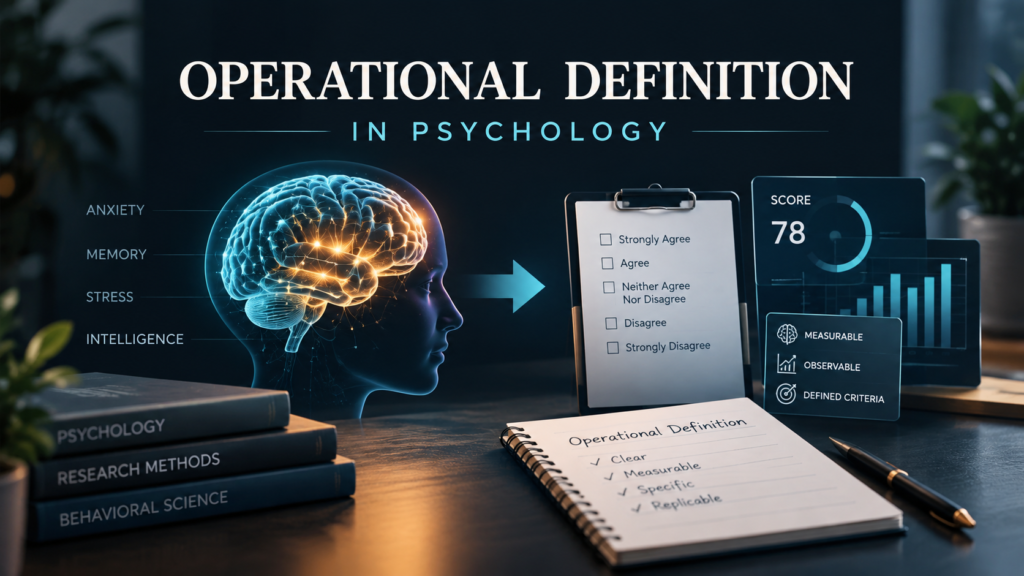
Quick Summary
What is an operational definition in psychology? It’s a precise statement of how a researcher will observe, measure, or manipulate a variable in a study. Anxiety, for instance, stops being “a feeling of worry” and becomes “a score of 10 or higher on the GAD-7 questionnaire.”
Highlight
- An operational definition answers one blunt question: how will you actually measure this?
- It turns abstract ideas (anxiety, memory, intelligence) into numbers, counts, or scores.
- A conceptual definition says what a thing is. An operational one says how you’ll catch it.
- Good definitions are specific, objective, and repeatable by someone else.
- Vague wording is the mistake that sinks most student projects.
- The same concept can be measured differently from one study to the next, and that’s fine.
Featured Snippet Table
| Psychological concept | Possible operational definition |
|---|---|
| Anxiety | Score on a validated questionnaire (e.g., GAD-7) |
| Memory | Number of words correctly recalled from a list |
| Stress | Score on a perceived stress scale (e.g., PSS-10) |
| Sleep | Hours slept per night, logged in a diary or app |
| Aggression | Number of predefined aggressive behaviors in a set time |
| Depression | Score on a depression inventory (e.g., PHQ-9) |
| Intelligence | IQ score on a standardized test (e.g., WAIS) |
An operational definition in psychology is a clear statement of how a researcher will identify or measure a variable in a study. It’s the step that takes a fuzzy idea and makes it countable. (APA Dictionary)
Picture this. A friend says, “I’m going to study anxiety.” Great. But what will she actually measure? Heart rate? A questionnaire? How often people skip parties? Until she picks one, she doesn’t have a study. She has a topic.
What Is an Operational Definition in Psychology?
Psychologists deal in constructs. Anxiety, memory, motivation, intelligence: big ideas you can’t see, touch, or put on a scale. So before collecting a single data point, researchers have to answer a few awkward questions. What counts as anxiety here? How do we measure memory? Which behavior counts as aggression?
The operational definition is that answer, written down.
Take anxiety. Conceptually, it’s a feeling of worry and fear. Operationally, it’s a score of 10 or higher on the GAD-7. Same idea, but now someone can check it.
Fun fact: The whole approach traces back to physicist Percy Bridgman, who argued in 1927 that a concept is nothing more than the operations you use to measure it. He won the Nobel Prize in Physics in 1946. Psychology borrowed his thinking to make its slippery concepts testable.
Conceptual vs Operational Definition
Students mix these up all the time. Honestly, it’s an easy trap.
A conceptual definition tells you what something means in theory. An operational definition tells you how one particular study will measure it. One is the dictionary entry. The other is the lab procedure.
| Aspect | Conceptual definition | Operational definition |
|---|---|---|
| Focus | What the concept means | How it gets measured |
| Level | Theoretical | Practical |
| Anxiety | “A state of worry and fear” | “Score of 10 or higher on the GAD-7” |
| Intelligence | “Ability to learn and solve problems” | “IQ score on the WAIS-IV” |
| Used for | Building hypotheses and theory | Collecting data and running statistics |
| Changes between studies? | Rarely | Often, depending on design and tools |
Once this clicks, research methods gets a lot less painful.
Examples of Operational Definitions in Psychology
Theory only gets you so far, so here are seven common variables and how researchers usually pin them down. (Paperguide)
Anxiety. Researchers often use the GAD-7. Participants answer seven questions, each scored 0 to 3, and the total is added up. A score of 10 or more may point to moderate-to-severe anxiety.
Depression. The PHQ-9 is the usual pick. People rate nine symptoms over the past two weeks, and the total reflects severity.
Memory. Give participants a 20-word list, wait five minutes, then ask them to write down what they remember. The count of correct words is your memory score.
Intelligence. A trained examiner runs standardized subtests, and the results combine into a full-scale IQ score on the WAIS-IV. (Lumen Learning)
Aggression. You can’t just say “aggression” and move on. One lab classic counts how many times a participant blasts a loud noise at another player during a competitive game. Each blast above a set intensity counts as one aggressive act.
Stress. The Perceived Stress Scale (PSS-10) asks ten questions about the past month. Add the scores and you’re done.
Sleep. Average hours slept per night over seven days, logged in a diary or app.
Notice the pattern? Every one names a tool, a scoring rule, and something concrete to count.
Why Operational Definitions Matter
Take them away and psychology can’t run experiments. Simple as that.
Anxiety as a feeling won’t fit in a spreadsheet, but a questionnaire score will. Replication depends on it too: another lab needs to repeat your study exactly, and vague wording makes that impossible. Clear definitions also stop two researchers from quietly meaning different things by “stress,” which keeps measurement consistent across the whole team. And since a hypothesis links variables, the definitions say precisely which variables you’re linking.
Want more depth? CASRAI’s guide to operationalization is worth a look.
How to Write an Operational Definition
Here’s the method, and it works for almost any variable.
- Pick the variable. Anxiety, memory, motivation, whatever you’re studying.
- Say what it means in theory. One line is enough. It keeps your measurement honest.
- Choose how you’ll measure it. Self-report scales, behavioral tasks, or physiological measures like heart rate or cortisol.
- Spell out what gets counted. “Number of correct responses.” “Total score.” “Frequency per 10 minutes.”
- Set the units or cut-offs. For example, “10 or higher on the GAD-7 indicates high anxiety.”
- Run the stranger test. Could someone you’ve never met follow your instructions and measure the same thing? If not, tighten the wording.
That whole process is called operationalization. It sits at the core of psychological research.
Independent and Dependent Variable Example
Operational definitions matter most in experiments. Try this question: does sleep duration affect memory performance?
Your independent variable is sleep duration, defined as average hours slept per night over seven days, recorded in a sleep diary. Your dependent variable is memory performance, defined as the number of words recalled from a 20-word list after a five-minute delay.
Now you’ve got a real study. You can group people by hours slept, compare their recall scores, and hand the exact procedure to another researcher. For related reading, look at guides on [research methods in psychology], [independent and dependent variables], and [forming a hypothesis].
Common Mistakes When Creating Operational Definitions
Even experienced researchers slip here. Watch out for these.
Being vague. “Stress will be measured by how stressed participants feel” says nothing. Name a scale and a scoring rule.
Using subjective words. “Aggression is when someone acts badly.” Badly according to whom? List exact behaviors instead, like shouting or hitting.
Skipping the method. “Anxiety will be measured.” Sure, but how? Try “anxiety equals total score on the GAD-7.”
Leaving room for interpretation. If two researchers could code the same behavior differently, the definition is too loose.
Confusing the concept with the tool. “Intelligence is the WAIS” isn’t right. Intelligence is general cognitive ability, and here it’s measured by WAIS-IV IQ score.
Get these right and your construct validity improves. That’s just a fancy way of asking whether your measure captures what you claim it does.
Operational Definition vs Measurement
They sound similar, but they aren’t the same thing. The operational definition describes what you’re measuring and what counts. Measurement is the actual act of collecting the data.
Think of a recipe and cooking. The definition is the recipe. Measurement is you standing at the stove. You need both.
Infographic Idea
Title: “From Concept to Data: How Operational Definitions Work in Psychology”
Left column: icons for abstract concepts (anxiety, memory, stress, aggression). Middle column: arrows leading to boxes with each operational definition, like “Anxiety → GAD-7 score.” Right column: the output, shown as simple charts, counts, and scores. Bottom strip: “Operational definitions turn psychological ideas into measurable data.” It suits classroom slides and social shares.
Step-by-Step Roadmap
| Step | What to do | Example (anxiety) |
|---|---|---|
| 1 | Identify the variable | Anxiety |
| 2 | Clarify the conceptual meaning | State of excessive worry and fear |
| 3 | Choose a measurement method | Self-report questionnaire (GAD-7) |
| 4 | Define observable criteria | Sum of item scores (0–3 per item) |
| 5 | Set units or thresholds | Total 0–21; 10 or more = moderate-to-severe anxiety |
| 6 | Check replicability | Confirm someone else can repeat the steps |
Save this for your next methods section or exam revision.
Your Turn
The operational definition in psychology is what turns a big idea into real data. Once you can say exactly how something will be scored or counted, you’ve stopped theorizing and started testing.
So try it. Pick something you’re curious about, like procrastination or loneliness, and write its operational definition using the six steps above. Then hand it to a classmate. If they’d measure it differently, congratulations: you’ve just found out why this skill matters.
FAQ
What is an operational definition in psychology?
It states exactly how a variable will be observed, measured, or manipulated in a study. Abstract ideas like anxiety or memory become concrete indicators, such as questionnaire scores or task results.
What is an example of an operational definition?
Defining memory as the number of words someone correctly recalls from a 20-word list after five minutes. It turns “memory” into a countable outcome you can analyze statistically.
Why are operational definitions important in psychology?
They make variables measurable, let other researchers replicate studies, cut ambiguity, and keep measurement consistent. Without them, concepts like intelligence stay too vague to test.
What’s the difference between conceptual and operational definitions?
A conceptual definition explains what a concept means in theory. An operational one explains how a specific study will measure it. Anxiety conceptually is “worry and fear.” Operationally, it might be “score on the GAD-7.”
How do you write an operational definition?
Identify the variable, state its conceptual meaning, pick a measurement method, define what gets counted, set scores or cut-offs, and check that someone else could repeat it.
What is an operational definition of anxiety?
The total score on the GAD-7, where higher scores mean greater anxiety. Researchers often use a cut-off of 10 or more to flag moderate-to-severe anxiety.
What is an operational definition of memory?
The number of words correctly recalled from a standardized list after a fixed delay. It gives a clear number you can compare across participants and studies.
Author Bio
Dr. A. Rahman is a research methods educator and psychology writer. He has taught undergraduate psychology and supervised student research projects for years. He loves turning ideas like operationalization, measurement, and experimental design into plain, practical advice for students and early-career researchers.