Quick Summary
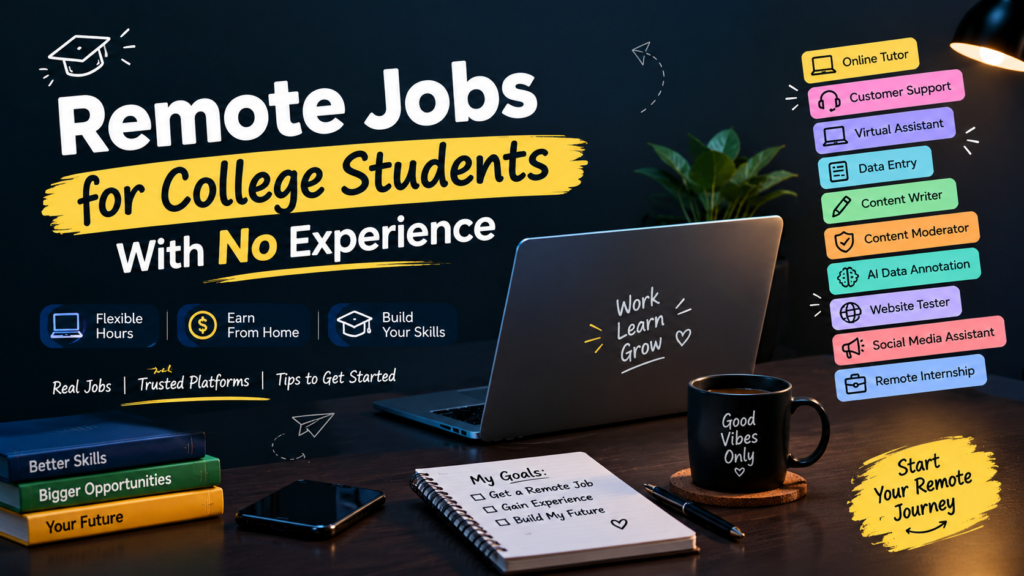
Remote jobs for college students with no experience include online tutoring, virtual assistance, customer support, data entry, content moderation, AI data annotation, website testing, freelance writing, social media assistance, and remote internships. The right option depends on your skills, class schedule, location, equipment, and whether you want flexible income or career-building experience.
Highlight
- You don’t need a long employment history to begin remote work.
- Academic projects, volunteering, student societies, and personal work can strengthen your application.
- Tutoring, freelance writing, website testing, and virtual assistance usually offer the most flexibility.
- Customer support and remote internships often provide more predictable hours.
- Data entry and “easy online work” attract scammers, so verify every employer carefully.
- Never pay upfront to apply, unlock tasks, receive training, or access your wages.
- A simple resume and two or three work samples can make you look far more prepared.
Featured Snippet Table
| Remote job | Best for | Flexibility | What you usually need |
|---|---|---|---|
| Online tutor | Students who know a subject well | High | Subject knowledge |
| Virtual assistant | Organised students | High | Basic admin skills |
| Customer support | Calm, clear communicators | Medium | Written communication |
| Data entry | Detail-focused beginners | High | Typing accuracy |
| Content moderator | Careful decision-makers | Medium | Good judgement |
| AI data annotation | Technology-curious students | High | Attention to detail |
| Freelance writer | Students who enjoy writing | High | Writing samples |
| Website tester | People who give clear feedback | High | Computer and internet |
| Social media assistant | Creative students | High | Platform knowledge |
| Remote internship | Students building a career | Medium | Interest in the field |
What are remote jobs for college students?
Remote jobs for college students with no experience are paid online roles that don’t require a long professional work history. They include entry-level employment, freelance projects, internships, contract work, and flexible task-based assignments.
That doesn’t mean “no skills required.” Employers still want reliability, communication, attention to detail, and basic digital confidence. The good news? You may already have evidence of those abilities through coursework, volunteering, student organisations, or personal projects.
Job boards also use different labels for similar opportunities. So, when searching, try terms such as “entry-level,” “junior,” “trainee,” “assistant,” “intern,” “part-time remote,” and “training provided.”
Best remote jobs for college students with no experience
1. Online tutor
Online tutoring suits students who feel confident in a subject. You might help school pupils with maths, science, English, history, languages, or exam preparation.
Some tutoring platforms ask for previous teaching experience. Others care more about your subject knowledge, communication style, and availability. You can also find private clients through university networks, local groups, referrals, and community organisations.
Possible services include:
- One-to-one video lessons.
- Homework guidance.
- Exam revision.
- Language conversation practice.
- Study planning.
- Presentation or essay feedback.
Keep the boundary clear: tutoring should help someone understand the work, not complete graded assignments for them.
2. Virtual assistant
A virtual assistant supports a business owner, creator, consultant, or small company with everyday online tasks. For a student, this can become a useful introduction to administration, marketing, operations, and customer service.
Typical tasks might involve:
- Managing email and calendars.
- Updating spreadsheets.
- Organising files.
- Scheduling social media posts.
- Researching products or competitors.
- Preparing basic documents.
- Answering straightforward customer messages.
You don’t need to master every tool before applying. Familiarity with Google Workspace, Microsoft Office, Canva, Trello, Notion, or similar software can help you stand out.
3. Remote customer support
Remote customer support roles usually involve helping customers by email, live chat, telephone, or social media. Many companies provide scripts, software training, and structured onboarding, which makes these roles accessible to beginners.
You may be a strong fit if you can:
- Write clearly and politely.
- Stay calm when someone is frustrated.
- Follow instructions precisely.
- Solve simple problems.
- Work scheduled shifts.
- Move comfortably between several browser tabs or support tools.
There’s one trade-off. Customer support often offers less freedom than freelance work because the employer may need you online at set times. However, it can build experience for future positions in sales, account management, operations, and communications.
4. Data entry
Data entry means entering, checking, transferring, or organising information in spreadsheets, databases, forms, or business software.
The work can include:
- Entering customer details.
- Updating product records.
- Checking documents.
- Cleaning spreadsheet data.
- Categorising information.
- Converting written records into digital files.
Although data entry often appears in searches for beginner jobs, approach it carefully. Scammers frequently use phrases such as “easy data entry,” “work from home,” and “no experience needed” to attract applicants.
Never pay to access a data-entry role. Also, don’t deposit a cheque and send part of the money elsewhere.
5. Content moderation
Content moderators review posts, comments, images, or videos according to a platform’s rules. Companies may offer this work through part-time contracts, freelance projects, or shift-based employment.
The role requires concentration and emotional maturity. Some assignments involve offensive, disturbing, or upsetting material, so read the description carefully and ask about wellbeing support before accepting an offer.
Content moderation may suit you if you are:
- Comfortable following detailed guidelines.
- Consistent when making decisions.
- Good at spotting rule violations.
- Able to work privately and professionally.
- Prepared for repetitive screen-based work.
6. AI data annotation
AI data annotation involves labelling, comparing, classifying, or reviewing information used to train artificial intelligence systems.
Depending on the project, you might:
- Evaluate search results.
- Check whether an answer is relevant.
- Label images.
- Compare two written responses.
- Identify errors in text.
- Categorise audio or video content.
Task availability can change quickly. Some assignments are freelance or temporary, so treat them as contract work rather than a guaranteed salary.
Careful reading, strong English, basic research skills, and close attention to instructions matter more than an impressive job history.
7. Freelance writing
Freelance writing works well for students who enjoy explaining ideas in a clear, natural voice. Beginners can start with blog posts, product descriptions, newsletters, social media captions, proofreading, or short website updates.
You don’t need years of experience to build a portfolio. Write two or three strong samples on topics you understand, then place them in a Google Drive folder, personal website, or simple portfolio page.
For more ideas, explore this guide to freelance jobs for college students in the UK. You can also compare beginner-friendly platforms through this guide to the best freelancing platforms for beginners in 2026.
A small portfolio often beats a blank “experience” section.
8. Website testing
Website testers visit websites or apps and describe what feels easy, confusing, slow, or difficult. A typical task might ask you to complete a purchase, find information, or create an account while recording your screen and speaking your thoughts aloud.
This work is usually project-based, so the number of available tasks can vary. It’s best viewed as flexible extra income rather than a dependable monthly wage.
Useful feedback sounds specific:
- “I couldn’t find the checkout button.”
- “The instructions became unclear at this step.”
- “The page loaded slowly after I selected this option.”
- “I expected this link to open a different section.”
9. Social media assistant
Small businesses, charities, creators, and agencies often need help preparing and organising social content. A student might schedule posts, write captions, find hashtags, reply to comments, or create simple graphics.
Your experience doesn’t have to come from a paid job. Managing an account for a student society, campus event, personal brand, or volunteer organisation still gives you examples to discuss.
Save your best work. Then, where possible, explain the result: more event registrations, better engagement, or a consistent posting schedule.
Students interested in AI tools, automation, and online content workflows can also explore this guide to AI side hustles for students.
10. Remote internships
A remote internship usually offers more structured career experience than casual online tasks. Opportunities may exist in marketing, finance, administration, software, research, communications, design, and customer success.
Look for internships through:
- Your university careers service.
- Official company career pages.
- LinkedIn Jobs.
- Handshake or similar student platforms.
- Professional associations.
- Faculty and alumni networks.
Before applying, check whether the position is paid, how many hours it requires, who supervises you, and what work you’ll actually perform. A vague description is a reason to ask questions—not a reason to rush.
How to choose the right remote role
The role with the highest advertised pay isn’t automatically the best fit. A good student job should work with your timetable, energy, skills, location, and longer-term plans.
Ask yourself:
- Can I work the required hours around lectures and exams?
- Is the role available in my country, state, or region?
- Do I need a laptop, headset, quiet room, or fast internet?
- Does the employer explain the pay clearly?
- Is this employment, freelance contracting, or task-based work?
- Will I gain a skill that helps my future career?
- Can I verify the employer independently?
- Does anyone ask for fees, deposits, or unusual payment transfers?
Students who need maximum flexibility often prefer tutoring, writing, website testing, virtual assistance, or AI data tasks. Those who want predictable hours may prefer customer support or a formal internship.
Here’s a useful rule of thumb: choose work that fits your life now but also leaves you with something valuable later—a portfolio piece, reference, practical skill, or stronger professional network.
How to apply without experience
Build a student resume
Your resume can include:
- Education and expected graduation date.
- Relevant coursework.
- Academic or personal projects.
- Technical and communication skills.
- Volunteer work.
- Student society responsibilities.
- Certifications.
- Portfolio or sample-work links.
Don’t write, “I have no experience,” and leave it there. Instead, show responsibility in action.
For example:
Managed weekly social media posts for a university society and helped promote a campus event.
That sentence tells a recruiter more than the vague phrase “social media experience.”
Create a small portfolio
A beginner portfolio might include:
- Two blog articles.
- Three social media captions.
- A sample spreadsheet.
- A customer-service response.
- A simple Canva graphic.
- A website usability review.
- A short presentation or video.
Keep the layout clean. A recruiter should understand what you can do within a few minutes.
Search using better phrases
Try combinations such as:
- “Entry-level remote.”
- “Part-time remote student.”
- “Remote internship.”
- “No experience required.”
- “Training provided.”
- “Junior assistant.”
- “Beginner freelance.”
- “Flexible remote work.”
Job titles vary from one company to another, so don’t search only for one exact phrase.
Finding legitimate remote opportunities
Begin with established job boards, university career portals, and official employer websites. A search page showing hundreds of vacancies doesn’t prove that every listing is current, suitable, or genuine.
Before applying:
- Visit the employer’s official website independently.
- Check whether the vacancy appears on its careers page.
- Search the company name with words such as “scam,” “complaint,” or “review.”
- Check the recruiter’s email domain.
- Read the full job description.
- Confirm pay, hours, location, and contract type.
- Avoid sharing sensitive information too early.
US readers can consult the Federal Trade Commission’s job scam guidance, which explains common work-from-home fraud patterns. UK readers should also review the GOV.UK fraud and scam guidance, particularly if an overseas recruiter mentions visa or placement fees. consumer.ftc
Here’s a fun fact: one of the most useful job-search skills isn’t finding more listings. It’s learning to reject bad ones quickly. That saves time, protects your money, and leaves more energy for genuine applications.
Remote job scam warning signs
Walk away if a recruiter:
- Asks you to pay for training, equipment, registration, or onboarding.
- Sends a cheque and asks you to transfer part of it elsewhere.
- Promises unusually high pay for very little work.
- Contacts you unexpectedly through WhatsApp or Telegram.
- Pressures you to accept immediately.
- Requests cryptocurrency, gift cards, or wire transfers.
- Wants your banking details before a verified offer.
- Refuses to explain the company or job duties.
- Offers work involving reshipping goods or moving money.
- Asks you to like or rate products for guaranteed income.
The FTC’s rule is wonderfully simple: never pay to get paid. It warns about fake recruiters, fake-check schemes, and task scams that eventually ask workers to deposit their own money. consumer.ftc
If a message promises hundreds of dollars for a few minutes of easy work, pause. A polished logo and convincing recruiter profile don’t prove that the opportunity is real.
A simple 30-day plan
You don’t need to overhaul your entire life before applying. Start small, build proof of your skills, and improve as you go.
| Time | Action | What you’ll have |
|---|---|---|
| Days 1–3 | Choose two job categories that suit your schedule | A clear direction |
| Days 4–7 | Update your resume and LinkedIn profile | An application-ready profile |
| Week 2 | Create two or three work samples | A beginner portfolio |
| Week 3 | Apply to verified listings | A consistent job search |
| Week 4 | Practise interviews and review responses | Stronger applications |
Apply selectively instead of sending the same generic message everywhere. Five thoughtful applications can teach you more than thirty rushed ones.
If you’re building a content service, read about how businesses hire an AI SEO content writer. It can help you understand what clients look for when they commission website content.
Infographic concept
Create an infographic titled “Which Remote Job Fits Your College Schedule?”
Use four colour-coded columns:
- Most flexible: freelance writing, website testing, virtual assistance, AI data tasks.
- Most predictable: customer support, remote internships, administrative assistant roles.
- Best for subject knowledge: online tutoring and research assistance.
- Best for creative skills: social media assistance, graphic design, and video editing.
Add a bottom section titled “Scam check” with three warning icons:
- Never pay upfront.
- Never deposit and return a job cheque.
- Verify the employer through its official website.
| Your priority | Strong starting options | What to watch |
|---|---|---|
| Maximum flexibility | Tutoring, writing, website testing | Irregular project volume |
| Predictable weekly hours | Customer support, internships | Fixed schedules |
| Building a portfolio | Writing, social media, design | Need to create samples |
| Using academic knowledge | Tutoring, research assistance | Subject-specific demand |
| Learning digital skills | Virtual assistance, AI annotation | Tool and project changes |
| Quick beginner entry | Data entry, moderation, testing | Scam-heavy search results |
| Long-term career value | Internships, customer support, virtual assistance | More structured selection |
FAQ Section
What are the best remote jobs for college students with no experience?
Good starting options include online tutoring, virtual assistance, customer support, data entry, content moderation, AI data annotation, website testing, freelance writing, social media assistance, and remote internships. Your strongest choice depends on your subject knowledge, communication skills, available hours, location, and access to a laptop and reliable internet.
Can I get a remote job without previous work experience?
Yes. Employers often consider academic projects, volunteering, campus activities, personal projects, certifications, and transferable skills. A short portfolio can also demonstrate your ability. Rather than apologising for a limited work history, use your resume to show what you have created, organised, improved, or learned.
What is the easiest remote job for a college student?
There isn’t one universally easy option. Website testing, data entry, content moderation, and some entry-level support jobs may have accessible requirements, but genuine employers still expect accuracy, reliability, and basic digital skills. Availability also changes, so check the employer and job details carefully.
Are remote jobs for college students legitimate?
Many are legitimate, but students should verify every listing. Apply through an official employer website or established job board, confirm the recruiter’s identity, and avoid offers that require upfront payment. A promise of extremely high income for almost no work should immediately make you cautious.
Can international students apply for remote jobs?
Sometimes, but eligibility depends on the employer, work location, immigration rules, tax requirements, and payment method. Don’t assume that working online for an overseas company is automatically permitted. Check official university or government guidance before accepting paid work.
Do legitimate remote jobs ask for money?
No legitimate employer should ask you to pay to apply, receive training, unlock tasks, access wages, or secure equipment. Be especially cautious if someone sends a cheque, requests gift cards, or asks you to transfer money. Those are classic employment-scam warning signs.
How can I find flexible remote work around classes?
Search for “part-time,” “freelance,” “flexible schedule,” “project-based,” and “remote internship.” Be honest about your availability, including exam periods. Freelance work and tutoring usually offer more control over timing, while customer support often involves fixed shifts.
A remote student job should do more than fill a few spare hours. Ideally, it gives you income, confidence, and something useful to show the next person who asks, “What experience do you have?” Start with one role that fits your week, create a few solid samples, and keep applying carefully.
About the author
Asmara khan is an SEO content writer and GEO specialist who researches online work, freelancing, digital careers, and student-friendly income opportunities. Their work focuses on practical, evidence-based guidance, clear search-intent optimisation, and helping beginners make safer decisions when exploring remote employment.