Direct Answer
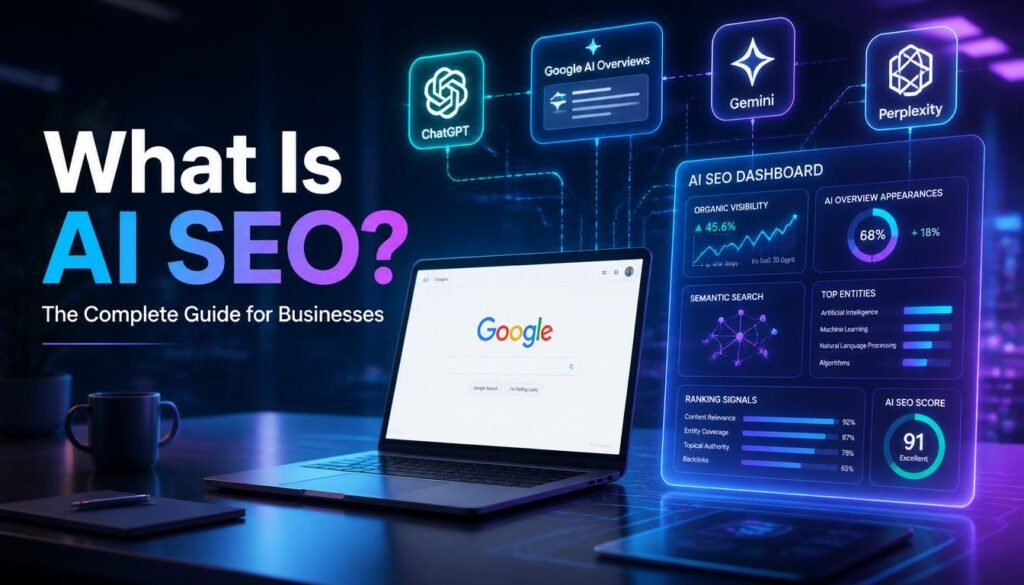
AI SEO is the process of optimising your website and content to rank in both traditional search engines and AI-powered search platforms such as Google AI Overviews, ChatGPT, Gemini, and Perplexity. It combines technical SEO, semantic search, topical authority, user intent, and high-quality content to improve visibility across the modern search landscape.
Key Takeaways
- AI SEO builds on traditional SEO rather than replacing it, helping your content perform better in both search engines and AI-generated results.
- Success depends on understanding search intent, building topical authority, and creating genuinely helpful content not simply targeting more keywords.
- Google rankings still matter, but visibility in AI platforms like ChatGPT, Gemini, Perplexity, and Google AI Overviews is becoming increasingly important.
- Businesses that publish trustworthy, well-structured content are more likely to be referenced in AI-generated answers.
- While AI tools can speed up research and optimisation, human expertise remains essential for creating accurate, credible, and experience-driven content.
At a Glance
| Feature | Traditional SEO | AI SEO |
|---|---|---|
| Primary Goal | Rank higher on search engines | Become discoverable across search engines and AI assistants |
| Focus | Keywords and backlinks | Search intent, entities, semantic relevance, and authority |
| Content Style | Keyword-focused | Human-focused, structured, and comprehensive |
| Search Experience | Blue links | AI-generated summaries and conversational answers |
| Success Metric | Rankings and traffic | Visibility, citations, authority, and conversions |
Table of Contents
- Why AI SEO Matters in 2026
- How AI SEO Works
- AI SEO vs Traditional SEO
- Google SEO vs GEO
- Core Components of AI SEO
- AI SEO Framework
- Business Examples
- What Is AI SEO?
- Common Mistakes
- AI SEO Checklist
- Frequently Asked Questions
- Final Thoughts
What Is AI SEO?
AI SEO is a modern approach to search engine optimisation that helps websites become visible not only in Google Search but also in AI-powered search experiences.
Instead of focusing only on rankings, AI SEO aims to create content that artificial intelligence systems can easily understand, trust, and reference when answering user questions.
Today’s search journey looks very different from just a few years ago. Many users now ask complete questions instead of typing short keywords. Rather than browsing multiple websites, they expect AI to provide clear and reliable answers within seconds.
As a result, businesses need content that serves both human readers and AI systems. If you’re just getting started, our guide to the best AI tools for student can help you learn how AI tools improve productivity before moving into advanced SEO workflows.
In simple terms, AI SEO combines the proven principles of traditional SEO with newer optimisation techniques designed for AI-driven search.
Instead of asking:
“How can I rank for this keyword?”
Businesses should now ask:
“How can I become the most trusted source on this topic?”
That shift in thinking is what makes AI SEO so powerful.
Interesting Fact: Studies show that users are increasingly interacting with AI-generated summaries before clicking on traditional search results. This means visibility is no longer limited to the first page of Google—it’s also about becoming part of the answer itself.
Why AI SEO Matters in 2026
Search behaviour is evolving faster than ever.
People are no longer relying solely on Google’s traditional search results. They now turn to AI assistants for instant recommendations, product research, business advice, and detailed explanations.
Whether someone asks ChatGPT for the best accounting software, Gemini for local marketing tips, or Google AI Overviews for SEO advice, the expectation is the same: receive an accurate answer immediately.
This shift creates new opportunities for businesses that produce trustworthy, well-structured content.
AI SEO helps your business:
- Increase visibility across multiple search platforms.
- Build long-term topical authority.
- Earn citations in AI-generated responses.
- Improve organic traffic quality.
- Strengthen customer trust.
- Future-proof your digital marketing strategy.
Businesses that continue relying only on outdated keyword tactics may struggle as AI-powered search becomes more common.
How AI SEO Works
Unlike traditional SEO, AI SEO evaluates content from multiple perspectives instead of relying heavily on keyword placement.
Modern AI systems analyse whether your content genuinely answers a user’s question, demonstrates expertise, and provides enough context to understand the topic completely. To get the best results, AI SEO should be combined with a solid AI content marketing guide that focuses on creating helpful, user-first content.
Several factors influence AI SEO performance, including:
Search Intent
Every successful page begins with understanding why someone is searching.
For example, a person searching for “What is AI SEO?” wants an easy-to-understand explanation rather than a sales pitch.
When your content satisfies that intent, both search engines and AI systems are more likely to recommend it.
Semantic Search
Search engines have become much better at understanding relationships between words and concepts.
Instead of repeating one keyword dozens of times, AI SEO naturally includes related terms such as:
- Semantic SEO
- Search intent
- Entity optimisation
- Topical authority
- EEAT
- AI search
- Google AI Overviews
- Conversational search
- Natural language processing
- Content relevance
These related concepts help AI understand the complete context of your content.
Topical Authority
Publishing one excellent article is helpful.
Publishing an entire collection of high-quality articles around the same subject is far more effective.
For example, a website that covers:
- What Is AI SEO
- Semantic SEO
- Entity SEO
- EEAT
- AI Search
- GEO
- AI SEO Tools
- AI SEO Checklist
is more likely to be recognised as an authority than a website with only one SEO article.
Topical authority tells both Google and AI systems that your website consistently provides reliable information within a specific subject area.
EEAT Signals
Google continues to reward websites that demonstrate:
- Experience
- Expertise
- Authoritativeness
- Trustworthiness
These principles have become even more important as AI-generated content becomes more common.
Businesses that publish original insights, practical examples, accurate information, and transparent author profiles are much more likely to earn trust from both users and AI systems.
Core Components of AI SEO
A successful AI SEO strategy isn’t built around a single ranking factor. Instead, it combines several elements that work together to improve visibility across search engines and AI-powered platforms.
The most important components include:
- High-quality, people-first content.
- Strong topical authority.
- Clear website structure.
- Semantic keyword optimisation.
- Entity-based optimisation.
- Internal linking.
- Technical SEO.
- Helpful user experience.
- Fast-loading pages.
- Credible external references.
When these elements work together, your website becomes easier for both humans and AI systems to understand, trust, and recommend.
AI SEO vs Traditional SEO
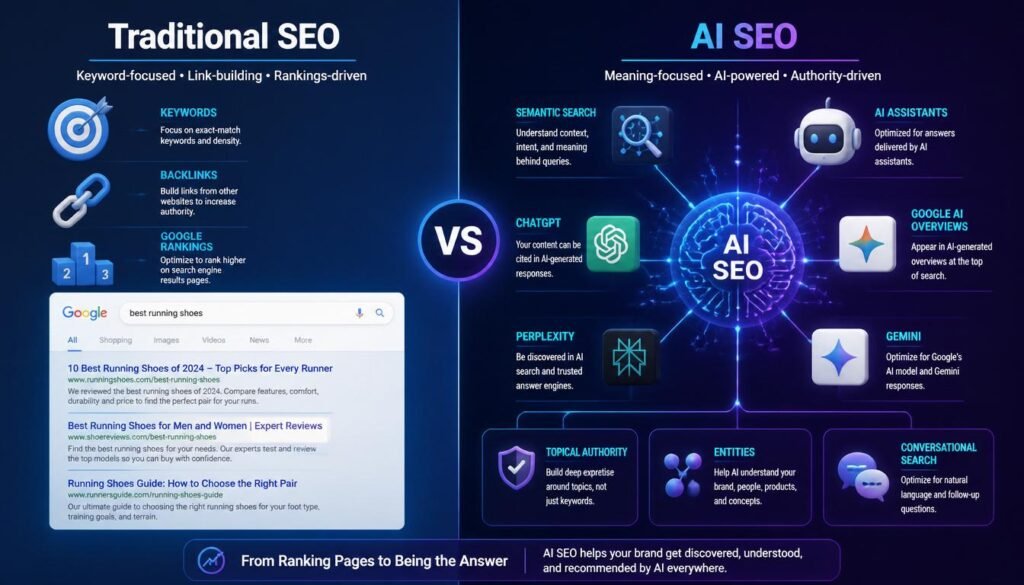
Although AI SEO is built on the foundations of traditional SEO, the two are no longer identical. Traditional SEO focuses primarily on improving rankings in search engine results pages (SERPs), whereas AI SEO aims to make your content discoverable, understandable, and trustworthy across both search engines and AI-powered assistants.
In 2026, businesses need more than keyword rankings. They need content that answers questions clearly, demonstrates expertise, and provides enough context for AI systems to reference confidently.
| Factor | Traditional SEO | AI SEO |
|---|---|---|
| Primary Goal | Rank higher on Google | Be visible across Google, AI Overviews, ChatGPT, Gemini, and Perplexity |
| Main Focus | Keywords and backlinks | User intent, entities, semantic relevance, and authority |
| Content Style | Keyword-focused | Comprehensive, people-first, and AI-friendly |
| Search Experience | Search results pages | AI-generated answers and conversational search |
| Success Metrics | Rankings and organic traffic | Visibility, citations, authority, engagement, and conversions |
| Content Structure | Standard blog posts | Structured, scannable, entity-rich content |
| Optimisation | Search engines | Search engines and AI systems |
The biggest difference is that traditional SEO asks, “How can I rank?” while AI SEO asks, “How can I become the best answer?”
Businesses that understand this shift will have a significant advantage as AI-powered search continues to evolve.
Google SEO vs GEO
Search engine optimisation is no longer limited to Google. As AI assistants become part of everyday search behaviour, businesses must also optimise for Generative Engine Optimisation (GEO).
Google SEO focuses on earning high rankings in traditional search results. GEO, on the other hand, focuses on increasing the likelihood that AI platforms will reference or recommend your content when generating answers.
Rather than replacing SEO, GEO complements it.
A strong digital strategy combines both approaches to maximise visibility across the entire search ecosystem.
| Google SEO | GEO |
|---|---|
| Optimises for Google’s search results | Optimises for AI-generated answers |
| Focuses on rankings | Focuses on citations and recommendations |
| Users click website links | Users often receive direct answers |
| Relies heavily on technical SEO and backlinks | Prioritises semantic relevance, entities, and topical authority |
| Measures rankings and traffic | Measures visibility, mentions, trust, and authority |
Businesses that invest in both SEO and GEO are far better positioned to succeed as search continues shifting towards AI-assisted experiences.
The AI SEO Framework
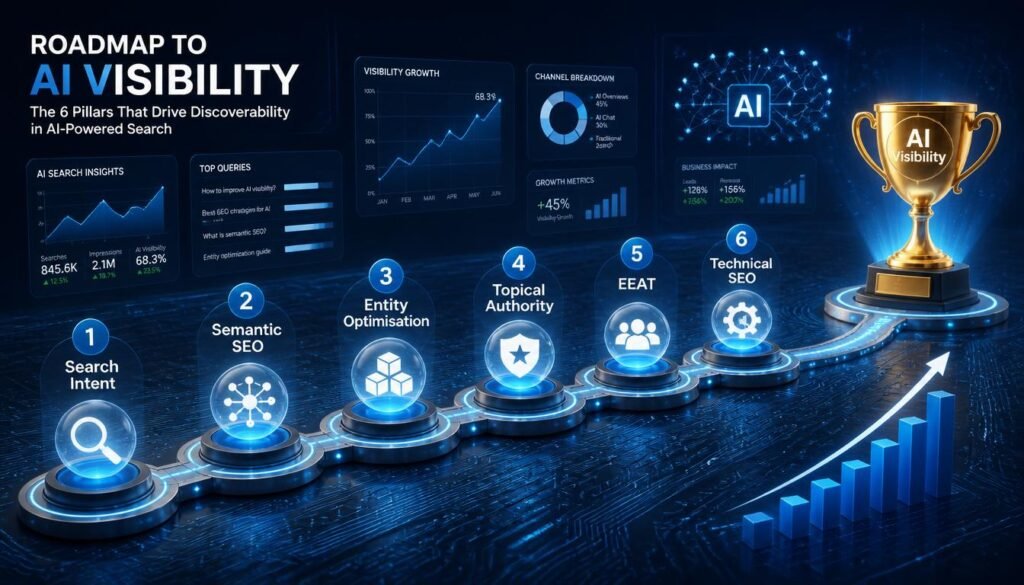
Instead of chasing algorithms, successful businesses follow a structured framework that focuses on long-term authority.
1. Understand Search Intent
Every successful article starts with understanding why someone is searching.
Ask yourself:
- What problem is the reader trying to solve?
- What information are they expecting?
- What questions might they ask next?
Content that fully satisfies search intent naturally performs better across both Google and AI search.
2. Build Topical Authority
Publishing dozens of unrelated articles rarely builds authority.
Instead, create a connected content cluster around one subject.
For example, your AI SEO cluster could include:
- What Is AI SEO?
- How AI Search Works
- Semantic SEO Explained
- Entity SEO Guide
- AI SEO Checklist
- Best AI SEO Tools
- EEAT Best Practices
- Why AI SEO Matters for Businesses
This approach helps search engines understand that your website is a trusted resource rather than a collection of isolated articles.
3. Create Helpful, Experience-Driven Content
AI systems increasingly favour content that demonstrates genuine expertise.
Rather than repeating information already available elsewhere, include:
- Practical advice
- Real-world examples
- Original insights
- Step-by-step explanations
- Industry experience
Helpful content is much more likely to earn trust and citations.
Pro Tip: Don’t write to impress search engines. Write to solve real problems. The more useful your content is, the easier it becomes for search engines and AI assistants to recommend it.
4. Optimise for Entities
Modern search engines understand relationships between people, organisations, technologies, products, and concepts.
Instead of repeating one keyword, naturally mention related entities throughout your content.
For AI SEO, relevant entities include:
- Google Search
- Google AI Overviews
- ChatGPT
- Gemini
- Perplexity
- Semantic SEO
- EEAT
- Natural Language Processing (NLP)
- Search Intent
- Structured Data
This provides additional context and helps AI understand your topic more accurately.
5. Improve Technical SEO
Even exceptional content can struggle if your website has technical issues.
Focus on:
- Fast page speed
- Mobile-friendly design
- Clear URL structure
- HTTPS security
- Schema markup
- Logical heading hierarchy
- Image optimisation
Strong technical foundations make it easier for both users and search engines to access and understand your content.
Real-World Business Examples
Example 1: Local Marketing Agency
A digital marketing agency publishes one generic SEO article.
Another agency creates a comprehensive AI SEO hub covering semantic SEO, EEAT, AI search, GEO, entity optimisation, and AI SEO tools.
Over time, the second website develops stronger topical authority, attracts more qualified traffic, and becomes more likely to appear in AI-generated answers.
Example 2: SaaS Company
A software company answers common customer questions through detailed educational content instead of relying only on product pages.
As a result, AI assistants begin referencing those articles when users search for industry advice.
This increases brand awareness before potential customers even visit the website.
Example 3: E-commerce Business
Instead of publishing only product descriptions, an online retailer creates buying guides, comparison articles, FAQs, and educational resources.
These supporting pages build trust, improve organic visibility, and increase the chances of appearing in AI-generated recommendations.
AI SEO Implementation Checklist
Before publishing any article, make sure it meets these best practices:
- Define a clear search intent.
- Create an attention-grabbing SEO title.
- Write a compelling meta description.
- Answer the main question within the first 100 words.
- Use descriptive H2 and H3 headings.
- Include semantic keywords naturally.
- Mention relevant entities throughout the article.
- Add internal links to related content.
- Reference trustworthy external sources where appropriate.
- Optimise images with descriptive alt text.
- Improve page speed and mobile usability.
- Use schema markup where applicable.
- Add FAQs that answer common user questions.
- Review grammar, readability, and factual accuracy before publishing.
A consistent publishing process produces stronger long-term SEO results than constantly chasing algorithm updates.
Common AI SEO Mistakes to Avoid
Many websites struggle with AI SEO because they continue using outdated optimisation tactics.
Avoid these common mistakes:
- Writing solely for search engines instead of people.
- Stuffing keywords unnaturally throughout the page.
- Ignoring search intent.
- Publishing thin or duplicate content.
- Covering too many unrelated topics.
- Neglecting internal linking.
- Forgetting technical SEO basics.
- Using AI-generated content without human editing.
- Publishing without demonstrating expertise or credibility.
- Failing to update older content regularly.
Avoiding these mistakes can significantly improve your chances of earning visibility in both traditional search and AI-generated results.
Did You Know? AI systems often evaluate an entire website not just a single page when deciding whether a source is trustworthy enough to reference. That’s why building topical authority across multiple related articles is more effective than relying on one standalone post.
(FAQs)
1. What is AI SEO?
AI SEO is the process of optimising websites and content for both traditional search engines and AI-powered search platforms like Google AI Overviews, ChatGPT, Gemini, and Perplexity. It focuses on search intent, semantic relevance, topical authority, and user experience to improve online visibility.
2. How is AI SEO different from traditional SEO?
Traditional SEO primarily aims to improve rankings in search engine results pages. AI SEO goes a step further by helping content become understandable, trustworthy, and reference-worthy for AI-powered search experiences. It combines technical SEO with semantic optimisation, entity SEO, and EEAT principles.
3. Why is AI SEO important in 2026?
Search behaviour is changing rapidly. Millions of users now rely on AI-generated answers instead of browsing multiple search results. Businesses that optimise for AI search are more likely to gain visibility, build authority, and attract qualified traffic in the years ahead.
4. Can AI replace SEO?
No. AI cannot replace SEO. Instead, it changes how SEO works. While AI tools can assist with research, optimisation, and content creation, successful SEO still depends on human expertise, strategic planning, technical optimisation, and creating genuinely valuable content.
5. Does Google use AI in search?
Yes. Google uses artificial intelligence in many aspects of search, including understanding user intent, evaluating content quality, and generating AI Overviews. AI helps Google deliver more accurate and relevant answers to users.
6. What are the best AI SEO tools?
Some of the most popular AI SEO tools include ChatGPT, Semrush, Ahrefs, Surfer SEO, Clearscope, Frase, MarketMuse, Jasper, and Google Search Console. However, these tools work best when combined with human expertise rather than replacing it.
7. How can I optimise my content for Google AI Overviews?
Create helpful, well-structured content that directly answers users’ questions. Use clear headings, semantic keywords, relevant entities, credible sources, internal links, and practical examples. Demonstrating experience and expertise also improves your chances of appearing in AI-generated summaries.
8. What is the difference between SEO and GEO?
SEO focuses on improving visibility in traditional search engine results, while Generative Engine Optimisation (GEO) aims to increase the likelihood of your content being referenced by AI-powered search platforms. Together, they create a more future-ready digital marketing strategy.
9. Is AI SEO suitable for small businesses?
Absolutely. AI SEO is valuable for businesses of all sizes. Small businesses can compete by publishing high-quality, trustworthy, and niche-focused content that answers customer questions better than larger competitors.
10. How long does AI SEO take to show results?
AI SEO is a long-term strategy. Depending on your website’s authority, competition, and content quality, noticeable improvements may take anywhere from three to six months. Consistency, regular updates, and strong topical authority are key to long-term success.
Conclusion
AI SEO is no longer a future trend it’s becoming an essential part of modern digital marketing. As search engines evolve and AI-powered platforms continue to shape how people discover information, businesses must adapt their content strategies accordingly.
Rather than focusing solely on rankings, successful AI SEO prioritises search intent, semantic relevance, topical authority, and user experience. By creating trustworthy, well-structured, and genuinely helpful content, businesses can improve their visibility across Google Search, Google AI Overviews, ChatGPT, Gemini, Perplexity, and other emerging AI platforms.
The businesses that invest in AI SEO today won’t simply keep up with the future of search they’ll be better positioned to lead it. As AI search continues to evolve, combining AI SEO with AI business automation can help companies build a scalable long-term growth strategy.
Continue Your AI SEO Journey
If you’re serious about building long-term organic growth, explore these related guides on Globe Hustle:
- What GEO Actually Means (And Why Old SEO Tactics Are Losing Power)
- GEO vs SEO: Why Your Traditional Ranking Strategy Will Fail in 2026
- How AI Search Works
- Why AI SEO Matters for Businesses
- AI SEO Glossary
- Best AI SEO Tools
- Semantic SEO Explained
- Entity SEO Guide
- EEAT Best Practices
- AI SEO Checklist
Together, these resources form a complete AI SEO knowledge hub designed to help businesses stay ahead of the rapidly evolving search landscape.
Ready to Future-Proof Your SEO Strategy?
Whether you’re a business owner, marketer, freelancer, or agency, now is the perfect time to embrace AI SEO. By combining proven SEO fundamentals with modern AI optimisation techniques, you can build sustainable visibility, strengthen your brand authority, and reach customers wherever they search.
Need expert guidance? Globe Hustle helps businesses develop AI SEO strategies that are designed for both today’s search engines and tomorrow’s AI-powered search experiences.
About the Author
Globe Hustle Editorial Team
The Globe Hustle Editorial Team specialises in AI SEO, Generative Engine Optimisation (GEO), semantic SEO, content strategy, and digital marketing. Our mission is to simplify complex marketing concepts into practical, evidence-based guides that help businesses grow online. Every article is carefully researched, fact-checked, and updated to reflect the latest developments in search technology and AI.