
Direct Answer
The best AI content writing tools for businesses in 2026 are Jasper AI, Copy.ai, Writesonic, ChatGPT (Plus), and Rytr. These tools help businesses automate blog posts, emails, social media copy, and product descriptions — saving up to 70% of writing time while maintaining quality and brand voice.
Featured Snippet: Top AI Writing Tools at a Glance
| Tool | Best For | Starting Price | Free Plan |
|---|---|---|---|
| Jasper AI | Brand voice & large teams | $69/month | No (7-day trial) |
| Copy.ai | Marketing copy & workflows | £29/month | Yes (limited) |
| Writesonic | AI search visibility (GEO) | $79/month | Yes (limited) |
| ChatGPT Plus | Versatile business writing | £16/month | Yes (limited) |
| Rytr | Startups & small businesses | $9/month | Yes |
| Anyword | Performance-based copywriting | £39/month | No (7-day trial) |
| Surfer AI | SEO-optimised long-form | $99/month | No |
| Hypotenuse AI | Ecommerce product copy | Custom | Demo only |
Fun Fact: According to a 2025 HubSpot report, 82% of marketers who use AI writing tools say it has significantly improved their content output — and 64% say it saves them more than 5 hours per week. That’s over 250 hours a year you could redirect toward strategy.
Key Takeaways
- AI content writing tools can cut business writing time by 50–70%
- The best tools for UK businesses combine SEO features with brand voice controls
- Free plans exist — but paid plans unlock the real commercial-grade features
- Jasper AI and Copy.ai dominate for marketing teams; Rytr wins for tight budgets
- Always review and humanise AI output before publishing — quality control matters
Table of Contents
- What Are AI Content Writing Tools?
- Why Businesses in the UK and US Are Adopting AI Writing
- Top 8 Best AI Content Writing Tools for Businesses (In-Depth Reviews)
- Free vs Paid AI Writing Tools — Which Should Your Business Choose?
- How to Choose the Right AI Writing Tool for Your Business
- Benefits of Using AI Writing Tools for Business
- Limitations to Know Before You Buy
- Final Verdict
1. What Are AI Content Writing Tools?
AI content writing tools are software platforms that use large language models (LLMs) — such as GPT-4o, Claude, or Gemini — to generate human-like written content automatically.
These tools help businesses create:
- Blog posts and long-form articles
- Email marketing campaigns
- Social media captions and ad copy
- Product descriptions for ecommerce
- Landing page and sales copy
- Internal business reports and summaries
In short, they act like a professional copywriter available 24/7, at a fraction of the cost.
💡 Fun Fact: The global AI writing assistant market is projected to reach $1.8 billion by 2030, growing at a CAGR of 26.5% — driven largely by small and medium businesses adopting content automation. (Source: Grand View Research)
2. Why UK and US Businesses Are Rapidly Adopting AI Writing Tools
Here’s the truth: content demand has exploded, but hiring skilled copywriters is expensive. A senior UK-based content writer costs between £35,000–£60,000 per year. Even a freelancer charges £50–£150 per article.
That’s why thousands of UK businesses — from Shopify stores in Manchester to SaaS startups in London — are now turning to AI writing tools.
The core business case is simple:
- Speed: Generate a 1,000-word blog draft in under 2 minutes
- Cost savings: Reduce content production costs by up to 60%
- Consistency: Maintain brand voice across all channels without constant briefing
- Scale: Publish 10x more content without hiring 10x more staff
Furthermore, as Google’s Helpful Content update continues to evolve, AI tools have become smarter at supporting — not replacing — human-led content strategies.
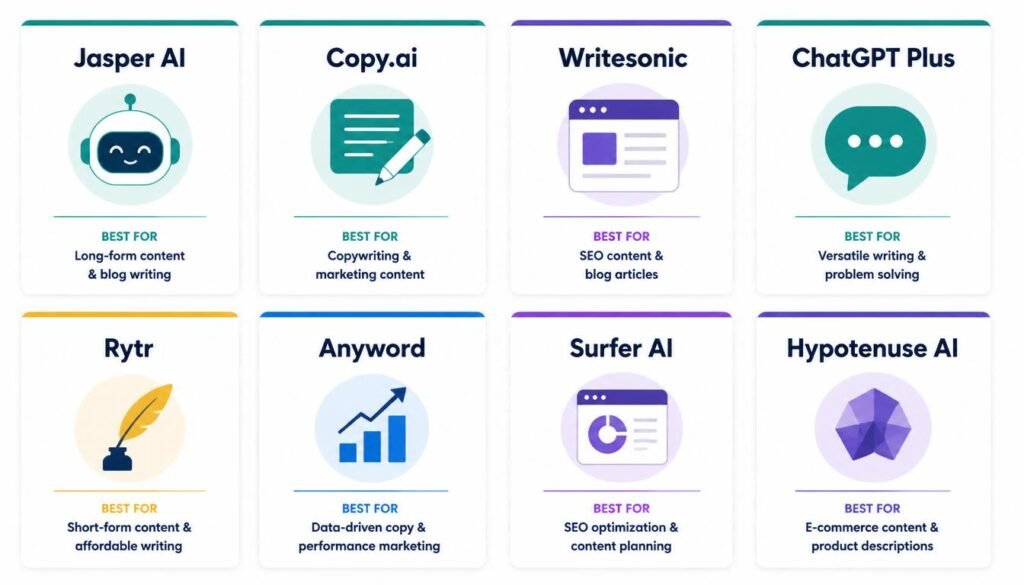
3. Top 8 Best AI Content Writing Tools for Businesses (In-Depth Reviews)
1. Jasper AI — Best for Brand Voice and Large Marketing Teams
Jasper AI remains the industry leader for businesses that need strict brand consistency. It lets you upload brand guidelines, tone documents, and past content so every piece of writing matches your company’s voice.
Key features:
- Brand Voice feature — train Jasper on your existing content
- 50+ templates covering ads, emails, blogs, and social media
- Jasper Chat for conversational content creation
- Integrates with Surfer SEO for optimised articles
- Team collaboration tools with approval workflows
Pros:
- Best-in-class for maintaining consistent brand voice
- Excellent for mid-size to enterprise marketing teams
- Reliable output quality with minimal editing needed
Cons:
- No free plan (only a 7-day free trial)
- Can feel expensive for solo operators or startups
- Occasional repetition in longer outputs
Pricing: From $69/month (Pro, billed monthly; $59/month billed annually, per seat) to custom Business plans. Best for: Agencies, marketing departments, and established UK businesses
2. Copy.ai — Best for Marketing Copy and Workflow Automation
Copy.ai has evolved from a simple copywriting tool into a full content workflow automation platform. It now offers pre-built workflows that chain multiple AI actions together — meaning you can go from a product brief to a complete email sequence in minutes.
Key features:
- 90+ pre-built copywriting templates
- Workflow automation (brief → first draft → revision → publish-ready)
- Brand voice settings per project
- GTM (Go-to-Market) AI workflows for sales and marketing
- Free plan available with generous monthly word limits
Pros:
- Best free plan of any commercial-grade AI writing tool
- Workflow automation is genuinely useful for marketing teams
- Clean, beginner-friendly interface
Cons:
- Long-form content quality sometimes inconsistent
- Workflow setup takes time to learn initially
- Not as strong for SEO-specific content as Surfer or Writesonic
Pricing: Free plan available; paid from £29/month
Best for: Marketing teams, SaaS companies, and ecommerce businesses
3. Writesonic — Best for AI Search Visibility (GEO)
Writesonic has pivoted into an AI search visibility platform (GEO) — it now helps businesses get cited by ChatGPT, Gemini, and other AI search engines, alongside its Article Writer for SEO content. Its Chatsonic assistant and web-connected writing tools produce well-structured, current articles.
Key features:
- Article Writer 6.0 — creates full SEO articles with one click
- Chatsonic — ChatGPT-like assistant with real-time web access
- Built-in SEO checker and keyword optimisation
- Landing page generator and ad copy tools
- Botsonic for building AI chatbots
Pros:
- One of the most affordable tools with strong quality output
- Real-time web browsing makes content more accurate and current
- Great for high-volume blog production
Cons:
- Output can occasionally feel formulaic
- Brand voice controls less sophisticated than Jasper
- Customer support response times vary
Pricing: From $79/month (Starter). Best for: Businesses focused on AI search visibility and SEO content
4. ChatGPT Plus (with GPT-4o) — Best for Versatile Business Writing
ChatGPT needs no introduction. With the GPT-4o model, it is arguably the most capable general-purpose AI writing assistant available to businesses today. It handles everything from drafting investor emails to writing product descriptions and brainstorming content ideas.
Key features:
- GPT-4o for fast, high-quality responses
- Web browsing and real-time search capability
- File upload and document analysis
- Custom GPTs for specialised business use cases
- Available via API for business integrations
Pros:
- Highly versatile — handles virtually any writing task
- Strongest reasoning and instruction-following of any tool
- Can analyse uploaded documents and write based on them
Cons:
- No built-in content templates
- Requires good prompting skills to get best results
- Less suited to bulk content production compared to dedicated tools
Pricing: Free (GPT-3.5); £16/month for Plus (GPT-4o)
Best for: All business sizes — particularly great for day-to-day business writing tasks
5. Rytr — Best Budget AI Writing Tool for Small Businesses and Startups
If you run a small business or startup with a tight content budget, Rytr is your best friend. It delivers surprisingly high-quality output at a price point that undercuts virtually every competitor.
Key features:
- 40+ use cases and writing tones
- AIDA and PAS copywriting frameworks built in
- Plagiarism checker included
- Browser extension for writing anywhere
- Simple, fast interface — no learning curve
Pros:
- Cheapest paid plan of any quality AI writing tool
- Very beginner-friendly
- Good enough quality for social media, emails, and short-form content
Cons:
- Not suitable for long-form SEO articles
- Limited brand voice and customisation options
- Falls behind premium tools for complex content tasks
Pricing: Free plan; Unlimited from $9/month ($7.50/month billed annually); Premium available. Best for: Freelancers, solopreneurs, and small UK businesses on a budget
6. Anyword — Best for Data-Driven, Performance Marketing Copy
Anyword is the tool for businesses that want measurable results from their copy. It scores every piece of content it generates with a predictive performance score — telling you how likely a headline or ad copy variant is to convert before you publish it.
Key features:
- Predictive Performance Score for every piece of copy
- Data-driven copy optimisation for ads, emails, and landing pages
- A/B testing copy generation
- Blog post wizard for longer content
- CRM and marketing tool integrations
Pros:
- Unique data-driven approach to copy performance
- Excellent for paid advertising and conversion rate optimisation
- Strong for teams running high-volume ad campaigns
Cons:
- More expensive than average for what it offers
- Best value only for businesses running active ad campaigns
- Interface feels complex at first
Pricing: From £39/month
Best for: Performance marketers, ecommerce brands, and ad agencies
7. Surfer AI — Best for SEO-Optimised Long-Form Content
Surfer AI is not a general writing tool — it’s purpose-built for one thing: ranking your content on Google. It combines keyword research, competitor SERP analysis, and AI writing into a single workflow.
Key features:
- Real-time SERP analysis and content scoring
- AI article generator built on Surfer’s SEO data
- Content editor with NLP keyword suggestions
- Internal linking recommendations
- Audit tool for improving existing content
Pros:
- Best tool if SEO ranking is the primary goal
- Content scoring gives clear guidance for writers
- Integrates with Jasper for a premium writing + SEO workflow
Cons:
- Expensive relative to other tools
- Primarily focused on long-form — not ideal for ad or social copy
- Requires some SEO knowledge to get full value
Pricing: From $99/month (Standard; now ‘Positive Surfer’). Best for: SEO agencies, content marketing managers, and businesses targeting competitive keywords
8. Hypotenuse AI — Best for Ecommerce Product Descriptions
For UK ecommerce businesses on Shopify, WooCommerce, or Amazon, Hypotenuse AI is the standout choice. It specialises in generating bulk product descriptions that are accurate, on-brand, and conversion-focused.
Key features:
- Bulk product description generation from CSV import
- Brand voice training on existing content
- Blog article generator
- Direct Shopify and ecommerce platform integration
- Image-to-content feature (generate descriptions from product photos)
Pros:
- Only tool that genuinely excels at ecommerce copy at scale
- Shopify integration saves enormous amounts of time
- Strong brand voice controls for consistent product listings
Cons:
- Less versatile for non-ecommerce content types
- Pricing can add up for very large product catalogues
Pricing: Custom (ecommerce-focused plans; demo available). Best for: Ecommerce businesses with large product catalogues
💡 Fun Fact: Businesses that publish 16+ blog posts per month generate 3.5x more traffic than those publishing 0–4 posts. AI writing tools make that volume sustainable for a team of any size. (Source: HubSpot)
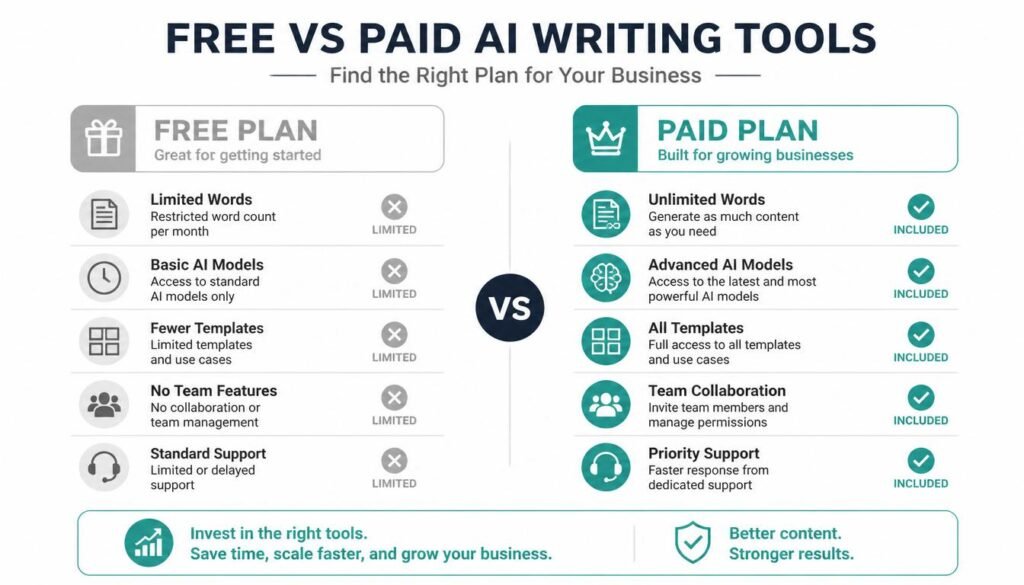
4. Free vs Paid AI Writing Tools — Which Should Your Business Choose?
This is one of the most common questions UK business owners ask — and the honest answer depends on your output volume and quality requirements.
| Factor | Free Plans | Paid Plans |
|---|---|---|
| Word / credit limits | Low (usually 2,000–10,000 words/month) | High or unlimited |
| Content quality | Good for short-form | Superior for long-form |
| Brand voice controls | Minimal or none | Full customisation |
| Templates available | Limited | Full library |
| SEO features | None | Available on select tools |
| Team collaboration | Usually not included | Included on most paid tiers |
| Customer support | Community / email only | Priority support |
| Best for | Testing before committing | Active business use |
The bottom line: Free plans are useful for testing and occasional use. However, if your business publishes content regularly — even just 2–4 pieces per month — a paid plan pays for itself quickly through time saved.
5. How to Choose the Right AI Writing Tool for Your Business
With so many options available, choosing feels overwhelming. However, the decision becomes straightforward when you ask the right questions:
Step 1 — Define your primary content type
Are you mainly writing blog posts? Go with Writesonic or Surfer AI. Primarily running ad campaigns? Choose Anyword. Need all-round versatility? ChatGPT Plus or Jasper.
Step 2 — Set your budget
- Under £10/month → Rytr
- £10–£30/month → Copy.ai or ChatGPT Plus
- £30–£50/month → Anyword
- £50–£70/month → Jasper AI or Writesonic; £70+/month → Surfer AI (only if SEO is your core business driver)
Step 3 — Consider your team size
Solo operators do fine with ChatGPT or Rytr. Growing teams benefit from Jasper or Copy.ai’s collaboration features and brand voice controls.
Step 4 — Test before you commit
Most tools offer free trials. Use them. Write the same brief in two or three tools and compare the output quality before paying.
6. Benefits of Using AI Writing Tools for Business
AI writing tools deliver real, measurable value for businesses. Here’s what the data and real-world results show:
- Faster content production: Reduce blog drafting time from 4 hours to under 30 minutes
- Lower costs: Replace a portion of freelance writing spend — save thousands annually
- Greater consistency: AI maintains the same tone and style across every channel
- More content output: Publish more frequently, which directly improves SEO rankings
- Better first drafts: Writers spend time editing and refining rather than staring at a blank page
- Multilingual capability: Many tools generate content in multiple languages — useful for UK businesses with European markets
According to Content Marketing Institute, businesses that consistently publish quality content generate 6x more conversions than those that don’t. AI writing tools make consistent publishing achievable for any team size.
7. Limitations to Know Before You Buy
AI writing tools are powerful — but they are not perfect. As a business owner, you need to know where they fall short:
- Factual accuracy: AI can “hallucinate” — inventing facts, statistics, or quotes that sound plausible but are wrong. Always fact-check.
- Brand nuance: Even with brand voice settings, AI sometimes misses the specific tone that makes your brand distinctive. Human editing is essential.
- Thin content risk: If you publish AI content without editing, Google may classify it as low-quality. Always add original insights, examples, and data.
- Compliance and legal copy: Never use AI for regulated content — financial advice, legal documents, or medical information — without professional review.
- Creative originality: AI draws from patterns in existing text. Truly original angles and ideas still require human thinking.
The best approach is to use AI as a first-draft generator and research assistant — not a replacement for skilled human writers.
For more business tools and strategies to grow your online presence, visit GlobeHustle — a trusted resource for UK entrepreneurs and digital business owners.
There’s no single winner — it depends on your needs. Jasper AI ($69/month) leads for brand voice and marketing teams, Surfer AI ($99/month) for SEO content, and Copy.ai ($29/month) for affordable workflows. For tight budgets, Rytr (from $9/month) or ChatGPT Plus ($20/month) cover most day-to-day business writing well.
ChatGPT Plus is a brilliant all-rounder, but dedicated tools beat it for specific jobs. Jasper AI handles brand voice better, Surfer AI bakes in SEO scoring, Anyword predicts copy performance, and Hypotenuse AI is built for ecommerce product descriptions. If you publish at scale, a specialist tool usually saves more editing time.
Not entirely — and they shouldn’t. AI drafts fast and handles routine content well, but it can invent facts, miss brand nuance, and produce generic copy. The smartest businesses use AI for first drafts and research, then have humans edit, fact-check, and add original insight. Think assistant, not replacement.
Some are. Copy.ai and ChatGPT offer genuinely useful free plans, and Rytr has a free tier too. But free plans cap your monthly words and skip the good stuff — brand voice controls, SEO scoring, and team features. If you’re only writing the odd post, free works; regular publishing needs a paid plan.
Yes — most do now. Industry reports suggest over 80% of marketers use AI writing assistance, mainly to beat the blank page and speed up drafts. Professionals typically generate a first draft with AI, then rewrite, fact-check, and inject expertise. The tool does the heavy lifting; the human adds the judgement.
Match the tool to your workflow. For SEO, look for SERP analysis, keyword suggestions, and content scoring — Surfer AI ($99/month) is built for exactly that, while Writesonic now targets AI search visibility (GEO). Test two or three tools on a real brief first, and always budget time for human editing.
9. Final Verdict — Which Tool Should Your Business Choose?
Here’s the straightforward summary:
| Business Type | Recommended Tool |
|---|---|
| Large marketing team | Jasper AI |
| Small business / startup | Rytr or Copy.ai |
| SEO-focused content strategy | Surfer AI or Writesonic |
| Ecommerce product copy | Hypotenuse AI |
| General all-purpose writing | ChatGPT Plus |
| Performance ad copy | Anyword |
| Budget under £10/month | Rytr |
| Need a free plan | Copy.ai or Writesonic |
The AI content writing tool market is maturing fast. The businesses that adopt these tools today — and learn to use them strategically — will build a significant content advantage over competitors who are still writing everything manually.
Start with a free trial of two or three tools. Test them on real content you need. Then commit to the one that fits your workflow, budget, and quality standards.
💡 Fun Fact: The word “copywriting” was first used in 1911. Over a century later, AI tools are doing in seconds what took professionals days. The craft hasn’t disappeared — it’s evolved. The best business writers in 2026 are the ones who know how to direct AI, not compete with it.
Tool Evolution Timeline — AI Writing for Business
| Year | Milestone |
|---|---|
| 2020 | OpenAI releases GPT-3 — first commercially viable AI writing model |
| 2021 | Jasper AI (formerly Jarvis) launches — first AI tool built specifically for marketing |
| 2022 | Copy.ai, Rytr, and Writesonic reach mainstream adoption among SMBs |
| 2022 | ChatGPT launches — transforms public awareness of AI writing |
| 2023 | GPT-4 launches; AI writing quality reaches near-human standard |
| 2024 | Surfer AI integrates SEO + writing; GEO optimisation becomes mainstream |
| 2025 | AI writing tools standard in 82% of marketing teams (HubSpot) |
| 2026 | Multi-agent AI workflows — tools now chain research, writing, and publishing automatically |
About the Author
Sarah Mitchell is a content strategist and AI tools specialist with 10 years of experience helping UK and US businesses build content strategies that rank and convert. She has personally tested and reviewed over 40 AI writing tools for clients ranging from Shopify ecommerce stores to B2B SaaS companies. Sarah regularly contributes to GlobeHustle and speaks at digital marketing events across the UK.