
Quick Summary
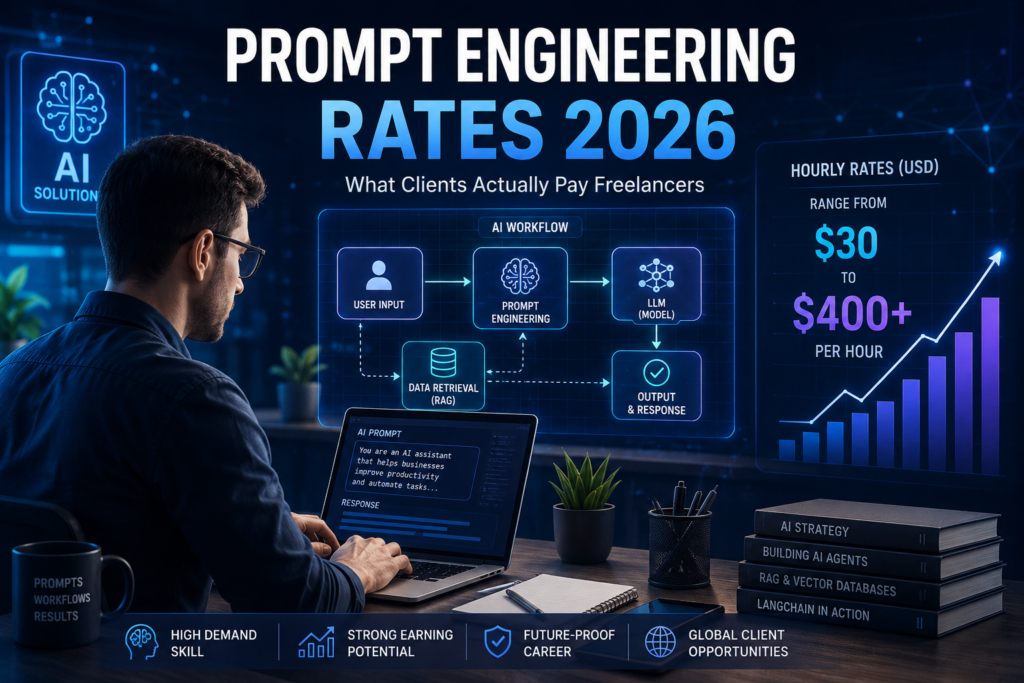
Freelance prompt engineering rates in 2026 range from roughly $30 to $400+ per hour. Beginners doing basic prompt tweaks typically earn $30–$75/hour, mid-level freelancers building AI workflows charge $75–$150/hour, and senior specialists designing AI agents or RAG systems command $150–$400+/hour, depending on complexity and client budget.
5. Featured Snippet Table
| Experience Level | Hourly Rate (USD) | Typical Work | Platform Fit |
|---|---|---|---|
| Beginner | $30 – $75 | Prompt tweaks, content prompts, small automations | Fiverr, Upwork |
| Mid-Level | $75 – $150 | Marketing AI pilots, API integrations, chatbot flows | Upwork, direct clients |
| Senior/Expert | $150 – $400+ | AI agent design, RAG architecture, safety guardrails | Freelancer.com, enterprise retainers |
| Fixed-price gigs | $30 – $125 per job | Standard, one-off prompt tasks | Fiverr |
| Monthly retainers | $5,000 – $15,000 | Ongoing enterprise AI optimisation | Direct contracts |
Highlights
- Freelance prompt engineering rates in 2026 span a wide range: $30/hour for basic tasks up to $400+/hour for advanced AI agent work.
- Experience and technical depth (Python, APIs, RAG, LangChain) matter far more than years in the industry.
- Marketplace rates (Fiverr, Upwork) sit well below direct-client and retainer rates.
- Senior specialists building safety guardrails and evaluation loops are the highest earners in this field.
- Location still affects pricing, though skill-based pricing is closing that gap faster than in most other tech freelance niches.
Ask ten different freelancers what a prompt engineer charges per hour, and you’ll get ten different answers — and honestly, most of them will be right. That’s the strange part about this niche. A year or so back, “prompt engineer” was still a bit of a punchline, the kind of title people rolled their eyes at on LinkedIn. Now it’s showing up as a proper line item in client budgets, and the people paying those invoices want a straight answer: what does this actually cost?
There isn’t one number, and anyone who gives you a single flat figure is oversimplifying. Someone tidying up ChatGPT prompts for Instagram captions is not doing the same job as someone wiring together a retrieval pipeline with safety checks so a chatbot doesn’t say something it shouldn’t to a paying customer. Both of them will happily call themselves prompt engineers on their Upwork profile. Only one of them bills $300 an hour, and it isn’t the one writing captions.
So let’s actually break down freelance prompt engineering rates in 2026 — what beginners charge, what the senior crowd gets away with, and why the gap between them is so much wider than in most other freelance fields.
Freelance Prompt Engineering Rates at a Glance
Here’s the market split, roughly, by skill tier.
| Tier | Hourly Range | Common Deliverables |
|---|---|---|
| Entry-level | $30 – $75 | Basic prompt tweaks, content generation, small workflow automation |
| Mid-level | $75 – $150 | Department-specific AI pilots, marketing systems, basic API work |
| Senior/expert | $150 – $400+ | Multi-step AI agents, RAG architecture, evaluation loops, guardrails |
Look at that spread for a second — the top of the range is more than thirteen times the bottom, for people carrying the same job title. That’s unusual even by freelance standards, and it tells you something worth remembering before you go further: “prompt engineer” isn’t really one job anymore. It’s stretched to cover everything from light copywriting to genuine systems engineering, and the pay reflects which end you’re actually standing on.
Expert tip: If a client wants a fixed quote before you’ve scoped anything, be cautious. Prompt work lives and dies on iteration — how many rounds of testing, how many edge cases break the output — and a quote given blind almost always ends up underpriced once the real hours show up.
What Actually Determines the Rate
An engineer’s rate is determined primarily by technical depth (such as API integration and RAG architecture), business risk (handling sensitive data vs. marketing copy), and specialized tooling fluency, rather than simply years of experience.
Clients tend to assume rates just track experience. They do, sort of, but not in the way most people picture it. Three things move a prompt engineer’s rate far more than a headline like “5 years of experience” ever will.
Technical depth is the big one. Someone who only writes and polishes prompts inside a chat window earns less than someone who can take those same prompts, wire them into an API, handle what happens when the call fails, and build a retrieval layer around the whole thing. Basic Python and API fluency alone can add $50 to $100 an hour to what you’re able to charge that’s not a small bump.
Then there’s business risk, which people underrate. Prompts writing marketing copy are low-stakes if something goes sideways; worst case, you rewrite a paragraph. Prompts sitting inside a customer support bot, a medical intake form, or a financial advisory tool are a different animal entirely get those wrong and someone’s business is exposed. Freelancers who understand guardrails and evaluation loops charge for that responsibility, not just for the words they typed.
And finally, tooling fluency. Freelancers who know their way around LangChain, vector databases, and RAG (retrieval-augmented generation) setups sit at the top of the pay scale, and for good reason that work looks a lot more like software engineering than anything you’d call “writing prompts,” and clients pay software-engineering money for it. If you’re still exploring which direction to take freelancing, consulting, or something else it’s worth stepping back and looking at the broader ways to make money with AI before narrowing in on prompt engineering specifically.
Rate Breakdown by Experience Level
Freelance prompt engineering rates are split into three clear tiers: entry-level roles charge $30–$75/hour for basic prompt tweaks, mid-level professionals charge $75–$150/hour for workflow integrations, and senior specialists charge $150–$400+/hour for advanced multi-agent systems and guardrails.
“Beginner” and “expert” mean wildly different things depending on who you ask, so let’s get specific about each tier.
Entry-Level ($30–$75/hour)
This covers people who are genuinely comfortable with tools like ChatGPT or Claude but haven’t crossed into technical integration work yet. In practice, that usually looks like:
- Writing and refining prompts for blog or social content
- Small workflow automations email templates, simple chatbot flows
- Basic prompt testing and iteration on existing campaigns
It’s a fine place to start, nothing wrong with it. But rates here flatten out fast, and most freelancers who stay in this lane for too long end up frustrated by the ceiling.
Mid-Level ($75–$150/hour)
This tier tends to attract people coming from marketing operations, customer support systems, or light development backgrounds. The work stops being purely creative and starts needing to function properly inside a real business:
- Department-specific AI pilots sales enablement, support triage, that sort of thing
- Basic API integrations that connect a model to tools the client already uses
- Marketing automation systems built from multiple prompt chains, not just one
Senior/Expert ($150–$400+/hour)
This is where the real money lives, and honestly, it’s a much smaller crowd than you’d expect. Most senior prompt engineers come out of a software engineering, data science, or ML background rather than a purely creative one:
- Designing multi-agent systems with clearly defined roles and handoffs
- Building RAG architecture for enterprise knowledge bases
- Writing evaluation loops and safety guardrails that catch failures before they ever reach a live user
Some specialists at this level are pulling in $200 to $400 an hour, mostly because there just aren’t that many freelancers who can do this kind of work reliably yet. Put that in perspective: it puts the top of freelance prompt engineering ahead of what most salaried software developers earn in the US. The Bureau of Labor Statistics puts the median wage for computer and information research scientists at roughly $65 an hour as of May 2025 — a solid, well-paid role, and still nowhere near what the top freelance prompt architects are billing.
Platform-by-Platform Rates
Marketplace platforms like Fiverr and Freelancer.com generally yield lower, project-based rates ($30–$125), whereas direct client relationships, hourly contracts, and enterprise retainers ($5,000–$15,000/month) offer significantly higher earning potential due to reduced price competition.
Where you actually find the work changes the price almost as much as your skill level does — sometimes more, honestly.
| Platform | Typical Pricing Model | Rate Range |
|---|---|---|
| Fiverr | Fixed-price gigs | $30 – $125 per job |
| Upwork | Hourly contracts | $50 – $150/hour |
| Freelancer.com | Mixed bids (fixed & hourly) | Varies widely, often lower on bid-based jobs |
| Direct/referral clients | Hourly or retainer | $100 – $400+/hour |
| Enterprise retainers | Monthly contract | $5,000 – $15,000/month |
Marketplaces push rates down almost by design. When five freelancers are bidding on the same job in real time, someone always drops their number to win it, and clients get used to seeing that low anchor. Direct relationships and referrals don’t have that problem there’s no bidding war happening in the background, so the rate reflects what the work is actually worth rather than what the cheapest competitor was willing to accept.
Fun fact: A fair few of the listings tagged “Prompt Engineering” on Freelancer.com right now aren’t pure prompt-writing jobs at all. Scroll through them and you’ll find AI development work, data cleansing, even chatbot content projects that just happen to touch on prompting somewhere in the brief. That blurring of categories is a big part of why rates look so inconsistent from the outside looking in.
Project-Based vs Hourly Pricing
Hourly billing works best for exploratory or loosely scoped tasks, while fixed pricing suits clearly defined deliverables with strict budget limits, though many senior freelancers prefer a hybrid model involving a paid scoping phase followed by milestone billing.
Not every client wants an hourly arrangement, and to be fair, not every freelancer should be offering one.
Hourly billing tends to make sense when the scope isn’t fully nailed down yet, when the client wants ongoing testing and iteration rather than a single deliverable, or when you’re doing something genuinely exploratory that neither side can fully predict in advance.
Fixed pricing works better when the deliverable is spelled out clearly “20 optimised prompts for X use case,” say you’ve done something similar before and can estimate the time with confidence, and the client is working against a hard budget ceiling they can’t move.
A lot of senior freelancers land somewhere in between: a small fixed fee just to scope the project properly, followed by hourly or milestone billing once the real work kicks off. It’s a decent way to protect both sides from scope creep without scaring off clients who want a number upfront.
US vs UK Freelance Prompt Engineering Rates
UK-based freelancers typically quote in a tighter band of roughly £25 to £200 an hour, though remote work and enterprise contracts with US clients are quickly bridging geographical pricing gaps based purely on high-level output value.
Location still nudges the price, though less than it used to across most tech freelance work. UK-based freelancers often quote in a tighter band roughly £25 to £200 an hour depending on tier which comes down partly to currency and partly to a market that’s still catching up with US demand for AI specialists. Remote work has flattened a lot of this gap, though. A UK freelancer building RAG architecture for a US enterprise client can quite reasonably charge US-comparable rates, because at that point the client is paying for the output, not the postcode.
How to Increase Your Rate as a Prompt Engineer
To increase your rate, move beyond chat-only interfaces by learning Python and API integration, mastering specific frameworks like LangChain, shifting your portfolio focus toward solving business problems, and transitioning away from bid-based marketplaces to direct outreach.
If you’re sitting at entry-level pricing and want to move up, the path looks fairly similar across freelancers who’ve actually made that jump.
Start by learning basic Python and API integration even fairly light scripting knowledge is enough to separate you from the “chat interface only” crowd, and it’s often the single biggest unlock. Pick one framework and go deep on it rather than skimming several; LangChain or something comparable tends to be the highest-leverage skill you can add right now. Build your portfolio around outcomes rather than prompts themselves clients aren’t paying for clever wording, they’re paying for a problem that got solved, so show before-and-after results wherever you can.
It’s also worth moving off pure marketplaces once you’ve got proof of work behind you. Referrals and direct outreach consistently pay better than bid-based platforms, mostly because you’re no longer competing on price against four other bids in the same window. And price for the risk you’re taking on, not just the hours you’re logging if your work sits inside a customer-facing or compliance-sensitive system, your rate should reflect that, not just the clock. If you want a fuller picture of which skills are actually paying off right now, this guide to the top AI freelance skills in the US breaks it down beyond just prompt engineering.”
Expert tip: Track your real hours per project for the first few months, even on fixed-price work. Most freelancers underprice simply because they underestimate revision cycles, and prompt engineering chews through more revision rounds than almost any other freelance skill out there.
Common Mistakes New Freelancers Make on Pricing
New freelancers often underprice to land initial work, quote fixed fees blindly without testing prompt iterations, ignore self-employment tax obligations, and compete purely on price, which trains clients to undervalue technical expertise.
A handful of patterns keep showing up among newer freelancers in this space, and they’re worth naming plainly.
Undercharging to land the first client is the classic one it feels smart at the time, then becomes genuinely hard to walk back once that client gets used to your low number. Quoting a flat fee before actually testing the prompts is another; you end up absorbing hours of unpaid iteration once the real complexity shows up. Plenty of freelancers also ignore the tax side of things entirely. In the US, self-employed freelancers owe self-employment tax and quarterly estimated payments the IRS lays this out clearly for independent contractors and it’s far better to budget for that from day one than get blindsided by it in April. And competing purely on price across marketplaces does long-term damage too: it trains clients to expect the cheapest possible rate rather than the best outcome, which is a hard habit to unlearn once it’s set in.
Prompt Engineering Rate Growth: 2023–2026 Timeline
| Year | Market Status | Typical Hourly Range |
|---|---|---|
| 2023 | Early, mostly experimental hiring | $20 – $60/hour |
| 2024 | Rates rise as businesses formalise AI workflows | $30 – $100/hour |
| 2025 | Specialisation splits the market (writers vs engineers) | $30 – $200/hour |
| 2026 | Clear tiering; senior agent/RAG work commands premium rates | $30 – $400+/hour |
The pattern here is pretty clear once you lay it out year by year. As the definition of “prompt engineering” has narrowed toward genuinely technical, systems-level work, the ceiling has climbed fast while the floor has barely moved at all. Basic prompt-writing hasn’t gotten meaningfully more valuable over three years. Building actual AI systems has and the rate data reflects that split cleanly.
Final Thoughts
If there’s one thing worth taking away from all this, it’s that “prompt engineering” was never going to settle into a single price point, and 2026 makes that obvious. The rate depends on how technical the work is, how much risk it carries, and how deeply the freelancer integrates it into the client’s actual systems. Someone polishing marketing prompts and someone architecting a RAG-based support agent may share the same job title, but they do very different work, so they shouldn’t charge the same rate. Whether you’re hiring or setting your own prices, match the rate to the actual technical scope of the work rather than the job title on the invoice. That approach keeps the arrangement fair for everyone involved.
8. FAQ Section
What is a fair starting rate for a freelance prompt engineer in 2026?
Most beginners charge between $30 and $75 per hour, depending on whether the work is pure prompt writing or includes light workflow automation.
Do prompt engineers charge more than regular content writers?
Generally yes, especially once technical skills like API integration are involved. Pure prompt-writing work can overlap with content writing rates, but technical prompt engineering commands considerably more.
Is prompt engineering still a viable freelance career in 2026?
Yes, particularly for freelancers who’ve moved beyond basic prompt writing into AI workflow design, RAG systems, or agent architecture, where demand and rates are both rising.
How do I know if a client’s budget is realistic for the scope?
Compare the request against the rate table above. If someone wants a multi-agent system built for $200 total, the scope and budget don’t match, and it’s worth saying so before starting.
Do freelance prompt engineers ever work for free or at donation-based rates?
Occasionally, for nonprofits, open-source projects, or portfolio-building early on, but this should be a deliberate choice with a clear time limit — not a default pricing strategy.
Which platform pays the most for prompt engineering work?
Direct client relationships and enterprise retainers consistently pay more than marketplace bidding platforms like Fiverr or Freelancer.com, mainly because there’s less price competition.
What skills increase a prompt engineer’s hourly rate the fastest?
Python scripting, API integration, and familiarity with RAG frameworks like LangChain tend to have the biggest impact on moving from mid-level to senior rates.