Quick Summary
The Elon Musk AI empire includes xAI and Grok, Tesla’s autonomous-driving and robotics programmes, Neuralink’s brain-computer interface research, and Musk’s earlier involvement with OpenAI. His strategy connects AI models, computing infrastructure, social media, electric vehicles, robotics and human-computer interfaces into one ambitious technology ecosystem.
Highlight
- The Elon Musk AI empire is a network of connected AI, robotics, automotive, space and neurotechnology projects.
- xAI is the centrepiece of Musk’s dedicated AI strategy, with Grok as its best-known product.
- Tesla contributes large-scale real-world data, autonomous-driving systems and humanoid-robot research.
- Neuralink focuses on brain-computer interfaces rather than a conventional chatbot or AI platform.
- Musk’s early involvement with OpenAI helped shape his public interest in AI safety and artificial general intelligence.
- X gives Grok a direct route to real-time conversations, content and user feedback.
- The empire’s major advantage is integration, although regulation, cost, safety and execution remain significant challenges.
Featured Snippet Table
| Company or project | Main AI role | Strategic value | Main product or focus |
|---|---|---|---|
| xAI | Foundation-model research and AI products | Builds Musk’s dedicated AI platform | Grok |
| Tesla | Embodied AI and autonomy | Uses vehicle data and hardware at scale | FSD and Optimus |
| Neuralink | Neurotechnology | Connects humans with computers | Brain-computer interfaces |
| X | AI distribution and data ecosystem | Provides a large social platform for Grok | Grok on X |
| SpaceX | Infrastructure and engineering ecosystem | Offers technical talent and computing ambitions | Space systems and satellite connectivity |
| OpenAI connection | Early AI research involvement | Shows Musk’s longstanding interest in advanced AI | AI safety and AGI research |
What Is the Elon Musk AI Empire?
The Elon Musk AI empire is the connected group of companies, investments and technology programmes through which Elon Musk is pursuing artificial intelligence, robotics, autonomy and human-computer interaction.
In simple terms, it is not one company. Instead, it is an ecosystem built around several layers:
- AI models and assistants.
- Autonomous vehicles and robots.
- Data, chips and computing infrastructure.
- Social-media distribution.
- Brain-computer interfaces.
- Engineering talent and large technology platforms.
The central idea is straightforward: Musk wants AI to move beyond a text chatbot. His projects aim to make AI operate vehicles, control robots, understand the physical world, interact with social platforms and eventually work alongside humans.
That broad ambition explains why an article about the Elon Musk AI empire must look beyond xAI. Grok may attract the most attention, but Tesla and Neuralink also form important parts of Musk’s wider technology strategy.
The OpenAI Connection
Musk’s relationship with AI began attracting major public attention before he launched xAI. He was involved in the founding of OpenAI in 2015, when the organisation presented itself as a nonprofit focused on ensuring that artificial general intelligence benefits humanity. OpenAI describes its original mission in its official foundation materials. OpenAI Foundation
However, Musk later left the organisation. The split became increasingly significant as OpenAI developed a commercial structure, raised substantial capital and became one of the most influential AI companies in the world.
The OpenAI episode matters for three reasons:
- It shows that Musk has followed advanced AI for more than a decade.
- It helped shape his criticism of concentrated control over powerful AI systems.
- It created a direct competitive and legal relationship between Musk and OpenAI.
Musk’s public argument has often centred on control, transparency and AI safety. At the same time, his later companies have pursued highly competitive commercial AI development. That tension gives the Elon Musk AI empire much of its drama: he criticises the risks of powerful AI while building systems intended to compete at the highest level.
Tesla: AI in the Physical World
Many people associate Tesla mainly with electric cars. Nevertheless, Tesla increasingly presents itself as an AI and robotics company as well as an automaker.
Tesla’s AI work focuses on machines that can see, predict, navigate and act in the physical world. Its main areas include:
- Driver-assistance and autonomous-driving software.
- Computer vision.
- Neural-network training.
- Vehicle data collection.
- Robotics and automation.
- The Optimus humanoid robot.
Tesla’s Full Self-Driving system remains a driver-supervised technology in many markets. Therefore, readers should not confuse the product name with unrestricted autonomous driving. Tesla’s own support material explains the role and limitations of Full Self-Driving technology. Tesla Full Self-Driving Support
Why Tesla matters to Musk’s AI strategy
Tesla gives Musk something that a new AI laboratory cannot easily replicate: a large installed hardware base operating in the real world.
Every vehicle can potentially contribute information about roads, weather, traffic behaviour and edge cases. That data can help train systems designed to make decisions outside controlled laboratory environments.
Tesla also gives Musk a robotics pathway. A successful humanoid robot requires many of the same capabilities that autonomous vehicles need:
- Visual perception.
- Motion planning.
- Decision-making.
- Manipulation.
- Real-time control.
- Safe interaction with people.
In fact, Tesla’s AI work connects software to physical machines. This distinguishes it from companies that mainly sell cloud-based AI tools.
Optimus and embodied intelligence
Optimus is Tesla’s humanoid-robot project. The long-term vision involves robots performing repetitive, dangerous or physically demanding tasks.
The project remains a work in progress, and public demonstrations do not automatically prove commercial readiness. Still, Optimus represents a major part of Musk’s AI ambitions because it moves the discussion from “What can an AI say?” to “What can an AI do?”
That shift is known as embodied intelligence: AI that perceives and acts in the physical world rather than simply generating text or images.
Neuralink: AI Meets the Human Brain
Neuralink represents a different branch of the Elon Musk AI empire. Rather than building a general-purpose chatbot, the company develops brain-computer interface technology.
A brain-computer interface aims to translate neural signals into commands that a computer can understand. In practical terms, the technology could eventually help some people control digital devices using brain activity.
Neuralink’s potential applications include:
- Assistive communication.
- Computer control for people with paralysis.
- Medical research.
- Restoring interaction with digital devices.
- Long-term human-computer integration.
Neuralink should not be described as an AI model company. Instead, it is an AI-adjacent neurotechnology venture. Its importance comes from the interface: AI may become more useful when humans can interact with computers faster and more naturally.
The medical and ethical questions are substantial. Researchers must consider safety, surgery, privacy, informed consent and long-term device performance. As a result, Neuralink’s progress should be measured through verified clinical and regulatory information rather than promotional claims alone.
xAI: Musk Builds His Own AI Lab
Musk founded xAI in 2023 to develop advanced artificial intelligence and compete with leading AI laboratories. The company quickly became the central pillar of his dedicated AI strategy.
The company’s best-known product is Grok, an AI assistant associated with the X platform. Grok aims to answer questions, summarise information, generate content and engage with current conversations.
Why Grok is different
Grok’s connection with X gives it a distinctive distribution model. Users can encounter the assistant inside a platform where news, commentary, jokes, political arguments and breaking events appear continuously.
That creates several potential advantages:
- Access to fast-moving public conversations.
- A large existing user base.
- Direct product feedback.
- A built-in route for product visibility.
- Opportunities to connect AI answers with social content.
However, real-time information also creates risks. Social platforms contain rumours, manipulated media, satire and inaccurate claims. Consequently, an AI assistant that uses current online conversations must handle verification and context carefully.
xAI’s infrastructure ambitions
Training large AI models requires enormous quantities of computing power. xAI has therefore focused not only on software but also on infrastructure, including large data-centre and supercomputer ambitions.
This approach reflects a wider trend in the AI industry. The companies that control models, chips, electricity, data centres and distribution can potentially capture more value than companies that control only one layer.
A January 2026 report said xAI announced a $20 billion Series E funding round, exceeding its initial target. TechCrunch xAI’s own announcement also presented the round as part of its effort to accelerate advanced AI development. xAI Series E Announcement
Because funding figures and valuations can change quickly, publishers should always identify the date, source and whether a number refers to funding raised, post-money valuation, revenue or an estimate.
X as an AI Distribution Layer
Musk’s acquisition of Twitter, later rebranded as X, gave his AI strategy a large consumer-facing platform.
X can support the AI empire in several ways:
- It provides a place to distribute Grok.
- It generates a constant stream of public text and media.
- It creates a feedback loop between users and AI products.
- It gives Musk control over a major communications channel.
- It can connect subscriptions, advertising and AI services.
This arrangement also raises difficult questions about data rights, moderation and reliability. For example, an AI assistant that summarises posts must distinguish between genuine reporting, personal opinion and coordinated misinformation.
The business logic, however, remains powerful. A model becomes more valuable when people use it frequently, and a platform becomes more engaging when it offers an integrated assistant. X and Grok can therefore reinforce each other.
The Business Model Behind the Empire
The Elon Musk AI empire does not depend on one revenue stream. Instead, it combines several possible business models:
Consumer subscriptions
Users may pay for premium access to AI assistants, higher usage limits or advanced features.
Enterprise services
Businesses can purchase AI tools through application programming interfaces, workplace assistants and customised services.
Vehicle software
Tesla may generate revenue from driver-assistance upgrades, subscriptions and future autonomous services.
Robotics
Optimus could eventually create a new market for industrial, commercial and domestic automation.
Infrastructure
AI companies can generate value by offering computing, model access or specialised hardware services.
Platform monetisation
X can combine subscriptions, advertising and AI features within one user ecosystem.
This strategy resembles a technology flywheel:
- Platforms attract users.
- Users generate activity and data.
- Data helps improve products.
- Better products attract more users.
- More users strengthen subscriptions and commercial opportunities.
The model looks attractive on paper. Nevertheless, it requires reliable products, regulatory approval, strong margins and public trust.
Comparison With Other AI Leaders
Musk’s approach differs from that of other technology leaders.
- OpenAI focuses heavily on general-purpose models and developer products.
- Google combines AI research with search, cloud computing and consumer services.
- Meta integrates AI into social networks and open model initiatives.
- Amazon emphasises cloud infrastructure and enterprise AI.
- Musk combines a frontier AI lab with vehicles, robotics, social media and neurotechnology.
The key difference is vertical integration. Musk’s companies attempt to connect the AI model to the machine, platform or human interface that uses it.
That structure could create powerful advantages. For example, Tesla can use AI in vehicles and robots, while X can distribute Grok directly to users. On the other hand, the same structure may create conflicts over resources, governance and corporate priorities.
The Biggest Risks
A realistic article about the Elon Musk AI empire should discuss risks as carefully as opportunities.
Regulatory pressure
Autonomous vehicles, medical devices, AI models and social platforms face different rules in the UK, United States and other markets.
Safety and reliability
A chatbot can produce an incorrect answer. A robot or vehicle can create physical consequences. Therefore, embodied AI requires much stricter testing.
Capital intensity
Frontier AI development consumes large amounts of computing power, energy and specialised talent. Funding alone does not guarantee a profitable product.
Governance concerns
When one leader influences several powerful technology platforms, observers may question accountability, data use and decision-making.
Public trust
Controversies involving content moderation, AI-generated material or product claims can affect adoption. In competitive markets, trust can become a commercial advantage.
Fun Fact and Infographic Concept
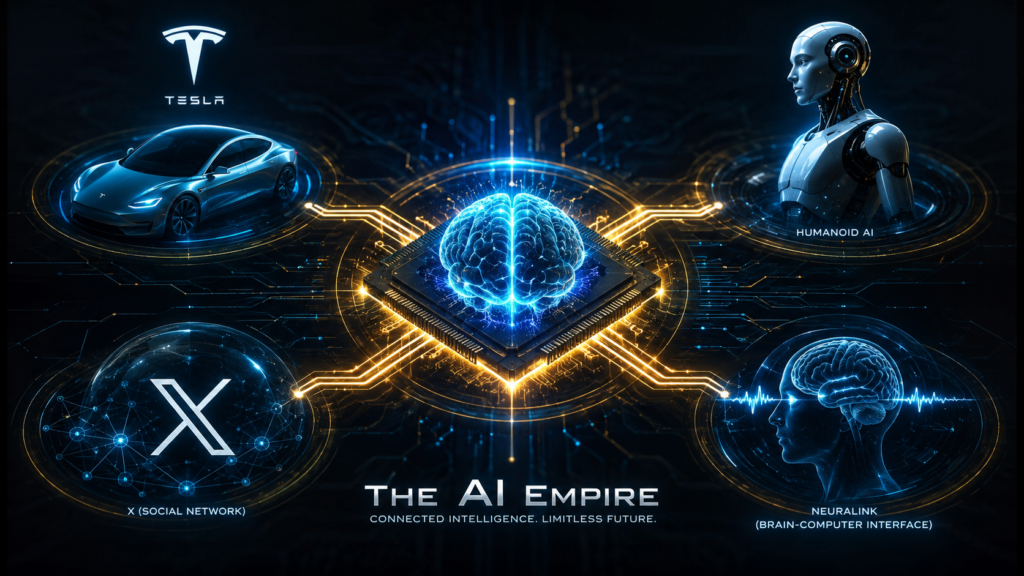
A useful fun fact is that Musk’s AI ambitions span three very different interfaces: a screen through Grok, a machine through Tesla and a biological system through Neuralink. Few technology strategies attempt to connect all three at once.
Original infographic concept
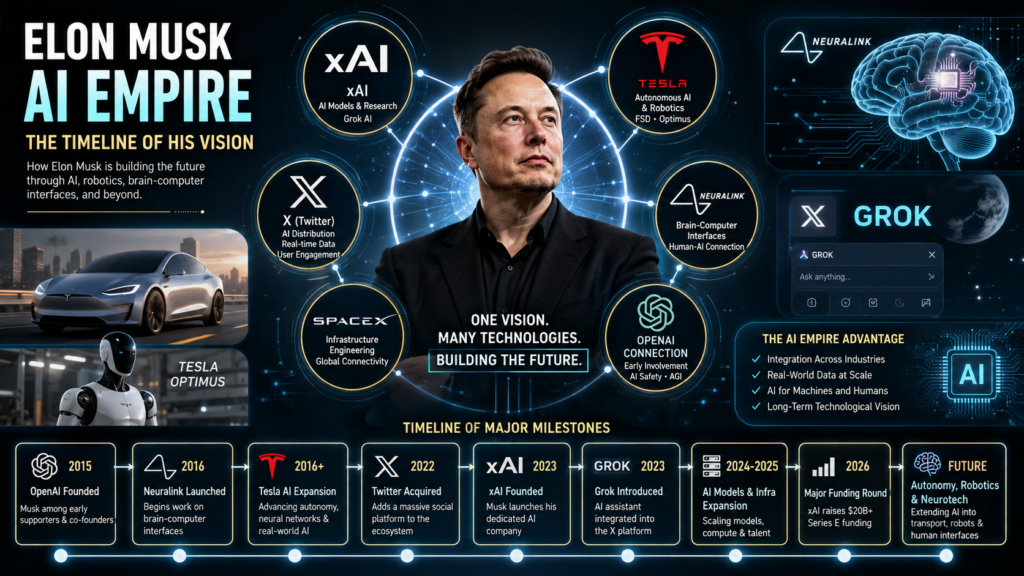
Create a visual titled “Inside the Elon Musk AI Empire” with a central circle labelled “AI Models and Compute.” Connect it to five outer circles:
- xAI: Grok and foundation models.
- Tesla: Full Self-Driving and Optimus.
- X: Distribution, conversations and user engagement.
- Neuralink: Brain-computer interfaces.
- SpaceX: Engineering, infrastructure and long-term technology ambitions.
Use arrows to show the strategic flow:
- Data moves from Tesla and X toward AI development.
- AI capabilities move from xAI toward Grok, vehicles and robots.
- Neuralink represents the human-interface layer.
- A bottom panel can show risks: regulation, safety, cost and trust.
Second Table: Timeline of Major Bets
| Year | Development | AI significance |
|---|---|---|
| 2015 | OpenAI founded with Musk among its early supporters and co-founders | Established Musk’s early public connection to AI safety and AGI |
| 2016 | Neuralink launched | Began work on brain-computer interface technology |
| 2016 onward | Tesla expanded its autonomy and neural-network ambitions | Connected AI with vehicles and real-world driving |
| 2022 | Musk acquired Twitter | Added a major social platform to his technology ecosystem |
| 2023 | xAI founded | Created a dedicated Musk-led AI company |
| 2023 | Grok introduced | Put Musk’s AI assistant inside the X ecosystem |
| 2024–2025 | xAI expanded models and infrastructure | Increased competition with leading frontier AI laboratories |
| 2026 | xAI announced a major Series E funding round | Signalled the scale of capital required for frontier AI |
| Future | Tesla autonomy, Optimus and Neuralink development | Could extend Musk’s AI strategy into transport, robotics and human interfaces |
People Also Ask
What is the Elon Musk AI empire?
The Elon Musk AI empire is the combined network of xAI, Grok, Tesla’s AI programmes, Neuralink, X and related technology initiatives. These projects cover AI models, autonomous vehicles, humanoid robots, social-media distribution, computing infrastructure and brain-computer interfaces.
Which AI company does Elon Musk own?
Elon Musk founded xAI, the company behind Grok. xAI is his main dedicated AI laboratory. Musk also influences AI-related programmes at Tesla, including autonomous-driving software and Optimus robotics, while Neuralink focuses on brain-computer interfaces.
Is Tesla part of Elon Musk’s AI empire?
Yes. Tesla forms a major part of the Elon Musk AI empire because it develops autonomous-driving systems, computer-vision technology and the Optimus humanoid robot. Tesla’s advantage comes from connecting AI software with vehicles, sensors, manufacturing and real-world data.
What is Grok AI?
Grok is an AI assistant developed by xAI and distributed through the X platform. It can answer questions, generate content and interact with current online conversations. Its platform integration distinguishes it from standalone chatbots, although users should still verify important information.
Did Elon Musk help start OpenAI?
Yes. Musk was involved in OpenAI’s founding in 2015, when it began as a nonprofit focused on ensuring that artificial general intelligence benefits humanity. He later left the organisation, and his relationship with OpenAI subsequently became competitive and legally contentious.
How does Elon Musk make money from AI?
Potential AI revenue sources include Grok subscriptions, enterprise API access, Tesla software services, autonomous transportation, robotics and platform monetisation on X. However, several projects remain in development, so projected opportunities should not be treated as guaranteed income.
What is the biggest challenge facing Musk’s AI companies?
The biggest challenge is turning ambitious demonstrations into safe, reliable and profitable products. Musk’s companies must manage high computing costs, regulatory approval, engineering complexity, competition and public trust across multiple industries at the same time.
Final Perspective
The Elon Musk AI empire is best understood as a connected technology strategy rather than a single AI startup. xAI supplies the dedicated AI laboratory, Grok provides a consumer product, X offers distribution, Tesla develops embodied AI and Neuralink explores a direct human-computer interface.
That combination gives Musk unusual reach. Yet reach alone does not guarantee success. The decisive test will be whether these companies can deliver safe products that people and businesses use repeatedly.
For readers interested in the wider business stories behind famous founders, Globe Hustle also covers how Rihanna became a billionaire and Kim Kardashian’s net worth. If you are building an authority-focused website, learn more about how to hire an AI SEO content writer or explore this guide to UK celebrity entrepreneurs and the Dragons’ Den 2026 list.
The most important question is no longer whether Musk is investing in AI. He clearly is. The more revealing question is whether his unusual combination of AI, vehicles, robotics, platforms and neurotechnology can become one coherent and commercially durable ecosystem.
Author Bio
About the Author:
The author is an SEO content strategist and technology writer specialising in artificial intelligence, billionaire entrepreneurs, emerging technology and digital business models. Their work combines search-intent research, source verification and reader-friendly explanations to help audiences understand fast-changing technology markets.