
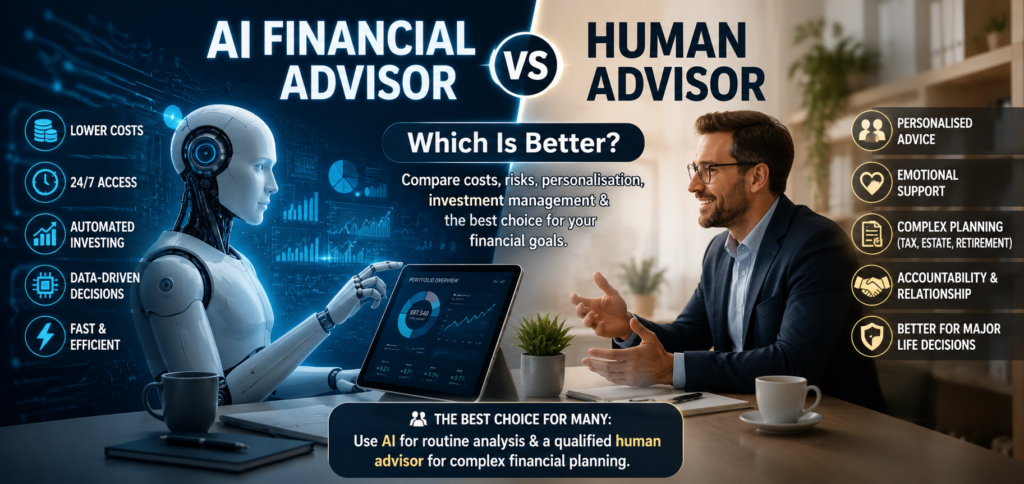
Quick Summary
An AI financial advisor tends to work best for low-cost, automated investing and simple portfolios. A human advisor earns their fee when things get complicated retirement, tax, estate planning, or decisions that come loaded with emotion. For most people, the smartest move isn’t picking a side. It’s using AI for the routine stuff and bringing in a qualified human when the stakes get higher.
Highlight
- AI financial advisors bring automation, lower fees, and access whenever you need it.
- Human advisors bring judgement, coaching, and someone to hold you accountable.
- AI tends to shine with simple, diversified portfolios and everyday investment tasks.
- Humans matter more once taxes, retirement income, estate planning, or business wealth enter the picture.
- A robo-advisor and a general AI chatbot aren’t the same thing don’t assume otherwise.
- Always check fees, regulation, data policies, conflicts of interest, and account security before you commit.
- For a lot of investors, blending AI tools with human oversight ends up being the strongest setup.
Featured Snippet Table
| Factor | AI financial advisor | Human financial advisor |
|---|---|---|
| Typical strength | Automation and portfolio management | Personalised planning and judgement |
| Cost | Usually lower | Usually higher |
| Availability | Often available 24/7 | Usually appointment-based |
| Best for | Simple goals and diversified portfolios | Complex financial situations |
| Emotional support | Limited | Strong |
| Tax and estate planning | Often limited | More comprehensive |
| Main risk | Inaccurate, generic or incomplete recommendations | Higher fees or conflicts of interest |
| Best overall choice | Efficient routine investing | Complex, personal planning |
AI Financial Advisor vs Human Advisor: The Real Difference
Picking between an AI financial advisor and a human one shouldn’t come down to “which sounds more modern.” It should come down to what your financial life actually looks like.
An AI financial advisor is a digital system — algorithms, automation, sometimes genuine machine learning — built to help with budgeting, investing, portfolio monitoring, and financial planning. A human advisor does something different. They bring technical knowledge, sure, but they also bring judgement, conversation, and a sense of responsibility for the fuller picture of your life.
That distinction actually matters more than people think. A 25-year-old with a straightforward portfolio might just want low fees and a system that rebalances itself quietly in the background. But someone five years from retirement? They’re usually dealing with tax-efficient withdrawals, rising healthcare costs, inheritance questions, and the gut-punch of watching markets swing right when they can least afford it.
So who wins? Honestly, it depends what you’re optimising for. AI tends to win on cost and convenience. Humans tend to win on context and judgement calls that don’t fit neatly into a form. For a lot of households, the real answer isn’t AI or human — it’s a thoughtfully managed mix of both.
What AI Financial Advisors Do Best
AI is very good at one thing in particular: processing huge amounts of information without getting tired, distracted, or emotional. It doesn’t panic when the market drops 8% in a week, and it doesn’t get greedy when a stock is on a hot streak.
Depending on the platform you use, an AI-powered service might help you:
- Build a portfolio matched to your risk tolerance
- Automate regular contributions
- Rebalance investments when allocations drift
- Track spending and savings patterns
- Compare financial products side by side
- Model out different saving scenarios
- Monitor accounts and send alerts
- Answer basic personal finance questions
- Flag possible tax-loss harvesting opportunities
Say you want a diversified portfolio and automatic monthly investing without the hassle of booking a call every time you want to tweak something. A digital platform can genuinely handle most of that grunt work. You set your preferences, link your accounts, and check in whenever you feel like it.
There’s real accessibility value here too. You can glance at your portfolio at 11pm on a Sunday, or ask a basic question without waiting for office hours. That matters a lot for people who feel out of place walking into a traditional advisory firm, or who simply haven’t built up enough assets yet to justify full-service fees.
That said, convenience isn’t the same thing as complete advice. A system only knows what you tell it and it’s surprisingly easy to leave out details you didn’t even realise mattered.
What Human Advisors Do Best
Where AI processes data, a human advisor reads you. They can ask a follow-up question, notice hesitation in your voice, and dig into things that a questionnaire would never think to ask.
A good adviser typically helps coordinate:
- Retirement income planning
- Tax planning alongside a CPA or tax adviser
- Estate and inheritance planning
- Insurance reviews
- Financial decisions tied to owning a business
- Charitable giving
- Education funding
- Investment decisions during a market crash
- Family conversations about money
- Changes after divorce, illness, or bereavement
Here’s a useful way to think about it. Imagine two people with identical incomes and identical portfolios. One shrugs off a market dip. The other sells everything in a panic the moment their balance drops 15%. An algorithm can calculate risk capacity all day long, but it can’t talk someone down from a bad decision the way a trusted adviser can.
This becomes even more important when several decisions start overlapping because in real life, they usually do. Retirement withdrawals affect your tax bill. Selling a business changes your estate plan. A new job shifts your pension contributions and insurance needs. None of that fits into a single automated recommendation; it needs someone actually coordinating the pieces.
Cost and Convenience
Cost is usually the first thing people compare, and fair enough it’s the easiest number to point to. Digital investing services generally charge less than traditional full-service advice, though pricing swings quite a bit depending on the provider, your account size, and the service tier you pick.
You might come across:
- A percentage of assets under management
- A fixed monthly subscription
- A flat financial planning fee
- Hourly advice rates
- Trading or transaction costs
- Fund expense ratios
- Premium charges for access to an actual human
Don’t just compare the headline number, though. A cheap platform fee might not include tax planning or human support at all. Meanwhile, a human adviser’s fee might already cover meetings, a full financial plan, account coordination, and the kind of behavioural coaching that quietly saves you from your own worst instincts during a crash.
The FINRA Investor Bulletin suggests checking whether an automated service genuinely fits your goals, understanding what data it’s using to build your portfolio, and paying close attention to how fees erode long-term returns small percentage differences compound into real money over decades. You can read their guidance directly on the FINRA website.
If you’re in the US, the SEC’s Investment Adviser Public Disclosure database lets you verify an adviser’s registration and background before you hand over a cent. UK readers should run the same check through the FCA Financial Services Register.
Personalisation and Investment Decisions
AI can personalise recommendations up to a point. It’ll usually ask about your age, income, goals, timeline, and risk tolerance, then spit out a portfolio based on your answers.
That works fine when your life is fairly simple. But a questionnaire, no matter how well designed, misses things.
A human adviser is far more likely to actually ask:
- Do you expect a large inheritance?
- Is your income likely to change soon?
- Do you own a company?
- Are you supporting children or ageing parents?
- Do you hold restricted stock or a concentrated position?
- How would you really react to a two-year market slump?
- Do you have ethical or faith-based investing preferences?
- What happens if you retire five years earlier than planned?
AI can absolutely support financial planning, but it can also produce advice that’s generic or flat-out incomplete the moment your situation drifts away from the norm. There’s growing concern among researchers and industry commentators about inconsistent or even biased personal finance suggestions coming out of generative AI tools, something worth keeping in mind before you take any single answer as gospel, as CNBC has reported.
None of that makes AI useless. It just means you should treat it like a smart assistant, not an oracle.
Regulation, Fiduciary Duty and Trust
Here’s a difference that doesn’t get talked about enough: responsibility.
A registered investment adviser may owe you a fiduciary duty, depending on the legal relationship and the services they provide. A general-purpose chatbot doesn’t automatically carry that same obligation just because it happens to answer money questions well.
So before trusting any digital service with your finances, it’s worth asking:
- Is the company actually regulated?
- Is this a robo-adviser, an AI assistant, or some blend of both?
- Who reviews the recommendations it gives?
- How does it disclose conflicts of interest?
- What happens if it gives you genuinely bad advice?
- How is your financial data protected?
- Can you reach an actual human if you need one?
The SEC has continued to focus on fiduciary duty, investor protection, and governance as more firms bring AI into their advisory processes and its 2026 guidance makes the point clearly that technology doesn’t erase an adviser’s underlying responsibilities, as noted in SEC commentary.
Worth remembering, too: a human adviser isn’t automatically trustworthy just for being human. You still need to check credentials, fee structures, disciplinary history, and how they actually get paid.
AI Financial Advice Risks
AI has a habit of sounding confident even when it’s wrong. That’s a genuinely dangerous trait in personal finance, because a smooth, well-written answer can push someone into acting faster than they should.
Watch out for:
- Hallucinated facts or invented sources
- Outdated tax or regulatory information
- Generic advice built on incomplete inputs
- Biased recommendations
- Misreading local rules that vary by country or state
- Poor handling of unusual investments
- Privacy and data-security gaps
- Overconfidence during genuinely uncertain markets
- Missing family or estate context entirely
A prompt as simple as “where should I invest my savings?” just doesn’t give an AI enough to work with for responsible, personalised advice. The right answer changes wildly depending on your debt, emergency fund, tax situation, timeline, and risk appetite.
A decent rule of thumb: use AI to sharpen your questions and organise your information. Before you make anything irreversible or high-value, double-check the answer against official sources or a qualified professional.
When AI May Be the Better Choice
An AI financial advisor or robo-advisor is probably a solid fit if:
- Your financial situation is genuinely simple
- You want a diversified, long-term portfolio
- Lower fees matter more to you than hand-holding
- You like automatic contributions and rebalancing
- You’re comfortable making your own calls
- Basic tracking and alerts are enough for you
- You don’t need detailed tax or estate planning
- You’re starting out with a modest balance
AI can also help with the everyday grind of managing money. An AI budgeting app, for example, can categorise your spending and flag recurring costs you forgot you were paying for. If that’s useful to you, our guide to AI budgeting apps is worth a look.
When a Human Advisor May Be Better
A human advisor tends to earn their fee once your situation involves:
- Being within a few years of retirement
- Needing an actual income withdrawal strategy
- Owning a business
- Facing genuinely complex tax issues
- Holding concentrated company stock
- Estate or inheritance planning
- Substantial assets that need real coordination
- Managing wealth across a family
- Struggling to stay disciplined when markets fall
- A major life event reshaping your priorities
In these cases, the adviser’s value rarely comes from picking one fund over another. It comes from stitching together a complete plan that actually holds together.
The Case for a Hybrid Approach
This doesn’t have to be AI versus human. Honestly, framing it that way misses the point. A hybrid model is often the most practical route.
Let AI handle:
- Budget tracking
- Portfolio monitoring
- Basic investment research
- Scenario comparisons
- Meeting prep
- Organising financial documents
- Generating questions to ask your adviser
Then bring in a human for:
- Retirement decisions
- Tax planning
- Estate planning
- Insurance needs
- Major portfolio changes
- Business or inheritance decisions
- Emotional support when markets get ugly
This setup keeps the routine stuff cheap while saving professional fees for decisions where the consequences of getting it wrong are actually serious. And if you’re already leaning on AI for broader productivity and research, our list of best AI tools for productivity can help you get organised before you even walk into that first meeting with an adviser.
A quick rule of thumb
Use AI to make financial work easier. Use qualified human advice when getting it wrong would actually cost you.
A Simple Decision Framework
Before choosing a service, run through this:
- List your goals. Separate short-term savings, investing, retirement, and legacy goals — don’t lump them together.
- Measure complexity. Note taxes, property, business interests, dependants, and whatever accounts you already have.
- Set your advice budget. Include platform fees, fund costs, and any planning charges.
- Check credentials. Verify registration, qualifications, and disciplinary history before trusting anyone with your money.
- Review data policies. Understand exactly how a platform stores and uses your information.
- Test the explanation. If you can’t understand why a service recommends something, that’s a red flag worth taking seriously.
- Choose review points. Reassess after marriage, divorce, inheritance, a job change, or retirement.
If you publish finance or technology content yourself, clear explanations and trustworthy sourcing matter just as much on your end. Businesses that need consistent, well-researched content around AI or personal finance sometimes look into hiring an AI SEO content writer, paired with expert review for anything touching financial claims.
Infographic Concept
“AI vs Human Advisor: Who Should Handle What?”
A designer could build this as a two-column infographic, with a third section for the hybrid model in the middle.
Left column: AI advisor
- Lower-cost automation
- 24/7 access
- Portfolio tracking
- Rebalancing
- Basic scenario modelling
- Simple, diversified portfolios
Right column: Human advisor
- Retirement income
- Tax and estate planning
- Business wealth
- Emotional coaching
- Family decision-making
- Complex or unusual circumstances
Centre or bottom: Hybrid sweet spot
- AI handles routine monitoring
- Human reviews major decisions
- Investor checks fees, regulation, and privacy throughout
A simple scale labelled low complexity → high complexity works well here, with automated tools sitting on the low-complexity end and human planning on the high-complexity end, and the hybrid model stretching across both.
Second Table: Choosing the Right Option
| Investor profile | Best starting point | Why | Human review needed? |
|---|---|---|---|
| Beginner with a simple goal | AI or robo-advisor | Low cost and easy automation | Helpful but not always essential |
| DIY investor | AI research and tracking tools | Faster analysis and organisation | Yes, before major decisions |
| Family building retirement savings | Hybrid approach | Automation plus periodic planning | Recommended |
| Near-retiree | Human or hybrid advisor | Withdrawal and tax decisions matter | Strongly recommended |
| Business owner | Human advisor with AI support | Business, tax, and personal wealth overlap | Essential |
| High-net-worth family | Human-led hybrid model | Estate, tax, and legacy planning get complex fast | Essential |
| Investor prone to panic selling | Human advisor | Behavioural coaching genuinely protects discipline | Strongly recommended |
FAQ
Is an AI financial advisor better than a human advisor?
Neither one wins outright. An AI financial advisor suits low-cost portfolio management and straightforward goals well, while a human advisor adds real value through retirement, tax, estate, and behavioural planning. What actually decides the winner is your portfolio complexity, confidence level, budget, and how much personal guidance you want.
Are AI financial advisors safe to use?
They can be genuinely useful, but safety comes down to the provider, its regulation, data security, and the quality of what it recommends. Don’t assume every chatbot counts as a regulated investment adviser. Check the platform’s disclosures, fees, and privacy policy before you connect any accounts.
Can AI replace human financial advisors?
AI is good at automating routine monitoring, portfolio admin, and basic analysis. But human advisors still bring judgement, accountability, emotional coaching, and the ability to coordinate across tax, estate, and retirement issues. AI is more likely to reshape the adviser’s role than eliminate the need for one altogether.
How much does an AI financial advisor cost?
Costs range from free basic tools to monthly subscriptions or a percentage of assets under management. Also check fund expense ratios, trading charges, account minimums, and any premium fees for human support. The cheapest option on paper isn’t always the best value for your actual situation.
Is a robo-advisor the same as an AI financial advisor?
Not quite. A robo-advisor usually means an automated digital investment service that builds and manages portfolios algorithmically. “AI financial advisor” is the broader term — it can include robo-advisors, dedicated planning software, and general-purpose chatbots, and their regulation and capabilities can differ quite a bit.
Should I use AI for retirement planning?
AI can help you organise information, compare scenarios, and figure out what questions to ask. But retirement planning also involves taxes, inflation, longevity, healthcare, withdrawal strategy, and circumstances that keep shifting. Treat AI as a planning assistant, then verify the important assumptions with a qualified adviser or tax professional.
What is the best choice for complex wealth?
A qualified human advisor, ideally backed by good technology, is usually the safer starting point once wealth gets complex. Business ownership, inheritance, trusts, concentrated holdings, and estate decisions all need real context that AI still struggles to capture. A hybrid setup can still lean on AI for reporting and routine monitoring underneath it all.
Author Bio
About the Author
The author is an SEO and personal-finance content specialist who writes about financial technology, investing tools, and digital wealth management in plain, practical language. Their work leans on evidence-based comparisons, responsible AI use, and consumer protection, aimed at helping readers actually make informed decisions rather than just react to headlines. This article is educational and doesn’t offer personalised financial, tax, or investment advice.
Editorial note: Financial products, fees, and regulations change over time. Readers should verify current details directly with the provider, the relevant regulator, or a qualified professional before making any financial decisions.