
Quick Summary
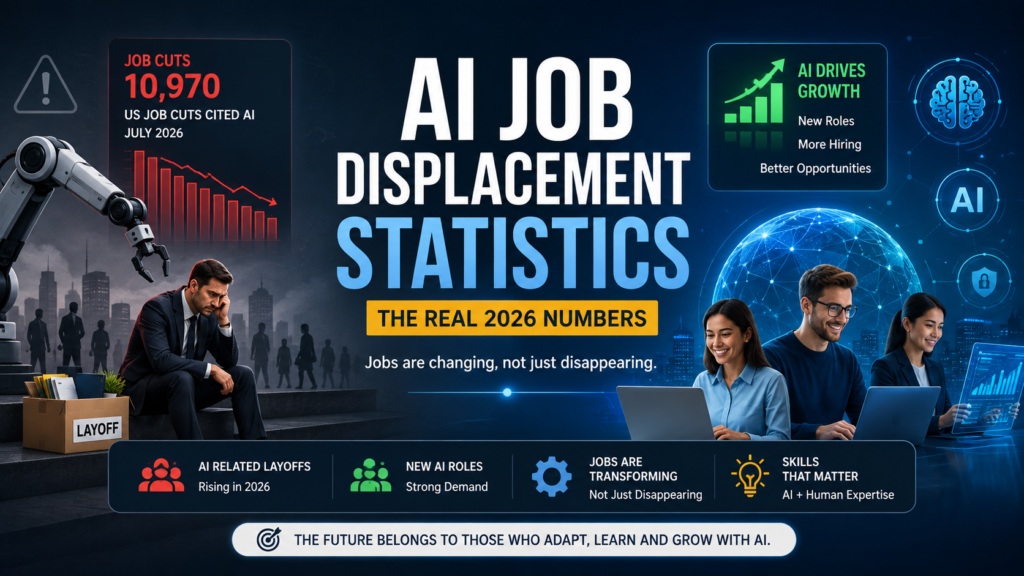
AI is cutting some jobs, creating others and changing many roles in between. In July 2026, US employers cited AI in 10,970 announced job cuts. At the same time, surveys found more organisations reporting AI-related hiring than workforce reductions. The honest answer is not “jobs versus no jobs”; it is job loss, creation and transformation happening together.
Highlight
- AI-related layoffs are rising, but an announced layoff is not proof that AI alone replaced a worker.
- Challenger reported 10,970 US job cuts linked to AI in July 2026.
- Snowflake and Omdia found more organisations reporting AI-related job creation than job losses.
- Routine digital tasks face the most immediate automation pressure.
- AI is creating demand for engineering, cybersecurity, data, governance and integration skills.
- Many jobs will change rather than disappear completely.
- The safest career strategy combines AI literacy with judgement, communication and real industry expertise.
Featured Snippet Table
| Question | Short answer |
|---|---|
| Is AI causing job losses in 2026? | Yes. Some US employers are citing AI when announcing layoffs. |
| Is AI creating jobs too? | Yes. Organisations are hiring for technical, operational and AI-related roles. |
| How many US cuts cited AI in July 2026? | 10,970 announced job cuts, according to Challenger. |
| Does every AI-related cut equal a job replaced? | No. Layoffs may also involve restructuring, cost-cutting or weaker demand. |
| Which tasks face the most pressure? | Repetitive administration, data entry, basic support, moderation and routine coding. |
| Which skills are becoming more valuable? | AI use, critical thinking, judgement, leadership, communication and domain expertise. |
| What is the bigger employment trend? | AI is eliminating some tasks while reshaping and expanding other kinds of work. |
The Real AI Jobs Story
Open LinkedIn today and you will probably see two completely different stories.
One headline warns that AI is taking people’s jobs. Another celebrates a company hiring hundreds of AI engineers. Both stories can be true at the same time.
That is what makes AI job displacement statistics difficult to interpret. The numbers do not all measure the same thing. Some reports count announced layoffs. Others track job adverts, survey employers or predict what may happen several years from now.
AI job displacement statistics measure how technology reduces, removes or changes human work through automation, restructuring, reduced hiring or redesigned roles. They do not always tell us how many people AI has permanently replaced.
That distinction is not just technical wording. It changes the entire conversation.
If a company says AI contributed to 1,000 job cuts, we can report that statement. However, we should not automatically claim that AI replaced 1,000 workers. The company may also have been dealing with falling demand, a merger, high costs or a wider restructuring plan.
What the 2026 Layoff Data Says
The most useful short-term source for US job cuts is Challenger, Gray & Christmas. The organisation tracks layoff announcements and records the reasons employers give for those decisions.
In July 2026, US employers announced 33,429 job cuts. Challenger reported that companies cited artificial intelligence in 10,970 of those announcements. AI was the leading stated reason for cuts for the fifth consecutive month. challengergray
That number sounds alarming, and it deserves attention. Still, it needs the right label:
10,970 jobs were included in US layoff announcements where employers cited AI as a reason.
That is different from saying:
AI independently replaced 10,970 workers.
Why? Because businesses rarely make employment decisions for one reason only. A company might introduce automation while also reducing costs, closing a department or changing its product strategy.
When you read AI job loss statistics, look for these details:
- Is the figure based on announced cuts or completed redundancies?
- Did employers identify AI as the only reason?
- Does the number cover one month or several years?
- Does it refer to the US, the UK or the global economy?
- Does it count jobs, workers, tasks or organisations?
- Does it include reduced hiring, or only layoffs?
A credible article should answer those questions before drawing a conclusion.
Are More Jobs Being Created?
The creation side of the debate usually comes from company surveys and job-posting analysis.
Snowflake and Omdia reported that 77% of surveyed organisations saw AI-driven job creation, while 46% reported AI-related workforce reductions. finance.yahoo
That result is encouraging, but it needs careful reading. The percentages describe organisations, not the total number of jobs. They do not tell us whether companies created ten jobs or ten thousand jobs.
Still, the survey captures something important. AI adoption does not always lead to a smaller workforce. In some businesses, it helps teams produce more, launch new services and expand into areas that were previously too expensive.
AI can create work in several ways:
- A new AI product needs engineers and product managers.
- Automated systems require testing and monitoring.
- Companies need people to check data quality.
- AI systems create cybersecurity and privacy concerns.
- Employees need training and workflow support.
- Organisations need governance, compliance and risk controls.
- New technology creates demand for implementation specialists.
There is also a quieter form of job creation. A company may not advertise a completely new role, but it may add AI responsibilities to an existing one.
A marketing specialist may become responsible for AI-assisted campaign design. A customer-service manager may oversee automated support and handle complex cases. A finance analyst may spend less time collecting data and more time explaining what it means.
The job title stays the same. The work changes underneath it.
AI Job Displacement Statistics and Job Transformation
Boston Consulting Group estimates that AI could reshape 50% to 55% of US jobs over the next two to three years. Its analysis makes a useful point: automating a task does not necessarily eliminate the entire occupation. bcg
Think about a restaurant manager. AI might help forecast demand, prepare staff schedules and analyse sales. Yet the manager still needs to lead people, resolve complaints, maintain standards and make decisions when the numbers do not tell the full story.
The same pattern appears in many professions.
In an office
AI may draft emails, summarise meetings and organise documents. The employee still manages relationships, handles confidential information and makes decisions.
In software development
AI may produce routine code quickly. Developers still need to test it, protect systems, understand users and solve problems that the model has not seen before.
In healthcare
AI may help sort information or flag possible concerns. Professionals still need to understand the patient, explain options and take responsibility for care.
In education
AI may create lesson ideas or personalise exercises. Teachers still motivate students, manage classrooms and notice emotional or learning difficulties.
This is why “AI will replace every job” is too simple. The more useful question is:
Which parts of this job can AI perform, and which parts still require a person?
Which Jobs Face the Most Pressure?
Jobs face higher automation pressure when they involve repetitive digital work with predictable rules.
Roles and tasks that may experience earlier disruption include:
- Basic data entry.
- Routine administrative processing.
- Template-based reports.
- Simple customer-service queries.
- Transcription and document formatting.
- Repetitive bookkeeping.
- Basic online research.
- Content rewriting.
- Simple translation.
- Routine coding.
- Standard spreadsheet analysis.
- First-level content moderation.
That does not mean every person in these jobs will lose employment. Some employers may move workers into quality control, customer relationships, sales, supervision or more complex support.
However, entry-level workers may feel the change first. Junior employees traditionally learn through routine assignments. If software handles those assignments, graduates may have fewer chances to develop experience.
That creates a difficult question for employers and educators: how do people become senior professionals if they cannot access the beginner work that once trained them?
Where New AI Roles Are Growing
The most obvious new opportunities sit inside technology, but the wider AI economy needs more than programmers.
Current demand is also growing around:
- Machine learning systems.
- Data quality and analysis.
- Cloud infrastructure.
- Cybersecurity.
- AI product management.
- Model testing and evaluation.
- Data governance.
- AI compliance.
- Robotics.
- Workflow design.
- Technical implementation.
- AI training and support.
PwC’s 2026 AI Jobs Barometer analysed more than one billion job adverts across 27 countries and territories. It found that AI is helping create a two-track labour market, where some professional roles become more specialised while other roles become easier to perform with AI support. pwc
That finding offers a more realistic career lesson. You do not necessarily need to become a machine learning engineer. You do need to understand how AI affects your industry.
A nurse who understands healthcare technology, a lawyer who can review AI-generated documents and a financial analyst who can validate automated forecasts may all benefit from combining professional knowledge with AI skills.
The winning combination is often not “technical skill alone”. It is:
AI literacy plus strong judgement plus knowledge of a real-world industry.
What the Global Forecasts Say
Short-term data tells us what employers are doing now. Forecasts tell us what researchers expect over a longer period. These figures should never be presented as if they are interchangeable.
The World Economic Forum projects that global labour-market changes could create 170 million jobs and displace 92 million jobs by 2030. That would produce a net gain of 78 million roles, but the transition would still force many workers to change careers, industries or skill sets. weforum
That is a forecast, not a final result.
A careful article should say:
The World Economic Forum projects 170 million new roles and 92 million displaced roles by 2030.
It should not say:
AI has already created 170 million jobs.
The forecast includes several forces affecting work, not AI alone. Technology, demographic change, economic conditions and the green transition also influence the result.
For US occupation-level context, the U.S. Bureau of Labor Statistics provides employment projections for technology and AI-related occupations. These projections differ from monthly layoff data because they examine longer-term changes in employment. bls
What Workers Can Do Now
The most practical response is not panic. It is a task audit.
Look at your current role and divide your work into three groups.
Tasks AI may automate
These usually include repetitive drafting, sorting, formatting, summarising and basic data processing.
Tasks AI may assist
These may include research, reporting, planning, coding, forecasting and customer communication.
Tasks that still need human judgement
These include leadership, negotiation, empathy, relationship-building, accountability and difficult decision-making.
Once you see the difference, your next step becomes clearer.
Build skills that help you work well with technology:
- AI tool use.
- Fact-checking and verification.
- Data interpretation.
- Clear writing and communication.
- Workflow design.
- Cybersecurity awareness.
- Industry-specific knowledge.
- Critical thinking.
- Project management.
- Ethical decision-making.
You do not need to learn every AI tool that appears on social media. Choose one that fits your work and learn it properly.
For example, professionals who manage websites or digital businesses can explore privacy-focused AI browsers and tools for small businesses while paying attention to data security and company policies.
Human Skills Are Becoming More Valuable
There is a common assumption that technical skills are the only protection against automation. In practice, employers also need people who can think clearly and take responsibility.
AI can produce an answer quickly. It cannot always recognise when the question itself is wrong.
People remain valuable when they can:
- Explain complex information simply.
- Notice errors in automated output.
- Make decisions with incomplete information.
- Build trust with customers.
- Lead teams through change.
- Negotiate when interests conflict.
- Understand emotional and cultural context.
- Take responsibility for an outcome.
PwC’s 2026 findings also highlight the growing importance of judgement, creativity and leadership as AI changes the skills employers value. pwc
A useful way to put it is:
The future workplace will not only ask whether you can use AI. It will ask whether you know when not to trust it.
How to Read AI Employment Data
Before sharing a statistic, identify its category.
| Data type | What it measures | What it cannot prove |
|---|---|---|
| Layoff announcements | Planned job cuts and employer-stated reasons | That AI alone caused every cut |
| Job adverts | Hiring demand and skill requirements | That every advertised role was filled |
| Employer surveys | Organisations reporting gains or losses | The exact number of workers affected |
| Employment projections | Expected future changes | What will definitely happen |
| Task-exposure studies | Work likely to be affected by AI | That the full occupation will vanish |
This simple check prevents most misleading AI employment headlines.
It also improves SEO and GEO performance. Search engines and answer engines prefer content that explains definitions, dates, scope and methodology. A clear sentence such as “This figure measures announced layoffs, not confirmed replacement” is more useful than a dramatic claim without context.
If your business publishes technology or career content, human editorial review still matters. You can explore hiring an AI SEO content writer for structure and research support, but every statistic should be checked against the original source before publication.
The More Honest Conclusion
So, how many jobs has AI replaced?
There is no single global number that answers the question honestly. Some jobs are being removed. New AI-related jobs are emerging. Many existing occupations are being redesigned from the inside.
The strongest evidence points towards a labour market in transition rather than a simple employment collapse.
Some workers will face real disruption, especially when their roles depend heavily on repetitive digital tasks. Others will find new opportunities by combining professional knowledge with AI tools. Companies that use AI well may hire more in some areas while reducing headcount in others.
The better question is not, “Will AI take my job?”
It is:
“Which parts of my work are becoming automated, and which valuable human abilities can I develop next?”
Second Table: A Practical AI Career Roadmap
| Stage | Action | Example |
|---|---|---|
| 1. Audit | List your daily tasks | Separate repetitive work from judgement-led work |
| 2. Identify risk | Find tasks AI can already perform | Data entry, summaries or routine reports |
| 3. Choose one tool | Learn software used in your field | An AI research, coding or scheduling tool |
| 4. Verify output | Check accuracy and sources | Compare AI results with official information |
| 5. Add human value | Strengthen communication and judgement | Explain decisions and manage relationships |
| 6. Build evidence | Track improvements | Record time saved or quality increased |
| 7. Review regularly | Update your plan every six to twelve months | Follow changes in your industry |
Original Infographic Concept
“The AI Work Shift: Lost, Changed and Created”
Design a three-part visual:
Red section: Work under pressure
- Data entry.
- Routine administration.
- Basic support.
- Template content.
- Simple coding.
Blue section: Work being reshaped
- Marketing with AI research.
- Software development with AI-assisted coding.
- Finance with automated analysis.
- Customer service with human escalation.
- Administration with AI scheduling.
Green section: New and growing work
- AI engineering.
- Cybersecurity.
- Model testing.
- Data governance.
- AI implementation.
- AI compliance.
- Robotics.
Place this sentence at the bottom:
“AI can remove one task, change another and create a new responsibility at the same time.”
Use Challenger for layoff data, Snowflake/Omdia for organisation-level survey data, BCG for job transformation and PwC for global job-ad analysis.
People Also Ask
How many jobs has AI replaced in 2026?
There is no single verified global total for jobs permanently replaced by AI in 2026. Challenger tracks US layoff announcements where employers cite AI as a reason, but those announcements do not prove that AI alone replaced every worker. Researchers must separate layoffs, reduced hiring, task automation and redesigned roles.
Does AI create more jobs than it destroys?
Some surveys suggest that more organisations report AI-related job creation than workforce reductions. Snowflake and Omdia found 77% reporting job creation and 46% reporting losses. However, these percentages count organisations rather than individual jobs, so they do not provide a final global total.
What jobs are most at risk from AI?
Routine work with predictable digital steps faces the most immediate pressure. Examples include basic data entry, administrative processing, simple customer support, template-based writing and some entry-level coding. Exposure does not guarantee job loss because employers may automate particular tasks while keeping and redesigning the wider occupation.
What jobs will AI create?
AI is creating demand for machine learning, data analysis, cybersecurity, system integration, model evaluation, AI governance, product management and technical implementation. It is also adding AI responsibilities to existing roles. Workers who combine AI literacy with deep industry knowledge may benefit most from these changes.
Will AI replace entry-level jobs?
AI may reduce some beginner tasks, particularly routine writing, research, support and coding. However, it will not eliminate every entry-level job. The bigger challenge is career development: graduates may receive fewer traditional training assignments. Employers will need new ways to help beginners gain practical experience.
How can workers prepare for AI disruption?
Start by reviewing your daily tasks and identify which AI can automate, assist or not easily perform. Learn one relevant tool, improve your ability to check information and strengthen communication, judgement and industry expertise. Workers who can supervise AI and apply its output responsibly may remain highly valuable.
Author Bio
About the Author
The GlobeHustle editorial team covers artificial intelligence, workplace technology, digital careers and the future of work. Its research-led articles explain complex technology trends in clear language, distinguish measured results from forecasts and offer practical guidance for workers, businesses and job seekers. This article is educational and does not provide individual employment or career advice.