What Is Off-Site GEO for B2B SaaS?
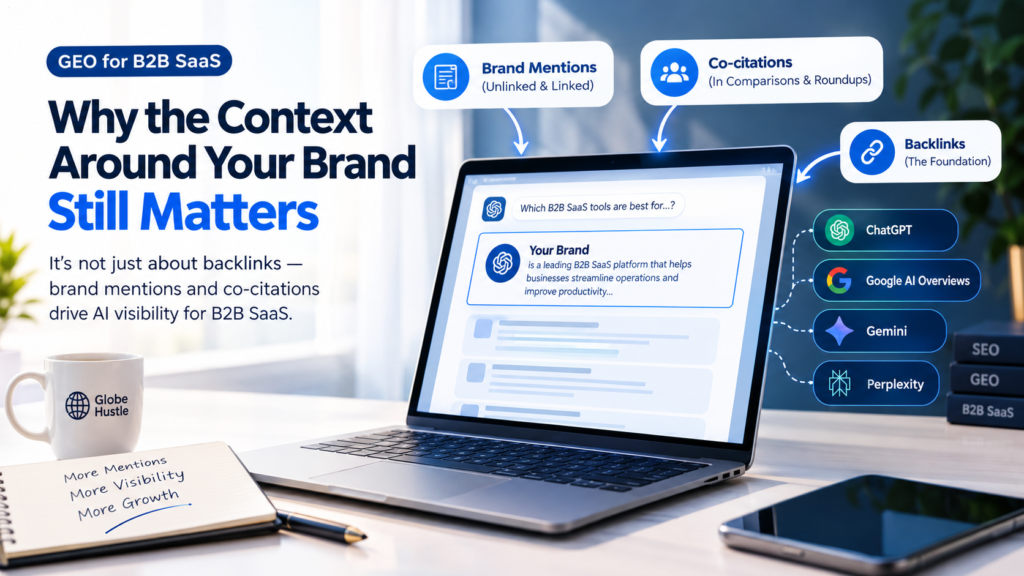
Off-site Generative Engine Optimization (GEO) is the process of building your brand’s visibility and credibility across websites beyond your own domain. For B2B SaaS companies, this includes earning relevant brand mentions, appearing in industry comparisons, getting featured in expert roundups and building backlinks from trusted publications.
The goal is to help AI-powered search systems discover your brand, understand what your business does and potentially reference it when answering relevant questions.
Traditional SEO focuses heavily on improving search rankings through content quality, technical optimization and backlinks. GEO builds on these foundations by considering how your brand is represented across the wider web.
For example, when someone asks ChatGPT, Perplexity or Google AI Overviews to recommend project management software, your SaaS product may have a better chance of being considered if relevant websites discuss its features, compare it with competitors or recommend it for a particular use case.
This does not guarantee an AI citation. However, it gives your brand more opportunities to be discovered and understood in relevant contexts.
In her article on GEO and customer acquisition costs for B2B SaaS, Asmara Khan explores the on-site side of GEO, including direct answers, structured content and schema markup.
These techniques help make your website content easier to understand and extract. Off-site GEO addresses the other side of the challenge: establishing your brand’s presence and relevance beyond your own website.
Backlinks vs. AI Citations: What’s the Difference?
Backlinks and AI citations are related, but they are not the same thing.
Understanding the difference helps B2B SaaS marketers develop a more balanced search visibility strategy instead of focusing exclusively on link counts.
What Are Backlinks?
A backlink is a hyperlink from one website to another. Search engines can use links as signals when evaluating the relationships and authority of web pages.
For a B2B SaaS business, a backlink from a relevant industry publication may help search visibility, referral traffic and brand discovery.
For example, a cybersecurity software company receiving a link from a respected cybersecurity publication may benefit because the linking website covers a closely related subject.
However, not all backlinks provide equal value. Relevance, editorial quality, placement and the overall credibility of the linking page matter more than simply accumulating large numbers of links.
What Are AI Citations?
An AI citation occurs when an AI-powered search or answer system references a source while responding to a user’s question.
Depending on the platform and interface, the system may provide a clickable source link, mention a brand by name or incorporate information from a page into its answer.
For example, a user might ask:
“Which customer support platforms are best for small B2B SaaS companies?”
An AI-generated answer could reference a software comparison article that discusses several products. Your company might be mentioned because the article explains its features, pricing or suitability for a specific audience.
A backlink is not required for every possible brand mention, and a brand mention does not automatically produce an AI citation.
Why the Difference Matters
A website can have a substantial backlink profile but still receive limited visibility in particular AI-generated answers. Another company may have fewer backlinks but appear frequently in relevant comparison articles and industry discussions.
Several factors could explain the difference, including content relevance, brand familiarity, source availability and the way each platform retrieves and selects information.
The practical lesson is straightforward: B2B SaaS companies should monitor both their link profiles and their broader brand presence across relevant online sources.
What Does the Research Say About Brand Mentions and AI Visibility?
Research into AI search visibility has examined the relationships between traditional SEO signals, brand mentions and AI-generated answers.
Several widely discussed studies offer useful evidence, although their findings should be interpreted carefully.
Semrush: Authority and AI Mentions
Semrush published research examining relationships between website authority and AI visibility. Its findings have been discussed as evidence that established domain authority can be associated with greater visibility in AI-generated answers.
This supports the idea that traditional SEO foundations remain relevant to GEO.
However, an association between authority and AI visibility does not establish a universal authority threshold. Different platforms use different retrieval systems, and their source-selection methods can change over time.
Ahrefs: Brand Mentions and Google AI Overviews
Ahrefs has published research examining how backlinks and brand mentions relate to visibility in Google AI Overviews.
One reported analysis of 75,000 brands found a correlation of approximately 0.664 between unlinked brand mentions and AI Overview visibility, compared with approximately 0.218 for backlinks.
These figures suggest that brand mentions may be a useful signal to investigate when assessing AI search visibility.
However, correlation does not establish causation. Well-known brands may naturally receive more mentions, stronger backlinks and greater search visibility at the same time.
The figures should therefore be treated as evidence of an observed relationship, not proof that brand mentions directly cause AI Overview placements.
SALT.agency: Backlinks Across AI Platforms
Research attributed to SALT.agency has also examined relationships between backlinks and visibility across AI platforms, including ChatGPT, Perplexity and Gemini.
Reported correlations have varied by platform, with moderate relationships for some systems and a weaker relationship for Google AI Overviews.
This variation reinforces an important point: AI search is not a single, uniform ranking system.
A signal that is associated with visibility on one platform may have a different relationship with visibility on another.
For a deeper discussion of these findings, read our breakdown of backlinks and AI citations.
Important: These studies use different datasets, methodologies and definitions of visibility. Compare their findings cautiously rather than treating their correlation figures as directly interchangeable.
The Authority Threshold: Why Backlinks Still Matter
A common mistake in GEO strategy is assuming that brand mentions can replace traditional SEO entirely.
That is not a sound assumption.
A new SaaS website with limited content, almost no organic visibility and few credible external references may struggle to gain visibility in competitive search environments. Publishing brand mentions alone will not necessarily solve those underlying problems.
Backlinks can support discovery, strengthen a website’s overall search presence and help search engines understand relationships between pages and domains.
At the same time, accumulating more backlinks does not guarantee more AI citations.
Why More Links Do Not Always Mean More AI Visibility
Consider two hypothetical B2B SaaS companies.
Imagine two B2B SaaS companies with different approaches to building online visibility.
The first has accumulated hundreds of backlinks from various websites, but few of those pages discuss its product in meaningful detail.
The second has fewer backlinks but receives coverage in relevant industry publications, detailed software comparisons and expert discussions that explain its product’s value.
As a result, the second company may have more relevant brand references for certain buyer queries, despite having fewer backlinks overall.
This example is illustrative rather than a prediction of which company will perform better.
The broader lesson is that link quantity alone cannot explain every difference in AI visibility.
How to Apply This to Your SaaS Strategy
If your website is new, prioritize the fundamentals first:
- Publish useful pages that address real customer questions.
- Improve technical SEO and ensure important pages can be crawled and indexed.
- Earn relevant, editorially justified backlinks.
- Develop clear product pages that explain your features, use cases and audience.
- Build your brand presence through credible industry publications and communities.
Once these foundations are in place, expand your efforts into brand mentions, comparison coverage and other off-site GEO activities.
How Different AI Search Platforms Discover and Reference Brands
Treating every AI platform as if it uses the same source-selection process can lead to ineffective optimization decisions.
The systems differ in how they retrieve information, use search indexes and generate answers. Their behavior also changes as products and search features evolve.
Google AI Overviews
Google AI Overviews are integrated into Google Search and draw on Google’s search and retrieval systems.
Traditional SEO remains relevant because discoverability, helpful content and indexing influence whether pages can be considered for search features.
However, achieving a conventional top-ten ranking does not guarantee inclusion in an AI Overview. Likewise, a ranking position alone cannot explain every citation outcome.
For B2B SaaS companies, useful actions include publishing authoritative product information, answering specific buyer questions and earning relevant references from credible websites.
ChatGPT Search
ChatGPT can use web search to retrieve current information and provide links to sources when appropriate.
Its answers may be influenced by the information retrieved for a particular question, the relevance of available pages and other aspects of the system.
A brand’s presence in relevant online discussions can help make information about its products discoverable. However, there is no universal formula that guarantees a brand will be mentioned in ChatGPT answers.
SaaS teams should test realistic customer queries and record which sources are referenced.
Perplexity
Perplexity is designed around answering questions with retrieved information and source references.
The availability and relevance of recent information can matter for queries involving current products, pricing, features or industry developments.
For this reason, B2B SaaS companies should keep their important product information accurate and maintain useful pages that explain current capabilities.
Participating in relevant communities and earning genuine editorial coverage may also help expand the range of sources discussing a brand.
Google Gemini
Gemini can answer questions using its available knowledge and, in supported experiences, information retrieved from Google Search.
Its source-selection behavior should not be assumed to match either Google AI Overviews or ChatGPT Search exactly.
The practical approach is to maintain strong SEO foundations, publish clear and accurate information and measure actual brand visibility within the Gemini experience available to your target audience.
Why Platform-Specific Testing Matters
Instead of assuming that one GEO tactic works everywhere, monitor your brand across multiple systems.
Test questions that your ideal customers might ask, such as:
- Which SaaS tools are best for small B2B companies?
- What are the best alternatives to [competitor]?
- Which platforms offer [specific feature]?
- What software is suitable for [specific industry]?
- How does [your brand] compare with [competitor]?
Record whether your brand appears, which pages are cited and whether competitors receive more visibility.
Repeat the tests periodically because AI-generated answers can vary between queries and over time.
A Real-World Example: Focused Backlink Building
A founder has described a campaign for a product called Reddinbox that involved building 159 backlinks concentrated around a specific keyword over six months. The product subsequently appeared in a Google AI Overview for that query.
This is an individual example, not controlled research.
It does not prove that backlinks alone caused the AI Overview appearance, nor does it establish that the same approach will work for other products.
Nevertheless, it illustrates a useful principle: focused work around a relevant topic can coincide with increased visibility for a specific query.
For B2B SaaS companies, a sensible strategy is to combine relevant link acquisition with useful content, accurate product information and genuine external brand references.
The objective should be sustained visibility for relevant customer questions, not simply reaching a target number of backlinks.
What B2B SaaS Teams Should Do This Quarter
A practical off-site GEO strategy does not require a large PR department. It requires a clear understanding of your audience, a focused list of opportunities and consistent measurement.
1. Assess Your Existing SEO Foundation
Before investing heavily in outreach, examine your current organic performance.
Review:
- Which product and category pages are indexed.
- Which non-branded queries generate impressions and clicks.
- Whether important pages have relevant backlinks.
- Whether your website explains your product clearly.
- Which competitors consistently appear in search results and AI-generated answers.
If the technical foundation is weak, address it before expecting off-site campaigns to deliver meaningful results.
2. Prioritize Relevant Editorial Placements
Do not select publications exclusively because they advertise a high domain rating.
Look for websites that your prospective customers actually read and that publish content related to your product category.
For example, an accounting SaaS company may benefit from relevant accounting publications, small-business resources and finance technology comparisons.
A cybersecurity SaaS company should pursue relevant security publications and specialist software guides instead.
A placement should make sense for the audience even if it provides no backlink.
3. Earn Mentions in Comparison Articles
Comparison pages can help potential customers evaluate competing products.
Identify articles that compare tools in your category and check whether your product is missing, outdated or inaccurately described.
Where appropriate, provide the publisher with useful evidence about your product, including its features, pricing, supported integrations and target audience.
Do not demand a positive review or attempt to influence editorial conclusions improperly. Accurate information gives publishers a stronger basis for deciding whether your product belongs in their coverage.
4. Build Co-Citations Naturally
Co-citation, in this context, refers to your brand appearing alongside other brands in relevant discussions or publications.
For example, a project management SaaS company may be discussed alongside several competing tools in an article about software for distributed teams.
These references help establish the context in which a brand is discussed. They can also help potential customers discover alternatives and understand differences between products.
Focus on earning inclusion where your product genuinely fits the topic.
Avoid mass-submitting your company to low-quality directories or paying for irrelevant placements solely to place your name beside a competitor.
5. Continue Building Quality Backlinks
Backlinks remain a valuable part of a well-rounded SEO strategy.
Useful approaches include:
- Publishing original research that other websites may reference.
- Contributing expert insights to relevant industry publications.
- Creating practical guides and resources for your target audience.
- Developing partnerships that produce genuine editorial coverage.
- Reclaiming unlinked mentions where a link would help readers access the relevant resource.
Avoid buying links intended to manipulate rankings or participating in schemes designed primarily to inflate backlink counts.
6. Monitor Brand Mentions Every Month
If your strategy aims to improve brand visibility beyond your own website, measure that activity.
Create a monthly record of:
- New pages mentioning your brand.
- Whether each mention includes a link.
- The publication’s relevance to your audience.
- Whether competitors are mentioned in the same article.
- Referral visits and conversions from relevant placements.
- Your brand’s presence in selected AI-generated answers.
You can start with a simple spreadsheet and expand your tracking process as your campaign grows.
Remember that the number of mentions is not the same as the quality of those mentions. Ten relevant editorial references may be more useful than dozens of irrelevant listings.
7. Measure Business Outcomes, Not Just Visibility
AI citations and brand mentions are intermediate indicators, not business results by themselves.
Connect your GEO activities to outcomes such as:
- Relevant referral traffic.
- Product demo requests.
- Qualified leads.
- Assisted conversions.
- Branded search growth.
- Organic visibility for commercial keywords.
Use analytics and CRM data where available to understand whether your efforts contribute to customer acquisition.
This helps prevent your team from spending months increasing mention counts without knowing whether the campaign supports business growth.
Frequently Asked Questions About GEO for B2B SaaS
Do backlinks still matter for AI search?
Yes. Backlinks can support traditional SEO, discovery and the broader authority of a website. However, they do not guarantee AI citations. B2B SaaS companies should combine relevant link acquisition with useful content and credible brand references.
Are brand mentions more important than backlinks?
It depends on the platform, query and measurement method. Some research has found stronger correlations between unlinked brand mentions and Google AI Overview visibility than between backlinks and that visibility. These findings do not prove that mentions are always more important or that backlinks are unnecessary.
Do unlinked brand mentions help GEO?
Unlinked brand mentions can contribute to your brand’s presence across the web, and research has found associations between such mentions and AI search visibility. Their actual impact depends on context, source quality, platform behavior and other factors. They should be pursued for genuine relevance rather than treated as a guaranteed ranking signal.
Do nofollow links count for AI visibility?
A nofollow link may still help people discover your brand and can provide a relevant contextual reference. However, the extent to which particular link attributes influence any AI system is not fully established. Do not assume that nofollow and followed links have identical effects on every platform.
Why does a competitor with fewer backlinks appear in ChatGPT more often?
Backlink totals do not capture every factor that may influence an answer. Your competitor may have more relevant content, stronger brand recognition, more mentions in comparison articles or pages that better answer the query being tested.
The first step is to compare the sources cited for the same set of realistic customer questions rather than comparing backlink counts alone.
How can a B2B SaaS company track AI citations?
Choose a consistent set of questions that potential customers might ask across relevant AI platforms. Record whether your brand appears, which sources are cited and which competitors are included. Repeat the tests regularly and treat individual answers cautiously because results can vary.
How long does off-site GEO take to work?
There is no guaranteed timeline. Results depend on your starting authority, industry competition, publication opportunities, content quality and how quickly search and AI systems discover relevant information.
Treat off-site GEO as an ongoing visibility strategy and evaluate progress over several months rather than expecting immediate citations.
The Takeaway: Build a Brand That Deserves to Be Referenced
On-site GEO helps make your content understandable and useful to search and answer systems. Off-site GEO expands the places where your brand is discussed, compared and discovered.
Backlinks remain part of the foundation, but link counts alone do not explain AI search visibility. Relevant brand mentions, comparison coverage and credible editorial references can provide additional context about what your company does and whom it serves.
For B2B SaaS teams, the practical next step is to assess the existing SEO foundation, identify relevant publications, earn meaningful coverage and track both search visibility and business outcomes.
The goal is not simply to get your brand mentioned more often. It is to build a credible presence across the web so that potential customers can discover, understand and evaluate your product when they need a solution.
About the Contributor
Nico More is the founder of Mentiohunt, a tool designed to help founders identify websites where their articles may be relevant and prepare outreach drafts.
Editorial note: Research statistics and platform-specific claims should be checked against the original studies and current product documentation before publication. Correlation figures are observational findings, not proof of direct causation.