
Quick Summary
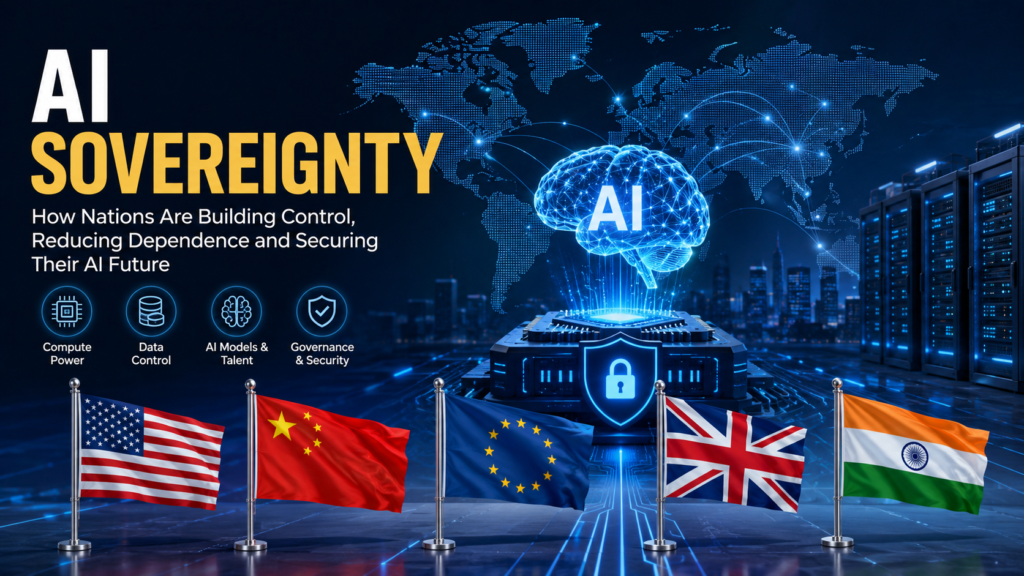
AI sovereignty means having meaningful control over the technology a country depends on, including AI models, data, chips, computing power and digital rules. No major country controls every part of the stack alone. Instead, governments are building domestic capability while trying to reduce the risks created by foreign technology dependence.
Highlight
- AI sovereignty is about control and resilience, not complete technological isolation.
- The United States remains strongest in frontier models, cloud infrastructure and private investment.
- China is building a broad domestic ecosystem that includes models, chips and industrial AI.
- The EU is using regulation, data protection and shared infrastructure to strengthen its position.
- The UK is investing in public compute and domestic AI companies, although its scale remains smaller.
- India’s main advantages are its technical workforce, digital infrastructure and large domestic market.
- Foreign partnerships will remain necessary for most countries, even when they build national AI systems.
Quick Comparison
| Country or region | Main advantage | Main challenge |
|---|---|---|
| United States | Frontier models, cloud platforms and investment | Global supply-chain dependence |
| China | Domestic technology ecosystem and industrial deployment | Access to some advanced chips |
| European Union | Regulation, data governance and shared infrastructure | Coordination across member states |
| United Kingdom | Research, public policy and growing compute capacity | Smaller investment and infrastructure scale |
| India | Technical talent and digital public infrastructure | Expanding access to advanced compute |
| UAE | Capital, data centres and fast adoption | Reliance on imported hardware |
| Singapore | Governance, trusted infrastructure and public services | Small domestic market |
| Japan, France and South Korea | Industrial expertise and strategic investment | Dependence on global semiconductor supply |
AI Sovereignty: What It Really Means
AI sovereignty can sound like a race to build a national version of ChatGPT. That is only one small part of the story.
AI sovereignty is a country’s ability to develop, host, deploy and govern important artificial intelligence systems without becoming dangerously dependent on another country or company.
That control can involve:
- AI models and training methods.
- Data storage and data access.
- GPUs, chips and computing infrastructure.
- Cloud platforms and software.
- Local research and engineering talent.
- Cybersecurity and supply-chain protection.
- Laws governing how AI is used.
The idea is easier to understand through an everyday example. Imagine a country running its healthcare system on an AI platform hosted by a foreign company. If that provider changes its pricing, restricts access or moves data to another jurisdiction, the country may have very little room to respond.
That does not mean foreign technology is automatically unsafe. International partnerships can bring investment, expertise and faster innovation. The concern begins when a government has no realistic alternative.
For that reason, AI sovereignty is better understood as strategic resilience. A country may still work with international companies, but it wants enough domestic capability to protect sensitive information, maintain essential services and make independent decisions.
Why Governments Care About It
The current AI industry is highly concentrated. A relatively small number of companies control much of the advanced computing, cloud infrastructure and model development used around the world.
According to the Center for a New American Security, around 90% of the computing power needed to develop and deploy frontier AI is located in the United States and China. That figure helps explain why other governments are investing in local data centres, AI models and national computing programmes. interactives.cnas
Governments are pursuing AI sovereignty for several connected reasons.
National security
Military, intelligence and emergency services cannot always depend on systems controlled by a foreign provider. They need secure access, reliable performance and confidence that sensitive data will remain protected.
Data protection
Healthcare records, tax information, legal documents and public-sector data can contain extremely sensitive details. Local or regional control may reduce the risk of unauthorised access and conflicting legal requirements.
Economic growth
AI infrastructure can support new companies, research laboratories, skilled employment and export industries. Governments do not want their economies to become permanent customers of foreign AI platforms.
Cultural and linguistic representation
A model trained mainly on English-language data may perform poorly in other languages or fail to understand local history, law and culture. Domestic models can help countries serve their own populations more accurately.
Public-sector reliability
AI is moving into transport, education, healthcare and government administration. Public institutions need systems that remain available and accountable over the long term.
The interesting part is that AI sovereignty affects ordinary businesses too. A small company may not build its own model, but it still needs to know where its customer data goes and which laws apply to the AI tools it uses.
Our guide to privacy-focused AI browsers and tools for small businesses explores some of those everyday privacy decisions.
How to Compare AI Sovereignty
A fair comparison needs more than one ranking. A country may lead in AI research but lack the chips required to train large models. Another may have strong regulation but limited domestic infrastructure.
The following six areas provide a more useful framework.
Compute infrastructure
Compute includes GPUs, data centres, cloud capacity, electricity and cooling systems. Without reliable computing power, even talented researchers may need to send their work to foreign providers.
Domestic AI models
Local foundation models can support national languages, public services and regulated industries. However, building a model is not enough; it must also be affordable, secure and useful in real-world settings.
Semiconductor capacity
Advanced AI depends on a complicated chip ecosystem. That includes chip design, manufacturing, packaging, specialist equipment and supply-chain logistics.
Data governance
Data sovereignty concerns more than where a server is located. It also involves who can access the data, which laws apply and whether a foreign company controls the software layer.
Talent and research
Universities, engineers, start-ups and public research institutions provide the skills needed to maintain AI capability over time.
Adoption and regulation
A country with excellent research but little practical adoption may struggle to turn AI into economic value. Clear regulation, public-sector use and industry adoption all matter.
This is also why different rankings should not be mixed carelessly. Stanford HAI tracks areas such as AI research, models, investment and technical development, while Oxford Insights focuses on government readiness to use AI for public benefit. Neither should automatically be treated as a complete sovereign AI ranking. hai.stanford
United States
The United States remains the strongest overall AI power because it combines advanced model companies, major cloud platforms, venture capital and world-class research institutions.
American companies have produced many of the leading commercial AI systems. The country also benefits from a deep technology market where new companies can attract funding, recruit talent and scale quickly.
Stanford’s 2026 AI Index reports that the US continues to lead in notable model production and private AI investment. China, however, leads in several other areas, including publication volume, citations and patent output. hai.stanford
The American approach relies heavily on private companies. Government agencies support national security and research, but much of the frontier development takes place inside large technology firms.
The country’s main strengths include:
- Frontier AI model development.
- Large cloud and data-centre capacity.
- Strong venture capital markets.
- Leading universities and research laboratories.
- Advanced semiconductor design.
- A large pool of technical talent.
The US still depends on global manufacturing and supply chains, particularly for advanced semiconductor production and specialist equipment. Even so, its control over models, cloud platforms, software ecosystems and investment gives it an unusually strong position.
China
China has followed a more coordinated approach. Government policy, major technology firms, universities and industrial manufacturers all contribute to the country’s AI strategy.
Chinese companies are developing domestic alternatives across models, cloud platforms and chips. Huawei’s Ascend ecosystem, for example, forms part of a broader effort to reduce dependence on foreign hardware and software.
China also has a major advantage in industrial deployment. AI is being connected to manufacturing, robotics, logistics, finance and public services. This creates a large testing ground for technology that might take longer to deploy elsewhere.
China’s strengths include:
- A large domestic market.
- Strong state-backed investment.
- Local AI and cloud providers.
- Industrial-scale deployment.
- A growing domestic chip ecosystem.
- Large amounts of engineering talent.
Its challenges include restrictions on access to some advanced chips and continued dependence on parts of the global technology supply chain.
China’s example shows why AI sovereignty involves more than producing a popular chatbot. A country also needs to use AI across factories, public institutions, transport networks and commercial services.
European Union
The European Union has built much of its AI strategy around regulation, privacy and strategic autonomy.
The EU AI Act gives the bloc an important role in setting rules around high-risk systems, transparency and accountability. However, regulation alone cannot create technological independence. Europe also needs more computing power, stronger companies and a deeper semiconductor ecosystem.
In July 2026, the European Commission launched a call to establish up to seven AI Gigafactories across Europe. The project aims to expand the continent’s computing capacity and unlock more than €30 billion in investment. digital-strategy.ec.europa
The EU’s strategy includes:
- Strong data protection.
- AI regulation.
- Shared computing infrastructure.
- Research partnerships.
- Open-source and open-weight models.
- Support for European technology companies.
Its biggest difficulty is coordination. The EU combines many languages, markets, legal systems and national priorities. That diversity brings advantages, but it can also slow decisions compared with countries that can move through a more centralised system.
United Kingdom
The UK has respected universities, strong AI research and a growing technology sector. It also has experience in financial services, healthcare, defence and other industries where specialised AI could create significant value.
The main limitation is scale. Britain cannot match the United States or China in total private investment, data-centre capacity or domestic hardware production.
The UK government is addressing that gap through public investment and infrastructure planning. Its AI Opportunities Action Plan supports sovereign compute, better use of public data and long-term investment in AI capability.
The government has committed £2 billion to expand public compute capacity twentyfold by 2030. It has also announced AI Growth Zones and up to £500 million in funding through its Sovereign AI Unit. gov
The UK’s advantages include:
- Strong research institutions.
- AI safety expertise.
- Skilled technology workers.
- A major financial and professional-services sector.
- Close links with international markets.
Britain still depends on overseas chip designers, cloud providers and hardware manufacturers. Its realistic goal, therefore, is not complete independence. It is to maintain trusted domestic compute, support British AI companies and protect critical national workloads.
For a business-focused explanation, see AI sovereignty for UK businesses.
India
India brings a different set of strengths to the AI sovereignty discussion. It has a large technical workforce, a huge domestic market and one of the world’s most advanced digital public infrastructure ecosystems.
The IndiaAI Mission was approved with an outlay of ₹10,371.92 crore over five years. The programme includes public compute access, AI development projects and support for national capability. pib.gov
India may not need to compete immediately with the most expensive frontier models. Its opportunity lies in building useful, affordable systems for local languages, healthcare, education, agriculture, public administration and small businesses.
India’s strongest areas include:
- Large engineering and developer communities.
- Local-language AI opportunities.
- Digital identity and payments infrastructure.
- A growing start-up ecosystem.
- Strong domestic demand.
- AI services for emerging markets.
The biggest challenge is access to advanced computing at scale. India has talent and demand, but it must continue expanding data centres, chip access and affordable model training.
UAE, Singapore, Japan and France
The UAE has built its AI strategy around capital, infrastructure and rapid adoption. Its government can mobilise funding and approve large projects quickly, which gives it an advantage when building data centres and attracting global technology partners.
However, the UAE still relies heavily on imported hardware, foreign expertise and international partnerships. Its model is therefore focused on strategic influence and access rather than complete self-sufficiency.
Singapore follows a different path. It emphasises trusted governance, data infrastructure, public-sector adoption and regional business services. Its domestic market is small, but its regulatory credibility gives it influence across Asia.
Japan brings industrial manufacturing, robotics and automation expertise. AI sovereignty in Japan is closely linked to smart factories, semiconductors and advanced machinery.
France has focused on European strategic autonomy, domestic models and public support for AI infrastructure. It also plays an important role in the development of European open-weight models.
South Korea combines advanced electronics manufacturing, semiconductor expertise and a highly connected population. Its opportunity lies in connecting AI models with chips, devices, robotics and industrial systems.
These countries show that there is no single formula for sovereignty. One nation may prioritise chips, another public services, another regulation and another industrial robotics.
The AI Sovereignty Paradox
Most countries cannot build every part of the AI stack alone.
Even a government with a domestic model may still depend on foreign:
- GPUs and semiconductor equipment.
- Cloud software.
- Cybersecurity tools.
- Data-centre components.
- Research partnerships.
- Model-development platforms.
- Specialist engineering talent.
This does not make national AI programmes pointless. It simply means sovereignty should be measured by practical control rather than total isolation.
A sensible strategy asks four questions:
- Which AI systems must continue working during a crisis?
- Which data sets cannot leave the country or region?
- Which foreign dependencies create the greatest risk?
- Where can public investment deliver the strongest long-term benefit?
For businesses, the answer may involve choosing providers with clear data residency policies, avoiding sensitive information in public AI tools and keeping a backup provider available.
For publishers and marketing teams, AI sovereignty also raises questions about content quality, data privacy and human oversight. If you are building an AI-focused content strategy, this guide on how to hire an AI SEO content writer may help you think through the human role behind automated tools.
Infographic Concept
Create an infographic titled “The Global AI Sovereignty Map.”
The visual could include:
- A world map highlighting the US, China, EU, UK, India, UAE, Singapore, Japan, France and South Korea.
- Five scoring rings for compute, models, chips, data governance and adoption.
- A separate indicator showing foreign-technology dependence.
- Blue for infrastructure, green for regulation, orange for domestic models and grey for external reliance.
- A note explaining that the chart compares strategic strengths rather than assigning one universal sovereignty score.
Image Alt-Text Suggestions
- AI sovereignty comparison showing compute, data, models and regulation by country.
- Global sovereign AI map comparing the United States, China, UK, EU and India.
- Country-by-country AI sovereignty chart showing domestic capability and foreign dependence.
A Practical Sovereignty Roadmap
| Stage | What governments focus on | Expected result |
|---|---|---|
| Assess | Map data, compute, chips and vendor dependencies | A clear view of national risks |
| Protect | Secure sensitive data and essential workloads | Better privacy and resilience |
| Build | Fund domestic compute, talent and models | Stronger local capability |
| Partner | Work with trusted foreign companies and allies | Access without excessive dependence |
| Deploy | Use AI in government, industry and public services | Real economic and social benefits |
| Review | Measure cost, security and performance | More sustainable long-term pol |
FAQ:
What is AI sovereignty?
AI sovereignty is a country’s ability to control important parts of its AI ecosystem, including data, computing infrastructure, chips, models, talent and regulation. It does not necessarily mean complete independence. Instead, it means reducing dangerous dependencies and ensuring that essential AI capabilities remain available when a country needs them.
Which countries have sovereign AI strategies?
The United States, China, India, the UK, France, Japan, South Korea, the UAE, Singapore and the European Union all have AI policies linked to national capability. Their priorities differ. Some focus on domestic models and chips, while others concentrate on regulation, public-sector adoption, data governance or computing infrastructure.
Which country leads in AI sovereignty?
There is no single, universally accepted AI sovereignty ranking. The US leads in frontier models, private investment and cloud infrastructure. China has a strong domestic ecosystem and industrial base, while the EU leads in regulation. India has major talent and digital infrastructure advantages, and the UK is building strength in research and public policy.
Is AI sovereignty the same as digital sovereignty?
No. Digital sovereignty covers a wider area, including networks, software, online platforms, data and digital infrastructure. AI sovereignty focuses specifically on artificial intelligence systems, models, GPUs, training data, AI talent and governance. The two ideas overlap, but AI sovereignty is a more specialised part of digital independence.
Why does AI sovereignty matter to businesses?
AI sovereignty affects where business data is stored, which legal system governs an AI service and how much a company depends on one provider. These issues are particularly important for finance, healthcare, defence and government suppliers. Businesses may need stronger data controls, local hosting, model transparency and backup providers.
Can a country become completely independent in AI?
Complete independence is unlikely because advanced AI depends on global supply chains, specialist equipment, research and cloud infrastructure. A more realistic goal is strategic resilience. Countries can protect critical workloads, diversify suppliers, develop domestic talent and maintain enough compute and data control to avoid serious disruption.
Author Bio
About the Author
Asmara Khan is an SEO content writer and technology blogger covering artificial intelligence, digital privacy, search strategy and emerging technology policy. Her work focuses on making complex technology topics understandable for UK and US readers while connecting research, search intent and real-world business needs.