
Quick Summary
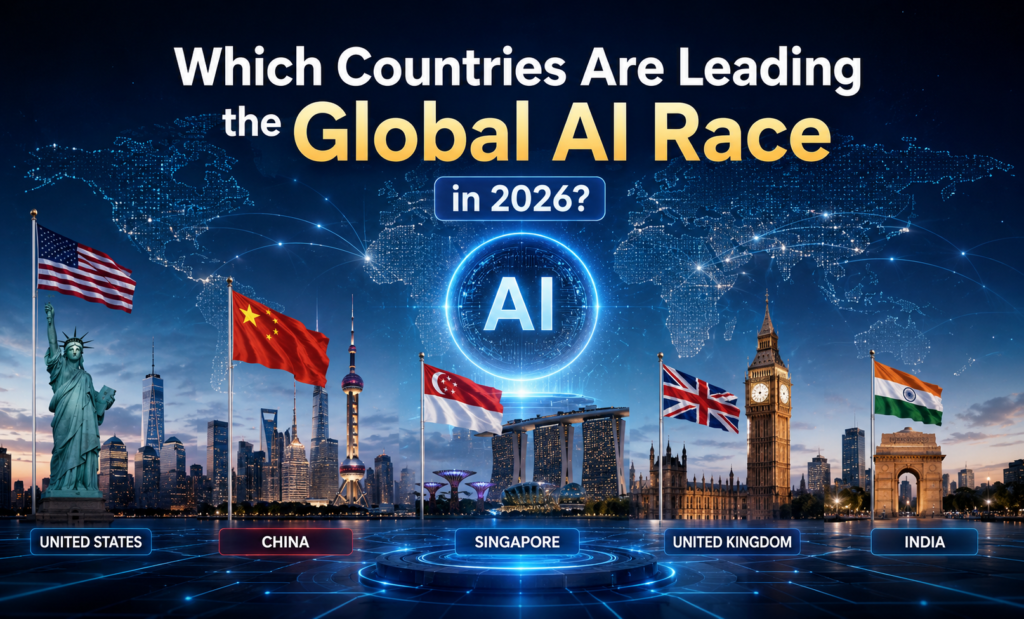
The United States currently leads the global AI race in 2026 in private investment, frontier models, computing power and major AI companies. China is the closest competitor, leading in research volume, patents, robotics and industrial scale. Singapore, the UK and India form the next leading group, each with a different competitive advantage.
Highlight
- The United States remains the strongest all-round AI power.
- China has narrowed the performance gap in advanced AI models.
- Singapore leads in AI readiness, digital government and enterprise adoption.
- The UK remains influential in AI research, safety and regulation.
- India’s greatest advantages are talent, developers and digital infrastructure.
- South Korea, Canada, France, Germany, the UAE, Israel and Japan are important challengers.
- AI leadership depends on the metric: models, investment, talent, chips, adoption or governance.
Featured Snippet Table
| Country | Main AI advantage | Position in the 2026 race |
|---|---|---|
| United States | Frontier models, investment, cloud, chips and major AI companies | Overall leader |
| China | Research, patents, robotics and industrial deployment | Closest competitor |
| Singapore | AI readiness, digital government and enterprise adoption | Leading innovation hub |
| United Kingdom | Research, AI safety, policy and DeepMind-led innovation | Research and governance leader |
| India | Talent, developers, startups and digital infrastructure | Fast-growing scale leader |
What Does the AI Race Mean?
The global AI race is the competition between countries and companies to develop, control and deploy artificial intelligence at scale.
That competition involves much more than chatbot quality. A country’s AI strength can depend on:
- Frontier AI models and large language models.
- Research papers, citations and patents.
- Private and government investment.
- Semiconductor, energy and data-centre infrastructure.
- Skilled researchers, engineers and developers.
- Business and public-sector adoption.
- AI regulation, safety and national strategy.
The Stanford HAI 2026 AI Index Report tracks many of these areas, including technical performance, research and development, economic impact, responsible AI and public opinion. cite hai.stanford
This broader definition matters because no country leads in every category. The United States has a major advantage in private capital and frontier-model companies, while China performs strongly in research output, patents, robotics and industrial implementation.
A useful way to think about the competition is this: the AI race is less like a 100-metre sprint and more like a decathlon. A country can win one event and still lose another.
1. United States: The Overall Leader
The United States remains the strongest all-round AI power in 2026. Its advantage comes from the combination of private investment, elite universities, major technology companies, cloud infrastructure and a deep startup ecosystem.
American companies such as OpenAI, Google DeepMind, Anthropic, Microsoft and Meta continue to shape the frontier-model market. They compete in large language models, AI agents, coding tools, image generation and enterprise software.
Why the US leads
- It attracts exceptionally high levels of private AI investment.
- It hosts many of the world’s most influential AI companies.
- It leads in the development of notable frontier models.
- It benefits from strong universities and research laboratories.
- It has major cloud platforms and advanced data-centre capacity.
- It connects AI research with commercial products quickly.
Stanford’s 2026 technical-performance coverage reported that the top US model held a 2.7% lead over the top Chinese model on the tracked comparison as of March 2026. That is still a lead, but it is far narrower than the gap seen in earlier comparisons. cite hai.stanford
The US position is therefore best described as leadership with a narrowing margin. American companies have money, talent and commercial reach, but competitors are improving quickly.
The country also depends on international supply chains for advanced chip manufacturing. Meanwhile, other countries are investing heavily to attract researchers, build data centres and develop local AI companies.
2. China: The Closest Competitor
China is the strongest challenger to the United States. It has built a large AI ecosystem around government support, industrial manufacturing, universities, technology companies and a vast domestic market.
Baidu, Alibaba, Tencent, ByteDance and Huawei are among the companies contributing to China’s AI development. Their work covers language models, recommendation systems, robotics, autonomous vehicles, cloud services and industrial automation.
China’s main strengths
- High-volume AI research and publication output.
- Strong patent activity and applied technology.
- Large-scale industrial AI deployment.
- Significant robotics manufacturing capacity.
- Rapid development of Chinese-language and open-weight models.
- Close links between government policy, universities and industry.
Recent reporting on Stanford’s 2026 findings described the US-China model gap as extremely narrow. The United States remained ahead in private investment and the number of notable models, while China was stronger in research volume, citations, patents and industrial robotics. cite fortune
China also benefits from scale. Once a technology proves useful, companies can deploy it across manufacturing, logistics, finance, transport and public services.
Its limitations include restricted access to some advanced chips, lower private investment than the US and a more complicated environment for international collaboration. Even so, China is no longer simply trying to catch up. In several practical areas, it is already setting the pace.
3. Singapore: A Small Country With Big Influence
Singapore does not compete with the US or China in population, capital or model volume. Instead, it has become one of the world’s most prepared and efficient AI economies.
The country combines strong digital infrastructure, advanced public services, high education standards and a business-friendly environment. Its Smart Nation programme has also helped create conditions for AI adoption in finance, healthcare, transport, security and government services.
Singapore’s competitive advantages
- High workforce readiness.
- Strong digital government systems.
- Concentration of regional technology headquarters.
- Advanced financial technology adoption.
- Close coordination between public policy and business.
- Strong links with wider Asian markets.
Singapore shows that AI leadership does not always mean building the biggest model. A country can become highly influential by implementing AI effectively and creating a trusted environment for businesses.
For companies seeking an Asia-Pacific base, Singapore offers a useful combination of talent, regulation, infrastructure and market access. Its influence comes from execution rather than sheer size.
4. United Kingdom: Research, Safety and Policy
The United Kingdom remains a major AI research and governance centre. It is home to leading universities, research groups and technology companies, including Google DeepMind, which was founded in London.
The UK’s role extends beyond commercial AI products. It has also become an important centre for discussions about frontier-model safety, responsible development and international cooperation.
Why the UK matters
- Strong academic research in machine learning.
- World-class AI laboratories and universities.
- DeepMind’s influence on scientific and commercial AI.
- Active involvement in AI safety research.
- A growing focus on national compute capacity.
- A mature technology, finance and startup ecosystem.
The UK may not match American private investment or Chinese industrial scale. Nevertheless, it has an outsized influence on how companies and governments think about advanced AI.
Its central challenge is commercial scale. The country needs to retain talent, support domestic startups and turn excellent research into products that can compete globally.
5. India: The Talent and Scale Engine
India is one of the most important fast-growing powers in artificial intelligence. It has a large technical workforce, strong engineering education, an expanding startup ecosystem and a huge domestic market.
India’s advantage is not yet the number of frontier models it produces. Its strength lies in implementation, software development, technical services and the ability to deploy technology across a diverse population.
India’s AI strengths
- A large pool of software engineers and technical workers.
- A growing AI startup and developer community.
- A strong information technology services sector.
- Expanding digital public infrastructure.
- High demand for affordable AI tools.
- Opportunities in healthcare, education, agriculture and government.
India could become especially influential in multilingual AI. Tools designed only for English cannot serve the country’s full population, so local-language models and voice-based systems may become major areas of growth.
The main challenge is infrastructure. India needs more domestic computing capacity, deeper research funding and reliable access to advanced chips. If those areas improve, the country could move from an AI implementation leader to a stronger model-development power.
Other Countries to Watch
The first five countries receive the most attention, but the wider AI race includes several serious contenders.
South Korea
South Korea combines advanced electronics, semiconductor expertise, robotics and major technology companies. Its AI position is closely connected to hardware, manufacturing and consumer technology.
Canada
Canada has a respected machine-learning research tradition and a strong network of universities, startups and AI researchers. Toronto, Montreal and Edmonton remain important research and development centres.
France and Germany
France has invested heavily in AI research and startups, while Germany brings deep industrial expertise. Their strongest opportunity lies in industrial AI, healthcare, engineering and regulated business applications.
United Arab Emirates
The UAE has moved quickly by investing in AI models, data centres, research partnerships and public-sector applications. Its financial resources and ambitious technology strategy give it influence beyond its population size.
Israel and Japan
Israel remains strong in cybersecurity, defence technology, computer vision and AI startups. Japan, meanwhile, has a natural advantage in robotics, manufacturing, ageing-population applications and industrial automation.
Who Is Actually Winning the AI Race?
The answer depends on what “winning” means.
If the question focuses on frontier models, venture capital and major commercial laboratories, the United States leads. Its technology companies have created a powerful pipeline from research to products.
When attention shifts to research volume, patents, robotics, and industrial implementation, China proves to be intensely competitive, taking the lead across multiple key metrics.
So, who is winning the AI race right now? The most balanced answer is:
The United States leads overall, China is closing the gap, and several smaller countries are winning specific parts of the competition.
The Real Race: From Models to Infrastructure
The public conversation often focuses on which chatbot gives the best answer. That is only one part of national AI power.
The deeper competition involves:
- Compute: Can a country access enough GPUs and data-centre capacity?
- Chips: Can it design, manufacture or reliably obtain advanced semiconductors?
- Talent: Can it educate and retain researchers, engineers and product teams?
- Capital: Can startups raise enough money to train and deploy models?
- Data: Can organisations access high-quality, lawful and useful data?
- Adoption: Can businesses and governments turn AI into measurable productivity?
- Trust: Can systems operate safely, transparently and fairly?
For businesses, AI adoption is not simply a matter of buying a chatbot. Companies need staff training, data governance, clear workflows and measurable outcomes. Small firms can find practical ideas in this guide to AI cost reduction for small business.
Governments face a similar challenge. The NIST AI Risk Management Framework provides a recognised structure for managing risks linked to trustworthy AI, including reliability, safety and accountability. cite nist
What Could Change Next?
The current leaders may not hold their positions permanently. Cheaper models, open-weight systems and better software could reduce the advantage of countries with the largest budgets.
The next phase of the AI race will reward countries that can:
- Deploy AI across real industries.
- Build dependable energy and data-centre infrastructure.
- Train workers to use AI effectively.
- Support local-language systems.
- Create sensible regulation without blocking innovation.
- Turn research into profitable products.
- Maintain public trust.
This shift also matters to online businesses. Search engines and AI answer systems increasingly favour pages that provide direct answers, clear evidence and useful comparisons. Organisations that need support with this work can explore hiring an AI SEO content writer.
Infographic Concept
Title: The 2026 Global AI Race: Who Leads Each Category?
Create a five-column comparison graphic showing:
- Frontier models and private investment: United States.
- Research, patents and industrial robotics: China.
- AI readiness and public-sector adoption: Singapore.
- Research, safety and policy: United Kingdom.
- Talent, developers and digital scale: India.
Place the US and China at the top of a central podium, then use category callouts for Singapore, the UK and India. Add smaller badges for South Korea in semiconductors, the UAE in infrastructure, Canada in research, Germany in industrial AI and Israel in cybersecurity.
2026–2030 AI Outlook
| Period | Likely focus of the AI race | Countries best positioned |
|---|---|---|
| 2026 | Frontier models, private investment and compute | United States and China |
| 2027 | AI agents, enterprise adoption and robotics | US, China, Singapore and South Korea |
| 2028 | Local-language AI and digital public services | India, Singapore, UAE and Europe |
| 2029 | Industrial automation and AI infrastructure | China, Germany, Japan and South Korea |
| 2030 | Trusted, affordable and widely deployed AI | Countries combining talent, infrastructure and governance |
People Also Ask
Which country is leading the global AI race in 2026?
The United States is the leading all-round AI power in 2026 because it combines private investment, frontier models, major technology companies, cloud infrastructure and research talent. China is the closest competitor and leads in several research and industrial measures. The answer changes when the metric shifts from innovation to adoption or manufacturing.
Is China ahead of the United States in AI?
China is ahead of the United States in several areas, including research publication volume, patent activity, industrial robotics and large-scale manufacturing deployment. However, the US retains a stronger position in private investment, frontier-model companies and computing infrastructure. The two countries are best described as close competitors rather than having one universal winner.
What are the top AI countries in 2026?
The leading group includes the United States, China, Singapore, the United Kingdom and India. South Korea, Canada, France, Germany, the UAE, Israel and Japan are also important AI powers. Their positions differ because some lead in models and investment, while others excel in chips, robotics, research, talent or adoption.
Why is Singapore considered an AI leader?
Singapore is considered an AI leader because it combines advanced digital infrastructure, strong government services, workforce readiness and high enterprise adoption. It does not compete with the US or China in population or model volume. Instead, Singapore’s strength comes from implementing AI efficiently across finance, transport, healthcare and public administration.
Which country has the best AI technology?
No single country has the best AI technology in every category. The United States is strongest in frontier models and commercial AI, China is highly competitive in research and industrial AI, South Korea and Japan are strong in hardware and robotics, and Singapore performs well in readiness and adoption.
Will India become an AI superpower?
India has the potential to become an AI superpower because of its large technical workforce, developer community, digital public infrastructure and expanding startup ecosystem. To reach that level, it will need more domestic computing capacity, research investment, advanced chip access and high-quality local-language datasets.
How do experts measure AI leadership?
Experts measure AI leadership through model performance, research papers, patents, investment, AI talent, computing infrastructure, business adoption, robotics and government policy. A credible ranking should explain its methodology because a country can rank first in one category and much lower in another.
Author Bio
About the GlobeHustle Technology Desk
The GlobeHustle Technology Desk produces research-led analysis on artificial intelligence, search strategy, automation and emerging technology. Its editorial work combines public research, primary reports and practical business insight to help readers understand complex technology trends clearly.