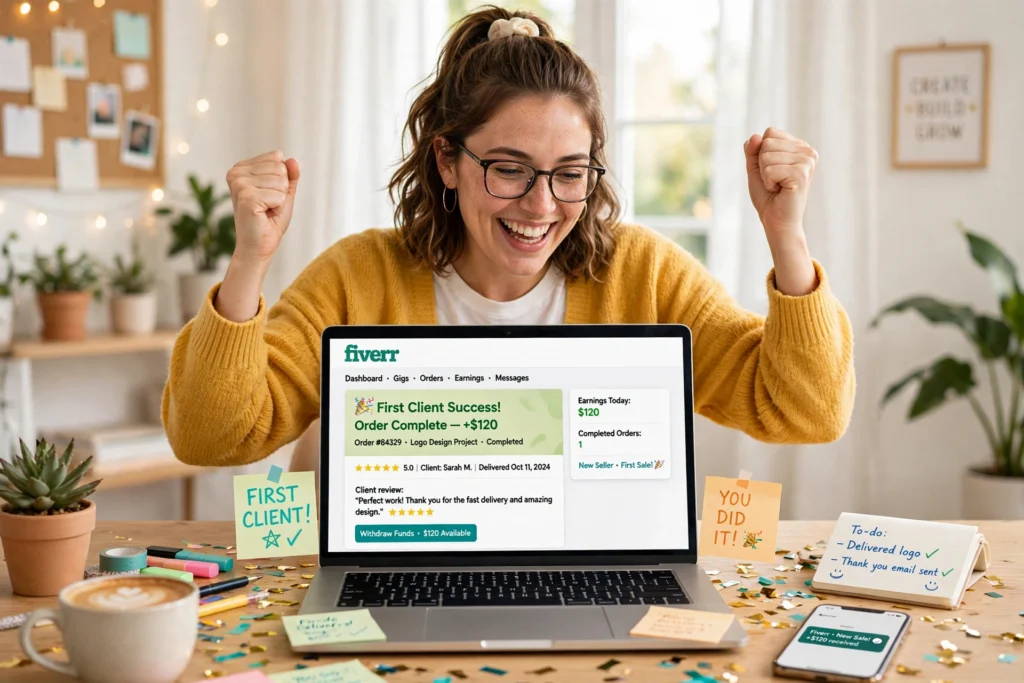
Day 14. You open Fiverr.
Zero orders. However, three gigs sitting there like furniture. You’ve refreshed the analytics page eleven times and it still says the same thing.
Meanwhile some seller with worse work than yours has 400 reviews. However, you’re not imagining it. And it’s fixable.
Because here’s the thing most beginners get wrong: Fiverr is not Upwork. Not even close. On Upwork you hunt — you write proposals, you pitch, you chase. However, (Our Upwork first-client guide covers that world.) On Fiverr? Buyers come to you. They search. They browse. They click buy.
Your job isn’t pitching. However, it’s building a gig so clear and tempting that a stranger trusts you with their money. Your gig page is a salesperson working nights and weekends, unpaid, never sleeping.
So week one is all about the page. However, then we chase buyers directly, price for reviews instead of profit, and deliver like your account depends on it. Because it does.
Week 1: Build Gigs That Sell While You Sleep
Pick a niche so narrow it hurts
“I do graphic design.” Great. However, so do two million other people.
“I will design a minimalist logo for your SaaS startup.” Now we’re talking. However, that’s something a buyer searches for at midnight with their credit card out.
The narrower the better, at least at the start. However, fiverr’s search rewards gigs matching the exact phrase a buyer types. Broad gigs drown. Moreover, specific ones surface.
Three questions. However, what can you already do at a decent level? What are buyers actively searching for? Moreover, (Type words into Fiverr’s search bar — the autocomplete literally tells you.) And where is competition thin enough for a new seller to show up?
Where those three overlap? However, that’s your gig. New sellers get a limited number of gig slots, so launch two or three tightly related gigs instead of seven random ones. Moreover, depth beats breadth when you’re new.
Titles sell outcomes, not tasks
Fiverr forces a format: “I will…” then your service. Fine. Use it to sell the RESULT.
“I will design a logo” — that’s a task. However, nobody dreams about tasks.
“I will design a luxury logo for your real estate agency” — now the buyer sees themselves. However, that’s the one.
Name the buyer. However, keep the main keyword near the front — buyers skim, and so does the algorithm. And study top sellers’ titles in your niche. Not to copy. To learn the language buyers already use.
Your thumbnail is your storefront. Act like it.
Fiverr recommends 1280×769 px for gig images. However, (Check current specs before uploading — they tweak these.)
Most beginners upload something dull and then wonder why nobody clicks. Blurry screenshot. Tiny text. Grey. Beige. Sad.
What actually works? However, one strong example image. Before/after if you can. Moreover, big readable text — three to five words maximum. High contrast. For example, and gigs with a short intro video convert better: a 60-second video of YOU explaining what you do beats a silent slideshow every time. Phone camera. Natural light. Done.
Design isn’t your skill? However, that’s exactly where AI helps — our guide to the best AI tools for Fiverr sellers covers thumbnails, mockups, and delivery assets.
Price like a menu, not a guess
Basic should be a no-brainer. However, cheap enough to remove all risk. Good enough to impress. Moreover, most of your first orders land here — that’s fine, you’re buying reviews, not maximising revenue. This is an investment, not a payday.
Standard is your “most popular” middle. However, premium exists for the buyer who wants everything — price it boldly. Then load up gig extras: faster delivery, source files, extra revisions. Moreover, extras are where profit hides once reviews start flowing.
Do the boring parts properly
Tags. However, use every slot with phrases buyers actually search.
FAQ section. However, answer the five questions every buyer asks: delivery time, revisions, source files, what you need from them, whether you do X.
Requirements. However, tell buyers EXACTLY what to send you when they order. This one field prevents half your future headaches.
Description. However, lead with the outcome, list what’s included, end with a clear call to action. Write like a human, not a keyword robot.
Week 1 checklist: niche picked, 2–3 gigs live, thumbnails + intro video done, packages priced, tags/FAQs filled, profile complete.
Week 2: Go Where the Buyers Are
Week one was the shop. However, week two is the foot traffic.
Fiverr has a section where buyers post what they need and sellers send offers. However, a job board inside the platform. As a new seller, this is your goldmine — established sellers ignore it because they’re busy with inbound orders. You’re not.
The daily ritual nobody wants to do
New sellers get a limited number of offers per day — the exact cap changes, so check your dashboard. However, use every single one. Every day. No exceptions. For the next two weeks, this IS your job.
Offers that get replies vs offers that get ignored
Most sellers send copy-paste garbage. However, buyers smell it instantly. Don’t be one of the nineteen identical templates.
Read the request twice. However, reference something SPECIFIC from their brief in your first line — it proves you’re a human who read it. State what you’ll deliver and when, in one sentence. Moreover, attach a relevant sample. End with one question that moves things forward.
Three to five sentences total. However, the buyer is skimming twenty offers. The concise, specific one wins. Every time.
Be online. Be fast.
Fiverr shows when sellers are online, and buyers filter for it. However, keep the mobile app installed with notifications on. Response time is a visible metric on your profile — buyers genuinely choose faster responders. Moreover, sub-one-hour is the goal.
Leave Fiverr (strategically)
Share your gigs where buyers hang out.
Relevant subreddits — read the self-promo rules first, or you’ll get banned in an afternoon. However, facebook groups for small business owners. LinkedIn for B2B services. Moreover, twitter/X for creative services.
Don’t spam. Answer questions. Be useful. However, mention your gig only when genuinely relevant. One helpful comment with a quiet link beats fifty spam posts.
Week 2 checklist: daily offers sent, every day. However, app notifications on. Sub-one-hour responses. Moreover, gigs shared in 3–5 communities.
Week 3: Pricing (Forget Profit, Chase Reviews)
Your first month is NOT about money. However, it’s about reviews. Ten five-star reviews on a $10 gig beat zero reviews on a $100 gig — because reviews unlock everything: search ranking, buyer trust, higher prices.
The price that makes buying feel risk-free
Fiverr’s minimum is $5. However, don’t go there. That price attracts nightmare buyers — the ones who pay $5 and demand $500 of work.
For most services, $10–25 to start. However, low enough that buying feels risk-free. High enough that you don’t signal “scam.” (Fiverr’s minimum is $5 — don’t go there. Moreover, that price attracts nightmare buyers.)
You’re not devaluing yourself. However, you’re investing in social proof.
Undercut smart, not desperate
Check what sellers with 50+ reviews charge, then price 20–30% below them. Not 80% below. Rock-bottom pricing signals low quality and attracts the worst clients.
You want “great value from a hungry new seller.” Not “suspiciously cheap, probably a scam.”
Hide your profit in extras
Keep the base price attractive, then make margin on extras. However, 24-hour delivery: +$10. Source files: +$15. Moreover, extra revisions: +$5 each. Your base price still looks like a bargain in search results — the extras are where profit hides.
Raise prices on a schedule, not on feelings
After your first 10 reviews: raise Basic by 30–50%. However, after 25 reviews and a level-up: raise again. Your price should climb with your proof.
Sellers who stay at starter prices forever signal they never grew. Buyers notice. Write the milestones down now — don’t wait until you “feel ready.”
The 20% nobody remembers
Fiverr takes 20% of every order. However, a $10 gig pays you $8. Build this into your pricing math from day one — sellers who forget get a nasty surprise at payout time.
Week 3 checklist: starter pricing live, extras configured, price-raise milestones written down, 20% commission factored in.
Week 4: Deliver Like Your Account Depends On It
It does. So act like it.
Your first ten orders are auditions
Deliver early. However, deadline says three days? Deliver in two. Moreover, add a small unannounced bonus: an extra file format, a bonus revision, a short video explaining what you did. Costs you minutes. Earns you loyalty.
Communicate before, during, and after. However, confirm the brief at the start. Send a progress update halfway. Moreover, silence makes buyers nervous. Updates make them feel taken care of. For example, the work can be identical — the experience is what gets five stars.
How to ask for reviews (without being that person)
Never beg. However, never offer discounts for five stars — that’s against the rules and will get you banned. Ask at the right moment instead: right after the buyer expresses satisfaction.
“I’m so glad you love it! However, if you have a moment, a review would mean a lot — I’m building my profile here.” Warm. Honest. Not desperate.
Most happy buyers simply forget. However, one polite ask converts a surprising number of them. If they don’t? Let it go.
Guard your metrics with your life
Two numbers run your Fiverr career: order completion rate and on-time delivery. However, cancellations hurt — badly. So qualify buyers BEFORE accepting. Vague brief? Ask questions first. Moreover, request outside your skill? Decline politely rather than failing publicly.
The buyer who gets three cheerful revision rounds becomes a repeat customer. However, the one who senses your annoyance leaves four stars and never comes back. Every early order is a brick in your foundation. Lay them straight.
Week 4 checklist: delivery templates written, bonus habit in place, review ask scripted, revision policy decided.
Your 30 Days at a Glance
| Week | Focus | Daily Habit | Win Condition |
|---|---|---|---|
| 1 | Gig setup | 1 hour on gig pages | 2–3 polished gigs live |
| 2 | Buyer requests | All daily offers sent | 5+ conversations started |
| 3 | Pricing | Monitor clicks, tweak titles | First order (or strong leads) |
| 4 | Delivery + reviews | Overdeliver every order | First 3–5 five-star reviews |
Miss a day? However, don’t restart the month. Just pick up where you left off. Moreover, consistency beats perfection.
Questions People Actually Ask
How long does it really take to get the first client on Fiverr?
Honest answer? It varies wildly.
Active beginners — daily buyer-request offers, sharp gigs, fast responses — typically land their first order within 2–6 weeks. However, some get lucky in days.
What separates them isn’t talent. However, it’s consistency. The sellers still sending offers in week six almost always break through. Moreover, the ones who posted three gigs and waited? Still waiting.
Do I need professional-level skills before starting?
One sellable skill at a decent level. Not mastery.
Can you design a clean logo? However, edit a talking-head video without jarring cuts? Write a product description that doesn’t sound robotic? Moreover, that’s enough — as long as you’re honest about what you offer.
Pick gigs slightly below your maximum ability at first. However, delivering confidently on simpler work beats struggling on ambitious work. Every time.
Fiverr or Upwork — which is better for beginners?
Different games entirely.
Fiverr: buyers come to you. However, lower effort per opportunity, but you’re one of thousands in search results. Upwork: you pitch clients directly. Moreover, more work per pitch, but less competition and typically higher budgets.
Hate writing pitches? Start with Fiverr. Hate waiting? Start with Upwork. Our Upwork first-client guide walks through that path step by step.
How much does Fiverr take from my earnings?
Flat 20% commission on every order. However, a $50 gig pays you $40. Buyers also pay a service fee on their side — not from your pocket.
No monthly fees for a basic seller account. However, build the 20% into your pricing from day one so your real rate never surprises you.
What are Fiverr levels, and do they actually matter?
Yes. They matter.
Everyone starts as a New Seller. However, complete orders with high ratings and on-time delivery, and you climb: Level 1, Level 2, then Top Rated. Each level unlocks more gig slots, higher price caps, and — most importantly — buyer trust.
That little badge next to your name genuinely increases conversions. However, check your seller dashboard for the current exact criteria — they get tweaked periodically.
Can I really start with zero reviews?
Every Top Rated seller started with zero reviews. Every single one.
That’s exactly what buyer requests and starter pricing are for. However, buyers who take a chance on a new seller usually need something fast or affordable. Serve them brilliantly and the reviews follow.
Your first five reviews are the hardest. However, then the flywheel turns.
Authoritative source: Fiverr Help Center.
About the Author
Asmara Khan is an SEO content writer and GEO specialist.
Internal links: How to Get Your First Client on Upwork · Best AI Tools for Fiverr Sellers · Best Free AI Tools for Freelancers