Quick Summary
AI-powered marketing systems are platforms that plan, launch, and adjust ad campaigns using machine learning instead of a human account team. They’re genuinely replacing agencies for the repetitive, data-heavy work bidding, targeting, reporting. What they still struggle with is brand storytelling and judgement calls. That part hasn’t changed much yet.
Highlights
- AI systems are best at the parts of advertising that come down to data: bidding, targeting, split-testing, reporting.
- A lot of small businesses are dropping £1,000–£4,000/month retainers for £150–£400/month AI stacks.
- Full replacement is rarer than the headlines suggest. Most people end up somewhere in between.
- Generative AI has made ad creative faster to produce, not necessarily better it still needs a human editor.
- Agencies aren’t going anywhere. Plenty are just quietly using the same AI tools their clients are considering.
- The businesses getting the best results right now are mixing AI execution with a bit of human oversight, not picking a side.
Quick Facts: AI Marketing Systems vs Traditional Agencies
| Factor | AI-Powered Marketing System | Traditional Ad Agency |
|---|---|---|
| Typical monthly cost | £150–£500 | £1,000–£5,000+ retainer |
| Setup time | Hours to days | Weeks (onboarding, strategy) |
| Campaign optimisation | Continuous, automated | Weekly or monthly manual review |
| Creative output | Fast, sometimes generic | Slower, more brand-specific |
| Strategic thinking | Limited | Strong |
| Best suited for | Small budgets, performance ads | Brand-building, complex campaigns |
Why Everyone’s Suddenly Talking About This
Two years ago, if a small business wanted to advertise properly, hiring an agency was more or less the only real option. You’d sign a retainer, sit through a monthly Zoom call, nod along to a slide deck, and hope the numbers were moving the right way.
That’s not really true anymore. AI-powered marketing systems can now handle a lot of what used to require an entire account team targeting the right audience, managing bids, writing ad copy, pulling reports for a fraction of the price. And honestly, that’s exactly why so many people are typing “AI-powered marketing systems replacing traditional ad agencies” into Google instead of “best marketing agency near me.”
So what actually is an AI-powered marketing system? Put simply, it’s software that uses machine learning and generative AI to plan and run ad campaigns with very little human input. Meta Advantage+ and Google Performance Max are the two most obvious examples they pick the audience, the placements, even the ad variations, largely on their own.
But “replacing” is a strong word here, and it’s worth slowing down on. AI is replacing specific tasks. It’s not replacing the whole relationship you’d normally have with an agency not yet, anyway, and maybe not for a while. That distinction matters more than most articles on this topic let on.
AI vs Creative Agencies: What’s Actually Changing
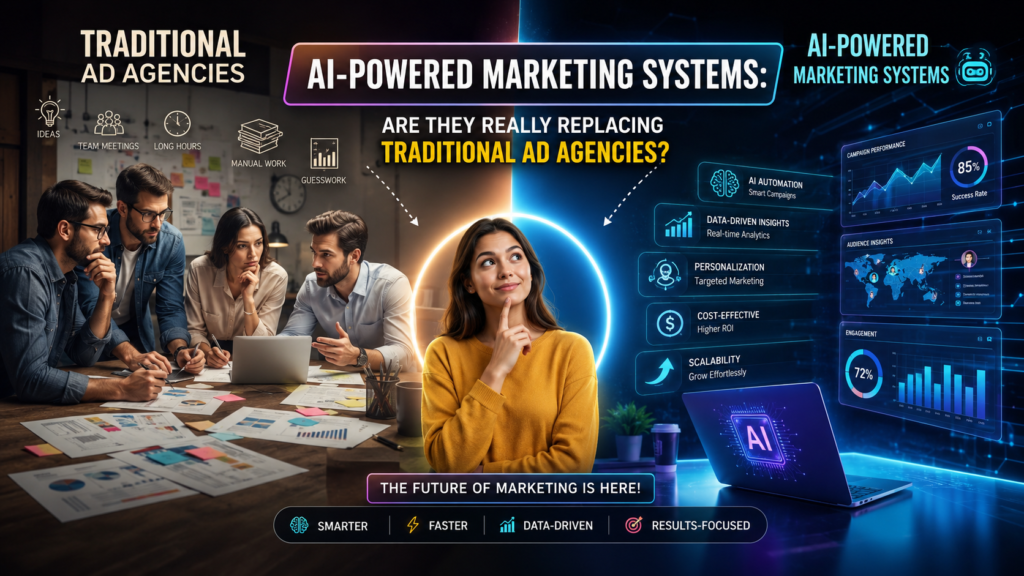
If you strip away the hype, the AI vs creative agencies debate really just comes down to who’s better at what.
AI tends to win at:
- Running dozens (sometimes hundreds) of ad variations at once to see what actually converts
- Adjusting bids in real time instead of waiting for a weekly check-in
- Segmenting audiences with a level of precision no human could manage by hand
- Producing first-draft copy, images, and video quickly
- Cutting down reporting from hours of spreadsheet work to a few minutes
Agencies still tend to win at:
- Understanding what a brand actually stands for, beyond the metrics
- Handling anything sensitive a PR issue, a delicate product launch, a tricky client situation
- Building the kind of trust that comes from an actual working relationship
- Coming up with a genuinely original creative concept, not just a competent one
- Making the judgement calls that no dataset can quite answer
What’s interesting is that this isn’t really a fight anymore. A lot of agencies have already folded these same AI tools into their own process which means the “AI vs agency” framing is a bit misleading. Often it’s AI and agency, just with fewer people on the account.
Automated Marketing Campaigns: How They Actually Work
Automated marketing campaigns run on a fairly simple loop, once you see it laid out: you set the goal, the algorithm tests a bunch of variations, and performance data steers what happens next with nobody manually tweaking each setting along the way.
Here’s roughly how it plays out:
- You set the goal. Sales, leads, app installs, brand awareness whatever matters most.
- The system builds the audience. It looks at your existing customer data and finds people who look similar.
- It generates and tests creative. Several headlines, images, and calls-to-action run side by side.
- Budget shifts automatically. Whatever’s working gets more spend; whatever isn’t gets cut, often within a day.
- You check the results. Dashboards summarise it all in plain English, sometimes with a suggested next move.
This is exactly why time-poor small business owners find automated marketing campaigns so appealing there’s no waiting three weeks for a report. The system is adjusting itself constantly, sometimes several times a day.
That said, it’s not magic, and it’s worth saying that plainly. It needs clean data, a realistic budget, and clear goals to actually work. Give it vague instructions or too small a budget, and it’ll optimise for the wrong thing with just as much confidence as it would optimise for the right one.
Generative AI in Advertising: The Creative Shift
Generative AI in advertising has changed the speed of creative production more than pretty much anything else in the industry’s recent history. Work that used to take a creative team a fortnight concepting, copywriting, design, three rounds of revisions can now happen in an afternoon.
These tools can now produce:
- Product photography from a single reference image
- Dozens of ad copy variations tailored to different audience segments
- Short-form video ads generated from a text prompt
- Voiceovers and background music that roughly match the brand’s tone
MIT Sloan Management Review has covered this shift in some depth, noting that generative AI is already reshaping how creative professionals approach their work and that businesses adapting early tend to gain the biggest edge. Their piece on AI-driven marketing strategy is worth a read if you want the fuller picture.
Here’s a fun fact that surprised me when I first came across it: the first fully AI-generated advert to run during a major televised event aired back in 2024, and most viewers genuinely couldn’t tell it apart from something made the traditional way. That’s how quickly this moved.
Still, fast isn’t the same as good. Generative AI tends to produce work that’s competent rather than distinctive and if nobody’s checking it, it can quietly push every brand toward the same visual style and the same slightly flat tone. That’s really the whole reason a human editor still needs to be in the loop.
Where AI Still Falls Short
No honest article on this would skip the limitations, so here they are, plainly:
- Brand storytelling. AI can write a decent sentence. It can’t yet build a brand narrative that actually means something to people over years.
- Crisis PR. When something goes wrong publicly, you want a person making the calls, not an algorithm guessing at tone.
- Long, relationship-driven sales cycles. Especially in B2B, human account managers still earn their keep here.
- Regulatory nuance. Any claim about what a product or service can actually do needs someone who understands the legal risk of overpromising. The Federal Trade Commission has been pretty direct about this businesses need to be able to back up whatever they claim their tools, AI included, can deliver. Their guidance on keeping AI claims accurate is a good reference if you’re unsure where the line is.
If you’re curious what else AI is handling well for small businesses outside of marketing specifically, this rundown of AI tools for automating small business admin is worth a look too.
Cost Comparison: AI Marketing Systems vs Agency Retainers
For most small business owners, this is really what it comes down to. Here’s a fairly realistic breakdown:
Traditional agency retainer:
- Small business package: £1,000–£2,500/month
- Mid-size campaign management: £2,500–£5,000/month
- Usually doesn’t include ad spend — that’s on top
AI marketing stack:
- One platform, entry-level: £150–£400/month
- A proper multi-tool stack (ads + copy + design AI): £400–£800/month
- Ad spend still applies here too, same as with an agency
So yes AI marketing systems can genuinely cost 70–90% less than an agency retainer. But that comparison only tells half the story. A £200/month tool running with zero oversight can waste far more money on poorly targeted ads than it ever saves in fees. Cheaper only wins if someone’s still checking the output now and then.
If you want to see how savings like this feed into bigger income opportunities, this guide on how to make money with AI covers a few different angles.
The Hybrid Model: What Most Businesses Actually End Up Doing
Despite the dramatic headlines, full replacement isn’t really the norm. Most businesses that move away from a traditional retainer land somewhere in the middle:
- AI handles the day-to-day execution and optimisation
- A freelance strategist or part-time consultant checks in on performance monthly
- A human still edits or writes the final creative before it goes live
- There’s still a small budget kept aside for one-off strategic projects, like a rebrand or a product launch
This hybrid setup tends to give you the best of both the cost savings of automation, plus enough human judgement to keep it on brand. If you’d rather have a person handling the strategic and written side while AI does the execution, working with someone who offers AI-powered SEO content writing can bridge that gap nicely.
Infographic Concept: “The AI vs Agency Decision Map”
For a designer to build this out, here’s the outline in plain text:
Title: Should You Choose AI, an Agency, or Both?
Format: A horizontal decision flowchart with three end points.
- Starting question: “What’s your monthly marketing budget?”
- Under £500 → Path A: AI-only stack
- £500–£1,500 → Path B: Hybrid model
- £1,500+ → Path C: Agency-led, AI-assisted
- Each path gets three small icons: cost range, time-to-launch, and best-fit business type (solo founder, small team, established brand).
- Bottom strip: A simple bar chart comparing average monthly cost (AI: £250 / Hybrid: £900 / Agency: £3,000) against average campaign turnaround (AI: 1 day / Hybrid: 3 days / Agency: 10 days).
A visual like this tends to get shared well on its own, and it gives AI answer engines a clean, structured fact to pull from too.
Roadmap: Migrating From Agency to AI (or Hybrid)
| Stage | Timeline | What Happens |
|---|---|---|
| 1. Audit | Week 1 | Review what the agency’s actually delivering, and separate the repetitive tasks from the strategic ones |
| 2. Tool selection | Week 2 | Trial 2–3 AI platforms that suit your ad channels |
| 3. Parallel run | Weeks 3–6 | Run AI campaigns alongside the agency and compare real numbers, not projections |
| 4. Decision point | Week 7 | Go full AI, hybrid, or stick with the agency based on what actually happened |
| 5. Transition | Weeks 8–10 | Migrate creative assets, pixel data, and historical performance |
| 6. Ongoing review | Monthly | A human still checks in on performance, brand fit, and spend efficiency |
Frequently Asked Questions
Will AI completely replace marketing agencies?
Probably not entirely. AI is replacing the repetitive, data-driven work bidding, targeting but strategy, storytelling, and crisis handling still lean on human judgement. Most businesses end up using both rather than dropping agencies altogether.
How much cheaper is AI marketing than hiring an agency?
Usually 70–90% cheaper. AI tools typically run £150–£800 a month against a £1,000–£5,000 agency retainer. Ad spend sits outside both figures, so your total cost still depends on your campaign budget.
What tasks can AI marketing tools handle on their own?
Audience targeting, bid optimisation, ad copy variations, basic creative, and real-time reporting are all things AI can run independently especially on performance campaigns with clear, measurable goals.
What can traditional agencies still do that AI can’t?
Brand strategy, emotional storytelling, crisis PR, and long-term client relationships. These all need context and judgement that current AI tools just don’t reliably have yet.
Is AI marketing suitable for small businesses with tight budgets?
Yes, often more so than for bigger brands. Small businesses get access to targeting and optimisation that used to be enterprise-only, at a fraction of the cost though it still helps to have someone glance over the output now and then.
How do AI marketing systems optimise campaigns in real time?
They keep analysing performance clicks, conversions, cost-per-result and shift budget toward whatever’s working, sometimes adjusting several times within a single day.
Are AI marketing tools good enough for bigger, more established businesses too?
Larger businesses tend to use AI alongside human oversight rather than instead of it, since the brand stakes are higher. That hybrid setup usually outperforms either option on its own.
About the Author
Author Bio: This piece was written by a digital marketing specialist with eight years of hands-on experience running paid campaigns across Google, Meta, and TikTok Ads for small and mid-sized businesses. Their focus is helping founders cut through the AI hype and figure out, practically, where it actually helps and where a human still needs to be in the room. They’ve personally overseen several client accounts moving from full agency retainers to hybrid AI-assisted setups, tracking the real performance numbers the whole way through not just the promised ones.