Quick Summary
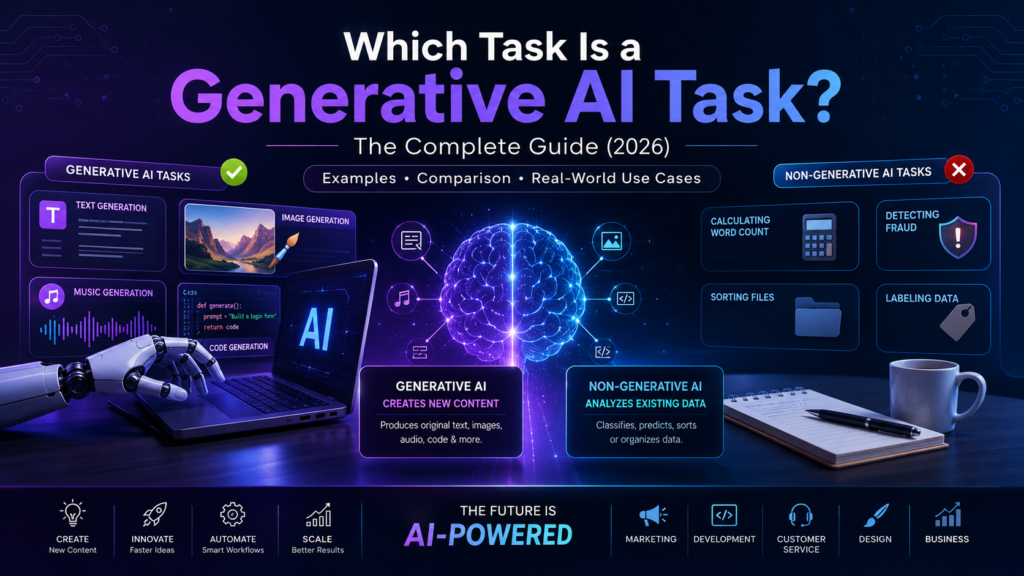
A generative AI task is any task where the AI creates something new text, an image, a piece of music, a block of code instead of just sorting, scoring, or classifying information that already exists.
So writing a blog post, generating a product image from a prompt, or drafting code from a description? All generative. Calculating a total, flagging a fraudulent transaction, or sorting files into folders? None of that is generative it’s classification or basic logic, even if AI is involved.
That’s the one-line version. Below is the fuller picture, with examples pulled from how people actually use these tools day to day.
So What Actually Makes a Task “Generative”?
Here’s the test I use: does the output exist before you ask, or does the AI have to invent it?
If a system is scanning a stack of transactions to flag one as suspicious, it’s choosing between options that were already defined fraud or not fraud. That’s classification. If it’s writing you a cover letter from scratch based on your resume, there was no cover letter sitting anywhere waiting to be found. The model had to generate it, word by word. That’s the difference.
This is also the line that separates generative AI from the AI that came before it. Older systems the ones behind spam filters, credit scoring, or recommendation engines are built to recognize patterns and make a decision. Generative systems, built on large language models, diffusion models, and similar architectures, are trained on huge datasets so they can produce brand-new output instead: a paragraph, an image, a melody, a working function.
Tools like Claude, ChatGPT, Gemini, and Copilot handle the text and code side. Midjourney and DALL·E handle images. All of them follow the same basic pattern you give a prompt, they produce something that didn’t exist a moment ago.
Worth knowing: the phrase “generative AI” only became a household term in late 2022, after ChatGPT launched. But the underlying research generative models capable of producing text and images goes back to the mid-2010s. What changed wasn’t the technology overnight; it was that regular people could finally use it without a research lab.
Generative AI Tasks, Sorted by Type
Generative AI has spread into nearly every corner of creative and technical work at this point. Here’s how the common tasks break down.
Writing and text
- Drafting emails, blog posts, or social captions
- Condensing long reports into a short summary
- Translating content between languages
- Writing product descriptions or ad copy
Images and design
- Turning a text prompt into an illustration or piece of art
- Producing logo concepts or quick mockups
- Adding or removing elements from an existing photo
Music and audio
- Composing original background tracks
- Generating voiceovers or synthetic narration
- Creating sound effects for video or games
Code
- Writing new code from a plain-language description
- Porting code from one language to another
- Debugging or cleaning up existing scripts
Every item on that list shares one thing in common: nothing existed until the prompt triggered it.
What’s NOT a Generative AI Task
This is where a lot of confusion happens, because plenty of tasks use AI without being generative at all:
- Counting words — that’s just logic, not generation
- Flagging credit card fraud — that’s classification
- Sorting or labeling files — that’s organization
- Predicting stock prices — that’s forecasting from existing patterns
- Recommending a product — that’s a recommendation engine, not creation
The rule of thumb: if the AI is analyzing, sorting, predicting, or classifying something that already exists, it’s not generative no matter how advanced the model behind it is.
Quick Comparison Table
| Task | Generative AI? | Category |
|---|---|---|
| Writing a poem or story | Yes | Text generation |
| Creating an image from a prompt | Yes | Image generation |
| Composing an original song | Yes | Audio generation |
| Writing or translating code | Yes | Code generation |
| Calculating a word count | No | Basic logic |
| Detecting credit card fraud | No | Classification |
| Sorting files or labeling data | No | Data organization |
| Predicting stock prices | No | Forecasting |
When Generative AI Actually Makes Sense
Not every job is a good fit for it. Generative AI earns its keep when the goal is to create something rather than crunch fixed numbers. It tends to work well for:
- Content creation — blog posts, scripts, marketing copy
- Brainstorming — pulling multiple angles or ideas out quickly
- Prototyping — draft layouts, sample code, mock designs
- Personalization — tailoring a message or recommendation to one specific person
- Language work — translation, tone shifts, rewrites
Where it doesn’t belong at least not unsupervised is anywhere accuracy is non-negotiable. Tax calculations, medical diagnoses, legal filings: these need rule-based or predictive systems doing the heavy lifting, with generative AI at most assisting in the background, not making the call.
How This Looks in Practice, by Industry
Marketing. Teams lean on generative tools to draft campaigns, spin up ad variations, and personalize email at scale. Small businesses that don’t want to manage this in-house often bring in a specialist AI content writer instead.
Software development. Developers use it to knock out boilerplate, generate test cases, and speed through documentation that used to eat hours.
Customer supportSupport teams use AI-drafted response templates as a starting point, then personalize them before hitting send finishing much faster than writing from a blank page every time.
Small business operations.More small businesses, particularly in the UK, are looking at privacy-conscious AI tools that let them automate without handing over customer data carelessly.
Freelance and side income. Some freelancers have built genuine income streams around generative tools content writing, automated design work, and similar services.
Generative vs. Non-Generative AI, Side by Side
| Generative AI | Non-Generative AI | |
|---|---|---|
| Main goal | Create new content | Analyze or classify existing data |
| Example tools | Claude, ChatGPT, Midjourney | Fraud detection systems, spam filters |
| Output type | Text, image, audio, code | Labels, scores, predictions |
| Common industries | Marketing, design, software | Finance, security, logistics |
| Underlying tech | Large language models, diffusion models | Decision trees, classifiers, regression models |
A Short Timeline
- 2014 — Generative Adversarial Networks (GANs) arrive, making early AI-generated images possible
- 2017 — The transformer architecture is published, becoming the backbone of modern LLMs
- 2020 — GPT-3 shows what large-scale text generation can actually do
- 2022 — ChatGPT puts generative AI in front of everyday users for the first time
- 2023–2024 — Multimodal models start combining text, image, and audio in one system
- 2025–2026 — Agentic systems begin handling multi-step generative work with less human oversight at each step
For a more technical, independent look at how these systems are evaluated and governed, the NIST AI Risk Management Framework is a solid resource.
Frequently Asked Questions
What are the three main types of generative AI?
Text generation, image generation, and audio/music generation are the big three. Code generation is common enough now that many people count it as a fourth.
Where is generative AI actually being used?
Marketing, software development, customer service, design, education — and increasingly small business automation and everyday content work.
Can you give some real examples?
Claude and ChatGPT for text, Midjourney and DALL·E for images, GitHub Copilot for code.
What counts as a “generative AI project”?
Any initiative built around a generative model with a specific goal — a chatbot, a content generator, an automated design tool, that kind of thing.
Which task is NOT a generative AI task?
Anything that analyzes, sorts, or classifies data that already exists — calculating totals, detecting fraud, filtering spam. If nothing new is being created, it’s not generative.
Written by a content strategist who’s been testing and implementing generative AI tools across marketing, small business automation, and content workflows since 2022. GlobeHustle publishes practical, no-fluff guides on AI tools and digital income for UK and US readers.