📌 Direct Answer: This SEO glossary covers 50 essential AI SEO and GEO (Generative Engine Optimization) terms that every marketer needs in 2026. From RAG and vector embeddings to topical authority and citation rate each term is defined in plain English, with real-world context for UK and US businesses navigating the shift to AI-powered search.
Key Takeaways
- AI search has introduced an entirely new vocabulary — and most marketers are behind
- GEO, RAG, vector embeddings, and citation rate are now as important as backlinks and keyword density
- Understanding these 50 terms gives you a genuine strategic advantage in AI-era digital marketing
- Each term in this glossary directly affects how visible your content is in ChatGPT, Perplexity, Gemini, and Google AI Overviews
- UK and US marketers who master this language now will lead their industries through 2026 and beyond
Quick Reference: 10 Must-Know Terms at a Glance
| Term | One-Line Definition |
|---|---|
| GEO | Optimizing content to be cited by AI search engines like ChatGPT and Perplexity |
| RAG | The process AI engines use to retrieve web content and build generated answers |
| Vector Embeddings | Mathematical representations of content meaning used by AI to understand relevance |
| Topical Authority | Depth of expertise a website demonstrates on a specific subject area |
| Citation Rate | How frequently an AI engine cites your content in its generated responses |
| Entity SEO | Optimizing content around named entities — brands, people, places, concepts |
| Semantic SEO | Optimizing for meaning and context, not just keyword matching |
| AI Overviews (AIO) | Google’s AI-generated answer boxes appearing above traditional search results |
| E-E-A-T | Experience, Expertise, Authoritativeness, Trustworthiness — Google’s content quality framework |
| Zero-Click Search | Searches where the user gets their answer directly in the results without clicking |
Introduction: The Language of Search Has Changed — Have You?
Not long ago, a solid understanding of keywords, backlinks, and meta tags was enough to hold your own in any SEO conversation. Then AI arrived — and brought an entirely new vocabulary with it.
Today, if you sit in a meeting with an AI SEO agency and they mention RAG, vector embeddings, or citation rate, do you know what they actually mean? More importantly, do you know why those terms matter for your business?
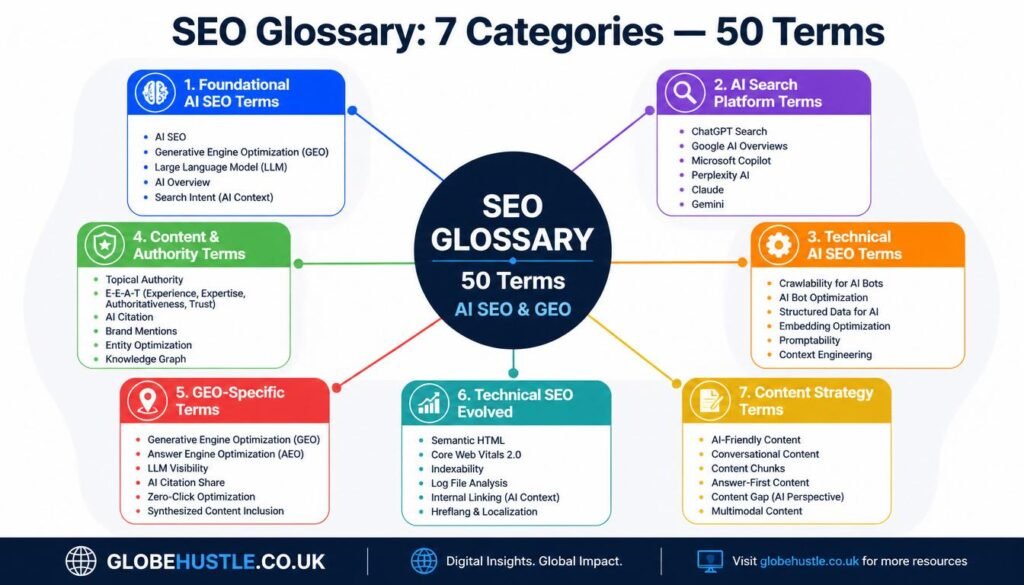
This SEO glossary exists to fix that gap. Whether you run a UK-based B2B company, manage digital marketing for a US brand, or freelance across clients in both markets, these 50 terms form the essential vocabulary of AI-era search. They cover everything from foundational SEO concepts that have evolved with AI, to brand-new GEO terms that didn’t exist three years ago.
Work through them at your own pace. Bookmark this page. Share it with your team. And if you find yourself wanting to apply these concepts practically, our guide on what AI SEO is and how it works for businesses is the logical next step.
💡 Fun Fact: According to research published in 2024, the term “Generative Engine Optimization” (GEO) was first formally introduced in academic literature. Within 18 months, it had become one of the most searched topics among digital marketing professionals in the UK and USA — proof that the industry’s vocabulary is evolving faster than most practitioners can keep up.
Let’s fix that — one term at a time.
📚 Category 1: Foundational AI SEO Terms
These are the core concepts underpinning how AI search works. Every other term in this glossary builds on these foundations.
1. AI SEO
Definition: AI SEO is the practice of optimizing website content so that AI-powered search platforms — including ChatGPT, Perplexity, Google Gemini, and Google AI Overviews — can find, understand, and cite it in their generated responses.
In Plain English: Traditional SEO gets you into Google’s list of ten results. AI SEO gets you into the actual answer AI gives users.
Why It Matters: As more users turn to AI tools for research, businesses that only optimize for traditional Google search are losing visibility in the places buyers increasingly look first.
Related Terms: GEO, Semantic SEO, Citation Rate
2. GEO (Generative Engine Optimization)
Definition: GEO is the discipline of optimizing content specifically for generative AI search engines — platforms that produce synthesized, cited answers rather than ranked lists of links.
In Plain English: If traditional SEO is about ranking in Google’s index, GEO is about being selected as a trusted source in an AI-generated answer.
Why It Matters: GEO is arguably the most important emerging discipline in digital marketing for 2026. Brands that master it will dominate AI-assisted search; those that ignore it will gradually disappear from the places their buyers research.
Related Terms: AI SEO, AEO, Citation Rate
Want to go deeper on this term? Our dedicated guide on what GEO actually means and why old SEO tactics are losing power covers it in full strategic detail.
3. AEO (Answer Engine Optimization)
Definition: AEO is the practice of structuring content to directly answer specific questions so that search engines and AI platforms surface it as the definitive response to a query.
In Plain English: AEO is about becoming the answer, not just a result. It focuses on question-based content that AI engines can pull and present directly.
Why It Matters: AEO and GEO overlap significantly, but AEO specifically targets question-answer format optimization — a format that works across both traditional featured snippets and AI-generated responses.
Related Terms: GEO, Featured Snippets, AI Overviews
4. LLM (Large Language Model)
Definition: A Large Language Model is an AI system trained on massive datasets of text that can understand, generate, and respond to natural language. ChatGPT, Claude, and Gemini are all powered by LLMs.
In Plain English: LLMs are the brains behind AI search. They read billions of web pages, learn patterns in language, and use that knowledge to generate human-like answers to questions.
Why It Matters: When an AI search engine answers a user’s question, an LLM is generating that answer. Understanding how LLMs evaluate content helps you write in ways they’ll trust and cite.
Related Terms: RAG, ChatGPT, Gemini, Claude
5. RAG (Retrieval Augmented Generation)
Definition: RAG is the technical process by which AI search engines retrieve relevant content from the web or an indexed database and use it as context to generate an accurate, cited response.
In Plain English: Instead of answering from memory alone, the AI goes and reads current web pages first — then builds its answer using what it finds, citing the sources it used.
Why It Matters: RAG is why your website content can become a cited source in AI answers. If your content is well-structured, authoritative, and accessible to AI crawlers, RAG gives it a pathway into AI-generated responses.
Related Terms: LLM, AI Crawlers, Vector Embeddings, Citation Rate
💡 Fun Fact: RAG was originally developed as a research technique at Facebook AI Research (Meta AI) in 2020. By 2024, it had become the dominant architecture behind commercial AI search engines including Perplexity AI and Google AI Overviews.
6. Semantic SEO
Definition: Semantic SEO is the practice of optimizing content for meaning and context rather than exact keyword matching — helping search engines understand the topic, intent, and relationships behind a piece of content.
In Plain English: Instead of repeating a keyword ten times, semantic SEO means writing comprehensively about a topic so that search engines understand what you’re an expert on — regardless of which exact words you use.
Why It Matters: AI search engines are fundamentally semantic. They understand meaning, not just keywords. Semantic SEO is therefore the foundation of all effective AI search optimization.
Related Terms: Entity SEO, NLP, Topical Authority, Vector Embeddings
7. Search Intent
Definition: Search intent is the underlying reason behind a search query — what the user actually wants to achieve, not just what words they typed.
In Plain English: Someone searching “best CRM software” wants a comparison, not a definition. Someone searching “what is CRM” wants an explanation. Same topic, completely different intent — and AI engines are very good at telling the difference.
Why It Matters: AI search engines prioritize content that satisfies the true intent behind a query. Matching your content to the right intent is the single most important factor in both traditional and AI SEO.
Types of Search Intent:
- Informational — user wants to learn something
- Commercial — user is researching before buying
- Transactional — user wants to take an action
- Navigational — user wants to find a specific website
Related Terms: GEO, Semantic SEO, AI Overviews
8. E-E-A-T (Experience, Expertise, Authoritativeness, Trustworthiness)
Definition: E-E-A-T is Google’s framework for evaluating content quality. It stands for Experience (first-hand knowledge), Expertise (depth of understanding), Authoritativeness (recognized credibility), and Trustworthiness (accuracy and transparency).
In Plain English: Google — and increasingly AI engines — ask four questions about every piece of content: Did someone with real experience write this? Do they know their subject deeply? Is their source credible? Can the reader trust what’s written?
Why It Matters: E-E-A-T signals are critical for both Google rankings and AI citation rates. Content that demonstrates strong E-E-A-T gets cited more frequently by ChatGPT, Perplexity, and Gemini than thin, generic content — regardless of keyword optimization.
Related Terms: Topical Authority, Author Authority, Trust Signals
For a full breakdown of how E-E-A-T applies specifically to AI search, see our pillar guide on what AI SEO is and how it works.
📚 Category 2: AI Search Platform Terms
Understanding the specific platforms shaping AI search is essential for any serious AI digital marketing strategy.
9. AI Overviews (AIO)
Definition: Google AI Overviews are AI-generated answer boxes that appear at the top of Google search results, synthesizing information from multiple web sources to provide a direct response to a query.
In Plain English: The box that now appears above Google’s traditional blue links — where Google’s AI summarizes an answer and cites a few sources. Getting featured there is the new “Position 1.”
Why It Matters: AI Overviews receive significant user attention because they appear before any traditional results. Appearing as a cited source in AIO increases brand visibility even when users don’t click through to your site.
Related Terms: GEO, Featured Snippets, Citation Rate, Google Gemini
10. ChatGPT Search (SearchGPT)
Definition: ChatGPT Search is OpenAI’s web-connected search feature that allows ChatGPT to retrieve and cite live web content when answering user queries.
In Plain English: When you ask ChatGPT a question and it references websites, that’s SearchGPT — pulling real-time web content to give you a sourced, up-to-date answer.
Why It Matters: ChatGPT has hundreds of millions of users globally. Being cited as a source in ChatGPT answers exposes your brand to a massive, research-oriented audience — many of whom are UK and US business professionals.
Related Terms: GPTBot, OAI-SearchBot, RAG, Citation Rate
11. Perplexity AI
Definition: Perplexity AI is an AI-powered answer engine that provides real-time, cited responses to queries by actively crawling the web and synthesizing information from multiple sources.
In Plain English: Think of Perplexity as a research assistant that reads the current web, finds the most relevant sources, and gives you a summarized answer with all the citations visible.
Why It Matters: Perplexity is particularly active in citing B2B and professional content. It crawls the live web for many queries, meaning recent, well-structured content can appear in Perplexity answers very quickly after publication.
Related Terms: PerplexityBot, Citation Rate, RAG
12. Google Gemini
Definition: Google Gemini is Google’s multimodal large language model, powering both Google AI Overviews in Search and Google’s standalone Gemini AI assistant.
In Plain English: Gemini is the AI brain behind Google’s new search experience. It reads your content, understands it, and decides whether it’s worth citing in AI-generated answers.
Why It Matters: Because Gemini powers both Google Search AI features and the standalone Gemini app, optimizing for Gemini effectively means optimizing for the entire Google ecosystem in the AI era.
Related Terms: Google AI Overviews, LLM, GEO
13. Claude (Anthropic)
Definition: Claude is the large language model developed by Anthropic, available as a standalone AI assistant and increasingly integrated into business workflows and search tools.
In Plain English: Claude is ChatGPT’s main competitor — a powerful AI assistant built with a strong emphasis on safety, accuracy, and nuanced reasoning.
Why It Matters: Claude’s crawler (ClaudeBot) actively indexes web content. As Claude expands into more search and research applications, having your content accessible to ClaudeBot becomes increasingly valuable.
Related Terms: ClaudeBot, LLM, RAG
14. Microsoft Copilot
Definition: Microsoft Copilot is Microsoft’s AI assistant, integrated into Bing Search, Microsoft 365, and Windows — powered by OpenAI’s technology and Microsoft’s own Prometheus model.
In Plain English: Copilot is the AI built into Bing and Microsoft’s productivity suite. When someone uses Bing’s AI search or asks Copilot a question in Word or Teams, it draws on web content to generate responses.
Why It Matters: For UK and US B2B brands targeting professionals who use Microsoft’s ecosystem — which is a very large audience — Copilot visibility is a meaningful channel that’s often overlooked in AI SEO strategy.
Related Terms: BingBot, RAG, GEO
📚 Category 3: Technical AI SEO Terms
These terms define the technical infrastructure behind AI search — the mechanics that determine whether your content gets found, processed, and cited.
15. Vector Embeddings
Definition: Vector embeddings are numerical representations of text that capture semantic meaning — allowing AI systems to understand the relationship between concepts, not just the presence of specific words.
In Plain English: Instead of seeing your article as a list of words, an AI converts it into a mathematical fingerprint of its meaning. Two articles about “AI search optimization” might use different words but have very similar fingerprints — and the AI understands they cover the same concept.
Why It Matters: AI search engines index content using vector embeddings, not keyword databases. This is why content that covers a topic comprehensively can rank for queries that never appear in the text — because its meaning matches.
Related Terms: Semantic SEO, LLM, RAG, Knowledge Graph
16. AI Crawlers (AI Bots)
Definition: AI crawlers are specialized web bots deployed by AI search companies to discover, read, and index web content for use in AI-generated responses.
Key AI Crawlers Active in 2026:
- GPTBot — OpenAI (ChatGPT)
- OAI-SearchBot — OpenAI real-time search
- PerplexityBot — Perplexity AI
- ClaudeBot — Anthropic (Claude)
- Google-Extended — Google Gemini training
- BingBot — Microsoft Copilot
In Plain English: These are the robots that visit your website, read your content, and report back to their respective AI engines. If they can’t access your site, your content doesn’t exist in AI search.
Why It Matters: Accidentally blocking AI crawlers in your robots.txt file is one of the most common — and most damaging — technical AI SEO mistakes. Always verify crawler access.
Related Terms: robots.txt, GPTBot, Crawling and Indexing
💡 Fun Fact: GPTBot, OpenAI’s primary web crawler, was first publicly documented in August 2023. Within six months of its announcement, it had become one of the most frequently discussed topics in technical SEO communities across both the UK and the USA.
17. robots.txt
Definition: robots.txt is a plain-text file on your website that instructs web crawlers which pages or sections they are and aren’t allowed to access.
In Plain English: It’s a set of rules you leave at your website’s front door, telling bots what they can and can’t read. The problem is, many websites have rules that accidentally tell AI crawlers to stay out.
Why It Matters: A single line in your robots.txt blocking GPTBot or PerplexityBot makes your entire website invisible to those AI search engines. This is a critical technical check for any AI SEO audit.
Related Terms: AI Crawlers, Technical SEO, Crawling and Indexing
18. Schema Markup (Structured Data)
Definition: Schema markup is code added to web pages that provides explicit information about the content’s meaning, structure, and context — helping search engines and AI engines understand and categorize what they’re reading.
In Plain English: Schema is like adding labels to your content. Instead of making Google guess that your article is a recipe, FAQ, or product review — schema tells it directly.
Why It Matters: AI engines use schema markup to extract and present structured information accurately. FAQ schema, Article schema, and HowTo schema are particularly effective for improving AI search visibility and featured snippet performance.
Common Schema Types:
- Article — for blog posts and editorial content
- FAQPage — for question-and-answer sections
- HowTo — for step-by-step process content
- DefinedTerm — for glossary entries (like this one)
- Organization — for brand entity signals
Related Terms: Entity SEO, AI Overviews, GEO
19. Knowledge Graph
Definition: A Knowledge Graph is a structured database of entities people, places, organizations, concepts — and the relationships between them, used by AI systems to understand the world and evaluate content authority.
In Plain English: Google’s Knowledge Graph is essentially a giant map of real-world things and how they connect. When Google knows your brand exists and understands what it does, your content becomes more trusted in AI-powered search.
Why It Matters: Appearing in Google’s Knowledge Graph through consistent brand signals, Wikipedia mentions, and structured entity data strengthens the authority signals that AI engines use to evaluate whether your content is worth citing.
Related Terms: Entity SEO, Brand Entity, Google Gemini
20. Core Web Vitals
Definition: Core Web Vitals are Google’s set of technical performance metrics measuring loading speed (LCP), interactivity (INP), and visual stability (CLS) all of which affect both traditional rankings and AI crawler accessibility.
In Plain English: If your website loads slowly, jumps around while loading, or takes ages to respond to clicks, Google penalizes it. And slow sites are also harder for AI crawlers to process efficiently.
Why It Matters: A technically strong website improves both Google rankings and AI crawler experience. Fast-loading, stable pages are indexed more effectively by all major AI crawlers.
Related Terms: Technical SEO, AI Crawlers, Crawling and Indexing
📚 Category 4: Content & Authority Terms
These terms govern how content quality, depth, and authority are evaluated by both Google and AI search engines.
21. Topical Authority
Definition: Topical authority is the degree of recognized expertise a website or author demonstrates on a specific subject — earned by consistently producing comprehensive, interconnected content on that topic over time.
In Plain English: A website that publishes 30 deeply researched articles on AI SEO has more topical authority on that subject than one that publishes one article on AI SEO and 29 articles on unrelated topics.
Why It Matters: AI engines strongly prefer citing sources with high topical authority in their niche. Building topical authority through content clusters is one of the most reliable long-term AI SEO strategies.
Related Terms: Content Clustering, Pillar Content, E-E-A-T, Semantic SEO
22. Content Clustering
Definition: Content clustering is a strategic approach to organizing website content around a central pillar article, supported by multiple interconnected cluster articles covering related subtopics in depth.
In Plain English: Instead of writing random articles about random topics, you build a hub-and-spoke content structure. One main article covers the big topic; supporting articles go deep on each subtopic and all link back to the hub.
Why It Matters: Content clusters signal topical authority to both Google and AI engines. A well-structured cluster tells AI search that your site covers a topic comprehensively — making it a more trustworthy citation source.
Related Terms: Topical Authority, Internal Linking, Pillar Content
23. Pillar Content
Definition: Pillar content is a comprehensive, authoritative piece that covers a broad topic thoroughly and serves as the central hub for a cluster of related supporting articles.
In Plain English: A pillar article is the “everything you need to know about X” guide on your site. It covers the topic broadly and links to deeper-dive articles on each subtopic.
Why It Matters: Pillar articles are the cornerstone of topical authority. AI engines frequently cite pillar content because it demonstrates breadth of knowledge and the internal links to cluster content demonstrate depth.
Related Terms: Content Clustering, Topical Authority, Internal Linking
24. Entity SEO
Definition: Entity SEO is the practice of optimizing content around named entities specific, identifiable things like brands, people, places, products, and concepts to help AI search engines understand who you are and what you’re about.
In Plain English: AI doesn’t just search for keywords. It searches for things. “HubSpot,” “UK AI SEO agency,” and “Generative Engine Optimization” are all entities. Making sure AI engines correctly understand your brand as a recognized entity in your field is the foundation of modern SEO.
Why It Matters: The more clearly your brand is established as a recognized entity through consistent mentions, structured data, and authoritative external references the more confidently AI engines will cite your content.
Related Terms: Knowledge Graph, Schema Markup, Brand Entity, Semantic SEO
25. Brand Entity
Definition: A brand entity is the digital representation of your company as a recognized, distinct entity within search engines’ and AI engines’ understanding of the world confirmed through consistent signals across the web.
In Plain English: Your brand entity is essentially how well AI engines “know” your company exists and what it does. Strong brand entities get cited. Weak or absent brand entities get ignored.
How to Build It:
- Complete, accurate Crunchbase and LinkedIn Company profiles
- Mentions in authoritative industry publications
- Consistent NAP (Name, Address, Phone) data across directories
- Schema Organization markup on your website
- Wikipedia or Wikidata presence (where applicable)
Related Terms: Entity SEO, Knowledge Graph, Schema Markup
26. Topical Map
Definition: A topical map is a strategic planning document that outlines all the content a website needs to produce to demonstrate complete authority on a subject area covering every angle, question, and subtopic a user might explore.
In Plain English: Before writing a single article, you map out everything that needs to be covered on a topic. The map shows gaps, overlaps, and the logical order of content production.
Why It Matters: Building a topical map before publishing ensures that your content cluster covers a topic comprehensively which is precisely what AI engines evaluate when assessing whether your site deserves to be cited as an authority.
Related Terms: Content Clustering, Topical Authority, Pillar Content
27. Author Authority
Definition: Author authority refers to the credibility and expertise of the person who wrote a piece of content — a signal that both Google and AI engines use to evaluate the trustworthiness of the information.
In Plain English: A cybersecurity article written by a certified security professional carries more weight than the same article written by an anonymous contributor. AI engines are increasingly good at detecting the difference.
Why It Matters: Including a detailed author bio with relevant credentials, first-hand experience, and professional links significantly improves both E-E-A-T signals and the likelihood of being cited by AI search engines.
Related Terms: E-E-A-T, Trustworthiness, YMYL Content
28. YMYL (Your Money or Your Life)
Definition: YMYL refers to content categories that can significantly impact a reader’s health, financial wellbeing, safety, or major life decisions and therefore require the highest standards of accuracy and expertise.
In Plain English: Finance, health, legal advice, and safety topics are YMYL. Google and AI engines apply extra scrutiny to content in these categories, requiring stronger E-E-A-T signals before featuring or citing it.
Why It Matters: If your business operates in a YMYL category, your AI SEO strategy needs particularly strong author credentials, cited sources, and transparent accuracy signals.
Related Terms: E-E-A-T, Author Authority, Trustworthiness
📚 Category 5: GEO-Specific Terms
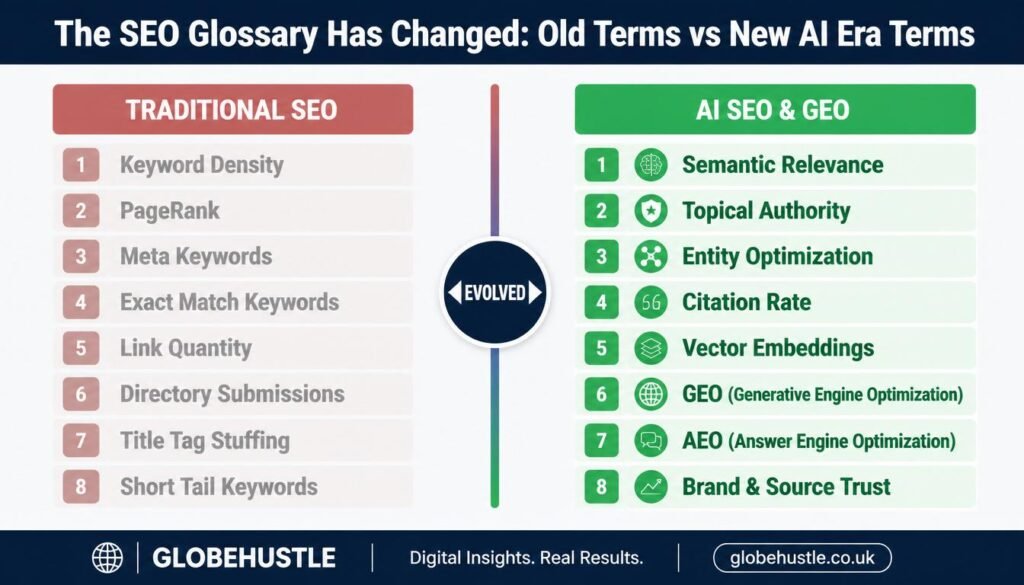
These terms are unique to Generative Engine Optimization the emerging discipline that sits at the heart of AI search visibility.
29. Citation Rate
Definition: Citation rate in GEO refers to the frequency with which an AI search engine selects and attributes your content as a source when generating responses to relevant queries.
In Plain English: How often does ChatGPT, Perplexity, or Gemini actually name your website when it answers a question in your niche? That’s your citation rate and in 2026, it’s one of the most important visibility metrics for any content-driven business.
Why It Matters: Citation rate is to GEO what click-through rate is to traditional SEO. It measures whether your content investment is actually translating into AI search visibility.
Related Terms: GEO, RAG, Source Attribution, AI Overviews
30. Source Attribution
Definition: Source attribution is the process by which AI search engines identify, reference, and link to the original web sources they used to construct a generated answer.
In Plain English: When Perplexity says “According to GlobeHustle.co.uk…” that’s source attribution. Your content was used, and your brand got credit.
Why It Matters: Source attribution is the mechanism through which AI search generates value for content creators. Understanding how AI engines decide which sources to attribute helps you structure content that earns those references.
Related Terms: Citation Rate, RAG, GEO
31. Zero-Click Search
Definition: Zero-click search describes a search session where the user receives their answer directly within the search results page or from an AI-generated response without ever clicking through to a source website.
In Plain English: The user asked a question, got a complete answer, and never visited anyone’s website. From a traffic perspective, that click was lost. But if your brand was cited in the answer, your visibility was not.
Why It Matters: Zero-click searches are increasing rapidly with the growth of AI search. For B2B brands in particular, adapting strategy from “generating clicks” to “earning citations” is the key mindset shift for 2026.
Related Terms: AI Overviews, Citation Rate, GEO
For a deeper look at how zero-click search is reshaping B2B marketing, our article on B2B SEO strategy in the AI era covers the commercial implications in detail.
32. AI Visibility Score
Definition: AI visibility score is an emerging metric that measures how prominently and consistently a brand or website appears in AI-generated search responses across multiple AI platforms.
In Plain English: Just as Domain Authority approximates traditional SEO strength, AI visibility score approximates how “present” your brand is in the AI search ecosystem across ChatGPT, Perplexity, Gemini, and AI Overviews.
Why It Matters: Tracking AI visibility is the new baseline for understanding whether your content strategy is working in the AI search era. You can run a basic version manually by searching your brand and key topics in major AI tools.
Related Terms: Citation Rate, GEO, Brand Entity
33. Conversational Search
Definition: Conversational search refers to queries phrased as natural questions or statements the way you’d speak to a person rather than the fragmented keyword strings that characterized early search behavior.
In Plain English: Instead of typing “best CRM UK,” a conversational search looks like: “What’s the best CRM for a 20-person UK marketing agency that needs LinkedIn integration?”
Why It Matters: AI search engines are built for conversational queries. Content that naturally answers full-sentence questions rather than targeting isolated keyword fragments performs significantly better in AI-powered search.
Related Terms: NLP, Search Intent, AEO, GEO
34. Prompt-Based Search
Definition: Prompt-based search is the behavior of users who interact with AI search tools by entering detailed prompts or instructions rather than brief keywords expecting comprehensive, synthesized responses.
In Plain English: Traditional search: “AI SEO agency UK.” Prompt-based search: “Compare the top AI SEO agencies in the UK for a B2B SaaS company with a £5,000 monthly budget.” Completely different interaction model.
Why It Matters: Prompt-based searches are longer, more specific, and more intent-driven than traditional queries. Content that comprehensively addresses specific scenarios rather than broad topics earns more AI citations from prompt-based searches.
Related Terms: Conversational Search, GEO, LLM
📚 Category 6: Technical SEO Terms (Evolved for AI)
These are established SEO concepts that have taken on new significance in the AI search era.
35. Crawling and Indexing
Definition: Crawling is the process by which search engine or AI bots discover and visit web pages. Indexing is the process of storing and organizing the information found during crawling so it can be retrieved when relevant.
In Plain English: Crawling is the bot reading your page. Indexing is the bot filing it away for later. Both steps must work correctly before your content can ever appear in any search result traditional or AI.
Why It Matters: AI crawlers operate differently from Googlebot. Understanding the crawling and indexing behavior of GPTBot, PerplexityBot, and ClaudeBot is essential for ensuring your content actually reaches AI search engines.
Related Terms: AI Crawlers, robots.txt, Schema Markup
36. Featured Snippets
Definition: Featured snippets are highlighted answer boxes that Google places above traditional organic results — typically containing a direct answer to the user’s query, pulled from a web page and attributed with a link.
In Plain English: The box at the top of Google results that directly answers your question. Position Zero. The result before the results.
Why It Matters: Featured snippets and Google AI Overviews increasingly overlap. Content structured to earn featured snippets — direct answers, clear formatting, FAQ schema tends to also perform well in AI Overview citations.
Related Terms: AI Overviews, Schema Markup, AEO, Zero-Click Search
37. Internal Linking
Definition: Internal linking is the practice of creating hyperlinks between pages on the same website connecting related content and helping both users and search engines navigate the site’s information structure.
In Plain English: When you link from one article on your site to another relevant article on your site, that’s internal linking. It tells search engines which pages are related and which are most important.
Why It Matters: Internal linking is critical for topical authority. Well-linked content clusters signal to AI engines that your site covers a topic comprehensively not just in one isolated article.
Related Terms: Content Clustering, Topical Authority, Pillar Content
38. Backlinks (Inbound Links)
Definition: Backlinks are links from other websites pointing to your website widely recognized as one of the strongest authority signals in traditional SEO, and still relevant as a trust signal in AI search.
In Plain English: When Forbes, Search Engine Journal, or any credible site links to your content, that’s a backlink essentially a vote of confidence that AI engines notice and factor into trust evaluation.
Why It Matters: While AI search relies less on raw link counts than traditional Google, backlinks from authoritative sources still strengthen brand entity signals and overall domain trust both of which influence AI citation rates.
Related Terms: Domain Authority, Brand Entity, E-E-A-T
39. Domain Authority (DA)
Definition: Domain Authority is a metric developed by Moz that predicts a website’s likelihood of ranking well in search results, based primarily on the quality and quantity of inbound links.
In Plain English: DA is a score from 1–100 estimating how credible and authoritative your website is. Higher DA websites tend to rank better in traditional SEO and carry more weight as AI citation sources.
Why It Matters: While not a direct Google ranking factor, DA correlates strongly with the trust signals that both Google and AI engines use. Building domain authority through quality backlinks and consistent expert content improves AI visibility over time.
Related Terms: Backlinks, E-E-A-T, Brand Entity
40. Keyword Density
Definition: Keyword density is the percentage of times a target keyword appears in a piece of content relative to the total word count.
In Plain English: If your article is 1,000 words and “AI SEO” appears 10 times, your keyword density for that term is 1%. Once an important traditional SEO metric — now much less so.
Why It Matters: In AI search, keyword density is largely irrelevant. AI engines understand meaning through vector embeddings, not word frequency. Over-optimizing for keyword density while ignoring semantic depth is one of the most common modern SEO mistakes.
Related Terms: Semantic SEO, Vector Embeddings, LSI Keywords
📚 Category 7: Content Strategy & Optimization Terms
41. NLP (Natural Language Processing)
Definition: Natural Language Processing is the branch of AI technology that enables computers to understand, interpret, and generate human language the foundational technology behind all AI search engines.
In Plain English: NLP is what allows AI engines to understand that “best software for managing projects remotely” and “top project management tools for distributed teams” mean essentially the same thing.
Why It Matters: Writing in natural, conversational language rather than forced keyword strings aligns with how NLP processes content. NLP-friendly writing is AI-search-friendly writing.
Related Terms: LLM, Semantic SEO, Conversational Search
42. LSI Keywords (Latent Semantic Indexing Keywords)
Definition: LSI keywords are semantically related terms that commonly appear alongside a primary topic — helping search engines confirm that a piece of content genuinely covers a subject in depth.
In Plain English: If you write about “AI SEO,” related LSI keywords might include “machine learning,” “search rankings,” “content optimization,” and “LLMs.” Their natural presence signals that your article is genuinely comprehensive on the topic.
Why It Matters: Including semantically related terms naturally throughout your content helps AI engines map your content to the right topic areas improving relevance signals across the board.
Related Terms: Semantic SEO, Vector Embeddings, Topical Authority
43. Helpful Content
Definition: Helpful Content refers to Google’s algorithmic prioritization first introduced via the Helpful Content Update of content genuinely written for human readers over content primarily created to rank in search results.
In Plain English: Google designed this update to reward articles that actually help readers solve problems and penalize articles written purely to game search algorithms.
Why It Matters: Helpful content principles apply equally to AI search. AI engines cite content that genuinely answers questions not content stuffed with keywords and lacking real value. Writing for your reader is, paradoxically, the best thing you can do for your AI search rankings.
Related Terms: E-E-A-T, People-First Content, Search Intent
44. Content Freshness
Definition: Content freshness refers to how recently a piece of content was published or updated a signal that both Google and AI search engines use to assess relevance for time-sensitive queries.
In Plain English: For topics that change frequently AI SEO, digital marketing trends, technology recently updated content is preferred over content that hasn’t been touched in two years.
Why It Matters: Perplexity AI in particular favors fresh content, often crawling in near real-time for many queries. Regularly updating and expanding your key articles sends positive freshness signals to all AI search platforms.
Related Terms: AI Crawlers, GEO, Topical Authority
45. Direct Answer Block
Definition: A direct answer block is a concise, clearly structured paragraph or section placed near the top of an article that immediately answers the primary query optimized for AI extraction and featured snippet capture.
In Plain English: The “Quick Answer” box you see at the top of well-structured articles. It answers the main question in 40–80 words before the article expands into detail.
Why It Matters: AI engines prioritize sources that answer questions immediately and clearly. A well-crafted direct answer block significantly increases the likelihood of your content being cited in AI-generated responses.
Related Terms: AEO, Featured Snippets, GEO, AI Overviews
46. Anchor Text
Definition: Anchor text is the clickable, visible text of a hyperlink the words a user sees and clicks to follow a link to another page.
In Plain English: In the sentence “Learn more about [AI SEO strategies],” the anchor text is “AI SEO strategies.” The words you choose for anchor text signal to search engines what the linked page is about.
Why It Matters: Natural, descriptive anchor text strengthens internal linking signals and helps AI engines understand the relationship between content pieces in your cluster.
Related Terms: Internal Linking, Content Clustering, Backlinks
47. People Also Ask (PAA)
Definition: People Also Ask is a Google SERP feature displaying a dynamic list of questions related to the user’s original search query — pulled from web content that Google’s AI has identified as answering those questions.
In Plain English: The expandable question boxes that appear in the middle of Google results. Click one, and it expands to show a brief answer from a cited webpage.
Why It Matters: PAA boxes are a direct window into the questions your target audience is actually asking. Structuring your content to answer these questions improves both PAA inclusion and AI citation rates.
Related Terms: AEO, Search Intent, Featured Snippets, GEO
48. Digital PR
Definition: Digital PR is the practice of earning mentions, citations, and backlinks from authoritative online publications, industry blogs, and media outlets building the third-party credibility signals that both Google and AI search engines evaluate.
In Plain English: Getting your brand mentioned or quoted in Forbes, Search Engine Journal, B2B Marketing, or relevant industry publications. Every authoritative mention strengthens your brand entity signals.
Why It Matters: AI engines cite brands they have encountered across trusted sources. Digital PR is one of the most effective off-page strategies for improving AI search visibility because it builds exactly the kind of authoritative external presence that AI engines treat as a trust signal.
Related Terms: Brand Entity, E-E-A-T, Backlinks, Knowledge Graph
49. Structured Content
Definition: Structured content is content organized with clear formatting elements H2/H3 headings, numbered lists, bullet points, comparison tables, definition blocks, and FAQ sections making it easy for both human readers and AI engines to navigate and extract information.
In Plain English: Content with clear headings, short paragraphs, and organized sections rather than long walls of unbroken text. AI engines strongly prefer structured content because it’s easier to parse, summarize, and cite accurately.
Why It Matters: Well-structured content gets cited more frequently by AI search engines. It’s also more readable for human visitors which improves engagement signals that reinforce overall authority.
Related Terms: Schema Markup, GEO, Direct Answer Block, AEO
50. AI-First Content Strategy
Definition: An AI-first content strategy is a content planning approach that prioritizes visibility in AI-generated search responses designing every piece of content with AI citation potential, structured formatting, semantic depth, and E-E-A-T signals as primary objectives alongside traditional Google ranking.
In Plain English: It means writing every article with two audiences in mind simultaneously: the human reader who will find it valuable, and the AI engine that will decide whether it deserves to be cited. When you serve both well, you win in modern search.
Why It Matters: An AI-first content strategy is the bridge between everything covered in this glossary and real-world business results. Understanding these 50 terms is the first step. Applying them through a coherent, intentional content strategy is what generates sustainable AI search visibility.
Related Terms: GEO, Topical Authority, Content Clustering, E-E-A-T
From Glossary to Action: What Comes Next
Reading a glossary is a start. But knowing what vector embeddings and citation rates mean only creates value when you apply that knowledge to your actual content strategy.
The businesses winning in AI search right now are not the ones with the largest content libraries or the biggest budgets. They are the ones who understood the language of AI search early and built their strategy around it before the competition caught up.
For UK and US businesses, the window to gain first-mover advantage in AI search is real. It will not stay open indefinitely.
If you want to understand how GEO fits into your broader SEO approach, our guide on what GEO means and why traditional SEO is losing power covers the full strategic picture. And if you want to see how AI search engines actually crawl and process content, our technical breakdown of how AI search engines crawl, index and rank content explains the mechanics behind these terms in action.
💡 Fun Fact: According to data from Semrush, the keyword “ai in digital marketing” carries a CPC of £10.24 in the UK market — one of the highest in the digital marketing category. That level of advertiser investment signals that brands are actively competing to reach marketers who are learning about AI search. You’re now one of them.
AI SEO & GEO Learning Timeline: Your 90-Day Roadmap
| Timeframe | Focus | Terms to Master |
|---|---|---|
| Week 1–2 | Foundational understanding | AI SEO, GEO, LLM, RAG, Semantic SEO |
| Week 3–4 | Platform knowledge | AI Overviews, ChatGPT Search, Perplexity, Gemini |
| Month 2 — Week 1 | Technical audit | AI Crawlers, robots.txt, Schema Markup, Core Web Vitals |
| Month 2 — Week 2–3 | Content strategy | Topical Authority, Content Clustering, Pillar Content, Topical Map |
| Month 2 — Week 4 | Authority building | Entity SEO, Brand Entity, Digital PR, E-E-A-T |
| Month 3 — Week 1–2 | GEO optimization | Citation Rate, Source Attribution, Direct Answer Block, Structured Content |
| Month 3 — Week 3–4 | Full strategy | AI-First Content Strategy, AI Visibility Score, Conversational Search |
Conclusion: The Marketers Who Know This Language Will Lead
The shift to AI-powered search is not a future concern. It is the present reality of digital marketing in 2026 and the vocabulary that governs it is expanding faster than most professionals can track.
This SEO glossary gives you the language. GEO, RAG, citation rate, vector embeddings, topical authority, brand entity, structured content these are not buzzwords. They are the operational terms of a new search ecosystem that is actively reshaping how UK and US businesses get found online.
Every term in this list connects to a practical action your business can take. Every concept maps to a content, technical, or authority-building strategy that improves AI search visibility. The foundation starts with understanding and you now have it.
Ready to Apply These Terms to Your Business?
Understanding AI SEO and GEO terminology is step one. Step two is building a content strategy that puts these concepts into practice and generating real visibility in ChatGPT, Perplexity, Gemini, and Google AI Overviews.
Book Your AI SEO Strategy Session → GlobeHustle.co.uk
Frequently Asked Questions
What is the difference between SEO and GEO?
Traditional SEO (Search Engine Optimization) focuses on ranking in Google’s list of ten blue links. GEO (Generative Engine Optimization) focuses on being cited as a trusted source in AI-generated answers from platforms like ChatGPT, Perplexity, and Gemini. SEO gets you into the results list; GEO gets you into the answer itself. For a full comparison, see our guide on GEO vs traditional SEO.
What does RAG mean in AI search?
RAG stands for Retrieval Augmented Generation. It is the process by which AI search engines retrieve relevant content from the web and use it as context to generate accurate, cited responses. When an AI cites your website in an answer, RAG is the mechanism that made it possible.
What is the most important AI SEO term to understand in 2026?
Citation rate. It measures how frequently AI engines cite your content in their generated responses and it is the core metric that determines whether your content investment is translating into AI search visibility.
How is semantic SEO different from traditional keyword SEO?
Traditional keyword SEO focuses on the presence of specific words in your content. Semantic SEO focuses on meaning, context, and the relationships between concepts. AI search engines are fundamentally semantic — they understand what your content means, not just which words it contains.
What is topical authority and how do you build it?
Topical authority is the recognized depth of expertise your website demonstrates on a specific subject. You build it by consistently producing comprehensive, interconnected content on a focused topic area — using a pillar content and content clustering strategy. AI engines strongly prefer citing sources with established topical authority.
What is the difference between GEO, AEO, and traditional SEO?
Traditional SEO targets Google’s ranked results list. AEO (Answer Engine Optimization) targets direct question-answer formats for featured snippets and voice search. GEO (Generative Engine Optimization) targets AI-generated responses in tools like ChatGPT, Perplexity, and Gemini. In practice, strong GEO and AEO optimization overlap significantly.
Why do AI search engines prefer structured content?
AI engines use structured content clear headings, numbered lists, comparison tables, definition blocks, FAQ sections to extract and cite specific information accurately. Unstructured text is harder for AI to parse and present confidently. Structured content improves citation rates across all major AI search platforms.