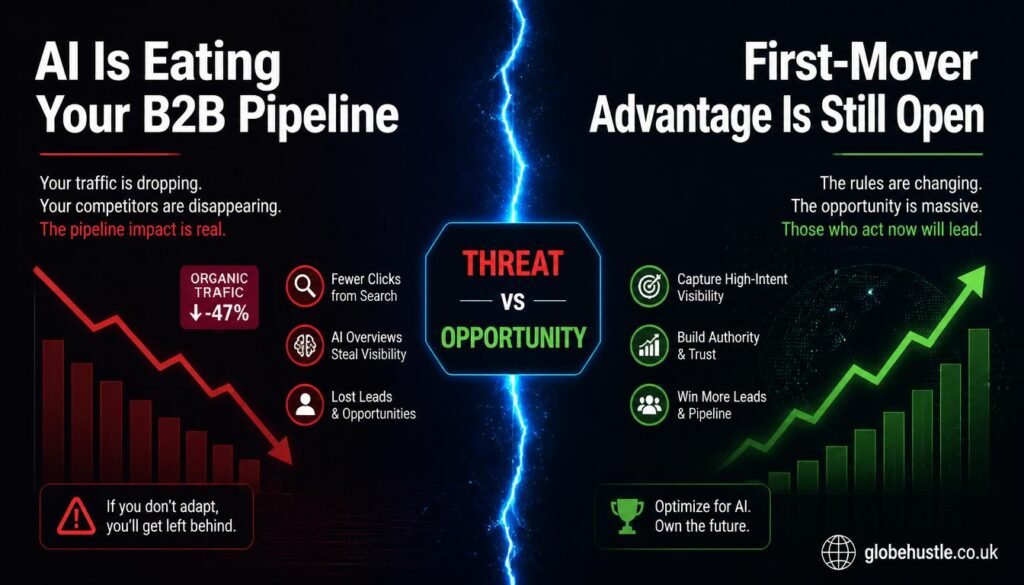
📌 Direct Answer: AI search engines like ChatGPT, Perplexity, and Google Gemini are fundamentally changing B2B SEO strategy. They are cutting off top-of-funnel traffic, answering buyer research questions without a single click and handing authority to the brands whose content gets cited. For B2B companies, this is both a serious threat and a first-mover opportunity.
Key Takeaways
- B2B buyers now use ChatGPT and Perplexity to research vendors — before they ever visit a website
- Zero-click AI answers are quietly removing B2B brands from the early stages of the buyer journey
- Brands cited by AI engines build trust and authority even without direct traffic
- B2B AI SEO is less competitive than B2C early movers gain a significant advantage
- Thought leadership content, structured formatting, and entity optimization are the new B2B SEO foundations
- UK and US B2B companies with KD 5–17 keyword opportunities can rank faster than they think
Featured Snippet: Traditional B2B SEO vs AI-Era B2B SEO Strategy
| Factor | Traditional B2B SEO | AI-Era B2B SEO Strategy |
|---|---|---|
| Primary Goal | Rank in Google’s top 10 | Get cited in AI-generated answers |
| Content Format | Long-form keyword-optimized | Structured, answer-first, entity-rich |
| Buyer Touchpoint | Google search → website visit | AI answer → brand recognition → website |
| Traffic Model | Direct organic clicks | Brand citations + qualified direct visits |
| Key Signal | Backlinks + keyword density | Semantic relevance + E-E-A-T + authority |
| Competitive Gap | Saturated in most B2B niches | Still wide open in AI search |
| Lead Quality | Mixed — volume-driven | Higher intent — AI-referred visitors convert better |
| UK/US Advantage | Marginal for new sites | Significant first-mover opportunity right now |
Introduction: Something Is Quietly Eating Your B2B Pipeline
Picture this. A procurement manager at a mid-size UK tech company needs a new CRM. She doesn’t start with Google anymore. She opens ChatGPT and types: “What’s the best CRM for a 50-person B2B SaaS company in the UK?”
ChatGPT gives her a detailed, confident answer. The text names three platforms, explaining the pros and cons of each while guiding her on what to look for in a vendor. She reads it, saves two names, and moves on.
Your company which has been producing CRM-related blog content for two years is not mentioned once.
That scenario is not hypothetical. It is happening right now, across every B2B industry, in every English-speaking market. And yet most B2B brands have not changed a single element of their SEO strategy in response.
A solid B2B SEO strategy in 2026 means understanding two things simultaneously: where AI search is hurting your visibility, and where it is creating openings your competitors haven’t found yet. This guide covers both with real data, practical steps, and a clear picture of what needs to change.
What Is AI SEO for B2B Brands?
AI SEO for B2B brands is the practice of optimizing your website’s content so that AI-powered search platforms including ChatGPT, Perplexity AI, Google AI Overviews, and Gemini surface and cite your brand during the research phase of the B2B buyer journey.
It is not a replacement for your existing B2B SEO strategy. It is an extension of it one that accounts for how your buyers are increasingly starting their research, and what kind of content earns a citation rather than just a ranking.
The core difference is this: traditional B2B SEO gets you into a list of ten results. AI SEO gets you into the answer itself.
💡 Fun Fact: According to Forrester Research, B2B buyers complete approximately 70% of their research journey before ever speaking to a sales representative. In 2026, a growing proportion of that independent research is happening inside AI tools not on Google.
For B2B brands with long sales cycles, complex buying committees, and trust-dependent decisions, that shift in where research happens is not a minor footnote. It changes the entire top-of-funnel equation.
The Threat: What AI Search Is Taking From B2B Brands
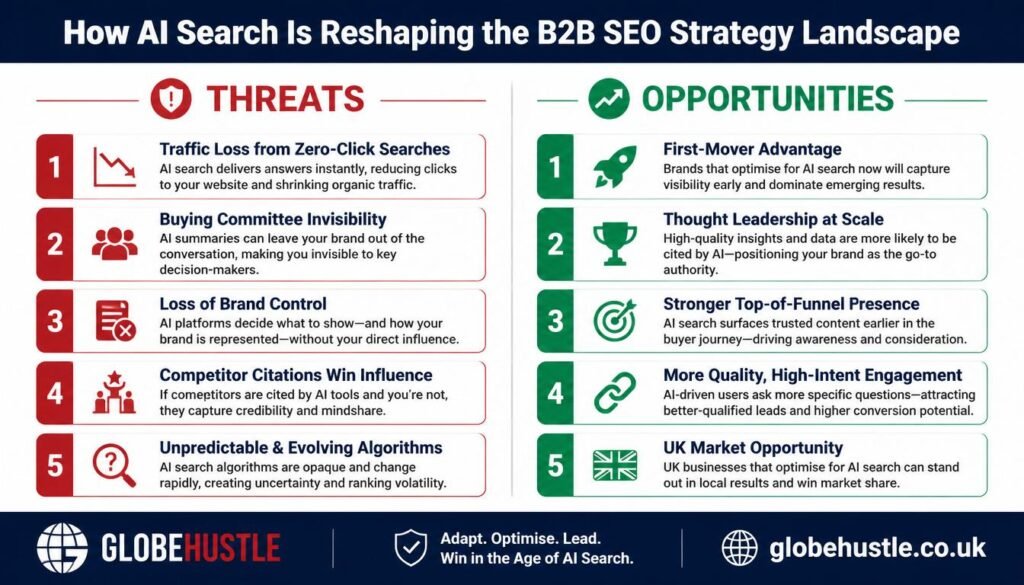
1. Your Top-of-Funnel Traffic Is Disappearing Without Warning
The first and most immediate threat is simple: AI engines are answering the questions your content was designed to capture.
For years, B2B content strategy has followed a predictable path. You identify the questions your buyers ask early in their journey “what is the best project management software for agencies?” or “how do I choose an enterprise cybersecurity vendor?” and you write thorough, well-optimized articles to attract that research traffic.
Now, ChatGPT and Perplexity answer those questions directly. The buyer gets a complete response without leaving the AI platform. Your article, however well-written, receives no visit.
This is not a traffic dip. For many B2B websites, it represents a structural removal from the earliest stage of the buyer journey the very stage where brand familiarity begins.
2. The B2B Buying Committee Now Has an AI Research Tool
B2B purchasing decisions are rarely made by one person. A typical enterprise deal might involve a technical evaluator, a financial decision-maker, a department head, and a procurement specialist all doing their own independent research.
In the past, each of those people would run individual Google searches. Some would find your content. Some wouldn’t. But there were multiple touchpoints where your brand could appear.
Today, that same committee might all be using ChatGPT or Perplexity to gather their initial intelligence. If your brand isn’t cited in those AI responses, you are invisible to all of them simultaneously before a single conversation has started.
💡 Industry Insight: Gartner projects that by 2026, more than 30% of B2B buying journeys will involve AI-assisted research tools at some stage. For B2B brands that have not adapted their SEO strategy, this represents a growing blind spot in their pipeline.
3. Your Competitor Who Gets Cited Is Winning the Trust Game
B2B sales is fundamentally about trust. Buyers choose vendors they have heard of, read about, and encountered repeatedly during their research. This is why thought leadership content has always mattered in B2B — not because it drives immediate conversions, but because it builds the familiarity that makes a buyer comfortable shortlisting your brand.
AI search has added a new dimension to this dynamic. When ChatGPT cites a competitor’s article as a source, that brand gains an implicit endorsement. The buyer sees the name attached to a trusted answer. That association builds quietly, consistently across every AI-assisted research session.
If your competitor is being cited and you are not, they are building brand trust in the places where your buyers now do their thinking. That is a compounding disadvantage.
4. Long Sales Cycles Mean Long Exposure to AI-Driven Invisibility
Unlike B2C purchases, B2B deals unfold over months. A typical enterprise software sale might take six to eighteen months from initial research to contract signing. During that entire period, the buyer is continuously researching comparing vendors, validating decisions, and checking assumptions.
Every time they turn to an AI engine during that research journey, your brand either shows up or it doesn’t. The brands that show up consistently, across multiple AI-assisted touchpoints, accumulate a recognition advantage that is very difficult to overcome by the time the buyer reaches a final decision.
A weak B2B SEO strategy that ignores AI search doesn’t just cost you one conversation. It costs you repeated opportunities across a multi-month buying journey.
5. Niche B2B Industries Are Especially Vulnerable
General consumer topics have been saturated by content for years. But many B2B niches supply chain management, industrial equipment, B2B financial services, specialist professional services have relatively thin content ecosystems. AI engines, when asked about these topics, pull from a small pool of sources.
If your brand is not producing structured, authoritative content in your niche, the AI engine will cite whoever is. And in many B2B verticals, that pool of well-optimized content is very shallow which means a modest, focused content effort can yield disproportionate AI visibility.
The Opportunity: What AI Search Is Opening Up for B2B Brands
1. The B2B AI Search Space Is Still Wide Open
Here is the reality that most B2B marketing teams have not fully processed: the competition in AI search is significantly lower than in traditional Google search particularly for B2B topics.
The data bears this out directly. Keywords like “b2b seo strategy” (2,400 monthly searches, KD 17), “b2b seo content strategy” (KD 16), and “seo strategies for b2b companies UK” (KD 5) represent genuine ranking opportunities for businesses that are willing to produce well-structured, expert content.
KD 17 means that even a relatively new domain, with a focused content strategy, can realistically achieve strong organic rankings. In traditional B2C SEO, that kind of opportunity at that search volume simply doesn’t exist anymore.
2. How to Improve Brand Visibility in AI Search Engines — Starting Now
This is one of the most searched questions in this space right now “how to improve brand visibility in ai search engines” with 2,900 monthly US searches and a KD of just 12. That is an almost uncontested featured snippet opportunity.
The answer, for B2B brands, involves five concrete actions:
- Audit your robots.txt file ensure GPTBot, PerplexityBot, and ClaudeBot are explicitly allowed to crawl your site
- Restructure your top-performing content with direct answer blocks, H2/H3 headings, comparison tables, and FAQ sections
- Build brand entity presence ensure your company appears on Crunchbase, LinkedIn, industry directories, and is mentioned by authoritative publications in your space
- Produce genuinely expert content that goes beyond surface-level overviews AI engines cite sources that demonstrate real domain depth
- Target low-KD B2B AI search keywords where competition is thin and citation opportunity is high
3. Thought Leadership Has a New ROI
B2B thought leadership has always been difficult to measure. Its value is in the long game brand recognition, trust accumulation, and the kind of credibility that turns a cold outreach into a warm conversation.
AI search has given thought leadership a measurable new dimension. When your expert content gets cited by ChatGPT or Perplexity, that citation is traceable.By searching for your brand name in AI tools, you can easily monitor which of your articles are being surfaced to directly assess your overall AI search visibility.
For B2B marketers who have always struggled to demonstrate the value of content investment, this creates a concrete new metric: citation rate in AI-generated responses.
4. Higher-Quality Leads From AI-Referred Traffic
When a B2B buyer visits your website after seeing your brand cited in an AI answer, they arrive with a different mindset than a cold organic visitor. The AI has, in effect, pre-validated your authority. The buyer already has a reason to trust you.
Early data from B2B brands tracking AI-referred traffic suggests that these visitors tend to engage more deeply, spend more time on service pages, and convert at higher rates than standard organic visitors. The citation itself functions as a warm introduction.
If you want to understand how this fits into your broader content architecture, our detailed guide on what AI SEO is and how it works for businesses explains the full strategic framework including how to structure your content so AI engines select it as a trusted source.
5. First-Mover Advantage Is Real — And It’s Available Right Now
In traditional SEO, the concept of first-mover advantage has largely expired. Highly competitive niches are dominated by brands that have been publishing for a decade. Catching up takes years.
In B2B AI search, that dynamic has not yet set in. The brands building structured, AI-optimized content libraries right now are establishing citation patterns appearing consistently in AI answers before their competitors have even considered the strategy.
That window will close. As more B2B marketing teams recognize the opportunity, the space will become more competitive. But in mid-2026, for most B2B niches, the gap is still open.
Industry-by-Industry: Threat & Opportunity Breakdown
| B2B Industry | Primary AI Threat | Primary AI Opportunity |
|---|---|---|
| SaaS / Tech | Competitors cited in “best software for X” queries | Deep feature comparison and use-case content |
| Professional Services | AI gives generic advice, reducing perceived need for specialists | Position as niche specialist — AI cites specialists over generalists |
| Manufacturing / Supply Chain | Historically low content output = others fill the gap | True first-mover advantage — space largely empty |
| Marketing Agencies | AI answering strategy questions directly | Become the agency AI cites as the AI SEO authority |
| B2B Consulting | AI replacing surface-level strategic advice | Cite-worthy thought leadership with proprietary frameworks |
| Financial Services B2B | Regulatory complexity creates content gaps | Authoritative, compliant content becomes go-to AI source |
| Legal Services | AI summarizing legal concepts reduces initial research visits | Deep expertise content earns consistent citations |
What Strategies Improve Brand Visibility in AI Search Engines?
This is the question B2B marketing leaders are asking most urgently right now and the answer is more accessible than most assume.
For B2B brands specifically, these five strategies deliver the most reliable AI visibility improvement:
Structure content for direct answers. Every piece of B2B content should open with a concise, direct response to the question it targets. AI engines prioritize sources that answer questions immediately and clearly — before expanding into detail.
Build topical authority in your niche. Covering a B2B topic cluster comprehensively rather than publishing isolated articles — signals deep domain expertise to AI ranking systems. A cluster of ten well-linked articles on a B2B topic outperforms ten disconnected pieces on ten different topics.
Establish brand entity signals. AI engines build trust from consistent brand mentions across authoritative sources. Getting your company cited in industry publications, featured in relevant directories, and referenced in high-authority B2B content builds the entity recognition that makes AI engines confident citing you.
Earn digital PR in your industry. Being quoted in Search Engine Journal, B2B Marketing, or industry-specific publications creates the kind of third-party validation that AI engines treat as authority evidence. Even a single high-authority mention can influence citation patterns.
Use FAQ and schema markup consistently. B2B content with properly implemented FAQ schema performs significantly better in Google AI Overviews. The structured format helps AI engines extract and present your content accurately.
For a practical walkthrough of how generative engine optimization works alongside your existing strategy, our guide on what GEO actually means and why traditional SEO tactics are losing power covers the transition in detail.
The UK B2B Opportunity: A Specific Note
For UK-based B2B brands, the opportunity is particularly significant. The keyword “seo strategies for b2b companies UK” carries a KD of just 5 meaning almost no competition exists for well-structured content targeting this specific market.
UK B2B buyers are increasingly sophisticated AI search users. LinkedIn remains central to the UK B2B marketing ecosystem, but ChatGPT and Perplexity are now regularly used for vendor research, market analysis, and solution evaluation by UK procurement teams and senior decision-makers.
A UK B2B brand that produces structured, AI-optimized content in English that reflects UK business culture and regulatory context is targeting a market that is underserved from an AI search perspective. That is a rare position in digital marketing in 2026.
💡 Fun Fact: The UK B2B market is the largest in Europe by digital marketing spend. Yet according to research from B2B Marketing (UK), fewer than 15% of UK B2B brands have formally integrated AI search optimization into their content strategy as of early 2026. The gap between awareness and action remains significant.
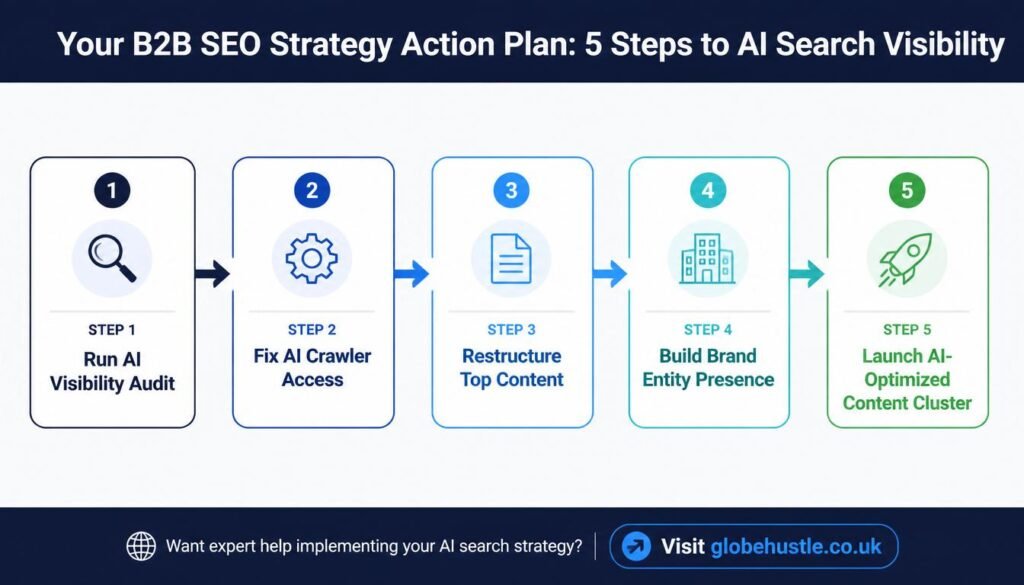
5-Step B2B AI SEO Action Plan
If your business is ready to treat AI search as a genuine strategic priority not just a future consideration — here is where to begin:
Step 1: Run an AI Visibility Audit
Search for your brand name and your primary services in ChatGPT, Perplexity, and Google AI Overviews. Note whether you appear. Note who does appear instead. This gives you your baseline and identifies your primary competitors in AI search.
Step 2: Fix Technical Access for AI Crawlers
Check your robots.txt file. Confirm that GPTBot, PerplexityBot, ClaudeBot, and Google-Extended are not blocked. This single technical fix is the most immediate action any B2B brand can take.
Step 3: Restructure Your Highest-Value Content
Identify your five to ten most strategically important content pieces the ones targeting your core buyer journey stages. Restructure each with a direct answer block, clear H2/H3 headings, at least one comparison table, and a FAQ section.
Step 4: Build Brand Entity Presence
Ensure your company has a complete, accurate presence on Crunchbase, LinkedIn Company Page, relevant industry directories, and where applicable Wikipedia or Wikidata. Consistent, accurate brand information across authoritative sources strengthens AI entity recognition.
Step 5: Launch a Focused AI-Optimized Content Cluster
Choose one B2B topic your business genuinely has authority on. Produce a pillar article and five to eight supporting cluster articles, all properly interlinked and structured for AI citation. This is the most reliable way to build AI search authority in a defined area.
If the scale of this feels significant, our overview of how GEO and traditional SEO differ — and why old ranking strategies are failing in 2026 explains exactly how to prioritize your effort.
B2B AI SEO Timeline: What to Expect
| Timeframe | What Happens | Focus Area |
|---|---|---|
| Week 1–2 | AI visibility audit complete, robots.txt fixed | Technical foundation |
| Month 1 | Top content restructured with AI-optimized formatting | Content optimization |
| Month 2–3 | Brand entity signals built across directories and publications | Authority building |
| Month 3–4 | First content cluster published and interlinked | Topical authority |
| Month 4–6 | First AI citations begin appearing consistently | Citation growth |
| Month 6–12 | Compounding authority — multiple topics cited regularly | Scale and expand |
| 12+ months | Established AI search presence, qualified lead flow visible | Maintain and build |
Conclusion: Your B2B SEO Strategy Cannot Afford to Stand Still
The shift to AI search is not something B2B brands can defer to next year’s planning cycle. It is already affecting buyer behavior, research patterns, and the early stages of sales pipelines right now, across every major B2B industry in the UK and USA.
The threat is real. AI engines are answering the questions your content was built to capture. Buyers are completing more of their research journey inside AI tools. And competitors who earn AI citations are building trust in places you may not even be tracking.
But the opportunity is equally real and in B2B, it remains genuinely open. Low keyword difficulty scores, underdeveloped content niches, and a first-mover advantage that still exists across most B2B industries mean that the brands who act on a coherent B2B SEO strategy for the AI era right now will set the terms for their competitors over the next three to five years.
The buyers are already there. The question is whether your brand is visible when they arrive.
Ready to Find Out Where Your B2B Brand Stands in AI Search?
We offer a comprehensive AI SEO Audit built specifically for B2B brands in the UK and USA. You will get a clear picture of your current AI search visibility, the specific gaps in your content and technical setup, and a practical roadmap for building consistent citations across ChatGPT, Perplexity, Gemini, and Google AI Overviews.
Book Your B2B AI SEO Audit → GlobeHustle.co.uk
Frequently Asked Questions
Is AI SEO important for B2B companies?
Yes and increasingly so. B2B buyers use ChatGPT, Perplexity, and Google AI Overviews to research vendors, compare solutions, and evaluate options before speaking to any sales representative. If your brand is not appearing in those AI-generated answers, you are missing the early stages of the buyer journey entirely.
How does AI search affect B2B lead generation?
AI search affects B2B lead generation primarily at the top of the funnel. When buyers get their initial research questions answered by AI engines without visiting your website, they may never enter your lead generation ecosystem at all unless your brand has been cited by the AI as a trusted source.
Is AI SEO different for B2B versus B2C brands?
Yes, in several important ways. B2B buyers research more extensively, involve multiple decision-makers, and operate on longer timescales. This means AI visibility needs to be maintained across a multi-month buyer journey, not just at a single search moment. B2B content also needs to demonstrate deeper technical and industry expertise to earn AI citations in specialist niches.
What type of B2B content gets cited by ChatGPT and Perplexity?
AI engines consistently favor content that answers questions directly, demonstrates genuine expertise, includes specific data and named references, uses clear structure (headings, lists, tables, FAQs), and comes from domains with established authority signals. Thin, generic content — regardless of how well it ranks in traditional Google — rarely gets cited.
How does zero-click search impact B2B organic traffic?
Zero-click AI answers reduce the volume of clicks that would previously have gone to informational B2B content. However, brands cited as sources in AI answers still benefit from visibility and trust-building even without a direct click. The metric that matters is shifting from traffic volume to citation frequency and brand recognition.
How long does it take to see results from B2B AI SEO?
Most B2B brands begin seeing initial AI citations within four to six months of implementing a structured AI SEO strategy assuming technical access for crawlers is in place and content is properly formatted. Compounding authority, where citations appear consistently across multiple topics, typically develops over a twelve-month horizon.
Which AI platforms matter most for B2B brands?
All four major platforms are relevant ChatGPT (OpenAI), Perplexity AI, Google AI Overviews, and Gemini. For B2B research specifically, Perplexity and ChatGPT Search are currently the most actively used by buyers doing independent vendor evaluation.
Should B2B brands prioritize AI SEO over traditional SEO?
Not over alongside. Traditional Google SEO remains important, particularly for bottom-of-funnel transactional searches. But AI SEO should now receive dedicated resource and strategy, not be treated as an afterthought. The most effective approach integrates both, with content structured to perform in traditional search results and earn AI citations simultaneously.