
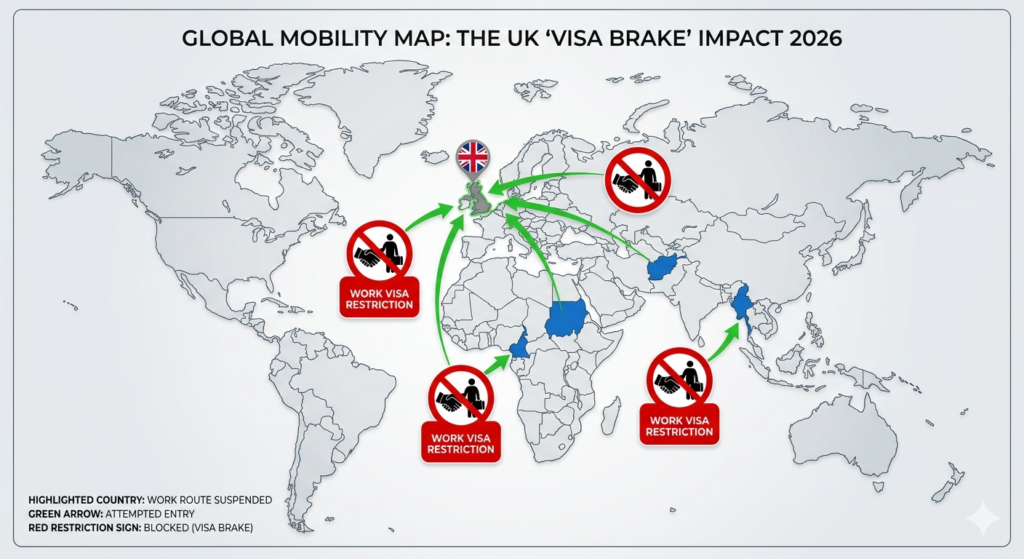
On March 26, 2026, the UK Home Office officially activated a powerful new immigration tool: the “Visa Brake.” This policy allows the government to automatically refuse certain visa applications based on nationality to manage asylum pressures.
If you are an international professional, a student, or a UK employer, understanding these rules is critical. A mistake in today’s climate doesn’t just mean a rejection it means a significant financial loss with no refund. As of mid-2026, over 15,900 nationals from these four countries were already in the UK asylum system the exact pressure point the government cites for this policy.
📊 Quick Summary: Who is Affected?
To help you navigate these changes, refer to the table below to see if your nationality is currently under the “Brake.”
| Nationality | Skilled Worker Visa | Student Visa | Applicability |
| Afghanistan | ❌ Refused | ❌ Refused | Applications from outside the UK |
| Cameroon | ✅ Available* | ❌ Refused | Applications from outside the UK |
| Myanmar | ✅ Available* | ❌ Refused | Applications from outside the UK |
| Sudan | ✅ Available* | ❌ Refused | Applications from outside the UK |
Full 2026 UK Student Visa Rules (Beyond the Brake)
- Visa fee £490 hai, plus Immigration Health Surcharge £776/year
- Financial requirement: London mein £1,334/month, London ke bahar £1,023/month
- Ab digital eVisa system hai, physical card nahi milta
- English requirement B2 level hai degree courses ke liye
*Note: While the Skilled Worker route remains open for Cameroon, Myanmar, and Sudan, expect significantly higher scrutiny and longer processing times.
🏗️ 1. The Skilled Worker Suspension: Facts vs. Myths
There is a common misconception that all four countries are banned from working in the UK. This is incorrect.
The Facts:
- Afghanistan only: As of March 2026, only Afghan nationals face a total suspension of the Skilled Worker Visa when applying from overseas.
- Student Route Impact: For Cameroon, Myanmar, and Sudan, the “Brake” specifically targets Student Visas. The government’s goal is to prevent the use of study routes as a precursor to asylum claims.
- In-Country Exception: If you are already in the UK on a valid visa, you are unaffected. You can still apply to switch routes or extend your stay under the standard rules.
⚖️ 2. The “No Refund” Trap for Employers
For UK businesses, the biggest “pain point” of the 2026 update is the financial risk. The Home Office has confirmed a strict No Refund Policy for applications blocked by the Visa Brake.
- Sponsorship Costs: If a company assigns a Certificate of Sponsorship (CoS) to a national from a “Braked” country, and the visa is refused under these rules, the CoS fee is non-refundable.
- Immigration Skills Charge: While some portions may be recoupable, the administrative burden and lost time can cost a business thousands of pounds per candidate.
Strategic Advice: Before recruiting, consult theGlobeHustle Compliance Portalto verify the latest “Brake” status for your candidates.
Economic Outcomes & The “Talent Gap”
The global labor gap in high-skilled sectors like Tech and Engineering is widening because of these disruptions.
- Project Stalling: UK firms in London and Manchester are reporting delays as key international hires are suddenly blocked.
- The “Rerouting” Trend: Many global corporations are now bypassing the UK entirely, moving talented professionals from affected regions to offices in Ireland, Germany, or the UAE.
- Family Concerns: Many are asking if this will lead to a Spouse Visa refusal. While the brake doesn’t currently target family routes, the atmosphere of “higher scrutiny” makes it harder to join family members. Read our Full Guide on Spouse Visas for more details.
Skilled Worker Visa: New Rules Beyond the Brake
- Skilled Worker visa ke liye salary threshold £38,700 hai
- Agar koi Student/Graduate visa se switch kar raha hai to sirf £30,960 chahiye (new entrant discount)
- Ye switch UK ke andar se ho sakta hai, bahar jane ki zarurat nahi (agar visa brake wale country se nahi hain)
(FAQ)
Q: What are the new rules for UK student visa 2026?
A: Short answer: eVisa, higher financial requirement, stricter genuine student checks, dependants restrictions, Graduate Route shrinking to 18 months from Jan 2027.
Q: Can I switch from Student visa to Skilled Worker visa without completing my degree?
A: Short answer: Generally no you need to complete your course and hold a valid CAS/degree, then get a qualifying job offer before switching.
Q: Is there a UK visa banned list?
A: Short answer: No official “banned list” exists the Visa Brake is a temporary, reviewable restriction on 4 specific nationalities, not a permanent ban
Q: Is the Visa Brake permanent?
A: No. The Home Office stated there is no “sunset clause,” but the policy will be reviewed every few months. The initial impact assessment suggests a 18-month duration unless asylum claim rates drop significantly.
Q: Can I apply from a third country?
A: The Brake applies to your nationality, not your location. For example, an Afghan national applying from Dubai will still face an automatic refusal for a Skilled Worker visa.
Q: What should I do if my nationality is on the list?
A: Explore alternative markets. Countries like Canada and Australia are currently maintaining stable pathways for skilled workers from these regions and are actively seeking the talent the UK is pausing.
Reviewed for accuracy July 2026
Conclusion: 2026
The UK Visa Brake is a reminder that immigration is now tied closely to border security and geopolitical data. For migrant professionals, it’s a time to be flexible and explore different markets. For UK employers, it’s a time to diversify recruitment pipelines.
Stay updated with the latest shifts in UK policy by visiting GlobeHustle.co.uk. We provide the tools you need to stay ahead of the curve in an unpredictable world.