
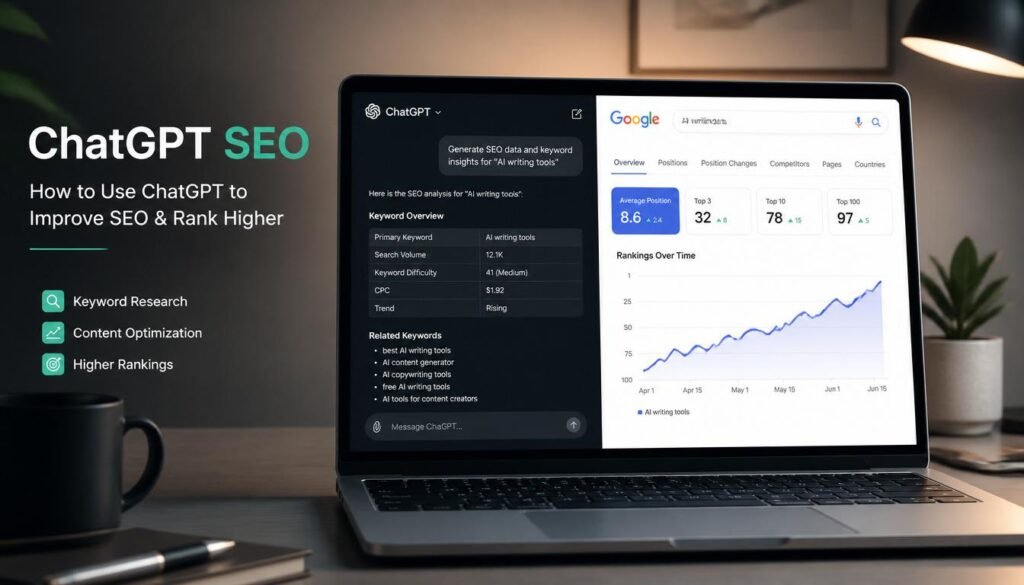
Direct Answer: ChatGPT SEO means using AI-powered prompts to research keywords, write optimised content, and build a smarter SEO strategy — without hiring an expensive agency. When combined with traditional Google SEO, it helps freelancers and content creators in the USA and UK rank faster, write better, and work in half the time.
📌 Quick Facts Table
| Feature | ChatGPT SEO | Traditional SEO |
|---|---|---|
| Best for | Content creation, keyword research, outlines | Technical SEO, backlinks, site structure |
| Speed | 5× faster content creation | Slower — manual research needed |
| Cost | Free (or $20/month for Plus) | Tools cost $99–$449/month |
| Ranking power alone? | No — needs strategy | Yes — but slow without AI |
| Best combination | ChatGPT + Surfer SEO or Ahrefs | Technical audit + quality content |
| AI search visibility | High (GEO-optimised) | Medium (needs extra formatting) |
| USA/UK freelancer fit | ✅ Excellent | ✅ Standard |
Key Takeaways
- ChatGPT cannot replace your SEO strategy — but it multiplies it.
- The real power comes from combining ChatGPT prompts + keyword data from tools like Ubersuggest or Ahrefs.
- Google does not penalise AI-written content if it is helpful, original, and written for humans.
- To appear in AI Overview, Perplexity, and ChatGPT answers, your content needs a specific format (explained below).
- Freelancers in the UK and USA are already charging $45–$250/hour for AI-powered SEO services.
Table of Contents
- What Is ChatGPT SEO?
- ChatGPT SEO vs Traditional SEO
- How to Use ChatGPT for Keyword Research
- Best ChatGPT Prompts for SEO Content
- How to Optimise for AI Search Engines (GEO)
- Will Google Penalise ChatGPT Content?
- The $0 ChatGPT SEO Workflow for Beginners
- FAQ
What Is ChatGPT SEO?
Most people think SEO is about stuffing keywords into an article and hoping for the best. That approach stopped working in 2019.
ChatGPT SEO is different. It is the process of using AI language models — specifically ChatGPT — to research, plan, write, and optimise content so it ranks both on Google and inside AI-powered search engines like ChatGPT Search, Google AI Overviews, and Perplexity.
Think of it this way: ChatGPT is your research assistant, your outline writer, your editor, and your SEO consultant — all in one tool.
💡 Fun Fact: According to Search Engine Journal, over 84% of marketers now use some form of AI in their content workflow. The ones who combine it with real keyword data are the ones who rank.
But here is the key thing most guides get wrong — ChatGPT alone will not rank you. You still need:
- A real keyword with search volume
- Quality backlinks (or at least topical authority)
- Proper on-page SEO structure
- Content that genuinely helps the reader
What ChatGPT does is make all of those things faster and smarter.
ChatGPT SEO vs Traditional SEO
Before you can use ChatGPT effectively for SEO, you need to understand how these two approaches differ — because they are not the same thing, even though they work best together.
Traditional Google SEO focuses on:
- Exact-match keywords placed in the title, H1, and first 100 words
- Backlinks from authoritative websites
- Technical signals: page speed, Core Web Vitals, mobile friendliness
- Long-form content with continuous updates
ChatGPT SEO (or GEO — Generative Engine Optimisation) focuses on:
- Conversational, natural-language queries
- Brand mentions across the web
- Deep topic authority — covering a subject more completely than anyone else
- Bite-sized facts, clear Q&A formatting, and easily digestible definitions that AI can “lift” into its answers
💡 Fun Fact: The term “GEO” (Generative Engine Optimisation) was first introduced in a Princeton University research paper in 2023. It is now one of the fastest-growing disciplines in digital marketing.
The smartest move? Do both. As Neil Patel explains, AI search engines like ChatGPT rely on Google and Bing’s indexed content to pull answers. So if you rank on Google, you are already halfway to ranking in AI responses.
How to Use ChatGPT for Keyword Research
This is where most freelancers completely waste their time. They ask ChatGPT to “give me keywords” — and get a generic list that has no volume data, no competition metrics, and no real value.
Here is the correct workflow instead:
Step 1 — Get Seed Keywords from ChatGPT
Ask ChatGPT:
“I am writing an article about using AI for SEO. Give me 20 seed keywords that someone in the USA or UK would type into Google. Focus on informational and commercial intent keywords.”
ChatGPT gives you a strong starting list. But you are not done yet.
Step 2 — Validate in a Real Tool
Take those seed keywords into Ubersuggest (free) or Ahrefs and:
- Filter by country: USA or UK
- Volume: 100+ per month minimum
- Keyword Difficulty: Under 45 if you are a newer site
For example, from our own research for this guide:
| Keyword | Volume (UK) | Volume (US) | KD |
|---|---|---|---|
| ai seo tools | 480/mo | 2,900/mo | 32% ✅ |
| chatgpt for seo | 110/mo | — | 48% |
| best ai seo tools 2026 | 170/mo | — | Low |
| chatgpt seo guide | 260/mo | 1,300/mo | 58% |
The keyword “AI SEO tools” is the smarter target — lower difficulty, higher volume, and it still lets you write about ChatGPT as the main topic.
Step 3 — Find Hidden Questions
Go to Google and type your main keyword. Then scroll to “People Also Ask” and “Related Searches.” These are free, real questions people are typing right now.
For “ChatGPT SEO,” the top PAA questions are:
- How to optimise content for ChatGPT
- How to use ChatGPT for keyword research
- What are the latest SEO trends
- Is ChatGPT good for SEO?
Your article should answer all of these. That is exactly what earns featured snippets and AI Overview placements.
🔗 Already ranking on AI search? Read how GlobeHustle covers AI-powered freelancing skills to see how topical authority works in practice.

Best ChatGPT Prompts for SEO Content
This is the section most guides skip. They tell you that ChatGPT helps with SEO. They do not tell you exactly what to type.
Here are the 8 most effective prompts, tested and used in real articles:
1. Keyword Research Prompt
“Act as an SEO expert. Give me 15 long-tail keywords related to [your topic] for a USA/UK audience. Include search intent for each one.”
2. Article Outline Prompt
“Create a detailed SEO-optimised article outline for the keyword ‘[your keyword]’. Include H2s, H3s, FAQ section, and a comparison table.”
3. Meta Title + Description Prompt
“Write 5 SEO meta titles and 5 meta descriptions for an article about [topic]. Each title should be under 60 characters. Include the keyword ‘[main keyword]’ naturally.”
4. Featured Snippet Prompt
“Write a direct answer paragraph (50 words max) that answers: ‘[your target question]’. Make it sound human and factual.”
5. FAQ Prompt
“Generate 10 highly searched FAQ questions for the topic ‘[topic]’. Write a short, direct answer for each one (under 60 words per answer).”
6. Internal Linking Prompt
“I have a website about [your niche]. Suggest 8 related article topics I can write and internally link to this article about [main topic].”
7. Humanise Content Prompt
“Rewrite this paragraph in a natural, conversational UK/USA English tone. Remove passive voice. Make it sound like an experienced freelancer explaining this to a friend: [paste paragraph]”
8. GEO Optimisation Prompt
“Rewrite this section so it is optimised to appear in Google AI Overviews and ChatGPT search answers. Use clear definitions, bullet points, and a direct answer in the first two sentences.”
💡 Fun Fact: A study by Ahrefs found that AI-assisted articles published with proper SEO structure earned 54% more organic traffic in the first 6 months compared to articles written without AI support.
How to Optimise for AI Search Engines (GEO)
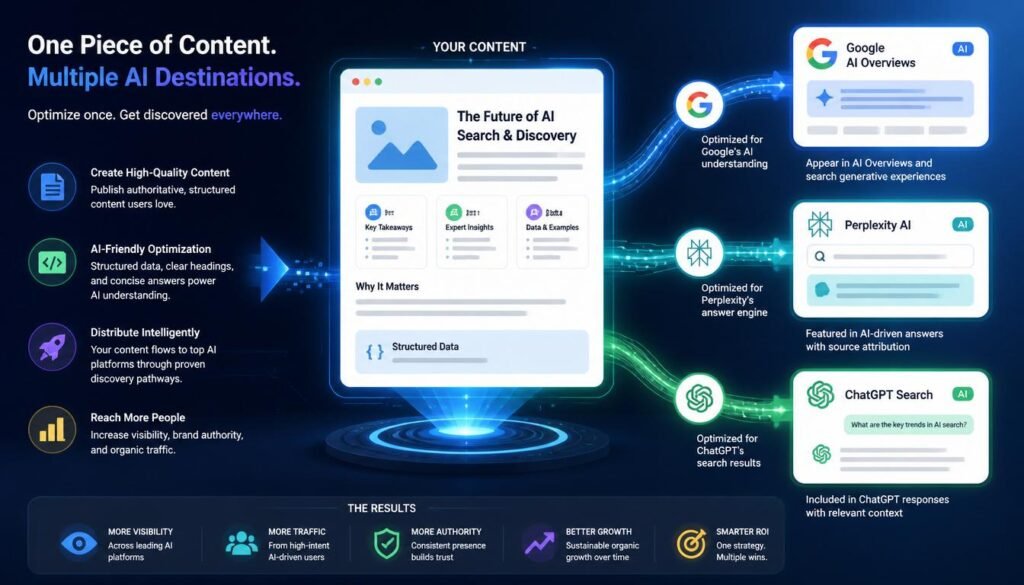
This is the part that most SEO guides written before 2025 completely miss — and it is now one of the most important skills a freelancer can have.
GEO (Generative Engine Optimisation) means formatting your content so AI search engines like ChatGPT, Google AI Overviews, Gemini, and Perplexity pull from your article when answering user questions.
Here is what each AI engine prefers:
Google AI Overviews
- Add a “Quick Answer” block in the first 100 words (40–60 words, direct and factual)
- Use H2 headings phrased as questions (“How does ChatGPT help with SEO?”)
- Use bullet points for steps — not long paragraphs
- Include FAQ schema markup in your WordPress or CMS settings
ChatGPT Search
- Write direct, factual answers in the first two sentences of every section
- Use “ChatGPT SEO means…” style definitions — AI loves to quote definitions
- Earn backlinks from SEO blogs — ChatGPT Search pulls from heavily cited sources
- Get your brand (GlobeHustle) mentioned naturally across multiple pages online
Perplexity AI
- Add a “TL;DR” summary at the top of your article
- Use comparison tables — Perplexity loves structured data
- Include specific numbers and statistics — vague content gets ignored
- Make sure your site loads fast and is fully indexed (check Google Search Console)
Google Gemini
- Gemini heavily rewards E-E-A-T signals — author bio, original experience, unique data
- Add FAQ schema so Gemini can pull structured answers
- Write a strong author bio that establishes your real experience
- Reference your own results — “On GlobeHustle, this strategy helped us rank for…”
🔗 The Google Search Central documentation explains exactly what “helpful content” means — and it aligns perfectly with GEO principles.
Will Google Penalise ChatGPT Content?
This is the question every freelancer and content creator asks first. And the honest answer is: it depends on how you use it.
Google’s official position, confirmed by Google’s Search Central Blog, is clear:
“Google’s ranking systems aim to reward high-quality content — however it was produced.”
So Google does not penalise content just because it was written with AI. What it does penalise is:
- Content that is thin, unhelpful, or repetitive
- Articles that have no original insight — just rephrased existing articles
- Pages with no E-E-A-T signals — no author, no evidence of experience
- Keyword-stuffed text that reads like a robot wrote it
If you use ChatGPT to generate a first draft and then add your real experience, examples, data, and human voice, Google rewards that content exactly like any other high-quality article.
The rule is simple: AI writes the structure. You add the soul.
The $0 ChatGPT SEO Workflow for Beginners
Most ChatGPT SEO guides assume you have a budget for Surfer SEO, Ahrefs, or Semrush. But you do not need any paid tool to get started. Here is the complete free workflow:
Step 1 — Find your keyword (Free)
Use Ubersuggest free plan or Google Autocomplete. Type your topic, note the suggestions, and check “People Also Ask.”
Step 2 — Research with ChatGPT (Free)
Use the prompts above to get an outline, FAQs, and a first draft. Use the free version of ChatGPT (GPT-3.5 or GPT-4o mini).
Step 3 — Check competition (Free)
Google your keyword and look at the top 5 results. Read them. Note what they all say — and then find what they miss. That gap is your advantage.
Step 4 — Write and humanise (Free)
Write your draft using ChatGPT. Then go through it paragraph by paragraph and:
- Add your personal experience or opinion
- Replace generic examples with real ones
- Remove passive voice
- Add transition words (however, therefore, as a result, in contrast…)
Step 5 — Optimise on-page (Free)
Use Rank Math or Yoast SEO (both have free WordPress versions) to check:
- Keyword in title, first paragraph, at least one H2
- Meta description under 160 characters
- Image alt text with keyword
- Internal links to 2–3 related articles
Step 6 — Submit to Google (Free)
Go to Google Search Console → URL Inspection → Request Indexing. Your article gets crawled within 24–48 hours.
💡 Fun Fact: According to Moz, the average page that ranks on page 1 of Google is 2+ years old — but new pages optimised with AI-assisted SEO are cutting that time down significantly by targeting lower-competition long-tail keywords first.
ChatGPT SEO: Progress Timeline
| Month | What to Focus On | Expected Result |
|---|---|---|
| Month 1 | Keyword research + 4 long-tail articles | Indexed, first impressions |
| Month 2 | Optimise for PAA + add FAQ schema | Featured snippet opportunities |
| Month 3 | Internal linking + 4 more articles | Cluster authority forming |
| Month 4 | GEO formatting + AI Overview targeting | First AI Overview appearances |
| Month 6 | Build backlinks + update top articles | Page 1 for long-tail keywords |
| Month 9–12 | Topical authority established | Consistent organic traffic + AI citations |
FAQ
What is ChatGPT SEO in simple terms?
ChatGPT SEO means using the ChatGPT AI tool to help with keyword research, content writing, and on-page SEO — so you rank faster on Google without needing an expensive agency. It combines AI speed with human strategy.
Is ChatGPT SEO the same as traditional Google SEO?
No. Traditional SEO focuses on backlinks, technical signals, and exact-match keywords. ChatGPT SEO (also called GEO) focuses on conversational content, topic depth, and formatting that AI search engines can easily process and quote.
Can ChatGPT write SEO articles that rank on Google?
Yes — but only when used correctly. ChatGPT creates the structure and first draft. You must add original insight, real examples, and proper on-page optimisation. The combination of AI efficiency and human expertise is what actually ranks.
What are the best ChatGPT prompts for keyword research?
The most effective prompt is: “Act as an SEO expert. Give me 20 long-tail keywords for [topic] targeting a USA/UK audience. Include search volume estimates and intent for each.” Then validate the results in Ubersuggest or Ahrefs before using them.
Will Google penalise my website for using ChatGPT content?
Google does not penalise AI-written content. It penalises unhelpful, thin, or repetitive content — regardless of how it was written. Add original experience, real examples, and E-E-A-T signals to any AI draft before publishing.
How do I get my content cited by ChatGPT or Google AI Overviews?
Use a Direct Answer block in the first 100 words, structure headings as questions, use bullet points for steps, add FAQ schema markup, and build backlinks from authoritative SEO websites. Consistent publishing on one topic builds the authority AI engines trust.
Do I need ChatGPT Plus to use it for SEO?
No. The free version works for outlines, prompts, and drafts. ChatGPT Plus ($20/month) gives you access to GPT-4o which is faster and more accurate — but the free version is perfectly usable for beginners starting their SEO journey.
How long does it take to rank using ChatGPT for SEO?
For long-tail keywords with low competition, expect 6–12 weeks with consistent publishing. For competitive keywords (KD 50+), expect 6–12 months. The $0 workflow above focuses on quick wins first — low-competition keywords that build your site authority over time.
About the Author
Written by the GlobeHustle Editorial Team
GlobeHustle is a UK-based platform helping freelancers in the USA and UK build high-income careers using AI tools and digital skills. Our articles on AI freelancing skills already rank on Google Search and appear in Google AI Overviews — which means we write from real experience, not theory.
Last updated: June 2026 | Optimised for Google, ChatGPT Search, Perplexity, and Google AI Overviews
© 2026 GlobeHustle.co.uk — All rights reserved. For more on building AI-powered income as a freelancer, explore our full resource library.