
Quick Summary
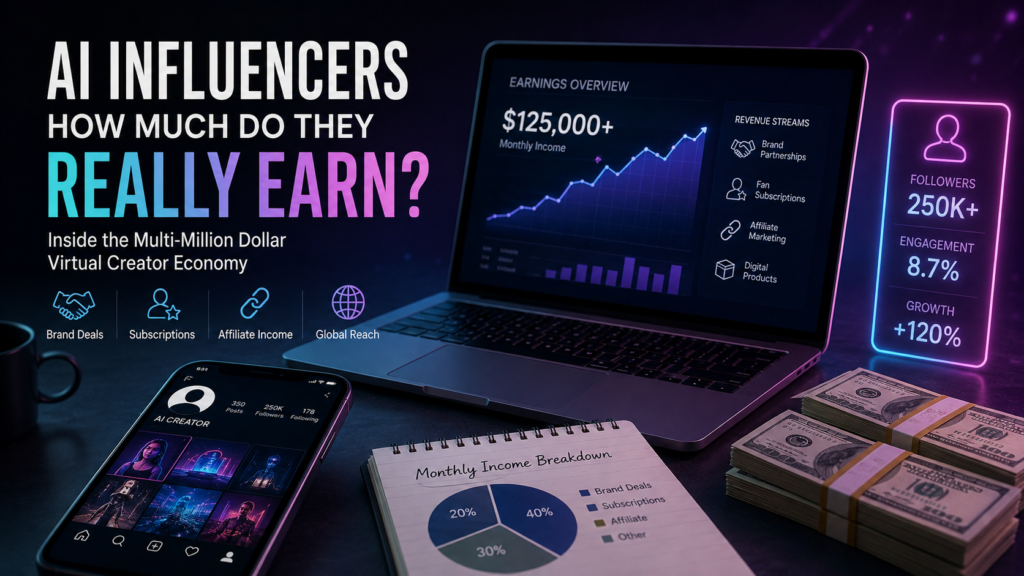
Most AI influencers earn somewhere between $500 and $10,000 a month during their first year. The biggest names in the space accounts with millions of followers clear well past $100,000 monthly. It comes down to follower size, niche, and how many income streams a creator bothers to stack together.
Featured Snippet Table
| Creator Tier | Follower Range | Estimated Monthly Income | Average Rate per Post |
|---|---|---|---|
| Nano | 1K – 10K | $200 – $800 | $5 – $150 |
| Micro | 10K – 100K | $1,000 – $5,000 | $50 – $500 |
| Mid-Tier | 100K – 500K | $5,000 – $30,000+ | $500 – $2,500 |
| Macro / Mega | 500K – 1M+ | $30,000 – $200,000+ | $2,500 – $20,000+ |
Highlights
- Most AI influencers land somewhere in the $500–$10,000 monthly range early on; the exceptions earn six figures.
- Brand deals still pay best, but fan subscriptions on sites like Fanvue are closing the gap fast.
- Lu do Magalu, Lil Miquela, and Aitana López prove there’s more than one way to build this business.
- Skip the FTC’s AI-disclosure rules and you’re risking fines that run into the tens of thousands.
- A smaller, well-run AI persona under 100K followers can still be a genuinely profitable side project.
Type “AI influencer” into Google and you’ll find articles calling it either a goldmine or a gimmick. Neither answer is quite right. The truth sits somewhere in the middle, and it depends almost entirely on which AI influencer you’re looking at.
Lu do Magalu, the digital mascot for a Brazilian retail chain, reportedly pulls in over $2.5 million a year. A brand new AI persona posted by a solo creator working from a laptop might make $150 in its first month, if that. Both of these are “AI influencers.” Both numbers are real. That’s the honest starting point for this whole conversation.
So let’s break down what’s actually happening with the money who’s making it, how much, and what separates a struggling AI account from one that’s genuinely paying rent.
How much do AI influencers make per month?
This is the version of the question most people are really asking, so here’s the direct breakdown.
Income scales with followers, but not in a straight line it jumps noticeably once a creator crosses certain thresholds, because that’s when brands start paying attention.
- Nano (1K–10K followers): $200–$800 a month. Mostly small affiliate commissions and the occasional low-budget sponsorship.
- Micro (10K–100K followers): $1,000–$5,000 a month, once brand collaborations start becoming a regular thing rather than a lucky break.
- Mid-tier (100K–500K followers): $5,000–$30,000+ a month. This is where subscriptions and sponsorships genuinely start compounding.
- Macro/Mega (500K–1M+ followers): $30,000–$200,000+ a month, reserved for the small handful of virtual creators who’ve basically become brands in their own right.
Follower count gets the attention, but engagement rate closes the deal. A 40,000-follower AI account with 9% engagement will usually out-earn a 200,000-follower page where nobody’s commenting.
What actually counts as an “AI influencer”?
An AI influencer is a fictional persona built with CGI, 3D modelling, or generative AI image and video tools that runs a social media presence the same way a real person would. It posts, it has a personality, it replies to comments, and in a lot of cases, it gets paid exactly the way a human creator does.
Some of these personas are built to look almost indistinguishable from a real human. Others don’t even try to hide that they’re synthetic think less “photorealistic influencer” and more “branded character with opinions.” Both approaches work. It really depends on the niche.
What the Top AI Influencers Are Actually Earning
Numbers on a chart only tell you so much. Real examples make it click, so here are three creators who’ve taken genuinely different paths to making money.
Lu do Magalu (7M+ followers). She started as a mascot for a Brazilian department store and has quietly become one of the highest-earning virtual personas on the planet. Estimates put her income above $2.5 million a year, with individual sponsored posts commanding $21,000 to $34,000. Read that again — a fictional character earning more per post than most people earn in a year.
Lil Miquela (2.5M+ followers). One of the original digital avatars, and arguably the one that proved this whole category could work. She’s collaborated with Dior, Prada, and Calvin Klein, with an estimated annual income around $10 million and per-post rates between $7,500 and $10,000. Miquela’s less a “content creator” at this point and more a fashion-world fixture who happens to be rendered rather than photographed.
Aitana López (320K+ followers). This is the one worth studying if you’re actually thinking about building an AI persona yourself. A Spanish marketing agency created her using off-the-shelf AI tools, not a massive CGI budget. She earns roughly $11,000 a month (about €10,000) from brand sponsorships, lingerie campaigns, and fan subscriptions — a scale that’s genuinely achievable for an independent creator, unlike Lu do Magalu’s retail-backed empire.
Aitana López’s creators have said openly that they built her partly because working with human influencers came with too much friction — no rate negotiations, no scheduling headaches, no burnout.
How Do AI Influencers Actually Generate Revenue?
Human creators tend to lean on one or two income sources ad revenue, maybe a brand deal here and there. AI influencers, by contrast, are usually run more like small businesses with several income streams running at once.
- Brand partnerships and sponsored posts. Still the biggest earner for mid-to-large accounts. Brands like the predictability no off-brand behaviour, no scheduling conflicts, and a persona that’s technically available around the clock.
- Premium fan subscriptions. Platforms like Fanvue, Patreon, and RM11 let fans pay $15–$25 a month for exclusive content, DMs, or pay-per-view unlocks. This has become one of the fastest-growing income lines in the space.
- Affiliate marketing. An AI creator can wear ten outfits and appear in ten different settings in a single day without the logistics a human faces, which naturally pushes affiliate volume higher.
- Interactive tools and paid challenges. More advanced creators run chatbots or voice tools so fans can “talk” to the character directly, plus paid programmes fitness plans, lifestyle clubs that don’t depend on the algorithm at all.
If you’re weighing an AI influencer against other ways to earn online, it’s worth seeing how it stacks up against other low-effort income models our best passive income apps guide covers where this fits relative to other options.
Is Making an AI Influencer Legal?
Yes running an AI influencer is legal in the UK and US, but there’s a catch: disclosure isn’t optional. The Federal Trade Commission requires creators to clearly state both that a post is sponsored and that the persona itself is AI-generated. Skip that, and penalties can run up to $51,744 per violation, based on current FTC guidance.
If you’re planning to monetise a virtual persona, it’s genuinely worth reading the FTC’s endorsement guidelines directly. Enforcement in this space has picked up noticeably over the past couple of years.
Put the disclosure in the caption itself, not buried under a wall of hashtags. Regulators and platforms have started flagging disclosures that aren’t immediately visible to a scrolling user.
What It Actually Takes to Run a Profitable AI Persona
Making money from an AI influencer isn’t just about generating a nice-looking image and hoping. The creators who actually turn a profit treat it like a content operation, not a side hobby. In practice, that usually means:
- Posting on a consistent schedule daily or close to it.
- Keeping the visual style and personality stable, rather than letting it drift post to post.
- Actually replying to comments and DMs in the character’s voice.
- Having a monetisation plan from day one instead of hoping a brand notices organically.
That’s a lot of ongoing work, and plenty of creators now outsource pieces of it. Some use AI agent orchestration for freelancing to automate scheduling and repetitive tasks, while others bring in a hired AI SEO content writer to keep captions and bios sharp without burning hours every week.
Are AI Influencers Really Making Money, or Is This Overhyped?
There’s a real amount of skepticism around this online, and honestly, some of it’s fair. Not every AI influencer makes a dime. Plenty of accounts get built, post for a few weeks, and quietly vanish because the person behind them underestimated how much consistent work a “fake” character actually needs.
But the ones that succeed aren’t just lucky. They’re strategic. The creators pulling in real money treat the persona like an actual brand pick a niche, build genuine engagement, and layer several income streams instead of sitting around waiting for one big sponsorship to change everything.
How an AI Influencer’s Income Tends to Grow Over Time
| Timeframe | Typical Milestone | Estimated Monthly Income |
|---|---|---|
| Month 1–3 | Persona built, consistent posting begins | $0 – $200 |
| Month 4–6 | First affiliate links and small sponsorships | $200 – $1,000 |
| Month 7–12 | Follower base crosses 10K–50K, brand interest grows | $1,000 – $5,000 |
| Year 2 | Established niche, recurring subscriptions begin | $5,000 – $15,000 |
| Year 3+ | Recognised persona, multiple brand contracts | $15,000 – $200,000+ |
FAQ Section
Are AI influencers really making money?
Yes, though results vary a lot. Established AI personas earn through brand deals, subscriptions, and affiliate marketing, and the top performers clear six figures a month.
How much do AI influencers earn?
Most sit between $500 and $10,000 a month depending on follower size and niche, while the biggest virtual creators can earn over $200,000 monthly.
How much does an influencer with 1,000,000 followers make?
At that scale, an AI influencer typically earns $30,000 to $200,000+ a month, mostly from major brand partnerships stacked with other income streams.
Is making an AI influencer legal?
Yes, it’s legal in both the UK and US, provided the content clearly discloses that it’s AI-generated, in line with FTC endorsement rules.
Do people donate money to AI influencers?
Some do, though it’s usually structured as a fan subscription through platforms like Fanvue or Patreon rather than a one-off donation.
What is an AI influencer?
It’s a computer-generated persona, built with CGI or generative AI tools, that posts content and engages with followers much like a human creator would and often earns money the same way too.