Quick Summary
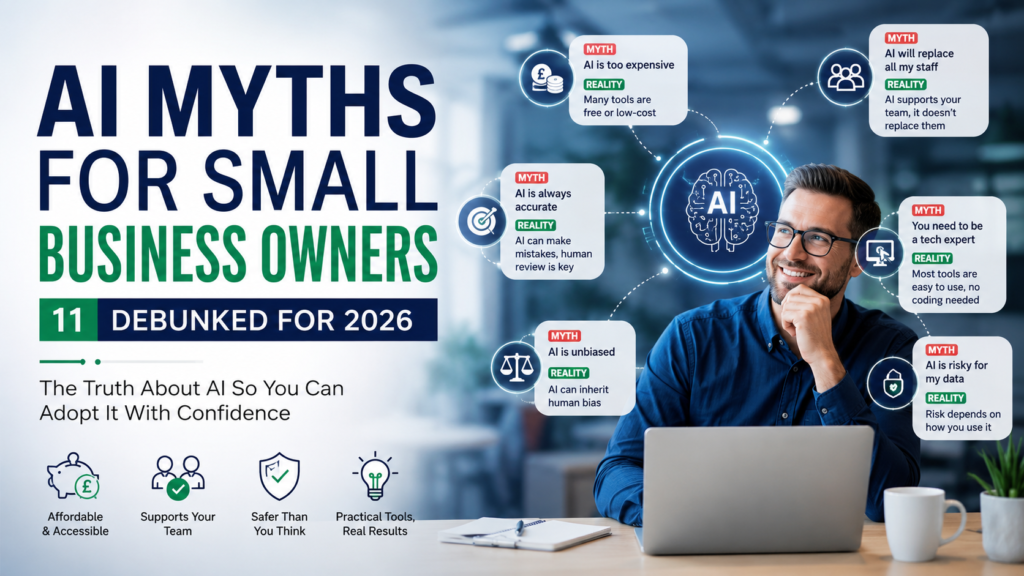
AI myths are popular but misleading ideas about artificial intelligence. For UK small businesses, the most common myths include the belief that AI is always accurate, replaces entire teams, thinks like a human, stays unbiased and works without supervision. In practice, AI is most useful when it supports people, follows clear rules and receives human review.
Highlights
- AI is a business tool, not a human brain.
- It can write convincing answers that contain factual mistakes.
- AI usually automates tasks rather than replacing complete jobs.
- Small businesses can benefit from affordable, focused AI projects.
- Human judgement remains essential for important business decisions.
- AI can inherit bias from data, processes and design choices.
- Good AI adoption starts with privacy, permissions, testing and accountability.
Featured Snippet Table
| AI myth | The reality | What a small business should do |
|---|---|---|
| AI is always accurate | AI can produce confident but incorrect information | Verify important claims |
| AI will replace every worker | It mainly automates selected tasks | Redesign work around people and tools |
| AI understands like a person | It identifies patterns and generates outputs | Treat it as assistance, not human judgement |
| AI is naturally unbiased | Bias can enter through data and processes | Test outputs for fairness |
| AI is only for big companies | Many tools suit small teams and simple workflows | Begin with one practical use case |
| AI learns without human input | Training and configuration still matter | Assign an owner for each system |
| AI is secure automatically | Security depends on the supplier and settings | Protect confidential business data |
| AI agents can run everything | Autonomous actions can create larger risks | Limit permissions and require approvals |
What are AI myths?
AI myths are widely repeated claims that make artificial intelligence seem more capable, more dangerous or easier to use than it really is.
For a small business owner, these misunderstandings can lead to poor decisions. You might spend money on a tool that solves no real problem, or avoid a useful system because you assume it will replace your staff. The better approach is practical: understand what AI does well, recognise where it fails and introduce it one controlled task at a time.
AI means software that performs tasks usually associated with human intelligence, such as recognising patterns, generating language, classifying information or making predictions. That definition sounds straightforward, but the technology behind it can behave in surprising ways.
1. AI always gives the right answer
This is one of the most dangerous AI myths for business owners.
Generative AI can produce a fluent answer in seconds, but fluency does not equal accuracy. A chatbot may invent a source, misunderstand a question, use outdated information or mix several facts together.
These errors are often called AI hallucinations. They can cause real problems if a business publishes incorrect product information, sends a misleading customer response or relies on an unverified tax explanation.
Use AI confidently for low-risk first drafts, but check anything involving:
- Money or pricing.
- Legal, tax or employment advice.
- Health and safety.
- Customer complaints.
- Statistics and research.
- Product specifications.
- Contracts or policy wording.
A simple rule works well: the more serious the possible consequence, the more carefully a person must review the output.
2. AI will replace all employees
AI can replace particular tasks. That is different from replacing an entire job.
Most roles include several types of work. A customer service employee may answer routine questions, calm frustrated customers, notice unusual issues and decide when to escalate a complaint. AI might help with the first task, but it cannot automatically take responsibility for the whole role.
Similarly, a marketing employee may use AI to brainstorm ideas or prepare a draft. However, the person still needs to understand the audience, protect the brand and decide what the business should say.
The more useful question is:
Which parts of this job can AI support without reducing quality or trust?
For many UK businesses, the likely outcome is task redesign rather than instant mass replacement. AI may remove repetitive administration while increasing the value of communication, judgement, creativity and relationship-building.
3. AI thinks like a human
AI can sound human, but it does not have human experience.
A large language model generates text by identifying patterns and predicting likely sequences. It can imitate an explanation, a joke or a sympathetic message. Nevertheless, it does not experience emotion, understand your business personally or accept responsibility for its answer.
That does not make it useless. In fact, AI can support many everyday activities:
- Turning meeting notes into an action list.
- Creating a first draft of an email.
- Summarising a long report.
- Suggesting social media ideas.
- Organising unstructured information.
- Preparing questions for a customer interview.
The important distinction is that AI can assist with thinking-related tasks without becoming a human decision-maker.
4. AI is completely unbiased
AI is not automatically fair or neutral.
Bias can enter through historical data, human decisions, system design, prompts or the way a business measures success. For example, a recruitment model trained on past hiring decisions may learn patterns that favour one group, even if nobody explicitly tells it to discriminate.
Bias may appear in:
- Hiring recommendations.
- Customer risk assessments.
- Credit or payment decisions.
- Facial recognition.
- Marketing audiences.
- Automated customer support.
- Performance scoring.
If an AI system affects people, test the results and keep a human involved. Also, create a clear process for someone to question or appeal an important decision.
The NIST AI Risk Management Framework provides a useful reference for thinking about reliability, fairness, transparency and accountability. Although NIST is a US organisation, its framework gives small businesses a practical vocabulary for discussing AI risks. gov
5. AI is only useful for large companies
You do not need a large technical department to benefit from AI.
A small firm can start with a narrow task that happens frequently and creates little risk. For example, an independent estate agent might use AI to organise property enquiries, while a small consultancy might turn recorded meetings into draft notes.
Good first projects often involve:
- Summarising documents.
- Transcribing calls.
- Sorting customer enquiries.
- Drafting routine emails.
- Creating internal checklists.
- Finding information in company documents.
- Analysing basic spreadsheet data.
Do not begin with the most sensitive process in the business. Start with something easy to supervise, then measure whether the tool saves time without creating too much rework.
6. AI is too expensive for a small business
Some AI systems cost very little. Others require integration, training, data preparation and specialist support.
Therefore, “AI is expensive” is too broad to be useful. The real question is whether the investment produces a worthwhile result.
Before paying for a tool, write down:
- The current process.
- The time it takes each week.
- The cost of mistakes.
- The information the AI will access.
- The person responsible for checking it.
- The cost of cancelling or changing suppliers.
A cheap tool can become expensive if it creates errors that staff must repair. Conversely, a well-designed system may quickly pay for itself by reducing repetitive work.
If you need help creating high-quality, AI-supported SEO content, you can hire an experienced AI SEO content writer through Globe Hustle. The service combines AI-assisted efficiency with human research, original insights, careful editing and fact-checking to create content that is useful for readers and optimised for search engines.
7. AI learns everything by itself
AI does not simply watch your business and become intelligent on its own.
Different tools use different approaches. Some models receive additional training, some retrieve information from connected documents, and others follow rules created by the software provider or user.
You should never assume that a tool treats your data in the way you expect. Check:
- Whether prompts are stored.
- Whether conversations train a shared model.
- Who can access uploaded files.
- How long data remains available.
- Whether administrators can delete records.
- Where the provider stores information.
- What happens when you cancel the service.
Create a short approved-use policy for staff. It should explain which AI tools they may use and what information must never be pasted into them.
8. AI can run a business without people
AI agents are becoming more capable. Unlike a basic chatbot, an agent may plan several steps, use connected software and take action on a user’s behalf.
However, greater autonomy also creates greater risk. An agent that drafts a reply is relatively easy to control. An agent that sends refunds, changes stock levels or edits customer records needs much stricter permissions.
A responsible setup should include:
- Minimum necessary access.
- Spending limits.
- Approval before irreversible actions.
- Activity logs.
- Regular testing.
- A clear emergency stop.
- A person accountable for the result.
If you sell online, learn more about agentic commerce versus traditional e-commerce. The same principle applies to any industry: let AI recommend before you allow it to act independently.
9. AI is secure by default
AI security depends on the product, the supplier, your settings and the way employees use the system.
A business can create unnecessary risk by:
- Uploading confidential customer information.
- Reusing weak passwords.
- Failing to enable multi-factor authentication.
- Connecting AI to too many business systems.
- Allowing every employee the same level of access.
- Trusting AI-generated invoices or emails.
- Ignoring supplier changes to terms and privacy policies.
Begin by classifying business information as public, internal, confidential or highly restricted. Then define which tools may handle each category.
Staff training matters as much as technical security. Employees should know that an AI-generated message can contain a malicious instruction, just as a normal email can.
10. AI will automatically improve productivity
AI can speed up a poor process, but speed alone is not productivity.
Suppose a company uses AI to generate twice as many customer emails. If half contain incorrect promises, staff may spend even more time fixing mistakes. The output has increased, but the business has not become more productive.
Measure the whole workflow, including:
- Time saved.
- Quality.
- Rework.
- Customer satisfaction.
- Error rates.
- Staff confidence.
- Total software costs.
A useful pilot has one clear goal. “Use AI everywhere” is not a goal. “Reduce the time needed to prepare weekly meeting summaries from two hours to 30 minutes, with no missed actions” is measurable.
11. Using AI automatically creates a competitive advantage
AI tools are widely available, so access alone rarely creates a lasting advantage.
Your real advantage may come from better customer knowledge, faster service, proprietary information, stronger relationships or a more reliable process. AI can strengthen those advantages, but it cannot replace business strategy.
For example, two companies may use the same writing tool. The one with better customer insight will usually create the more useful content.
Before adopting AI, ask:
- What customer problem are we solving?
- Which process needs improvement?
- What would success look like?
- What must remain human?
- How will we know when the system fails?
That approach protects your business from the “everyone else is using it” trap.
A simple AI policy for UK small businesses
You do not need a 40-page document to manage everyday AI use. A one-page policy can cover the essentials.
Include these points:
- Approved AI tools.
- Prohibited information.
- Required human review.
- Rules for customer-facing content.
- Data protection responsibilities.
- Access and password controls.
- Who owns each AI system.
- How employees report errors.
- When the policy receives an update.
For higher-risk uses, involve a qualified data protection, legal or technical professional. The right level of oversight depends on the information involved and the effect on people.
You can also review your dependence on major vendors and overseas platforms through this resource on AI sovereignty for UK businesses.
What should a small business do first?
Start with one process, one tool and one success measure.
A sensible first month might look like this:
- Choose a repetitive, low-risk activity.
- Record how long the current process takes.
- Test the AI output with real but non-sensitive examples.
- Create a review checklist.
- Train the people who will use the tool.
- Measure quality as well as speed.
- Continue only if the results justify the cost.
Fun fact: the most impressive AI demonstration is not always the most valuable business application. A simple transcription tool that saves a team several hours each week may create more value than an advanced chatbot that nobody uses consistently.
Infographic concept
“AI Myths: From Hype to Safe Action”
Create a horizontal three-stage visual:
1 Stage : The myth
- AI is always right.
- AI will replace everyone.
- AI is unbiased.
- AI can work independently.
2 Stage : The fact
- AI can hallucinate.
- AI changes tasks and roles.
- Bias can enter through data.
- Autonomy increases risk.
3 tage : The action
- Verify important information.
- Keep humans responsible.
- Test outcomes for fairness.
- Limit permissions and require approval.
End with a central flow diagram:
Business goal → AI assistance → Human review → Approved decision → Measured result
30-Day AI Adoption Roadmap
| Time | Main task | Practical deliverable |
|---|---|---|
| Days 1–5 | List existing AI features and tools | AI inventory |
| Days 6–10 | Select one low-risk task | Pilot plan |
| Days 11–15 | Set privacy and review rules | One-page AI policy |
| Days 16–22 | Test the workflow | Output samples and error log |
| Days 23–26 | Compare results with the old process | Time, quality and cost review |
| Days 27–30 | Decide what happens next | Improve, expand or stop |
FAQ
What are the most common AI myths?
The most common AI myths claim that artificial intelligence is always accurate, understands language like a person, remains unbiased, replaces all employees and works safely without supervision. These claims overlook the importance of training data, human review, privacy controls, business context and accountability.
Can AI really replace human jobs?
AI can automate specific tasks, but most jobs include responsibilities that require judgement, communication, creativity and accountability. A small business should examine which activities AI can support rather than assume that an entire role will disappear. In many cases, AI changes the job instead of removing it completely.
Is AI always accurate?
No. AI systems can produce plausible but incorrect information, especially when a question lacks context or involves unfamiliar facts. Businesses should verify important claims, figures, legal information and customer advice. AI works best as a drafting and analysis assistant, not as an unquestioned authority.
Does AI understand what it says?
AI can produce language that sounds thoughtful, but it does not necessarily understand the meaning in a human way. Most language models identify patterns and predict likely wording. They can imitate explanation and empathy, yet they do not possess personal experience, emotions or responsibility for the output.
Is AI biased?
AI can be biased because it learns from data and operates within systems created by people. Historical decisions, incomplete data and poorly designed objectives can affect results. Businesses should test AI outputs, monitor outcomes across relevant groups and ensure a person can review significant decisions.
Is AI affordable for small businesses?
Many AI tools are affordable, especially when they support a narrow task such as transcription, drafting, summarisation or enquiry sorting. However, the subscription price is only part of the cost. Training, checking, integration, privacy controls and mistakes also matter, so calculate the expected return before purchasing.
Should a small business use AI agents?
A small business can use AI agents, but it should begin cautiously. Give the agent limited permissions, define spending and activity limits, keep detailed logs and require approval for actions involving money, contracts, customer data or public communications.
Author Bio
About the author:
Asmara khan is a UK-focused SEO and AI strategy writer who helps small businesses understand technology in clear, practical language. Their experience covers generative AI, content systems, responsible automation, search visibility and digital workflows. They focus on useful implementation rather than hype, helping business owners make informed technology decisions.