
Quick Summary
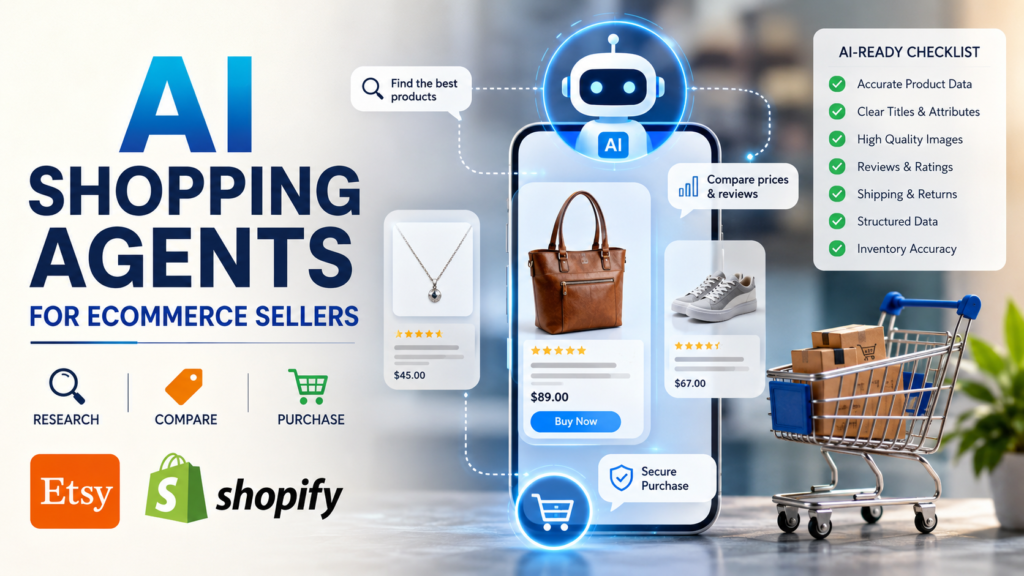
AI shopping agents for ecommerce sellers research products, compare prices, check availability and sometimes complete purchases for customers. Etsy and Shopify sellers should prepare by improving product titles, attributes, images, reviews, shipping details, inventory accuracy and structured data. Clear, current information gives AI systems a better chance of understanding and recommending their products.
Highlight
- AI shopping agents can research, compare and purchase products on a shopper’s behalf.
- Etsy sellers should improve listing titles, tags, materials, dimensions, variations and shop policies.
- Shopify merchants should maintain a clean product catalogue and review eligible AI sales channels.
- Accurate price, stock, shipping and returns data matters more than vague promotional language.
- Structured data can help search engines interpret product information, although it never guarantees visibility.
- AI-ready content should answer practical buyer questions directly.
- Sellers should monitor AI referrals, product accuracy and conversion performance over time.
Quick Comparison: Etsy and Shopify Sellers
| Area | Etsy sellers | Shopify sellers |
|---|---|---|
| Main focus | Clear listings, tags, variations, materials and shop policies | Product catalogue, structured data, feeds and sales channels |
| Product information | Handmade details, size, colour, materials and care instructions | Product attributes, SKU, price, availability and variants |
| AI readiness | Keep Etsy listings accurate and easy to interpret | Review Shopify Catalog and eligible agentic storefront options |
| Customer trust | Reviews, processing times and delivery information | Reviews, returns, shipping, policies and product-page quality |
| First action | Audit your top 10 listings | Audit your product catalogue and connected channels |
How AI Shopping Agents Change Ecommerce
A shopper may soon type a request such as, “Find a waterproof laptop bag under £100 that can arrive in Manchester this week.” Instead of showing ten blue links, an AI shopping agent may search catalogues, compare product specifications, check delivery information and present a short list.
AI shopping agents for ecommerce sellers are software systems that use product data and buyer preferences to discover, compare and sometimes purchase products with limited human input.
That makes this topic different from ordinary AI content or a basic store chatbot. A chatbot answers questions inside one shop. An agentic shopping system may compare products across several merchants before recommending one.
The change also affects smaller businesses. A handmade seller on Etsy and a growing Shopify brand may both compete for inclusion in an AI-generated recommendation, but they do not control the same data, checkout or marketplace settings.
Shopify describes agentic commerce as a buying model in which AI agents research products, compare options and complete parts of the customer journey. Its guidance also recommends auditing structured product data, building an AI-facing brand presence, enabling suitable channels and monitoring AI visibility. shopify
The opportunity is significant, but sellers should avoid exaggerated promises. AI systems do not guarantee that every product will appear, and enabling a shopping channel does not automatically make a catalogue competitive.
Why Product Data Matters
AI systems need facts they can interpret consistently. A product called “The Everyday Essential” may sound attractive to a human visitor, but it tells an agent very little about what the item is.
A clearer title might say:
“Handmade cotton canvas tote bag with zip pocket, 15-inch laptop size.”
The second version gives an AI system useful information about the product type, material, feature and use case. It also matches the way buyers describe their needs.
Google’s merchant-listing guidance shows how structured product information can communicate price, availability, shipping, returns, images, brand and product identifiers. Google also recommends testing structured data and checking that product pages remain crawlable. developers.google
For UK and USA audiences, local details deserve extra care:
- Display the correct currency, such as GBP or USD.
- Explain shipping destinations clearly.
- Use centimetres and inches where your audience needs both.
- State processing and delivery times separately.
- Make return conditions easy to find.
- Keep stock and sale prices up to date.
- Avoid promising delivery dates you cannot reliably meet.
A useful rule is simple: if a buyer would ask about it before purchasing, add it clearly to the listing or product page.
Etsy and Shopify Preparation
Start by improving your product titles so shoppers and AI systems can understand each listing quickly. Next, update descriptions with specific details about materials, size and intended use. Accurate product attributes will make variations easier to interpret. Finally, review your shipping information and make sure delivery estimates match your actual fulfilment process.
Etsy for Sellers
Etsy sellers operate inside a marketplace with its own listing structure, buyer expectations and search system. You may not control every technical layer, so your first priority should be listing clarity.
Review your strongest listings and improve:
- Descriptive titles that identify the actual product.
- Complete attributes, such as colour, size, material and occasion.
- All relevant variations grouped under one listing.
- Accurate processing times and delivery estimates.
- Clear care, sizing and customisation instructions.
- High-resolution product images.
- Natural tags that describe real buyer needs.
- Shop policies and frequently asked questions.
- Reviews that reflect product quality and customer experience.
Do not turn every title into a string of disconnected keywords. For example, “Gold Earrings Gift Jewellery Women Handmade” is less useful than “Handmade gold-filled hoop earrings for everyday wear.”
The best Etsy listing combines search relevance with specific product facts. That approach supports ordinary Etsy search while making the information easier for an answer engine to summarise.
You can also use a broader content marketing strategy for small businesses to support your Etsy shop with useful guides, gift ideas and category content outside the marketplace.
One important distinction matters here: an AI agent that drafts a customer reply is not the same as an AI shopping agent that recommends or purchases a product. Automation tools can help with messages, listing audits and stock reminders, but marketplace permissions and seller policies still apply.
Shopify Sellers
Shopify gives merchants more control over their own catalogue, product pages, checkout experience and connected channels. That control creates more opportunities, but it also creates more responsibility.
Start with a catalogue audit:
- Remove duplicate or outdated products.
- Give every variant a clear relationship to its parent product.
- Check titles, descriptions, prices and availability.
- Add complete product attributes.
- Review product and collection URLs.
- Confirm that shipping and returns information matches your policy.
- Check structured data and product feeds.
- Review eligible AI sales channels inside Shopify Admin.
Shopify’s official documentation says its agentic storefronts can connect eligible merchants with AI channels such as ChatGPT, Google AI Mode, Gemini, Microsoft Copilot and Meta. Availability and features can depend on the merchant, region and channel, so sellers should verify their current Shopify Admin settings rather than rely on an old tutorial. help.shopify
OpenAI’s published launch information also explains that eligible Etsy items and selected Shopify merchants can support shopping experiences in ChatGPT. That does not mean every seller receives automatic access, so use “eligible” and “participating merchants” when describing availability. openai
For smaller brands, a practical Shopify checklist includes:
- Confirm that products are included in the relevant catalogue.
- Keep inventory synchronised across sales channels.
- Use consistent product names and attributes.
- Check whether direct checkout is available to your store.
- Review how AI-referred orders appear in analytics.
- Test how your products appear for realistic shopping prompts.
If you run the business alone, prioritise the tasks that create the greatest risk first. This guide to AI tools for one-person businesses can help you think about content, customer service and operational automation separately from product discovery.
Make Your Catalogue AI-Ready
Write for Questions, Not Hype
AI shopping agents often need to answer questions such as:
- Is this jacket waterproof?
- Will this desk fit a small home office?
- Is the necklace suitable for sensitive skin?
- Can this item arrive before Christmas?
- Does the product come in a larger size?
- What is the return policy?
Answer these questions directly. Instead of writing, “A revolutionary must-have for modern living,” provide measurable facts:
“The backpack holds a 15-inch laptop, weighs 720 grams and uses water-resistant recycled polyester.”
The factual version gives customers confidence and gives AI systems information they can use.
This is where AI SEO tools for small businesses may help with audits, content briefs and missing-topic checks. However, review every suggestion manually. AI tools can identify gaps, but they cannot confirm whether your product is actually waterproof, hypoallergenic or suitable for a particular use.
Organise Product Attributes
At minimum, review these fields:
- Product name and category.
- Brand or maker.
- Materials and ingredients.
- Dimensions and weight.
- Colour, size and fit.
- Compatibility.
- Intended use.
- Price and currency.
- Stock status.
- Processing and delivery time.
- Shipping cost.
- Return conditions.
- Warranty details.
- Product identifiers, where applicable.
- Reviews and rating information.
Keep the same facts consistent across Etsy, Shopify, your website, Google Merchant Center and any connected feed. Conflicting prices or delivery times can damage trust and make automated recommendations less reliable.
Use Structured Data Carefully
For an independent Shopify website, Product and Offer structured data can help search engines understand the item. Include relevant information such as:
- Product name.
- Image.
- Description.
- Brand.
- SKU or other applicable identifier.
- Price.
- Currency.
- Availability.
- Review information.
- Shipping details.
- Return policy.
Structured data supports discoverability, but it does not replace useful visible content. The page should display the same information that appears in the markup.
Google recommends using its Rich Results Test and URL Inspection tools to validate product markup and check how pages are seen by Google. Source: Google Search Central also explains that merchant listings can show details such as price, availability, shipping and returns.
Build Answer-Shaped Content
Create supporting pages that answer real shopping questions:
- Size guide.
- Materials and care guide.
- Shipping information.
- Returns and exchanges.
- Product comparison.
- Gift guide.
- Frequently asked questions.
- “Which product is right for me?” guide.
These pages also strengthen traditional SEO. If you need help producing useful, consistent content, you can review this guide on hiring an AI SEO content writer. The writer should edit and verify the material rather than publish unchecked AI output.
A small but useful thought experiment: ask an AI tool to find one of your products using three different prompts. For example, try a price-led prompt, a use-case prompt and a location-based delivery prompt. Then check whether the product details it gives back are correct.
GEO Strategy and 30-Day Roadmap
Generative Engine Optimization means making information easy for AI answer engines to understand, quote and connect with the right entity.
For this article’s subject, GEO involves more than repeating “AI shopping agents.” You should:
- Define important terms in plain English.
- Use clear H2 and H3 headings.
- Put direct answers near the beginning of each section.
- Add comparison tables and checklists.
- Use consistent brand and product entities.
- Support claims with official sources.
- Include original examples.
- Keep product facts current.
- Add descriptive FAQs.
- Link related pages with natural anchor text.
Do not block legitimate discovery crawlers accidentally, but do not assume that allowing a crawler guarantees inclusion. Review each platform’s documentation and privacy terms before changing robots.txt or connecting a new commerce integration.
Shopify’s recent agentic-commerce guidance also highlights the importance of product data, FAQs, return policies, shipping information and customer reviews. These elements help an AI system answer the complete buying question rather than identify only a product name. shopify
Infographic Concept
Create a horizontal infographic titled “From Product Listing to AI Purchase.”
Use five connected stages:
- Product facts: title, material, size, images and identifiers.
- Trust signals: reviews, policies, shipping and returns.
- AI discovery: ChatGPT, Gemini, Copilot and Google AI experiences.
- Comparison: price, availability, delivery and suitability.
- Purchase: merchant checkout, fulfilment, support and measurement.
Show Etsy and Shopify in two colours, then highlight the shared foundations: accurate data, clear policies and reliable stock.
Internal Linking Structure
Use the links above in context, but avoid placing all four links in one paragraph. A natural linking structure would be:
- Link the content strategy guide from the section about supporting content.
- Link the AI SEO tools guide from the catalogue audit section.
- Link the one-person business tools guide from the prioritisation section.
- Link the AI SEO writer guide from the answer-shaped content section.
30-Day Roadmap
| Time period | Etsy seller actions | Shopify seller actions | Success check |
|---|---|---|---|
| Days 1–7 | Audit 10 best listings, titles, attributes and variations | Audit top products, variants, prices and stock | No major factual inconsistencies |
| Days 8–14 | Improve materials, dimensions, images, tags and policies | Improve descriptions, structured data, shipping and return pages | Product facts are complete |
| Days 15–21 | Test buyer questions and review listing clarity | Review catalogue connections and eligible AI channels | AI tools can understand the products |
| Days 22–30 | Compare impressions, visits and listing engagement | Track AI referrals, channel sales and conversion data | Keep improvements that support sales |
FAQ:
What are AI shopping agents?
AI shopping agents are software systems that help people complete buying tasks. They can interpret a request, find relevant products, compare price and availability, review delivery information and sometimes complete an approved purchase. Unlike a basic chatbot, an agent may work across multiple merchants and manage several steps of the shopping journey.
How can Etsy sellers prepare for AI shopping agents?
Etsy sellers should make their listings specific and complete. Add accurate titles, materials, sizes, colours, variations, processing times, delivery information, care instructions and shop policies. Use natural tags, strong images and honest reviews. Most importantly, ensure that every factual detail matches the actual product and fulfilment process.
How can Shopify sellers prepare for AI shopping agents?
Shopify sellers should audit their product catalogue, organise variants, maintain real-time inventory and keep price, shipping and returns data accurate. They should also review structured data, connected product feeds and eligible AI sales channels in Shopify Admin. Features vary by merchant and region, so sellers should check current official documentation.
Do AI shopping agents use product reviews?
Reviews can help an AI system understand customer experience, product quality and common concerns. Sellers should not manufacture or manipulate reviews. Instead, encourage genuine feedback according to marketplace rules, respond professionally to issues and use recurring customer questions to improve product descriptions, sizing information and support content.
Does structured data guarantee AI visibility?
No. Structured data helps search engines and commerce systems interpret product information, but it cannot guarantee rankings, recommendations or inclusion in an AI shopping result. Product relevance, availability, price, trust, content quality, platform eligibility and user preferences can all influence whether an item appears.
Can Etsy and Shopify sellers use the same AI strategy?
They can share the same foundation: accurate product facts, clear policies, good images, trustworthy reviews and current inventory. However, the implementation differs. Etsy sellers work mainly within marketplace listing controls, while Shopify merchants usually have more control over their catalogue, website, feeds, checkout and connected commerce channels.
How should sellers measure AI shopping performance?
Track AI-referred visits, product views, add-to-cart activity, completed orders, conversion rate, average order value and returns where your platform provides the data. Also test your products using realistic shopping prompts and record whether the AI gives correct information. Treat these checks as ongoing quality control, not a one-time ranking test.
Author Bio
An SEO and GEO content specialist focused on ecommerce, marketplace visibility and practical content strategy for small businesses. Their work combines search-intent research, structured content, product-page optimisation and human editorial review to create useful articles for UK and USA audiences.