Quick Summary
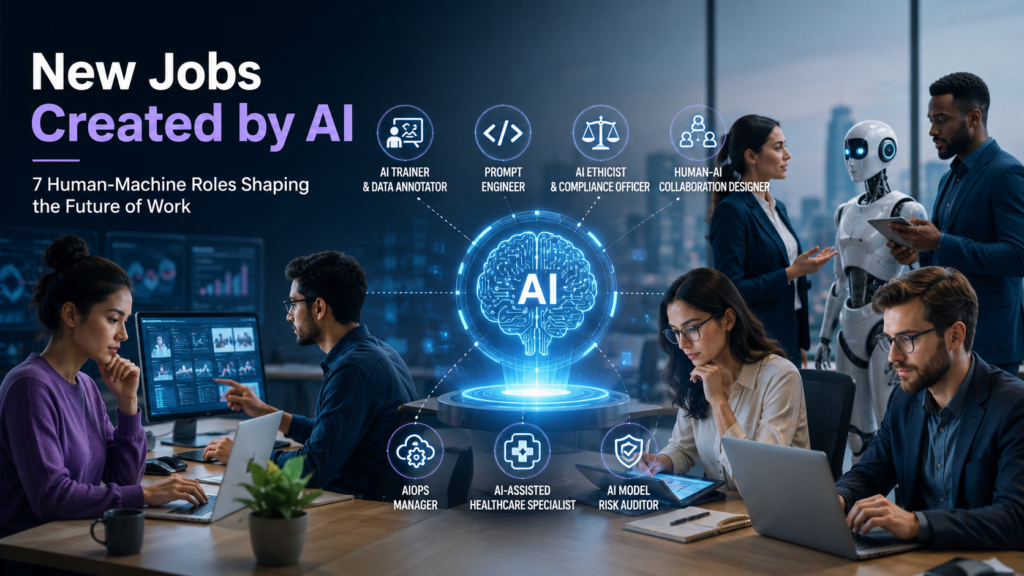
Human-machine hybrid jobs pair AI’s speed and pattern-spotting with human judgement, creativity, and accountability. Seven worth watching are the AI trainer, prompt engineer, AI ethicist, human-AI collaboration designer, AIOps manager, AI-assisted healthcare specialist, and AI model risk auditor. None of these roles replace people — they lean on AI to help people do more.
Highlight
- Human-machine hybrid jobs pair human expertise with AI systems rather than swapping one for the other.
- New opportunities are opening up across tech, healthcare, finance, design, operations, and compliance.
- The human’s job is context, judgement, empathy, and accountability — things AI still can’t reliably provide.
- AI trainers teach models to work from accurate, useful data.
- Prompt engineers write and test the instructions that steer generative AI tools.
- AI ethicists and model risk auditors check whether a system is actually fair, safe, and dependable.
- The candidates who stand out combine general AI literacy with deep knowledge of one specific industry.
Featured Snippet Table
| Role | What AI handles | What the human adds | Useful skills |
|---|---|---|---|
| AI trainer or data annotator | Processes and learns from examples | Context, accuracy, and judgement | Research, language, quality control |
| Prompt engineer | Generates responses and completes tasks | Clear instructions and evaluation | Writing, testing, problem-solving |
| AI ethicist or compliance officer | Identifies patterns and applies rules | Ethical and legal judgement | Policy, risk, regulation |
| Human-AI collaboration designer | Supports workflows and recommendations | Empathy and user understanding | UX, research, systems thinking |
| AIOps manager | Monitors systems and detects issues | Oversight and decision-making | Cloud, automation, analytics |
| AI-assisted healthcare specialist | Supports analysis and clinical workflows | Patient care and professional judgement | Healthcare, data, safety |
| AI model risk auditor | Tests models and produces results | Independent review and accountability | Auditing, statistics, governance |
What Does a Human-Machine Hybrid Job Actually Mean?
Picture a radiology department on a busy Tuesday. An AI tool flags a shadow on a chest scan that might be worth a second look. It does this in seconds, without getting tired or distracted. But nobody sends that patient home based on a flag alone — a radiologist still reads the scan, checks the history, weighs up anything unusual, and decides what happens next.
That’s the whole idea of a human-machine hybrid job in a nutshell.
It’s a role where AI handles the pattern-spotting, drafting, or repetitive analysis, and a person supplies the judgement, context, and accountability that the software can’t. The machine does the heavy lifting on volume. The human decides what actually matters.
Worth clearing up: this isn’t the same “hybrid” you see in job listings about splitting time between home and the office. Here, hybrid describes the working relationship between a person and an intelligent system — two very different jobs sharing the same word.
And this shift isn’t theoretical anymore. PwC’s 2026 AI Jobs Barometer found that job postings requiring specific AI skills grew 69%, against just 9% growth across the broader labour market — and workers with those skills commanded an average 62% wage premium. pwc
That doesn’t mean every AI-adjacent job pays well or leads anywhere interesting. It does mean employers are willing to pay more for people who can use AI sensibly and tie it to a real business problem, rather than just knowing how to type a good prompt.
7 New Jobs Created by AI
1. AI Trainer and Data Annotator
Models don’t learn on their own — someone has to show them what “good” looks like first. That’s the AI trainer or data annotator’s job: helping a system understand what accurate, safe, and genuinely useful output actually resembles.
Day to day, this can mean:
- Labelling images, documents, audio, or video.
- Reading through customer-service transcripts.
- Comparing two AI answers and deciding which is better.
- Correcting biased or flat-out wrong outputs.
- Explaining tone, sarcasm, slang, or cultural nuance the model missed.
- Building training examples for language, vision, or speech systems.
A language model can parse the words in a sentence perfectly and still miss that the person was being sarcastic. It might flatten a regional turn of phrase into nonsense, or produce something that reads confidently but is actually wrong. That’s where a human reviewer earns their keep.
This work tends to suit people coming from teaching, translation, research, customer service, writing, or administrative backgrounds — you don’t necessarily need to code. That said, more technical training roles, especially ones touching machine-learning pipelines directly, will expect Python and data analysis skills.
At its core, the job boils down to one question someone has to keep asking: does this answer actually make sense?
2. Prompt Engineer
Prompt engineering gets treated like a party trick sometimes — “just ask the AI the right question” — but the real job is a lot more disciplined than that.
A prompt engineer typically:
- Defines the AI’s role and the boundaries it shouldn’t cross.
- Supplies examples of what a good output looks like.
- Locks down tone, format, and structure.
- Tests the same prompt across a range of edge cases.
- Works to cut down on vague, inconsistent, or made-up answers.
- Builds reusable prompt templates for a team or an automated pipeline.
Say a marketing team wants to turn a single product brief into a dozen campaign angles. Someone still has to write the instructions that keep the brand’s voice consistent, respect the target audience, and stay inside legal or compliance limits that’s the prompt engineer’s contribution, not the AI’s.
Good writing helps here, sure, but subject-matter knowledge probably matters more. Someone who’s spent years in customer support, law, finance, or healthcare will usually write sharper prompts for that domain than a generalist who only understands the tooling.
It’s also worth knowing that prompt engineering rarely stands alone as a job title. More often, it’s folded into a broader role content, product, research, automation, or software development rather than existing as its own department.
3. AI Ethicist or Compliance Officer
Before an AI system starts affecting real people’s lives, someone needs to have asked the uncomfortable questions first. That’s the AI ethicist’s or compliance officer’s territory.
Questions they’ll typically raise:
- Could this system disadvantage a particular group?
- Is the training data actually representative?
- Can a user understand how the decision was reached?
- Is personal data being handled within the law?
- Who’s accountable if this goes wrong and someone is harmed?
- Does the tool meet both regulatory requirements and internal policy?
An AI ethicist might spend their time auditing datasets, drafting responsible-AI policy, running impact assessments, and pushing back on product decisions before launch. A compliance officer tends to lean more heavily into documentation, audit trails, privacy controls, and security less philosophy, more paperwork that holds up under scrutiny.
Take an automated hiring tool as an example. It can screen thousands of CVs in the time it takes a recruiter to make coffee. But it can also quietly learn to penalise candidates in ways nobody intended a gap in employment history, a particular university, a name pattern. A compliance professional’s job is catching that before it becomes a lawsuit.
The NIST AI Risk Management Framework is a useful reference point here it’s a voluntary framework covering reliability, safety, transparency, explainability, privacy, and fairness in AI systems. nist
People land in this field from law, public policy, cybersecurity, HR, philosophy, and risk management. The ones who do it well can translate a technical risk into a sentence a non-technical executive will actually understand.
4. Human-AI Collaboration Designer
Somebody has to decide how people and AI should actually work together and that’s a genuinely different skill from building the AI itself.
Take an insurance company rolling out an AI assistant for claims. It can flag missing paperwork and suggest a risk tier in seconds. But a claims handler still needs to look at the unusual cases, talk to the customer directly, and be the one who explains a denial. Someone has to design that handoff so it doesn’t feel broken or confusing on either end.
That’s what a human-AI collaboration designer figures out:
- Which tasks the AI should own outright.
- Where a human sign-off is non-negotiable.
- How a user can push back on or correct a recommendation.
- What the interface actually needs to show, and what it should hide.
- What the fallback plan is when the system gets it wrong.
This role sits at the intersection of UX design, service design, psychology, and product management. It calls for a realistic read on how people behave when they’re rushed, stressed, or working with half the information they need — which is most of the time, honestly.
Good design in this space doesn’t pretend the AI is infallible. It surfaces uncertainty, shows its work, and always leaves a door open for a human to step in.
5. AIOps Manager
AIOps — AI applied to IT operations blends automation, monitoring, and machine learning to help technical teams keep sprawling systems running.
An AIOps manager typically oversees tools that:
- Monitor cloud infrastructure and network traffic.
- Flag unusual or suspicious activity.
- Predict outages before they happen.
- Cluster related incidents together instead of treating each alert separately.
- Suggest fixes to the engineering team.
- Automate the routine, low-risk responses.
The software can watch far more signals than any human team could keep up with. What it can’t do is know which of those signals actually matters to the business right now. That’s the manager’s call deciding what needs eyes on it immediately, and double-checking that an automated fix isn’t quietly creating a new problem somewhere else.
This suits people already working as IT service managers, DevOps engineers, cloud specialists, or systems administrators. Cloud computing, observability tooling, scripting, and incident management experience all transfer well.
AIOps is honestly one of the cleanest examples of AI augmentation out there: the software brings speed and scale, the manager brings judgement about what’s worth acting on.
6. AI-Assisted Healthcare Specialist
Healthcare has some of the biggest upside for AI and some of the least room for error, which is exactly why human oversight stays non-negotiable here.
AI can flag patterns on scans, summarise patient records, help triage cases, and chew through biomedical data faster than any team could manually. But the actual clinical decisions, the conversations with patients, the informed consent that stays with qualified professionals.
Roles taking shape in this space include:
- Radiologists using AI-flagged scans as a starting point, not a verdict.
- Clinical data annotators building datasets for medical models.
- Healthcare technicians reviewing AI-generated records for accuracy.
- Telehealth staff using triage software to prioritise urgent cases.
- Biomedical analysts working through treatment and outcomes data.
A model doesn’t know the patient’s history the way the clinician sitting across from them does the unusual symptom that doesn’t fit a pattern, the family history that changes the read. That context stays firmly human.
The FDA’s Artificial Intelligence and Medical Products page is a good starting point for understanding how AI and machine learning intersect with regulated healthcare products.
This isn’t a field where AI output should ever be treated as a final diagnosis, full stop. Depending on the specific role, you’re likely looking at clinical qualifications, medical-data experience, or dedicated training in health tech.
7. AI Model Risk Auditor
An AI model risk auditor’s job is to stress-test whether an AI system is actually reliable, well-documented, secure, and appropriate for the decision it’s being used to support.
That typically involves digging into:
- Where the training data came from and how clean it is.
- Whether accuracy holds steady across different demographic groups.
- Bias and discrimination risk.
- Cybersecurity weaknesses.
- How well the model is documented.
- Monitoring and change-control processes once it’s live.
- Compliance with internal policy and external regulation.
Think about a bank using AI to help decide loan approvals. An auditor’s job is to test whether similar applicants get similar outcomes, whether the system can actually explain its own recommendation, and whether a staff member can override it when something looks off.
This role blends traditional auditing with statistics, data analysis, and governance and it’s becoming especially relevant in finance, insurance, healthcare, government, and any large tech company deploying models at scale.
A good model risk auditor doesn’t just ask “is this accurate?” They ask: is it fit for this specific purpose? Can we actually monitor it over time? Can it explain itself? And when it’s wrong because it will be, eventually who’s on the hook?
The Skills Behind These Careers
These seven roles sit at pretty different points on the technical spectrum, but there’s a common thread running through all of them.
Technical skills
- AI and machine-learning fundamentals.
- Data literacy — comfortable in a spreadsheet, comfortable questioning a dataset.
- Prompt design and systematic output testing.
- Basic familiarity with automation and workflow tools.
- Privacy and cybersecurity awareness.
- Model evaluation and quality assurance.
- Working knowledge of cloud platforms, APIs, or databases.
Human skills
- Critical thinking.
- Writing and communicating clearly.
- Creative problem-solving.
- Ethical judgement.
- Working well across departments and disciplines.
- Adaptability, because the tools change fast.
- The willingness to actually challenge an AI recommendation instead of rubber-stamping it.
The UK government’s AI skills projections split the market into experts, specialists, and implementers, and estimate that jobs involving AI-related activities could grow from around 158,000 in 2024 to as many as 3.9 million by 2035 — worth treating as a projection rather than a guarantee, given how far out that timeline runs. gov
The practical takeaway for most job seekers is actually reassuring: you don’t need to retrain as a machine-learning researcher. Start with the industry you already know, and figure out how AI is changing the tasks inside it.
If you’re a student, there are practical ways to build early experience — see AI side hustles for students in the UK. Running a small business? It’s worth looking at AI tools for a one-person business before jumping into automation or consulting work.
AI Is Changing Existing Jobs Too, Not Just Creating New Ones
Not every AI-driven change shows up as a shiny new job title. More often, an existing role just quietly absorbs new responsibilities.
A recruiter starts screening candidates with AI support and becomes something closer to an AI-assisted talent specialist. A financial analyst starts running machine-learning scenarios instead of building every model by hand. A designer leans on generative tools for rough first drafts, then spends more of their actual time on direction, refinement, and talking to clients.
That’s exactly why it’s worth reading a job posting’s responsibilities section properly instead of skimming the title. Ask yourself:
- Which tasks does the AI actually complete here?
- Which decisions stay with the person in this role?
- What evidence does the employee need to check before signing off?
- What’s the process when the system gets something wrong?
- Does this role carry legal, clinical, or financial accountability?
AI creates opportunity and disrupts existing roles at the same time — it’s rarely one or the other. For a more sobering look at the flip side, it’s worth reading AI job displacement statistics alongside this piece.
Content work is going through its own version of this. Editors and writers are still the ones providing accuracy, voice, and editorial judgement, even as AI speeds up research and first drafts. Businesses experimenting with that split might also look at hiring an AI SEO content writer.
How to Actually Prepare for an AI Career
You don’t need a dramatic career pivot to start. Pick one field you already understand and study how the people working in it are using AI right now.
A workable process looks something like this:
- Pick an industry you know reasonably well.
- Identify three tasks in that industry that feel repetitive.
- Test an AI tool on one low-risk example from that list.
- Check the output properly instead of trusting it on sight.
- Note down what time it actually saved and what mistakes it made.
- Turn that into a small portfolio case study.
- Learn the privacy, safety, and compliance issues specific to that industry.
A portfolio doesn’t need to be elaborate. It could simply show how you streamlined a support workflow, evaluated a batch of AI outputs for accuracy, built in a human approval step, or put together a repeatable prompt-testing process.
What employers are really looking for is judgement — proof that you understand both what AI is good at and exactly where it shouldn’t be trusted blindly.
Infographic Concept
“The Human-AI Job Spectrum: Seven Careers Built Around Artificial Intelligence.”
Group the seven roles into three sections:
- Build: AI trainer, data annotator, and prompt engineer.
- Coordinate: Human-AI collaboration designer and AIOps manager.
- Protect: AI ethicist, healthcare specialist, and model risk auditor.
For each role, show:
- The task AI handles.
- The decision the human controls.
- The main industry it shows up in.
- The single most important skill.
Use one colour for automation, one for human judgement, one for risk management. Centre statement:
AI provides scale. People provide context, accountability, and judgement.
Career Roadmap
| Stage | Action | Evidence of progress |
|---|---|---|
| Explore | Pick an industry and map out where AI could help | A list of real, practical use cases |
| Learn | Study AI basics, prompting, data handling, and responsible use | A course, notes, or a small project |
| Practise | Try an AI tool on one low-risk task | A documented before-and-after |
| Specialise | Focus on healthcare, finance, design, operations, or governance | An industry-specific project |
| Validate | Get a knowledgeable person to review your work | Feedback, or a measurable improvement |
| Apply | Target roles that combine AI with your existing background | A CV and portfolio built around outcomesFAQ |
FAQ:
What are human-machine hybrid jobs?
They’re roles that combine artificial intelligence with human expertise — AI handles the data-crunching, pattern-spotting, or drafting, while a person supplies context, judgement, and accountability. AI trainers, prompt engineers, AI ethicists, healthcare specialists, and model risk auditors are all good examples.
What jobs will AI create for humans?
AI is opening up or expanding roles in model training, prompt engineering, AI governance, workflow design, IT operations, health tech, and model auditing. It’s also reshaping established careers in recruitment, finance, marketing, design, and customer support. Exact titles vary a lot by industry and employer.
Is prompt engineering a real career?
It’s a genuine, in-demand skill, and yes, it does sometimes show up as its own job title. More often, though, companies fold it into content, product, research, automation, or software roles. The prompt engineers who are actually good at this understand the underlying business problem, test their work rigorously, and know when a human still needs to check the result.
Do human-AI jobs require coding?
Some do — AIOps, machine learning, and technical model auditing typically expect programming or data skills. Plenty of others lean on writing, research, compliance, design, healthcare knowledge, or communication instead. General AI literacy and data awareness help across the board, even where heavy coding isn’t required.
Are AI-created jobs available in the UK and USA?
Employers in both markets are adding AI-related responsibilities across tech, healthcare, professional services, finance, education, and government. What’s actually available depends on location, experience level, industry, and security clearance requirements. It’s worth searching both for AI-specific titles and for traditional roles that have quietly picked up AI responsibilities.
Will AI create more jobs than it destroys?
Nobody can answer that with confidence for the labour market as a whole. AI removes some tasks, reshapes existing occupations, and creates demand for new skills, often all three at once. You’ll get a more useful answer by looking closely at a specific industry or occupation than by trying to generalise across the entire economy.
Author Bio
Globe Hustle AI & Workforce Editorial Desk
The Globe Hustle editorial team covers artificial intelligence, digital careers, SEO, and the shifting labour market, combining practical guidance with official workforce research and clear explanations for UK and US readers.