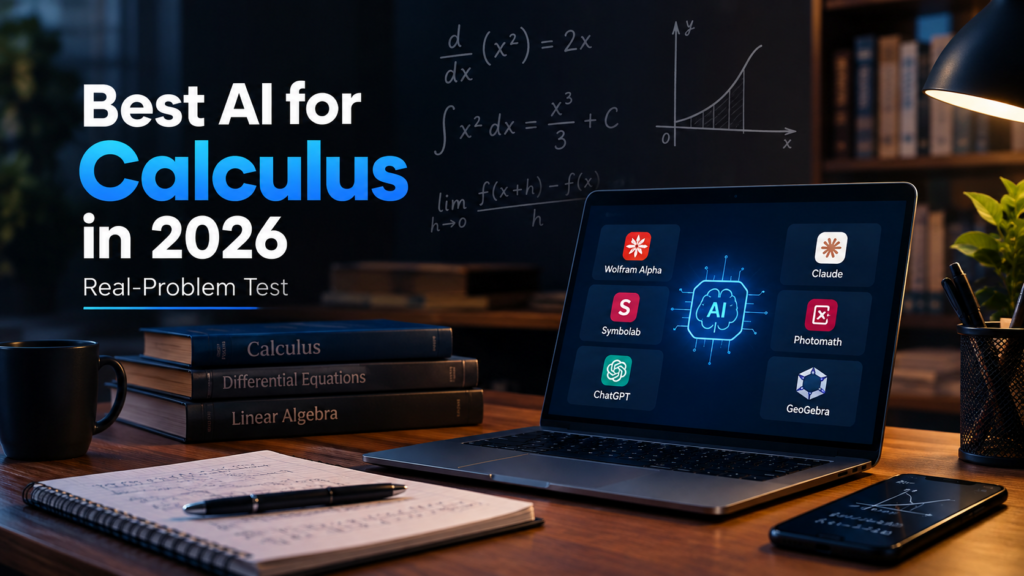
Quick Summary What Is the Best AI for Calculus?
If you need one tool for calculus calculations, Wolfram Alpha is the strongest choice for checking derivatives, integrals, limits and more advanced problems. Symbolab is especially useful when you want to see the working. ChatGPT and Claude are better for explanations and word problems. For students, using two tools together is often more useful than relying on one.
Highlight
- Wolfram Alpha is best suited to mathematical computation and checking difficult results.
- Symbolab is useful when you want to follow the steps rather than see only an answer.
- ChatGPT works well as a calculus tutor, especially when a textbook explanation doesn’t make sense.
- Claude can help break down longer or confusing calculus questions.
- Photomath is handy when you want to scan a problem instead of typing it.
- GeoGebra is worth using when a graph or visual explanation makes the mathematics clearer.
- The best choice depends on whether you’re trying to solve, learn, check or visualise a calculus problem.
Best AI Calculus Tools at a Glance
| Tool | What It Does Best | Good For |
|---|---|---|
| Wolfram Alpha | Mathematical computation | Derivatives, integrals, limits, advanced calculus |
| Symbolab | Step-by-step solutions | Homework practice and learning methods |
| ChatGPT | Explanation and tutoring | Concepts, word problems and practice |
| Claude | Detailed explanations | Understanding complicated questions |
| Photomath | Scanning problems | Printed or handwritten homework |
| GeoGebra | Graphs and visual maths | Functions, curves and calculus concepts |
| Mathos AI | AI maths tutoring | Guided problem solving |
So, Which AI Is Actually Good for Calculus?
There’s a simple reason this question doesn’t have a one-tool-fits-everyone answer.
Calculus isn’t one type of problem.
Finding a derivative is different from explaining what a derivative means. Solving an integral is different from deciding which integration method to use. And a word problem can be difficult even when the actual differentiation is easy.
That’s why the best AI for calculus depends on what you’re stuck on.
A dedicated mathematics engine and a conversational AI also work differently. Wolfram Alpha, for example, is built around computational mathematics. ChatGPT and Claude are general-purpose language models that can explain ideas, interpret questions and work through reasoning in conversation.
In simple terms: a calculus calculator is good at calculating; an AI tutor is good at talking you through the mathematics.
For a student, both roles matter.
1. Wolfram Alpha: The One I’d Use to Check the Maths
Let’s start with the tool that has a very different job from ChatGPT.
Wolfram Alpha is designed for computational mathematics. That makes it particularly useful when you already know what calculation you need and want to check the result.
You can use it for things such as:
- Derivatives
- Definite integrals
- Indefinite integrals
- Limits
- Series
- Differential equations
- Multivariable calculus
- Optimisation
- Mathematical expressions with several variables
Imagine you’ve spent twenty minutes working through an integral and finally get an answer.
Before handing it in, you want to know whether that answer is actually right.
That’s where a computational engine is useful.
It isn’t trying to have a conversation with you. It’s there to do the mathematics.
Best for: checking calculations and handling more advanced symbolic maths.
Not ideal for: students who need a long, conversational explanation of why a particular method works.
2. Symbolab: Better When You Want to See the Working
Getting the answer is one thing.
Knowing how to get there is another.
That’s where Symbolab becomes useful for students.
Say you’re learning the chain rule and you’ve reached the final answer, but you’re not sure whether you applied the rule correctly. A step-by-step solution gives you something concrete to compare with your own working.
Symbolab is useful for areas such as:
- Differentiation
- Integration
- Limits
- Equations
- Series
- Trigonometric problems
- Differential equations
I particularly like this type of tool for checking where your own method went off track.
There’s a temptation to open the solution, copy every line and move on. Don’t.
If you’re studying for an exam, that habit will hurt you later. Read the step, close the solution, and try to reproduce the reasoning yourself.
That’s how a solution tool becomes a learning tool.
3. ChatGPT: Best When the Problem Doesn’t Make Sense
Sometimes the calculation isn’t actually the problem.
The problem is that the question is written in a way you don’t understand.
For example:
A particle moves along a straight line according to a given position function. Determine the intervals on which the particle is moving in a particular direction.
A student who understands derivatives might still get stuck deciding what the question wants.
This is where ChatGPT can help.
Instead of asking:
“Solve this.”
try:
“Explain what this calculus question is asking me to find. Don’t solve it yet.”
That’s a much better prompt.
You can then ask the AI to help you identify:
- What information the question gives you.
- What you actually need to find.
- Which calculus concept applies.
- Which equation you should set up.
- How to check your final answer.
ChatGPT is also useful for creating practice questions, explaining mistakes and translating a dense textbook explanation into simpler language.
There is one big warning, though.
A convincing explanation doesn’t guarantee a correct calculation.
For difficult symbolic work, check the result with a dedicated maths tool.
4. Claude: Useful When You Need the Question Explained Slowly
Claude belongs in the general-purpose AI category rather than the dedicated calculus calculator category.
Its usefulness for students comes from the same basic idea: you can have a conversation about the problem.
Suppose you understand differentiation but don’t understand a related-rates question.
You can ask Claude to explain the setup without immediately giving you the answer.
That lets you work through the reasoning:
- What quantities are changing?
- Which variables depend on time?
- What relationship connects them?
- What should you differentiate?
- What information do you already know?
That style of tutoring can be more useful than simply seeing a completed solution.
And again, once you reach the final calculation, verify it.
5. Photomath: Handy When You Don’t Want to Type the Problem
Not every student wants to spend five minutes typing a page of mathematical notation into an AI tool.
Sometimes the problem is sitting right there on a worksheet.
Photomath is designed around that situation. You can use a phone camera to capture a mathematical expression and work from there.
It’s particularly convenient for:
- Textbook exercises
- Printed worksheets
- Quick homework checks
- Mathematical expressions that are annoying to type
This doesn’t make it the best all-round calculus tutor.
Its strength is convenience.
If you’ve got a complicated expression on paper and simply want to get it into a digital maths tool, that convenience matters.
6. GeoGebra: Use It When a Graph Explains More Than a Formula
Here’s something students sometimes overlook: calculus is visual.
A formula can tell you that something is happening. A graph can sometimes make it obvious.
For example, when you’re learning derivatives, looking at the slope of a curve can make the idea of instantaneous rate of change much easier to grasp.
GeoGebra is useful for exploring:
- Functions
- Curves
- Tangent lines
- Intersections
- Areas
- Transformations
- Graph-based calculus problems
This is especially helpful if you’re the kind of learner who looks at an equation and thinks, “I understand the algebra, but I still don’t really see what’s happening.”
Put the function on a graph.
Sometimes that is the missing piece.
Which AI Is Best for Solving Calculus Problems?
That depends on the problem sitting in front of you.
Derivatives
For checking the actual derivative, use a dedicated mathematical calculator such as Wolfram Alpha or Symbolab.
If you don’t understand why the chain rule, product rule or quotient rule applies, use an AI tutor to explain the concept first.
Integrals
Integrals are another area where dedicated calculation tools are useful.
You might use Wolfram Alpha to verify an answer, then use Symbolab to inspect the steps. If you don’t understand why substitution or integration by parts was chosen, ask ChatGPT or Claude to explain the decision.
That distinction matters because solving an integral isn’t always about performing the algebra. Sometimes choosing the right technique is the hardest part.
Limits
For limits, a calculator can quickly check the result.
An AI tutor becomes more useful when you’re asking questions such as:
- Why does the limit exist?
- Why can’t I substitute the value directly?
- When should I factor?
- When should I rationalise?
- What does the graph tell me?
Word Problems
This is probably where conversational AI has the clearest advantage.
A word problem mixes ordinary language with mathematics. Before you calculate anything, you need to figure out what the words mean mathematically.
An AI can help you turn the question into equations and explain the reasoning behind the setup.
Then check the actual calculation separately.
Best AI for Learning Calculus, Not Just Getting Answers
If you’re a student, this section matters more than the rankings.
There are two very different ways to use AI.
Bad approach:
“Solve these 15 calculus questions.”
Much better approach:
“I’m learning integration by substitution. Give me one problem at my level. Let me attempt it first, then check my work.”
The second approach forces you to think.
You can also ask an AI tutor to:
- Explain one concept using a simple example.
- Give you a similar problem.
- Hide the answer until you’ve tried.
- Point out your first mistake without solving the rest.
- Quiz you on formulas.
- Increase the difficulty as you improve.
- Explain the same idea in a different way.
That turns AI into something closer to a private study partner.
If you’re also studying physics, our guide to the best AI tools for math and physics covers the wider set of tools.
And if physics is the subject giving you trouble, you can also see our guide to AI tools for learning physics.
Are LLMs Good at Calculus?
Yes, but don’t confuse language ability with mathematical reliability.
An LLM is built to work with language and generate responses. A symbolic mathematics engine is specifically designed to perform mathematical operations.
That difference explains why a chatbot might give you an excellent explanation of a calculus concept but still deserve a second check on a complicated calculation.
Current comparisons of calculus AI tools make a similar distinction between dedicated computational systems and general-purpose AI models. Wolfram Alpha is commonly used for calculation and verification, while conversational AI tools are useful for explanations and problem setup. (Socratic)
So don’t ask:
“Is ChatGPT good at calculus?”
Ask:
“Which part of this calculus problem do I want AI to help me with?”
That’s a much more useful question.
What Is the Best Free AI for Calculus?
If you’re looking for a free AI calculus solver, don’t choose a tool just because its homepage says “free.”
Free access and features change, and some tools put advanced functions behind paid plans.
Instead, match the free tool to the job:
- Wolfram Alpha: calculation and verification
- Symbolab: step-by-step maths
- ChatGPT: explanations and tutoring
- Claude: conceptual help
- GeoGebra: graphing and visual learning
- Photomath: scanning mathematical problems
For occasional homework help, you may not need a paid subscription at all.
If you’re using AI every day for a university maths course, however, it’s worth checking exactly which features your chosen tool locks behind a paid plan.
How We Would Test an AI Calculus Solver
Testing only one easy derivative tells you almost nothing.
It’s like testing a car by driving it around a supermarket car park.
A useful calculus test should include different types of questions:
- Basic derivative
- Chain-rule derivative
- Implicit differentiation
- Definite integral
- Integration by substitution
- Integration by parts
- Limit
- Optimisation
- Related rates
- Multivariable calculus
Then judge each tool on four separate things:
Accuracy: Did it get the answer right?
Working: Were the steps mathematically sound?
Explanation: Could a student actually understand the solution?
Interpretation: Did it understand what the question was asking?
That last one gets overlooked.
A tool might calculate perfectly once you’ve given it the equation, yet struggle when the equation has to be extracted from a complicated word problem.
That’s why real-problem testing is much more useful than simply asking every tool the same basic derivative.
A Quick Reality Check for Students
AI makes calculus easier to practise.
It doesn’t make learning calculus unnecessary.
If you use a solver for every question, you’ll eventually run into a familiar problem: the AI looks confident, but you’re sitting in an exam without it.
That’s not a great trade.
Use AI to shorten the distance between “I don’t understand this” and “I understand how to approach this.”
Then put the screen away and solve a similar question yourself.
That’s the part that actually builds the skill.
A Student-Friendly AI Calculus Workflow
Here’s a workflow that makes much more sense than asking one chatbot to do everything.
| Stage | What to Do | Useful Tool |
|---|---|---|
| 1. Understand | Identify what the question is asking | ChatGPT / Claude |
| 2. Attempt | Work through the problem yourself | Paper + calculator |
| 3. Check | Compare your steps | Symbolab |
| 4. Verify | Confirm the mathematical result | Wolfram Alpha |
| 5. Visualise | Graph the function if useful | GeoGebra |
| 6. Practise | Solve a similar question without AI | Yourself |
Notice what’s missing?
There isn’t an “AI does everything” step.
That’s deliberate.
The point of these tools is to help you learn faster, not to remove the part of the process where you actually learn.
Infographic Idea: Which AI Should I Use for Calculus?
For the article’s main visual, create a simple decision-tree infographic titled:
Which AI Should I Use for My Calculus Problem?
Start with one question:
What do you need help with?
Then branch into:
Need an exact calculation?
→ Wolfram Alpha
Want to see every step?
→ Symbolab
Don’t understand the concept?
→ ChatGPT / Claude
Have a worksheet or handwritten problem?
→ Photomath
Need to see the graph?
→ GeoGebra
Have a complicated word problem?
→ ChatGPT / Claude → verify with Wolfram Alpha
At the bottom, show the recommended workflow:
Understand → Attempt → Check → Verify → Practise
That gives readers something practical rather than another generic “top AI tools” graphic.
So, What Is the Best AI for Calculus in 2026?
If you want a single answer, Wolfram Alpha is the strongest choice for serious mathematical calculation and verification.
But that’s not the whole story.
A calculus student doesn’t only need answers. You need to understand derivatives, recognise when to use integration by parts, interpret a limit, set up a related-rates equation and spot when an answer doesn’t make sense.
That’s where the other tools come in.
Use Wolfram Alpha when accuracy and computation matter. Reach for Symbolab when you want to inspect the working. Use ChatGPT or Claude when the question itself isn’t making sense. Bring in Photomath when typing the problem is a pain, and use GeoGebra when a graph would make the idea click.
The strongest setup isn’t one magical AI.
It’s a workflow.
Understand the problem. Try it yourself. Use AI for help. Verify the maths. Then solve another one without assistance.
That’s how you get the convenience of AI without handing over the actual learning.
If you’re looking for more tools beyond calculus, check out our guide to the best websites for students in 2026.
And if you’re a website owner who needs this kind of research-driven, search-focused content, you can learn more about hiring an AI SEO content writer.
People Also Ask
What is the best AI for calculus?
Wolfram Alpha is one of the strongest choices for calculus computation and verification. Symbolab is useful for step-by-step solutions, while ChatGPT and Claude work better for explanations and word problems. The right choice depends on whether you need an answer, working, conceptual help or visualisation.
Is ChatGPT good for calculus?
ChatGPT can be useful for explaining calculus concepts, breaking down word problems, creating practice questions and reviewing a student’s reasoning. However, students shouldn’t assume every complex calculation is correct. For difficult symbolic mathematics, checking the result with a dedicated mathematical engine is a sensible second step.
What is the best free AI for calculus?
There isn’t one free tool that is best for every calculus task. Wolfram Alpha and Symbolab are useful for calculations and worked solutions, while ChatGPT and similar AI tutors can help explain concepts. Free features change, so students should check the current limits of each service.
Can AI solve calculus homework?
AI tools can solve many types of calculus problems, including derivatives, integrals, limits and some applied problems. The bigger question is how you use them. Asking an AI to explain your mistake or guide your next step usually helps you learn more than simply copying its completed solution.
Is Wolfram Alpha better than ChatGPT for calculus?
They serve different purposes. Wolfram Alpha is designed around computational mathematics and is particularly useful for checking symbolic calculations. ChatGPT is more flexible for conversation, explanations and word problems. For difficult coursework, using ChatGPT for understanding and Wolfram Alpha for verification can be a practical combination.
What AI can show calculus steps?
Symbolab is specifically known for providing step-by-step mathematical solutions. Other AI tools can also explain working, but students should still check whether each mathematical transformation is valid. For important coursework, comparing the result with an independent calculation adds another layer of confidence.
Can AI help me learn calculus instead of just solving it?
Yes. AI can act as a practice tutor if you use it correctly. Ask for hints, explanations, quizzes and similar problems rather than requesting the final answer every time. A good study routine is to attempt the problem yourself, ask AI for targeted help, verify the result and then solve a new problem without assistance.
Author Bio
Asmara Khan is an SEO content writer and GEO specialist who creates research-driven content for Google Search and AI answer engines. Her work covers AI tools, education, technology, careers and digital growth, with a focus on making complicated topics clear, useful and easy to act on.