
Artificial Intelligence is no longer just a futuristic tech buzzword. By 2026, it has completely transformed into the most aggressive driver of global economic mobility and workplace evolution. Traditional multi-year degrees are struggling to keep up with the breakneck pace of technological advancement, making target-oriented online micro-credentials the fastest route to high-paying jobs. Consequently, thousands of career switchers and ambitious professionals are asking one core question: Which specific educational pathways actually yield a verifiable financial return on investment?
If you want to secure a high-paying role in this fast-moving space, you must focus on practical, industry-backed programs. This comprehensive analysis evaluates the absolute best online platforms offering specialized curricula designed to maximize your earning potential in 2026.
The Quick Answer: Highest-Paying AI Courses at a Glance
For those looking to rapidly compare options, the table below highlights the top-tier online training programs for 2026, categorized by technical depth, time commitment, and career outcomes.
| Program & Platform | Skill Level | Core Technical Focus | 2026 Career Path |
|---|---|---|---|
| LogicMojo AI & ML Program | Intermediate to Advanced | Full-Stack AI, Production MLOps, Enterprise Systems | AI Engineer / Machine Learning Systems Architect |
| DeepLearning.AI Specializations | Intermediate | Neural Networks, LLM Fine-Tuning, Agentic Frameworks | AI Research Analyst / NLP Developer |
| Google AI Essentials (Coursera) | Complete Beginner | No-Code AI Automation, Everyday Productivity, Tool Integration | AI Business Consultant / Operations Specialist |
| DataCamp AI Fundamentals | Beginner | Data Pipelines, Predictive Analytics, Applied Machine Learning | Data & AI Specialist |
1. LogicMojo Artificial Intelligence & Machine Learning Program
For professionals who are fully determined to break into elite, six-figure engineering positions, the LogicMojo AI & ML Program stands as a premier comprehensive training path. This platform intentionally skips basic introductory definitions to dive straight into production-grade systems architecture.
Why It Matters for Your Wallet
This program is specifically designed for developers, data analysts, and tech professionals who want to transition into high-level AI roles. It doesn’t just teach you how to write code; it trains you to build scalable infrastructure that enterprises actively recruit for. Therefore, it serves as a direct bridge to high-paying employment.
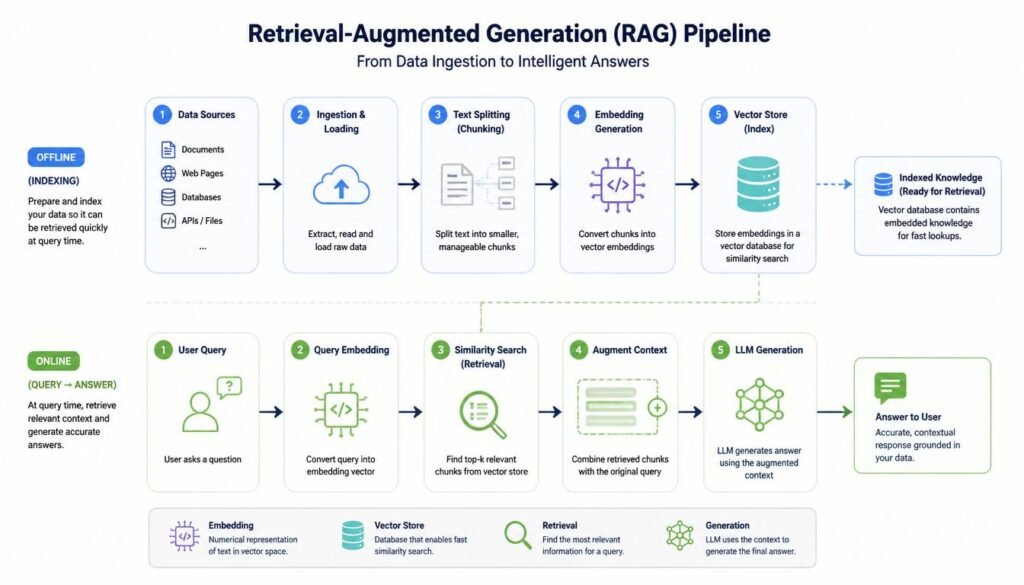
- Core Skills Acquired: Designing complex Retrieval-Augmented Generation (RAG) pipelines, building multi-agent autonomous systems, optimizing large language model (LLM) hyperparameters, and managing live MLOps workflows.
- The Practical Edge: Students build live, production-ready portfolio projects deployed on premium cloud environments like Microsoft Azure and AWS.
- Time & Financial Commitment: An intensive 7-month cohort experience priced at approximately $1,200, which includes direct career mentorship and active interview preparation.
💡 Fun Fact: According to recent enterprise recruitment data, over 80% of companies hiring for advanced technical positions prioritize candidates who can demonstrate hands-on experience deploying live models to production cloud environments over those who hold purely theoretical degrees.
2. DeepLearning.AI Specializations (Via Coursera)
Co-founded by global AI pioneer Andrew Ng, DeepLearning.AI remains an essential gold standard for structural machine learning education. Delivered smoothly through the Coursera platform, these programs bridge the gap between foundational math and advanced applied engineering. Because of this structural approach, students gain a deep conceptual understanding before touching code.
[DeepLearning.AI Strategic Learning Path]
       │
       ├──► AI For Everyone (Foundational / Business Mindset)
       │
       ├──► Machine Learning Specialization (Core Math & Algorithms)
       │
       └──► Generative AI with LLMs (Advanced Engineering & RAG)
Why It Matters for Your Wallet
The brand recognition of Andrew Ng’s certifications carries massive weight on platforms like LinkedIn. Consequently, recruiters immediately recognize these credentials as proof of a solid technical foundation.
- Core Skills Acquired: Mastering deep neural networks, building convolutional models for computer vision, handling natural language processing tasks, and safely fine-tuning open-source foundational models.
- The Practical Edge: You work directly in guided Jupyter Notebook environments, building real models from scratch using industry-standard frameworks like PyTorch and TensorFlow.
- Time & Financial Commitment: Self-paced learning paths that typically take 2 to 4 months. You can audit the course material completely for free, or pay a $49 monthly Coursera subscription to unlock graded assessments and shareable professional certificates.
3. Google AI Essentials (Via Coursera)
Not every high-paying job in 2026 requires writing thousands of lines of complex Python code. The Google AI Essentials certificate is explicitly designed for non-technical professionals, managers, and creative entrepreneurs who want to transform into highly efficient AI power users. Indeed, this course removes the technical barriers entirely.
Why It Matters for Your Wallet
Modern organizations are actively seeking “AI Translators”—professionals who understand how to integrate smart automation into everyday corporate workflows to cut overhead costs. Thus, this skill set makes you incredibly valuable to traditional businesses.
- Core Skills Acquired: Advanced prompt engineering engineering architectures, workflow automation, identifying corporate use cases for generative tools, and navigating the ethical use of enterprise data.
- The Practical Edge: Immersive, hands-on simulations where you use tools like Google Gemini to automate project management, summarize complex corporate data sets, and accelerate creative content production.
- Time & Financial Commitment: Extremely accessible and streamlined, requiring under 10 hours of total study time. It is included under the standard Coursera subscription, making it a highly cost-effective resume booster.
4. DataCamp AI Fundamentals
If you prefer interactive, hands-on learning without sitting through long video lectures, DataCamp AI Fundamentals offers an exceptional entry point into applied tech skills. Furthermore, the platform guides you through instant error correction.
Why It Matters for Your Wallet
DataCamp uses an engaging, interactive in-browser coding terminal that allows you to practice concepts immediately. This approach builds the practical muscle memory needed to confidently pass technical screenings during job interviews. As a result, students transition from learning to earning much faster.
- Core Skills Acquired: Essential Python programming for data science, understanding machine learning workflows, manipulating large data structures, and evaluating model accuracy.
- The Practical Edge: Immediate, bite-sized coding challenges and real-world data analysis tasks that require zero complex local software installation.
- Time & Financial Commitment: Approximately 15 to 20 hours of self-paced study, accessible via DataCamp’s annual premium subscription plan (often discounted to around $150–$300 per year).
Key Takeaways: How to Choose Your Training Path
- For Aspiring Engineers: Choose LogicMojo if you already have a basic programming background and want to target elite, high-paying system architecture roles.
- For Core Technical Credibility: Choose DeepLearning.AI to build deep foundational knowledge in machine learning algorithms that commands respect across the tech industry.
- For Non-Programmers: Opt for the Google AI Essentials certificate to master practical, everyday corporate automation without touching raw code.
- For Hands-On Practice: Utilize DataCamp if you want to develop swift, practical data manipulation and coding skills through interactive exercises.
Navigating the 2026 AI Job Market
When planning a career pivot, it helps to look at how rapidly these opportunities have evolved over time. The historical timeline below shows how training requirements have shifted from rigid academic degrees to agile, skills-first certifications.
- 2020 – 2022: The Academic Baseline
Enterprise hiring for advanced technical roles was heavily restricted to candidates holding formal Master’s degrees or PhDs in Computer Science or Data Analytics. - 2023 – 2024: The Prompt Engineering Wave
The explosion of early LLMs created a massive surge in demand for basic prompt design skills, with companies hiring rapidly based on introductory short courses. - 2025 – 2026: The Modern Paradigm Shift
Hiring shifts decisively toward practical execution. Top employers now explicitly prioritize portfolio-grade capstone projects, verified micro-credentials, and demonstrated competency in production cloud deployment over traditional university degrees.
Frequently Asked Questions (FAQ)
Can I learn high-paying AI skills if I have absolutely zero coding background?
Yes, you absolutely can. The job market has expanded significantly to include roles like AI Business Analysts, Prompt Architects, and Product Managers. These positions focus entirely on workflow automation, strategic tool integration, and user experience rather than writing raw underlying code. For this career path, programs like the Google AI Essentials are highly recommended.
Are free online AI certificates genuinely respected by tech recruiters?
Free certificates are excellent for learning core concepts, building initial confidence, and filling out your resume. However, tech recruiters generally look for a tangible portfolio. To stand out, you should use the knowledge gained from free courses to build original, public projects on GitHub to prove your practical capability.
What is the primary difference between a Data Science certificate and an AI Engineering credential?
Data Science certificates typically focus on analyzing historical data patterns, managing corporate databases, and generating business intelligence reports. On the other hand, AI Engineering credentials focus on building active, predictive software infrastructure, deploying large language models, and developing automated, real-time agentic systems.
How much time should I invest each week to complete an intermediate-level course within three months?
For most self-paced intermediate programs, dedicating approximately 8 to 12 hours per week is ideal. This schedule allows you enough time to thoroughly watch instructional modules, complete practical lab assignments, and troubleshoot your project code without burning out.
Do I need an expensive computer or a specialized GPU setup to complete these online courses?
No, you do not need expensive hardware. Almost all major online learning platforms—including DataCamp, Coursera, and elite bootcamps—provide access to cloud-based coding environments and sandboxes. This means all complex processing runs on their remote servers, allowing you to learn seamlessly using a standard consumer laptop.
Strategic Next Steps for Professionals
To maximize the career impact of your chosen program, consider utilizing professional career advancement networks like GlobeHustle. These specialized platforms provide highly valuable insight into navigating the modern remote work market, refining your professional digital footprint, and aligning your newly acquired skills with active global corporate demands.
Furthermore, staying closely connected with international tech standards is incredibly helpful for long-term career growth. Reviewing the comprehensive educational frameworks on The National Academies provides clear, authoritative guidance on how digital training programs are evolving to meet critical global enterprise demands.
When you pair target-oriented, skills-first online training with a commitment to building a strong portfolio, you position yourself perfectly to thrive in the modern digital economy. Simply choose the specific path that aligns with your professional background, dedicate consistent time to hands-on practice, and start building the real-world projects that global employers are actively looking for.
For a complete breakdown of which specific certifications deliver the highest financial returns without requiring a standard computer science background, take a look at this detailed analysis on Top High-Paying AI Certifications for Beginners. This guide scores individual learning pathways based on employer demand, structural depth, and real-world hiring outcomes.