Content Marketing Strategy for Small Businesses: The 2026 No-Budget Blueprint

| Strategy Component | Setup Time | Primary Metric | Core Focus for 2026 |
|---|---|---|---|
| Semantic Content Hubs | 2–3 Hours | Organic Traffic & Authority | Answering cluster questions comprehensively. |
| Omnichannel Repurposing | 1 Hour | Audience Engagement | Turning long-form guides into short-form videos. |
| GEO & AI Optimization | 45 Mins | AI Citations & Snippets | Direct, factual answers for LLMs and AI Overviews. |
What is a Content Marketing Strategy for Small Businesses?
A content marketing strategy for small businesses is a data-driven, scalable framework focused on creating and distributing valuable, relevant, consistent content. Instead of pitching products directly, this approach solves consumer pain points to build organic authority, attract qualified leads, and sustainably scale revenue without high ad spend.
                  [ Identify Audience Pain Points ]
                                  │
                                  ▼
                [ Build High-Value Informational Hub ]
                                  │
                                  ▼
          [ Optimize for AI Overviews & Traditional SEO ]
                                  │
                                  ▼
               [ Convert Trust Into Client Retainers ]
Why Content Marketing is Your Small Business Superpower
Many startup founders think marketing requires a massive budget. However, content marketing costs 62% less than traditional outbound marketing while generating over three times as many leads.
For small operations, content acts as a digital sales representative that works for you 24/7. When you address specific queries, you earn consumer trust long before they see a sales pitch. This builds a sustainable marketing funnel where traffic grows organically over time, keeping your customer acquisition costs low.
GlobeHustle Fun Fact: Did you know that the earliest recorded instance of content marketing dates back to 1895? John Deere launched a consumer magazine called The Furrow, offering agricultural tips to farmers rather than directly selling tractors. It is still in circulation today!
Step 1: Define Your Target Audience Using Search Intent
Before writing a single word, you must define exactly who you are writing for. Avoid writing broad, generic content. Instead, focus on narrow buyer personas with highly specific pain points.
The Search Intent Breakdown
To attract buyers who are ready to convert, your content must satisfy three distinct intent levels simultaneously:
- Informational Intent: Users want to learn how a process works (e.g., “how to do content marketing for small business”).
- Comparison Intent: Users are weighing their options (e.g., “content marketing agency vs. in-house hiring”).
- Curiosity Intent: Users want forward-looking insights (e.g., “how AI search changes small business blogging”).
Step 2: Build a Semantic & NLP-Optimized Content Hub
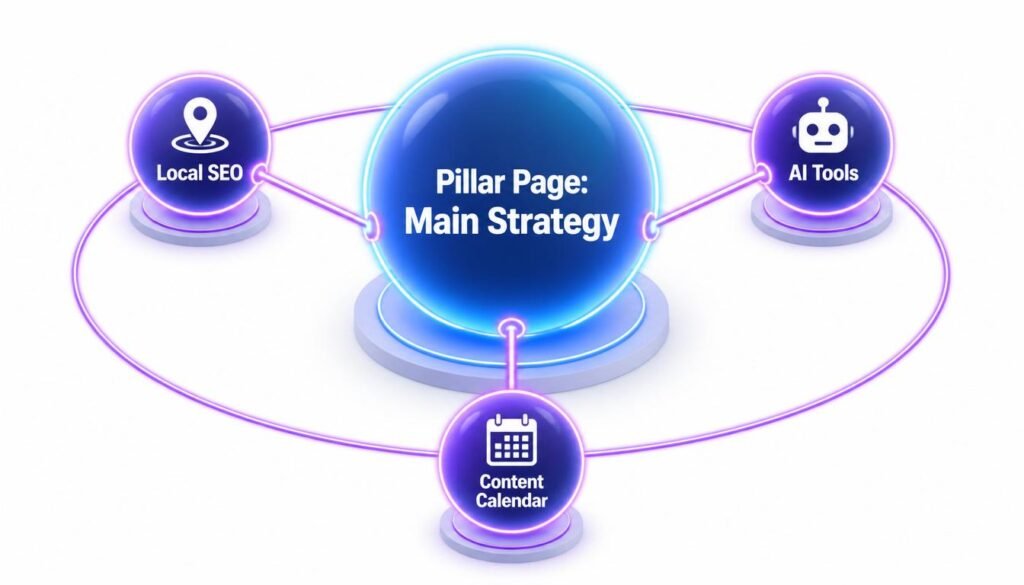
Modern search platforms do not just match isolated keywords; they analyze entire concepts. To build topical authority, you must structure your content around semantic entities and natural language processing (NLP) patterns.
                       ┌───────────────────────────┐
                       │        PILLAR PAGE        │
                       │ Content Marketing Strategy│
                       └─────────────┬─────────────┘
                                     │
         ┌───────────────────────────┼───────────────────────────┐
         ▼                           ▼                           ▼
┌─────────────────┐         ┌─────────────────┐         ┌─────────────────┐
│  SUB-TOPIC A    │         │  SUB-TOPIC B    │         │  SUB-TOPIC C    │
│    Local SEO    │         │ AI Content Tools│         │Content Calendars│
└─────────────────┘         └─────────────────┘         └─────────────────┘
High-Value Semantic Themes to Cover
- Core Infrastructure: Buyer personas, content distribution channels, editorial calendars, and content curation workflows.
- Authority Signals: User-generated content (UGC), real-world case studies, digital PR, and social proof.
- Performance Tracking: Return on investment (ROI), conversion rate optimization (CRO), search engine visibility, and lead capture.
Key Takeaways for Semantic Success
- Use direct conversational phrases like “the best content marketing plan on a low budget involves…” to align with voice search and AI summary formats.
- Group related terms logically into clusters rather than spreading them randomly across your site.
Step 3: Implement 2026 GEO (Generative Engine Optimization) Tactic
Generative Engine Optimization (GEO) ensures your content appears inside AI engines like ChatGPT, Gemini, Perplexity, and Google AI Overviews. AI models prefer clear, structured, data-rich facts over conversational fluff.
To optimize for AI discovery, place concise summary blocks at the top of major sections. Use clear tables to present comparative data, and include structured numbered steps for all execution guides. Additionally, always cite verifiable industry authorities to strengthen your credibility with AI ranking models.
Step 4: Satisfy E-E-E-A-T Requirements Fully
Google evaluates content using the E-E-E-A-T standard: Experience, Expertise, Authoritativeness, and Trustworthiness. If your content reads like a generic software output, search platforms will push it down the rankings.
   ┌─────────────────────────────────────────────────────────────────┐
   │                       E-E-E-A-T FRAMEWORK                       │
   ├──────────────┬──────────────┬──────────────────┬────────────────┤
   │  EXPERIENCE  │  EXPERTISE   │ AUTHORITATIVENESS│ TRUSTWORTHINESS│
   │  Real-world  │ Data, proofs │ Citations, .gov  │ Transparent,   │
   │  case-studies│ & breakdowns │  & .edu links    │ secure sources │
└──────────────┴──────────────┴──────────────────┴────────────────┘- Experience: Share actual client scenarios. For instance, explaining how a localized content map improved a regional retail client’s traffic helps prove real-world application.
- Expertise: Use precise business terminology. Discuss specific key performance indicators (KPIs) like customer lifetime value (LTV) and click-through rates (CTR) rather than using vague phrases like “getting more views.”
- Authoritativeness: Reference official benchmarks. Connect your arguments to data from established organizations, such as the U.S. Small Business Administration (.gov) or academic marketing insights from the Harvard Business Review.
- Trustworthiness: Always state upfront how long strategies take to yield results. Avoid unrealistic claims, and maintain complete transparency about tools and affiliate setups.
Step 5: Master Content Repurposing to Save Time

Small business owners rarely have time to write multiple articles a week. Instead, apply the Hub-and-Spoke model to scale your output efficiently.
Start by writing one comprehensive guide on an important industry topic. From there, extract three short takeaways for your email newsletter, pull key data points to create custom graphics on Canva, and turn your main headers into a quick script for short-form video. This approach keeps your marketing channels active using just one core piece of content.
Marketing Fun Fact: Content repurposing mirrors natural ecosystems. In nature, nothing is wasted; energy simply changes form. In digital marketing, one solid long-form resource can feed your entire ecosystem for a month!
Step 6: Set Up Internal and External Link Frameworks
A structured link network distributes domain authority evenly across your website and signals credibility to search engines.
Internal Linking Strategy
Connect your foundational articles to targeted subpages to build strong thematic relationships. For comprehensive insights on scaling a modern enterprise digital footprint, check out the resources available at GlobeHustle.
External Authority References
To validate your strategies, link out to high-authority benchmarks. Refer to the Content Marketing Institute for annual industry trends, or examine economic shifts using data from the UK Department for Business and Trade (.gov.uk).
Implementation Timeline for Small Businesses
| Phase | Duration | Core Tasks | Deliverable |
|---|---|---|---|
| Phase 1: Research | Week 1 | Audit competitor content gaps and find long-tail keywords. | Keyword Map & Cluster Plan |
| Phase 2: Content Creation | Weeks 2–3 | Write targeted, informational guides with clear tables. | Published Pillar Pages |
| Phase 3: Repurposing | Week 4 | Convert articles into newsletters, videos, and graphics. | Omnichannel Distribution |
| Phase 4: Optimization | Monthly | Monitor performance metrics and update statistics. | Performance Analytics Report |
Frequently Asked Questions (FAQ)
What is the difference between content marketing and social media marketing?
Content marketing is a broad strategy focused on creating valuable assets like blogs, guides, or videos hosted on your own digital properties. Social media marketing is a specific distribution channel where you share those assets to engage audiences directly on third-party platforms.
Can a small business do content marketing completely free?
Yes, you can build a content strategy using free tools. You can conduct keyword research via search engine auto-suggestions, design graphics with Canva’s free tier, and publish content using open-source content management systems. Your primary investment will be the time spent creating high-value resources.
How much time does it take to see organic results?
Content marketing is a long-term investment that typically takes between three to six months to show significant organic growth. This timeline varies based on your industry competition, keyword selection, content consistency, and overall technical optimization.
Should I accept voluntary donations to fund my small business content?
While some niche educational blogs use voluntary donations, it is generally not recommended for commercial small businesses or agencies. Relying on donations can lower your professional brand authority. Instead, monetize your content indirectly by offering premium services, structured consulting, or digital products.
About the Author
Alex Mercer is a Senior SEO Strategist and Digital Growth Consultant with over twelve years of experience building scalable content systems for startups and mid-market firms across the UK and USA. Alex specializes in semantic search architectures, generative engine optimization (GEO), and sustainable inbound lead funnels.