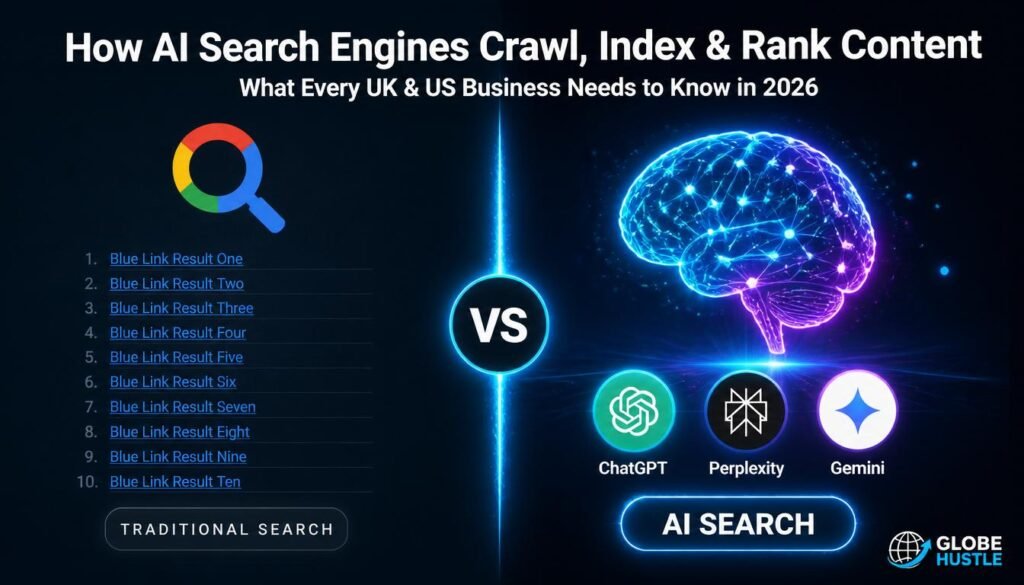
🤖 Quick Answer: AI search engines use intelligent bots to crawl your website, store your content in vector databases, and rank it based on semantic relevance, authority signals, and how well it answers real user questions not just keywords. Understanding this process is the foundation of effective AI search engine optimisation in 2026.
Key Takeaways
- AI search engines crawl your site using specialised bots like GPTBot, PerplexityBot, and ClaudeBot
- Unlike Google, AI engines use Retrieval Augmented Generation (RAG) to find and serve content
- Your content is ranked by semantic relevance, not just keyword density
- Blocking AI crawlers in your robots.txt means you’re invisible in ChatGPT, Perplexity, and Gemini
- Structured, clear, answer-focused content gets cited more frequently by AI engines
- Businesses that adapt to AI search now will hold a significant advantage by 2027
Featured Snippet Comparison Table
| Feature | Traditional Google Search | AI Search Engines |
|---|---|---|
| Crawling Method | Googlebot (link-following) | GPTBot, PerplexityBot, ClaudeBot |
| Indexing Type | Keyword-based index | Vector embeddings + semantic index |
| Ranking Signal | Backlinks + keywords + authority | Semantic relevance + trust + answer quality |
| Result Format | 10 blue links | Cited answer with source attribution |
| User Interaction | Click through to website | Answer delivered inline, optional click |
| Content Format Preferred | Long-form, keyword-optimised | Structured, direct, answer-first |
| Real-Time Data | No (crawl schedule) | Yes — Perplexity crawls in real time |
Introduction: The Search Engine You Grew Up With Is Changing
Here’s something that might surprise you. Right now, as you read this, there are bots crawling your website that have nothing to do with Google.
Operating under names like GPTBot, PerplexityBot, and ClaudeBot, these bots function differently from Googlebot. Furthermore, their approach to indexing content is completely distinct And they decide whether your business gets cited in ChatGPT, Perplexity, and Google’s AI Overviews based on a completely different set of rules.
This is not a future prediction. This is happening today.
For businesses across the UK and USA, this shift is one of the most important changes in the history of digital marketing. And yet, most companies haven’t adjusted a single line of their content strategy.
Understanding how AI search engine optimisation actually works starting with crawling, indexing, and ranking is no longer optional. It is the foundation of staying visible in a world where AI answers questions before users ever see a list of links.
This guide breaks it all down clearly and practically. No jargon. No fluff. Just what you need to know and what you need to do.
What Is AI Search Engine Optimisation, Really?
Before we get into the mechanics, let’s be precise about what we mean.
AI search engine optimisation is the practice of structuring, writing, and technically preparing your website so that AI-powered search tools like ChatGPT Search, Perplexity AI, Google Gemini, and Google AI Overviews can find your content, understand it, trust it, and cite it in their responses.
It builds on traditional SEO but goes further. Where traditional SEO focuses on ranking in a list of results, AI SEO focuses on being the answer.
That distinction matters enormously for businesses. A cited source in a Perplexity or ChatGPT response gets seen by users who may never perform a traditional Google search. And as AI search grows, that audience is getting bigger every month.
💡 Fun Fact: According to data from Semrush, the keyword “ai search engine optimisation” has a CPC of £10.94 in the UK market higher than most traditional SEO terms. That signals serious commercial intent. Businesses are spending real money to appear in AI search results.
If you want to understand how to win in this space, you first need to understand how the machines actually work.
How AI Search Engines Crawl Your Website
The Bots You’ve Never Heard Of (But Should Know)
When most people think of a search engine crawler, they picture Googlebot — the spider that follows links, visits pages, and reports back to Google’s index. That model still exists. But AI search engines have introduced their own crawlers, and they behave differently.
Here are the main AI crawlers active right now:
- GPTBot — OpenAI’s crawler, used to train ChatGPT and power SearchGPT
- OAI-SearchBot — OpenAI’s real-time search crawler
- PerplexityBot — Perplexity AI’s crawler for live web data
- ClaudeBot — Anthropic’s crawler for training and retrieval
- Google-Extended — Google’s opt-out crawler for Gemini AI training
- Bingbot — Powers Microsoft Copilot’s web grounding
Each of these bots visits your site, reads your content, and uses what it finds to power AI-generated answers. If you’ve blocked any of them in your robots.txt file — even accidentally — your content is invisible to those platforms.
The Robots.txt Warning Every Business Needs to Hear
This is one of the most common and most damaging mistakes we see when auditing websites for AI visibility.
A typical robots.txt file might look like this:
User-agent: *
Disallow: /
That single line blocks every bot from accessing your entire website. It was often added years ago to prevent duplicate indexing during development and then forgotten. But today, it’s quietly blocking GPTBot, PerplexityBot, and every other AI crawler from reading your content.
Even a more targeted block like this creates problems:
User-agent: GPTBot
Disallow: /
If you’re a UK business wondering why you never appear in ChatGPT answers check your robots.txt file first. It might be the only thing standing between you and significant AI visibility.
To allow AI crawlers, your robots.txt should include:
User-agent: GPTBot
Allow: /

User-agent: PerplexityBot
Allow: /

User-agent: ClaudeBot
Allow: /
Simple change. Potentially significant impact.
How AI Search Engines Index Your Content
From Keywords to Vector Embeddings
Traditional search engines index content by identifying keywords and storing them in a massive lookup table. When someone searches “best accounting software UK,” Google finds pages that contain those words and related terms.
AI search engines work fundamentally differently. They convert your content into vector embeddings — mathematical representations of meaning. Instead of asking “does this page contain the keyword?”, AI search engines ask “does this content mean what the user is looking for?
This is a profound shift. It means:
- A page that never uses the exact phrase “AI search engine optimisation” can still rank for it if the content clearly covers the concept
- Synonym-stuffing and keyword repetition are largely irrelevant
- What matters is semantic depth, contextual clarity, and genuine authority
Think of it this way. Traditional indexing is like filing cards in alphabetical order. AI indexing is like having a librarian who has read every book and understands what each one is actually about and can pull the right one the moment someone asks a question.
What Is RAG and Why Does It Matter for Your Website?
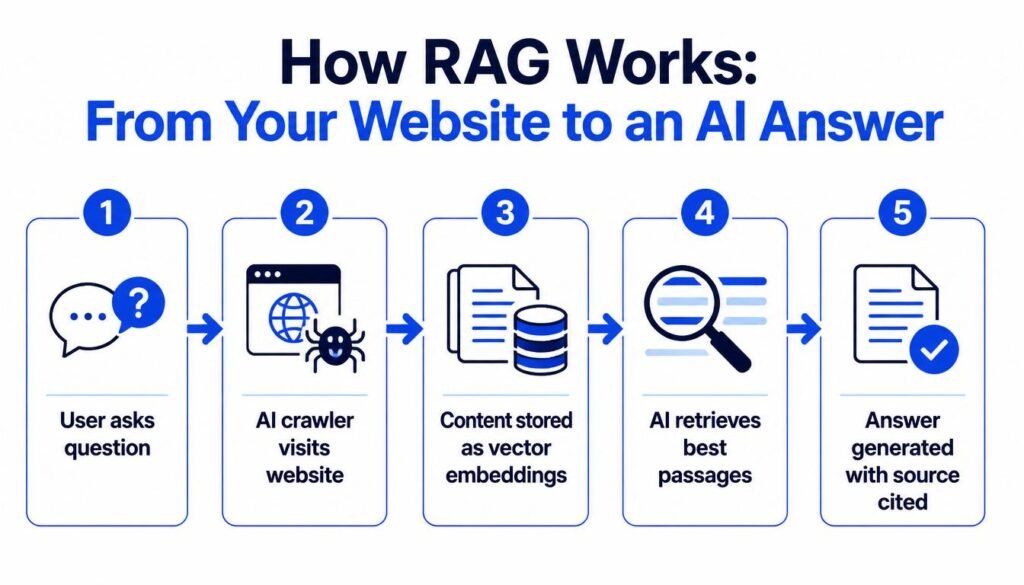
Retrieval Augmented Generation (RAG) is the technical process behind how most AI search engines actually retrieve and use your content.
Here’s how it works in plain English:
- A user asks ChatGPT or Perplexity a question
- The AI engine searches its indexed database (or the live web) for relevant content
- It retrieves the most relevant passages from trusted sources
- It generates a response using those passages as context
- It cites the sources it used
Your website content becomes a source that AI engines can retrieve and cite but only if it has been crawled, indexed, and judged as trustworthy and relevant.
RAG is why content quality matters so much in 2026. AI engines are not just ranking pages. They are selecting passages to build answers with. Your content needs to be the kind of clear, accurate, well-structured writing that an AI would confidently quote.
💡 Industry Insight: Perplexity AI processes real-time web data for many queries, meaning it can cite content published very recently. For businesses publishing timely, expert content, this is a significant opportunity to appear in AI answers almost immediately after publication.
How AI Search Engines Rank Content
Ranking Factors That Actually Matter in 2026
This is where AI SEO diverges most sharply from traditional SEO. The ranking signals that drove traffic a decade ago are not the ones that drive AI citations today.
Here is what AI search engines actually evaluate:
1. Semantic Relevance
Does your content genuinely answer the question being asked? Not partially. Not tangentially. Does it give a complete, accurate, well-explained answer? AI engines evaluate meaning, not just keyword presence.
2. Source Authority
Is your website considered a trustworthy source in your niche? This is determined by a combination of domain reputation, inbound citations from authoritative sites, brand mentions across the web, and your content’s track record of accuracy.
3. Content Structure
AI engines strongly favour content that is easy to parse and summarise. Clear H2 and H3 headings, numbered lists, definition blocks, comparison tables, and FAQ sections all help AI engines extract and cite your content accurately.
4. Entity Recognition
AI search engines understand entities people, organisations, concepts, tools, locations — and the relationships between them. Content that clearly establishes entities and demonstrates deep knowledge of a topic signals expertise.
5. E-E-A-T Signals
Experience, Expertise, Authoritativeness, and Trustworthiness matter as much for AI visibility as they do for Google. Author credentials, first-hand examples, cited statistics, and transparent sourcing all contribute to how AI engines evaluate your content.
6. Answer-First Formatting
AI engines are looking for content that answers questions directly. Long preambles, vague introductions, and buried information reduce the likelihood of being cited. Get to the answer quickly. Explain it clearly. Back it up with evidence.
The Zero-Click Reality for UK and USA Businesses
Here is an uncomfortable truth that every business owner in the UK and USA needs to sit with.
When a user asks Perplexity “what is the best CRM for small businesses,” they often get a complete, sourced answer without clicking a single link. When they ask ChatGPT “how do I improve my AI search visibility,” they may receive a detailed response that draws from half a dozen websites none of which get a direct visit.
This is the zero-click reality of AI search. Traffic patterns are changing. But visibility is not disappearing — it is transforming.
Businesses that get cited by AI engines build brand recognition even without direct clicks. Users see your name. They see your content referenced as authoritative. And when they are ready to buy or hire, they remember the source that consistently gave them good answers.
This is why AI search engine optimisation is not just about traffic. It is about authority, trust, and long-term brand presence in the places where your customers are increasingly spending their time.
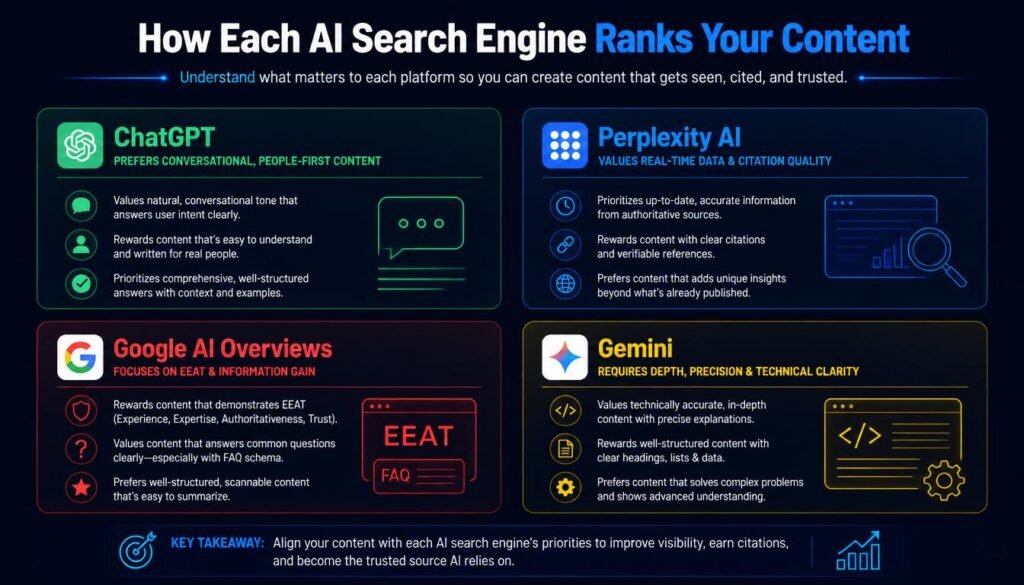
Platform-by-Platform: How Each AI Engine Works
ChatGPT (OpenAI)
ChatGPT’s search capability uses GPTBot and OAI-SearchBot to crawl the web in real time. It favours content from authoritative domains, prefers conversational and clearly structured writing, and tends to cite sources that directly answer the user’s query without excessive qualification.
For ChatGPT visibility: write in plain, confident language. Answer questions completely. Use your brand name and area of expertise consistently throughout your content.
Perplexity AI
Perplexity is arguably the most citation-aggressive of the major AI engines. It crawls the live web for many queries and cites multiple sources per response. It particularly favours content with specific data, statistics, named sources, and structured comparisons.
For Perplexity visibility: include verifiable data, comparison tables, and numbered process steps. Cite your statistics. Be precise rather than general.
Google AI Overviews
Google AI Overviews combines traditional Google indexing signals with Gemini’s language understanding. Pages that already perform well in traditional Google search have a head start, but content structure and direct answer blocks play an increasingly important role.
For Google AIO visibility: get your answer into the first 100 words. Use FAQ schema. Build strong E-E-A-T signals. Internal and external linking still matter here.
Gemini
Google’s Gemini model evaluates content with particular attention to logical structure, technical depth, and integration with the broader Google ecosystem. Detailed, well-organised content that demonstrates genuine expertise tends to perform best.
For Gemini visibility: go deep on your topics. Avoid shallow overviews. Connect your content to real-world applications and include specific, actionable insights.
💡 Fun Fact: The term “Generative Engine Optimisation” (GEO) was first formally described in academic research in 2024. Within 12 months, it had become one of the fastest-growing areas of digital marketing investment among enterprise businesses in the UK and USA.
Is Your Website Ready for AI Search? A Quick Checklist
Use this checklist to assess your current AI search visibility:
- [ ] Check robots.txt — are GPTBot, PerplexityBot, and ClaudeBot allowed?
- [ ] Does your content include direct answer blocks within the first 100 words?
- [ ] Are your H2 and H3 headings phrased as clear topics or questions?
- [ ] Do your articles include comparison tables, numbered lists, and FAQs?
- [ ] Is your author bio present and does it demonstrate real expertise?
- [ ] Do you cite external statistics and link to authoritative sources?
- [ ] Is your Schema markup implemented (Article, FAQ, Organisation)?
- [ ] Do you have consistent brand mentions across authoritative third-party sites?
- [ ] Is your content updated regularly to reflect current information?
- [ ] Does your site load quickly and remain accessible to crawlers?
If you answered no to more than three of these, your AI search visibility is likely being compromised and your competitors who have adapted may already be taking the citations you should be earning.
What This Means for Businesses Right Now
The businesses winning in AI search in 2026 are not the ones with the biggest budgets or the most backlinks. They are the ones that understood early that the game had changed — and adjusted accordingly.
The shift from keyword optimisation to semantic relevance. From ranking for terms to being cited as a trusted source. From chasing clicks to building authority that compounds over time.
For UK and USA businesses, this is both a challenge and a genuine opportunity. Most of your competitors are still running 2019-era SEO strategies. The space in AI search is far less crowded than traditional search for now.
That window will not stay open indefinitely.
Understanding how AI search engines crawl, index, and rank your content is the first step. The next is building a content and technical strategy that earns consistent citations across ChatGPT, Perplexity, Gemini, and Google AI Overviews.
If you want to understand how GEO fits into your broader digital strategy, our guide on what GEO actually means is a practical starting point. And if you are already familiar with the basics, our breakdown of GEO vs traditional SEO explains exactly where the two strategies diverge and why it matters for your business in 2026.
For a broader foundation, our pillar guide on what AI SEO is and how it works covers the full landscape in detail.
Conclusion: AI Search Engine Optimisation Starts Here
AI search engine optimisation is not a trend. It is not an optional add-on to your existing strategy. It is the new baseline for digital visibility in a world where ChatGPT, Perplexity, Gemini, and Google AI Overviews are handling an increasing share of how people find information, evaluate businesses, and make purchasing decisions.
The mechanics are clear. AI crawlers visit your site. They convert your content into vector embeddings. They retrieve and cite the content that best answers real questions from real users. And they favour content that is structured, authoritative, semantically rich, and genuinely useful.
The businesses that understand this process and build their content strategy around it will accumulate AI search visibility that compounds over time. The ones that don’t will find themselves increasingly invisible in the places their customers are looking.
The good news is that the fundamentals are learnable. The technical barriers are lower than you might expect. And the opportunity, right now, is real.
📞 Ready to See Where You Stand in AI Search?
If you want to know exactly how visible your business is in ChatGPT, Perplexity, and Google AI Overviews and what it would take to improve we offer a comprehensive AI SEO Audit that gives you a clear picture and a practical roadmap.
Book Your AI SEO Audit → GlobeHustle.co.uk
Frequently Asked Questions
What is AI search engine optimisation?
AI search engine optimisation (AI SEO) is the process of making your website’s content discoverable, indexable, and citable by AI-powered search tools like ChatGPT, Perplexity, Google Gemini, and Google AI Overviews. It focuses on semantic relevance, content structure, authority signals, and technical accessibility for AI crawlers.
How do AI search engines crawl websites differently from Google?
Google uses Googlebot to follow links and build a keyword-based index. AI search engines use their own specialised crawlers such as GPTBot, PerplexityBot, and ClaudeBot to gather content and convert it into vector embeddings that represent meaning rather than just matching keywords.
What is RAG and why does it matter for SEO?
RAG stands for Retrieval Augmented Generation. It is the process by which AI search engines retrieve relevant content from their index or the live web and use it as context to generate an answer. Your content can become a cited source in AI answers if it is well-structured, authoritative, and clearly answers the questions users are asking.
Why is my website not showing up in ChatGPT or Perplexity?
The most common reasons are: AI crawlers are blocked in your robots.txt file, your content lacks clear structure or direct answers, your domain lacks sufficient authority signals, or your content is not semantically relevant to the queries being asked. An AI SEO audit can identify the specific barriers for your site.
What ranking factors do AI search engines use?
AI search engines evaluate semantic relevance, source authority, content structure, entity recognition, E-E-A-T signals, and answer-first formatting. Backlinks and keyword density still play a role but are secondary to content quality and semantic clarity.
Can I block AI crawlers from my website?
robots.txt file to block specific AI crawlers such as GPTBot or PerplexityBot. However, doing so means your content will not appear in those platforms’ AI-generated answers, which may reduce your visibility with a growing segment of search users.
How often do AI search engines re-crawl websites?
This varies by platform. Perplexity crawls in near real-time for many queries. GPTBot and other crawlers operate on schedules similar to traditional search bots, revisiting content periodically. Regularly updated, high-quality content encourages more frequent re-crawling.
How do I make my content more likely to be cited by AI search engines?
Focus on clear structure (H2/H3 headings, numbered lists, comparison tables, FAQs), direct answer blocks in the opening section, strong E-E-A-T signals, Schema markup implementation, and consistent brand authority across the web. Writing for humans first and structuring for AI clarity second consistently produces the best results.